Jonathan Bowden | |
|---|---|
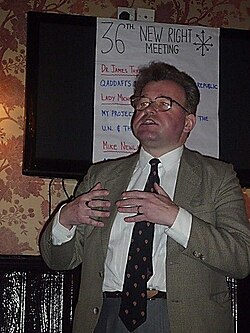 Bowden speaking in December 2011. The topic was Yukio Mishima. | |
| Born | (1962-04-12)12 April 1962 Royal Tunbridge Wells, Kent, England |
| Died | 29 March 2012(2012-03-29) (aged 49) Tadley, Hampshire, England |
| Alma mater | Birkbeck College, University of London |
| Occupations |
|
Jonathan David Anthony Bowden (12 April 1962 – 29 March 2012)1 was an English political activist, orator, writer and artist. A member of the Conservative Party in the early 1990s, he later became involved in far-right organisations, including the British National Party (BNP). Bowden has been described as a "cult figure" amongst the far-right movement, even more than a decade after his death.234
Life and career
Early life and education
Bowden was born in Royal Tunbridge Wells in Kent, and attended Presentation College in Reading, Berkshire.5 He was an only child. His mother, Dorothy Bowden, suffered from severe mental illness.2
In 1984 he completed one year of a Bachelor of Arts history degree course at Birkbeck, University of London, as a mature student, but left without graduating. He enrolled at Wolfson College, Cambridge, in 1988, but left after a few months. He became a lifelong friend of the novelist Bill Hopkins (1928–2011), one of the angry young men, during this time.6 Bowden was otherwise an autodidact.2
Conservative Party
Bowden began his career as a member of the Conservative Party in the parliamentary constituency of Bethnal Green and Stepney. In 1990 he joined the Monday Club, a pressure group on the fringes of the party, and the following year made an unsuccessful bid to be elected onto the club's Executive Council. In 1991 he was appointed co-chairman, with Stuart Millson, of the club's media committee,7 and was also active in the Western Goals Institute.8 In 1992 Bowden was expelled from the Monday Club.9 (The Conservative Party disassociated itself from the Monday Club in 2001, and the club disbanded in 2024.)
Revolutionary Conservative Caucus
Bowden and Millson co-founded the Revolutionary Conservative Caucus in November 199210 with the aim of introducing "abstract thought into the nether reaches of the Conservative and Unionist party".8 It published a quarterly journal entitled The Revolutionary Conservative Review. By the end of 1994 Millson and Bowden parted company and the group dissolved.
In 1993 Bowden published Right through the European Books Society. He was also reported to be a prominent figure in the creative milieu responsible for the emergence of the political magazine Right Now!.11
Freedom Party
Bowden then joined the Freedom Party; he was its treasurer for a short time,12 and subsequently was a member of the Bloomsbury Forum, alongside Adrian Davies.13
British National Party
In 2003 Bowden joined the BNP. He was appointed Cultural Officer, a position that was created by Nick Griffin, the party's leader at the time, to give Bowden an official role. In July 2007 Bowden resigned both his position and his membership after a dispute between him, Griffin and other individuals within the party. Although he gave speeches throughout England and Wales at local meetings for the BNP, he never re-joined the party, and cut all ties after the 2010 general election.14
Many of his speeches were recorded and have been transcribed. Topics of his lectures included philosophers, politicians, and historical literary figures who were prominent in the far-right. In late 2011 and early 2012 Bowden made 14 appearances on the American White supremacist Richard B. Spencer's Vanguard podcast.14
New Right
 | |
| Formation | 16 January 2005 |
|---|---|
| Founders | Troy Southgate, Jonathan Bowden, and Jonothon Boulter |
| Legal status | defunct |
| Website | new-right.org (archive) |
The New Right Committee, or simply "New Right", was a pan-European nationalist and far-right think tank founded by Bowden and the activist Troy Southgate. The name was a reference to the French Nouvelle Droite and the group was otherwise unrelated to the wider British and American usage of the term "New Right".
In March 2005 the group described itself on its Yahoo! Groups webpage: "We are opposed to liberalism, democracy and egalitarianism and fight to restore the eternal values and principles that have become submerged beneath the corrosive tsunami of the modern world."15
In June 2005 New Right announced that it would publish New Imperium, a quarterly magazine it described as an "intellectual journal".16 Bowden was the organisation's press officer.17
Death
On 29 March 2012 Bowden died of a heart attack at his home, 14 days before his 50th birthday.1 In 2011 he had been released from the psychiatric ward of a hospital, to which he was involuntarily committed earlier that year after suffering a mental breakdown.2
Views
Bowden's political ideology can be separated into four core components: the centrality of Western civilization, paganism, elitism and inegalitarianism, and literary sophistication.18 He sought to provide an intellectual framework for the British far-right by connecting it to a broader continental tradition, synthesizing the thought of the European New Right and philosophers such as Friedrich Nietzsche, Julius Evola, Oswald Spengler, and Martin Heidegger.19
Elitism and inegalitarianism
Bowden was strictly anti-egalitarian and viewed society as organically unequal. He vehemently rejected equality as a moral good and argued that social hierarchies are necessary for a civilization to advance.18 He maintained that hierarchies are vital for society, that "liberalism is moral syphilis" and that native Europeans are justified in asserting their cultural, ethnic, psychological and spiritual hegemony over Europe.2 Bowden argued that discrimination is a natural human inclination and opposed modern political correctness, stating that people naturally discriminate when gravitating toward a higher form of art or a preferred ecology.18 In a 2023 study published in the Journal of Political Ideologies, academics noted that strict anti-liberalism was a defining element of his worldview.20
Literary sophistication and oratory
Bowden sought to provide an intellectual platform for the British far-right. He argued that conversance with one's cultural heritage must take precedence and that philosophical contemplation is paramount.18 To this end, he frequently lectured on modernist literary figures and right-wing thinkers, including Ezra Pound, Wyndham Lewis, Yukio Mishima, and W. B. Yeats. Academic Muhammad Ahsan notes that Bowden believed cultural elites and geniuses, such as William Shakespeare and Leonardo da Vinci, provide essential spiritual sustenance for the masses.18 Rather than relying on traditional political campaigning, Bowden became known for his highly performative public speaking. Ahsan described Bowden as an "exceptional orator" whose "extempore delivery greatly captivated his audience."18 Academic observers have classified Bowden as a "vanguard leader" whose unique oratorical style and philosophical framework have had a profound posthumous impact on the modern trans-Atlantic alt-right and European identitarian movements.20 He also viewed popular culture as a tool for metapolitics. Scholar Jordan S. Carroll noted that Bowden treated speculative fiction and comic books as forms of "ideological world-building" meant to subvert egalitarianism and reassert white dominance.21
Centrality of Western civilization
Central to his worldview was the belief that Western civilization relies on a white ethnic foundation. He summarized his view as "race is culture and culture is race."18 He located the brilliance of Western civilization in its classical architecture and artistic majesty, arguing that this heritage would crash if severed from its genetic European roots.18 In his extemporaneous speeches, Bowden routinely promoted white nationalism, predicted white replacement, and utilized rhetoric characterized by critics as fascist and antisemitic.19
Paganism
Bowden expressed pagan religious beliefs.2 He characterized Europe's historical shift from paganism to Christianity as a deleterious event that detached Europeans from their genetic legacy and enshrouded them in a universalist canon.18 While Bowden deeply admired the artistic magnificence of Christian art, such as the ceiling of the Sistine Chapel, he rejected Christianity's ethical framework because he believed it exalted weakness. Instead, he favored the cultural dynamism of pre-Christian Europe and admired neo pagan groups like the Odinic Rite, reasoning that one should "not turn the other cheek but pay back in the same coin."18
Bibliography
Bibliography
Works
- Mad (London: Avant-Garde Publishing, 1989); (Nine-Banded Books, 2009) ISBN 978-0578006406
- Sade (London: Egotist, 1992); (Nine-Banded Books, 2013) ISBN 978-0989697217
- Aryan (London: Egotist Press, 1992); (Nine-Banded Books, 2020)
- Brute (London: Egotist Press, 1992)
- Skin (London: Egotist Press, 1992)
- Axe (London: Egotist, 1993); (London: The Palingenesis Project, 2014). ISBN 978-1909606074
- Craze (London: Egotist Press, 1993) ISBN 1-872181-17-1
- Right (London: European Books Society 1994); (London: The Palingenesis Project, 2016) ISBN 978-1909606159
- Collected Works, 6 vols. (London: Avant-guarde, 1995)
- Standardbearers – British Roots of the New Right, edited by Adrian Davies, Eddy Butler & Jonathan Bowden; Beckenham, Kent, 180pps, (April 1999)
- Apocalypse TV (London: The Spinning Top Club, 2007). ISBN 978-0-9557402-0-6
- The Art of Jonathan Bowden (1974–2007) (London: The Spinning Top Club, 2007). ISBN 978-0-9557402-2-0
- The Fanatical Pursuit of Purity (London: The Spinning Top Club, 2008). ISBN 978-0-9557402-3-7
- Al-Qa’eda Moth (London: The Spinning Top Club, 2008). ISBN 978-0-9557402-5-1
- Kratos (London: The Spinning Top Club, 2008). ISBN 978-0-9557402-1-3
- A Ballet of Wasps (London: The Spinning Top Club, 2008). ISBN 978-0-9557402-6-8
- Goodbye Homunculus! (London: The Spinning Top Club, 2009). ISBN 978-0-9557402-9-9
- The Art of Jonathan Bowden, Vol. 2 (1968–1974) (London: The Spinning Top Club, 2009). ISBN 978-0-9557402-4-4
- Lilith Before Eve (London: The Spinning Top Club, 2009). ISBN 978-0-9557402-8-2
- Louisiana Half-Face (London: The Spinning Top Club, 2010). ISBN 978-0-9565120-2-4
- The Art of Jonathan Bowden, Vol. 3 (1967–1974) (London: The Spinning Top Club, 2010). ISBN 978-0-9565120-1-7
- Our Name Is Legion (London: The Spinning Top Club, 2011). ISBN 978-0-9565120-3-1
- Colonel Sodom Goes to Gomorrah (London: The Spinning Top Club, 2011). ISBN 978-0-9565120-4-8
- Locusts Devour a Carcass (London: The Spinning Top Club, 2012). ISBN 978-0-9565120-5-5
- Spiders Are Not Insects (London: The Spinning Top Club, 2012). ISBN 978-0-9565120-6-2
- The Speeches (London: Black Front Press, 2012). ISBN 978-0957324510
- Pulp Fascism (San Francisco: Counter-Currents, 2013). ISBN 978-1935965640
- Western Civilization Bites Back (San Francisco: Counter-Currents, 2014). ISBN 978-1935965770
- Demon (London: The Palingenesis Project, 2014). ISBN 978-1909606043
- Blood (London: The Palingenesis Project, 2016). ISBN 978-1909606098
- Heat (London: The Palingenesis Project, 2017). ISBN 978-1909606197
- Deathlock (London: The Palingenesis Project, 2017). ISBN 978-1909606210
- Extremists: Studies in Metapolitics (San Francisco: Counter-Currents, 2017). ISBN 978-1940933481
- Why I Am Not a Liberal (Imperium Press, 2020). ISBN 978-0648859307
- Reactionary Modernism (San Francisco: Counter-Currents, 2022). ISBN 978-1642641677
- The Cultured Thug (San Francisco: Counter-Currents, 2023). ISBN 978-1642640113
Filmography
| Year | Title | Starring | Credits |
|---|---|---|---|
| 2001 (production)
2005 (release) |
Venus Flytrap | Jonathan Bowden, Lisa Garner, Nicola Henry, Jane Robinson, Katie Willow, Nicole Wiseman and Claudia Minne Boyle | Directed by Andrea Lioy
Produced by Jonathan Bowden Screenplay by Jonathan Bowden and Andrea Lioy Based upon the short story by Jonathan Bowden |
| 2007 (production/release) | Fenris Devours Odin | Written and narrated by Jonathan Bowden | |
| 2006 (production)
2009 (release) |
Grand Guignol | Jonathan Bowden, Nicola Henry, Katie Willow, Michael Woodbridge and Lucy Zara | Directed by Andrea Lioy
Produced by Jonathan Bowden Screenplay by Jonathan Bowden and Andrea Lioy Based upon the play by Jonathan Bowden22 |
References
References
- "Jonathan Bowden 1962-2012". Retrieved 25 April 2012.
{{cite web}}: CS1 maint: deprecated archival service (link) - Clements, Tom (4 September 2019) "I fell down the rabbit hole of alt-right propaganda and this is what I learned" The Independent
- Hawley, George; Marcy, Richard T.; Zúquete, José Pedro (31 May 2023). "Examining the performance and political influence of far right vanguard leaders: the case of Jonathan Bowden". Journal of Political Ideologies: 1–19. doi:10.1080/13569317.2023.2219211. ISSN 1356-9317. S2CID 259036311.
- "Jonathan Bowden Is a Fascist for Our Postliterate Age". jacobin.com. Retrieved 7 June 2025.
- Bowden, Jonathan (23 May 2012). "Credo: A Nietzschean Testament". Counter-Currents. Retrieved 10 August 2022.
- "Bill Hopkins and the Angry Young Men". 6 July 2006. Retrieved 23 July 2023.
- Monday Club News, July 1991 edition, p.2. – Monday Club Executive Council Minutes, 13 May 1991. This position did not, however, afford Bowden a seat on the Council
- "Interview with Bowden". Archived from the original on 7 August 2009.
- Sonia Gable and Adam Carter, "New Right chairman dies" Archived 21 November 2015 at the Wayback Machine, Searchlight, 26 April 2012
- The Revolutionary Conservative, issue no.2, 1993, p.16.
- "Right Now! A Forum for Eugenecists". Searchlight. July 1998. Archived from the original on 28 March 2022. Retrieved 22 October 2020 – via Institute for the Study of Academic Racism.
- "Freedom Party News". Freedom Party. 30 September 2006.
- "UNITED KINGDOM 2005". Stephen Roth Institute for the Study of Contemporary Antisemitism and Racism. Archived from the original on 21 February 2009. Retrieved 17 April 2024.
- George Hawley; Richard T. Marcy; José Pedro Zúquete (2023). "Examining the performance and political influence of far right vanguard leaders: the case of Jonathan Bowden". Journal of Political Ideologies. doi:10.1080/13569317.2023.2219211.
- "Yahoo! Groups : new_right". Archived from the original on 31 March 2005. Retrieved 14 December 2020.
- "NEW IMPERIUM". Altermedia UK. Archived from the original on 22 July 2012. Retrieved 14 December 2020.
- "New Right Committee". New Right. Archived from the original on 7 March 2007. Retrieved 31 July 2023.
- Ahsan, Muhammad. "The Meta-Politics of the British Radical Right: The Case of Jonathan Bowden." Journal of European Studies (2018).
- Merrick, John. "Jonathan Bowden Is a Fascist for Our Postliterate Age." Jacobin, 29 March 2025.
- Hawley, George; Marcy, Richard T.; Zúquete, José Pedro (2023). "Examining the performance and political influence of far right vanguard leaders: the case of Jonathan Bowden". Journal of Political Ideologies. Taylor & Francis. doi:10.1080/13569317.2023.2219211.
- Carroll, Jordan S. (2024). Speculative Whiteness: Science Fiction and the Alt-Right. University of Minnesota Press. ISBN 978-1517917081.
- "Films". The Jonathan Bowden Archive.
External links
External links
- Official website on the Wayback Machine
- The Jonathan Bowden Archive
- BOWDEN! on Spreaker
- Jonathan Bowden Archive on YouTube, featuring all known recordings of Bowden's speeches and lectures
Further reading
Further reading
- Graham D. Macklin, "Co-opting the counter culture: Troy Southgate and the National Revolutionary Faction", Patterns of Prejudice 39/3 (2005).
- Edward Dutton, Shaman of the Radical Right : The Life and Mind of Jonathan Bowden, Imperium Press, 354 p., 2025 ISBN 978-1-923104-68-6