 Molecular structure of isocarboxazid | |
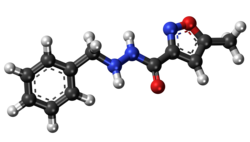 3D representation of an isocarboxazid molecule | |
| Clinical data | |
|---|---|
| Trade names | Marplan, Enerzer |
| AHFS/Drugs.com | Consumer Drug Information |
| MedlinePlus | a605036 |
| Routes of administration | By mouth |
| ATC code | |
| Legal status | |
| Legal status | |
| Pharmacokinetic data | |
| Bioavailability | Low, peak at 1–2 h2 |
| Metabolism | Liver (Carboxylesterase4) |
| Metabolites | Hippuric acid3 |
| Elimination half-life | 1.5–4 h2 |
| Excretion | Urine |
| Identifiers | |
| |
| CAS Number |
|
| PubChem CID | |
| IUPHAR/BPS | |
| DrugBank |
|
| ChemSpider |
|
| UNII | |
| KEGG |
|
| ChEMBL | |
| CompTox Dashboard (EPA) | |
| ECHA InfoCard | 100.000.399 |
| Chemical and physical data | |
| Formula | C12H13N3O2 |
| Molar mass | 231.255 g·mol−1 |
| 3D model (JSmol) | |
| |
| |
 N N Y (what is this?) (verify) Y (what is this?) (verify) | |
Isocarboxazid, sold under the brand name Marplan among others, is a non-selective irreversible monoamine oxidase inhibitor (MAOI) of the hydrazine class.5 Along with phenelzine and tranylcypromine, it is one of the three classic irreversible, non-selective MAOIs used as antidepressants in modern psychiatric practice.6 Availability varies by country; in the United States, all three remain available for clinical use, though isocarboxazid is prescribed less often than phenelzine or tranylcypromine. Its lower use has been attributed in part to practical issues of affordability and availability, a smaller literature base, and the absence of an FDA-approved generic equivalent.67
Isocarboxazid is used primarily in treatment-resistant depression. It has been used in various depressive subtypes, including atypical depression, melancholic depression, and endogenous depression.6 The usual effective dose range is 30–60 mg/day, although expert clinicians have used doses up to 80 mg/day, with greater antidepressant effects as well as more side effects.6 It may also be considered as an alternative classic MAOI when phenelzine or tranylcypromine is not well tolerated, including when troublesome daytime somnolence, sedation, sleep disturbance, or other adverse effects limit treatment.6
Isocarboxazid has also been investigated historically in other psychiatric and neurological conditions. Historical reports describe isocarboxazid among several MAO inhibitors tried in Parkinson's disease, alone or in combination with L-DOPA. Effects when these early MAO inhibitors were used alone were mild or absent, while they appeared to potentiate L-DOPA and also intensified adverse reactions.8 Evidence for Alzheimer's disease or other dementia-related disorders mainly concerns other MAO inhibitors, especially selegiline, rather than isocarboxazid specifically.8
Pharmacology
Pharmacodynamics
Isocarboxazid, like other classic non-selective irreversible MAOIs, inhibits both monoamine oxidase A and monoamine oxidase B, reducing the breakdown of the monoamine neurotransmitters serotonin, norepinephrine, and dopamine.6 Unlike many conventional antidepressants, such as selective serotonin reuptake inhibitors, serotonin–norepinephrine reuptake inhibitors, and tricyclic antidepressants, classic MAOIs such as isocarboxazid affect all three major monoamine neurotransmitter systems and increase monoamine availability both within and outside neurons, rather than only producing a relative extracellular increase in the synaptic cleft.6 This broader mechanism may contribute to their antidepressant effectiveness in treatment-resistant cases.6
Pharmacokinetics
Isocarboxazid has low oral bioavailability, reaches peak levels after about 1–2 hours, and has an elimination half-life of about 1.5–4 hours.2 It is metabolized in the liver by hydrolysis, without involvement of CYP2D6. As a result, dose adjustment based on CYP2D6 genetic polymorphisms is not required.6 Its reported metabolite is hippuric acid, and excretion is primarily urinary.9
Adverse effects and interactions
Isocarboxazid and other classic MAOIs are prescribed less often than newer antidepressants, partly because they require attention to dietary tyramine and drug interactions, and partly because many clinicians are less familiar with their modern use. The Prescriber's Guide to classic MAO inhibitors was written for clinicians, including those not experienced with MAOI prescribing, and describes its purpose as improving knowledge and correcting misconceptions about these drugs.6
Despite these limitations, classic MAOIs such as isocarboxazid continue to be considered clinically useful antidepressants, especially in treatment-resistant depression, and should not be regarded simply as drugs of last resort.6 The major interaction risks are mechanistically distinct: foods containing substantial tyramine can provoke hypertensive reactions, while drugs with significant serotonin reuptake inhibition or serotonin-releasing activity can precipitate serotonin syndrome.6
Common adverse effects of isocarboxazid and other classic MAOIs include orthostatic hypotension, sleep disturbance, and nervousness or agitation. At higher doses, isocarboxazid may cause anticholinergic-type effects such as constipation, dry mouth, and urinary hesitancy, as well as increased carbohydrate cravings, insomnia, subjective weakness, edema, and rarely hepatotoxicity.6
Contraindications
Isocarboxazid is contraindicated1011 in certain patient populations and with certain interacting drugs or foods due to the risk of serious adverse reactions. Some notable contraindications and precautions include:
- Pheochromocytoma, because of the risk of severe hypertensive reactions.
- Significant liver disease; rare hepatotoxicity has been reported with isocarboxazid.6
- Severe or clinically significant renal impairment, depending on individual risk assessment.
- Foods containing substantial amounts of tyramine, especially spoiled, aged, cured, fermented, or matured foods. This is a dietary restriction rather than a contraindication to treatment itself.
- Drugs with significant serotonin reuptake inhibition or serotonin-releasing activity, including selective serotonin reuptake inhibitors, serotonin–norepinephrine reuptake inhibitors, clomipramine, imipramine, tramadol, tapentadol, methadone, meperidine, and dextromethorphan.6
- Stimulant and sympathomimetic drugs vary in risk depending on mechanism, dose, and route. Medium- or high-dose amphetamines, MDMA, and cocaine are generally avoided because of monoamine-releasing activity. Low-dose amphetamines, including the amphetamine prodrug lisdexamfetamine, as well as ephedrine and pseudoephedrine, are relative contraindications rather than absolute contraindications; if used, reduced dosing, slow titration, and blood pressure monitoring are required. Other stimulants or wakefulness-promoting agents, such as methylphenidate, modafinil, and bupropion, are not automatically contraindicated but require low starting doses, slow titration, and monitoring when combined with MAOIs.6
- Some specific antihypertensive drugs, such as methyldopa and reserpine, which are generally avoided with MAOIs. Antihypertensive drugs as a class are not contraindicated.6
- Certain anesthetic-related drugs, especially pancuronium. Up-to-date MAOI literature does not support routine discontinuation of MAOI treatment before surgery or general anesthesia. In most cases, potentially serious interactions can be avoided through careful selection or dose adjustment of anesthetic and analgesic agents before, during, and after surgery; the MAOI should not be discontinued without consultation with the prescribing clinician.6
Stable hypertension is not itself a contraindication to classic MAOI treatment. Classic MAOIs commonly lower blood pressure and may cause orthostatic hypotension, particularly during treatment initiation and dose increases. Patients already taking antihypertensive medication may require blood pressure monitoring and dose adjustment to avoid excessive hypotension. Hypertensive reactions during MAOI treatment are mainly associated with tyramine ingestion or interacting sympathomimetic drugs, rather than with ordinary baseline hypertension itself.6
References
References
- Anvisa (2023-03-31). "RDC Nº 784 - Listas de Substâncias Entorpecentes, Psicotrópicas, Precursoras e Outras sob Controle Especial" [Collegiate Board Resolution No. 784 - Lists of Narcotic, Psychotropic, Precursor, and Other Substances under Special Control] (in Brazilian Portuguese). Diário Oficial da União (published 2023-04-04). Archived from the original on 2023-08-03. Retrieved 2023-08-16.
- Owens DC, Johnstone EC, Lawrie SM (January 2010). "Clinical psychopharmacology". Companion to Psychiatric Studies. pp. 227–294. doi:10.1016/B978-0-7020-3137-3.00011-5. ISBN 978-0-7020-3137-3.
- "Reaction: Isocarboxazid to 1 product". go.drugbank.com. Retrieved 27 October 2021.
- Moroi K, Kuga T (April 1982). "Inhibitory effect of leptophos on carboxylesterase (isocarboxazid amidase) in rat liver". Toxicology Letters. 11 (1–2): 81–85. doi:10.1016/0378-4274(82)90110-2. PMID 6178187.
- Fagervall I, Ross SB (April 1986). "Inhibition of monoamine oxidase in monoaminergic neurones in the rat brain by irreversible inhibitors". Biochemical Pharmacology. 35 (8): 1381–1387. doi:10.1016/0006-2952(86)90285-6. PMID 2870717.
- Van den Eynde V, Abdelmoemin WR, Abraham MM, Amsterdam JD, Anderson IM, Andrade C, et al. (August 2023). "The prescriber's guide to classic MAO inhibitors (phenelzine, tranylcypromine, isocarboxazid) for treatment-resistant depression". CNS Spectrums. 28 (4): 427–440. doi:10.1017/S1092852922000906. PMC 10198176. PMID 35837681.
{{cite journal}}: CS1 maint: overridden setting (link) - "Prescription List of Off-Patent, Off-Exclusivity Drugs without an Approved Generic". U.S. Food and Drug Administration. Food and Drug Administration. Retrieved 17 May 2026.
- Riederer P, Laux G (March 2011). "MAO-inhibitors in Parkinson's Disease". Experimental Neurobiology. 20 (1): 1–17. doi:10.5607/en.2011.20.1.1. PMC 3213739. PMID 22110357.
- "Reaction: Isocarboxazid to 1 product". go.drugbank.com. Retrieved 27 October 2021.
- "Marplan Drug Label". dailymed.nlm.nih.gov. Retrieved 2025-01-25.
- "Marplan® (isocarboxazid) | Safety Information". marplan.com. Retrieved 2025-01-25.