| Iris spuria | |
|---|---|

| |
Scientific classification 
| |
| Kingdom: | Plantae |
| Clade: | Embryophytes |
| Clade: | Tracheophytes |
| Clade: | Spermatophytes |
| Clade: | Angiosperms |
| Clade: | Monocots |
| Order: | Asparagales |
| Family: | Iridaceae |
| Genus: | Iris |
| Subgenus: | Iris subg. Limniris |
| Section: | Iris sect. Limniris |
| Series: | Iris ser. Spuriae |
| Species: | I. spuria
|
| Binomial name | |
| Iris spuria | |
| Synonyms2 | |
| |
Iris spuria, or blue flag, is a species of the genus Iris, part of the subgenus Limniris and the series Spuriae. It is a rhizomatous perennial plant, from Europe, Asia and Africa. It has purple or lilac flowers, and slender, elongated leaves. It is widely cultivated as an ornamental plant in temperate regions and hybridized for use in the garden. It has several subspecies; Iris spuria subsp. carthaliniae (Achv. & Mirzoeva) B.Mathew, Iris spuria subsp. demetrii (Achv. & Mirzoeva) B.Mathew, Iris spuria subsp. maritima (Dykes) P.Fourn. and Iris spuria subsp. musulmanica (Fomin) Takht. It used to have 3 other subspecies, which have now been re-classified as separate species; Iris spuria subsp. halophila (now Iris halophila), Iris spuria ssp. sogdiana (now Iris halophile subsp. sogdiana) and Iris spuria subsp. notha (now Iris notha). It has many common names including 'blue iris', 'spurious iris' and 'bastard iris'.
Description
It has a thin, slender rhizome,345 that is about 2 cm in diameter,6 fibrous and has a creeping habit.478 Under the rhizome are wiry roots.4
The creeping habit creates compact clumps of plants.910 They can reach over 90 cm (35 in) wide.9
It has erect, slender, sword-shaped, acuminate (ending in a point), glaucous green to blue green basal leaves.111213 They can grow up to between 25–90 cm (10–35 in) long and 5–12 mm wide.141516 They are normally nearly as long as the flowering stem.1718 After the plant has flowered and set seed, the leaves die in the late summer.4
It has a strong, erect, round stem,11 that can reach up to between 50–80 cm (20–31 in) long.192021
The stem has 1 or 2 lateral, upright branches,31122 or pedicels, which are about 2 cm long.6
The stem also has keeled, lanceolate, green, spathes (leaves of the flower bud) (or bracts).81112 These are 40–80 cm (16–31 in) long,16 and have a membranous tip.161723 The upper cauline (on stem) leaves are shorter than internodes.1216
The stems (and branches) hold 1–4 terminal (top of stem) flowers,52425 in summer,132322 between May and July.101415 They flower after Iris germanica and are similar in form to Iris × hollandica.10
It has large,13 lightly scented,10 flowers that are up to 6–12 cm (2–5 in) in diameter,91423 and they come in shades of lilac,141626 mauve-blue,19 violet-blue,358 purple-blue,101522 violet,1820 or blue.1318
It has 2 pairs of petals, 3 large sepals (outer petals), known as the 'falls' and 3 inner, smaller petals (or tepals, known as the 'standards'.27 The falls are broadly ovate, elliptic, or orbicular with a long claw (section leading to the stem).162324 The fall is 4.5–6 cm (2–2 in) long,51623 and 2.5 cm wide.7 They have purple or violet veining,19 and a central yellow or white stripe or signal area.232521
The standards are short, lanceolate or oblanceolate, erect wavy, and 3–6 cm (1–2 in) long and 8–20 mm wide.121316
It has a 7–10 mm long perianth tube,16 the ovary has a long tapering beak,11 which can be up to 40mm long.716
It has a narrow,12 violet style,6 2.5 cm long violet-lilac stigmas,7 1.27 cm long anthers, which equal the filament length.37
After the iris has flowered, it produces an oblong-ovate, hexagonal (2.5–4 cm long)516) seed capsule in September.3714 It has a long beak-like appendage on the top,3714 and 6 visible, longitudinal groves.516 Inside the capsule, are light brown, angular seeds,514 with a loose membranous testa (surface).16
Biochemistry
In 2002, a study was carried out on Iris spuria rhizomes, it found seven iridal-glycosides.28
In 2007, a chemical analysis was carried out on Iris spuria rhizomes, several compounds were isolated 12a-dehydrorotenoid 1, 11-dihydroxy-9, 10-methylenedioxy-12a-dehydrorotenoid, together with a new isoflavonoid glycoside tectorigenin-7-O-beta-glucosyl-4'-O-beta-glucoside, with 4 other known compounds, tectorigenin, tectorigenin-7-O-beta-glucosyl (1 --> 6) glucoside, tectoridin (a tectorigenin-7-O-beta-glucoside) and tectorigenin-4'-O-beta-glucoside.2930
In 2012, five Iris species (Iris pseudacorus, Iris crocea, Iris spuria, Iris orientalis and Iris ensata) were studied, to measure the flavonoids and phenolics content with the rhizomes. Iris pseudacorus had the highest content and Iris crocea had the lowest content.31
In May 2014, a study was carried out on the hepatoprotective activity of Iris spuria against paracetamol induced toxicity. 32
In July 2014, eight Irises from the Limniris section (Iris crocea, Iris ensata, Iris orientalis, Iris pseudacorus, Iris setosa, Iris sibirica with its cultivars 'Supernatural' and 'Whiskey White', Iris spuria and Iris versicolor) were studied to find 12 chemical compounds (flavonoids, phenols, quinones, tannins, saponins, cardiac glycosides, terpenoids, alkaloids, steroids, glycosides and proteins.33
Genetics
As most irises are diploid, having two sets of chromosomes, this can be used to identify hybrids and classification of groupings.27 It has been counted several times; 2n=22, Westergaraard, 1938; 2n=22, Lenz & Day, 1963; 2n=40, Banerji, 1970; 2n=40, Sharma & Sar., 1971; 2n=40, Roy et al., 1988.7 The chromosome count is normally stated as 2n=22.213435
Taxonomy

Jakob Sturm: "Deutschlands Flora in Abbildungen" Stuttgart (1796) source ↗

The Latin specific epithet spuria refers to 'spurious' meaning false.3637 Linnaeus thought that the plants were hybrids rather than a true species.3738
It is written as 假鸢尾 in Chinese script and known as Jia Yuan Wei in Pinyin Chinese.39
In Czech, it is called Iris Iris žlutofialový.51734
It is pronounced as 'EYE-ris SPUR-ee-uh'.40
Due to the wide distribution of the species, it has many different common names, including 'spurious iris',254142 'false iris',339 'bastard iris',81543 'blue iris' (in England),44451 'butterfly iris' (also in England),374546 'meadow marsh iris',35 'iris steppe',3547 'iris des steppes' (in France),46 'Steppen-Schwertlilie' (in Germany),4647 and 'dansk iris' (in Sweden).2146 and 'salt iris' (also in Sweden).46
Another is 'seashore iris',254748 but this probably applies to Iris spuria subsp. maritima. Also 'salt iris',46 and 'salt marsh iris',45 but this applies to Iris halophila (formerly a subspecies).
It was first described in 1753 by Linnaeus, who described it in the first volume of Species Plantarum as being a German species.49
On 4 November 1876, John Gilbert Baker described the iris in The Gardeners' Chronicle on page 583.7 An illustration of the iris was published in 1981 in Grey-Wilson and Mathew, Bulbs plate 28. It was then published in 1982 by P.J. Redoute in 'Liles and related flowers' (183).23
It has several subspecies; Iris spuria subsp. demetrii (Achv. & Mirzoeva) B.Mathew, Iris spuria subsp. demetrii (Achv. & Mirzoeva) B.Mathew, Iris spuria subsp. maritima (Dykes) P.Fourn. and Iris spuria subsp. musulmanica (Fomin) Takht. It used to have 3 other subspecies, which have now be re-classified as separate species; Iris spuria subsp. halophila (now Iris halophila), Iris spuria ssp. sogdiana (now Iris halophila var. sogdiana and Iris spuria subsp. notha (now Iris notha).27
It has been grown and cultivated in Britain since 1573. It naturalised in south Lincolnshire in 1836. Another colony was growing in Dorset, but in 1972 it was deliberately vandalised and damaged fatally.44
It was originally found on 10 July 1955 growing in Limhamm, Skane in Sweden. It was later published in Botanical Notices in 1958.8
It was verified by United States Department of Agriculture Agricultural Research Service on 20 April 1998, then updated on 1 December 2004.46 As of March 2015, Iris spuria is a 'tentatively accepted name' by the RHS.42
Distribution and habitat
Iris spuria is native to a very wide area, from Africa, to temperate and tropical Asia and Europe.444548
Range
It is found within Africa, in Algeria.7461 Within temperate Asia, it is found in the Western Asia regions of Afghanistan, Iran and Turkey.35461 In the Caucasus regions, it is in Armenia, Azerbaijan, Georgia, Ciscaucasia and Dagestan.461 and in the Russian, Siberian regions of Altay, Chelyabinsk, Gorno-Altay, Kurgan, Novosibirsk, Omsk and Tomsk.46 In the Middle Asia regions of Kazakhstan, Kyrgyzstan, Turkmenistan, Uzbekistan and Mongolia.46 It is also found in China, with the provinces of Gansu and Xinjiang.46 Within tropical Asia, it is found in the Indian sub-continental regions of Jammu, Kashmir and Pakistan.46
Within Europe, it is found in the northern European regions of Denmark and Sweden.34461 and in the middle European regions of Austria, Czech Republic, Slovakia, Germany and Hungary.51214 Within eastern European it is found in the regions of Moldova, Bashkortostan, Ukraine,1646 and Serbia.50 and in the southern European regions of Romania, France and Spain.34161
It has been naturalized within New Zealand and the United Kingdom,46 in Lincolnshire.51
Habitat
Iris spuria grows on seasonally damp grasslands,1 damp meadows (or pastures),19241 marshes,9241 alluvial plains,51 swamps,1 bogs,1 maquis,1 and salty flats.1
It also grows in saline soils.141516 It can be found naturalised in damp, grassy places, by ditches, on banks and on roadside verges.44
Conservation
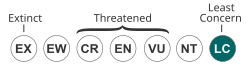
The iris is generally listed as of 'Least Concern' on 26 April 2013 in most European countries. But it is listed as rare or endangered in some.
In Russia, the digging up of wild iris rhizomes is strictly prohibited.20
In Sweden, it is rare and is only found on the coastal meadows in southern Sweden.8 On the island of Saltholm, the colony was diminishing, before being protected.12
In Germany, it is rare and colonies are protected.512
In Serbia, it is also rare,50 and within Hungary, colonies are also protected.5
In Czechoslovakia, it has mixed fortunes. In the region of Moravia, it is now regarded as extinct.534 In the Slovak Republic, it is classified as a 'critically endangered' species, and listed in the Red Book, with the meadows to the north and east of Štúrovo, now protected.34 It is currently found in about 10 locations in Podunajskej lowlands, near Komárno and Sturova Nitra.5
Cultivation
It is generally thought to be easy to grow.1037
It is hardy to between USDA Zone 3 and Zone 9.254045 It is also hardy to European Zone H2.23
It is tolerant to most garden soils,24 it will grow on wet soils, saline soils, and saline marshes.9 It prefers well drained, humus rich soils.132237 It is tolerant of acid soils,40 but prefers neutral soils.
It prefers positions in full sun or partial shade.91040 Although, shade reduces the flowering amount.1037
They prefer hot and dry summers,948 only requiring plenty of water during the spring.4048
Like most species in the Spuria series, they do not like root disturbance.91037
It is best planted from dormant rhizomes in autumn,37 and deeper in the soil than Iris germanica.10
It can be used in borders or in beds for cut flower (for the house).10 They create large full clumps of plants.48
Aphis newtoni Theobald can be found on Iris bloudowii, Iris latifolia, Iris spuria and Tigridia pavonia.52 Also Dysaphis tulipae can be found on Iris spuria.53 The iris is also the host plant of Mononychus punctumalbum (Herbst, 1784, iris seed weevil – a weevil that feeds on the seeds of the iris). The weevil lays its eggs within seed capsule of the iris, later the larva feeds on the seed and up to 2 other seeds, and then it pupates. Adult weevils emerge from the seed capsules, fly off for aestivation (summer dormancy) and hibernation within the soil.54
Propagation
It can be pollinated by bees.37
It can also be propagated by division (of the rhizomes),13 or by seed growing.40 Growing by seeds gives a more reliable results.20
Hybrids and cultivars
Due to the wide range of species, (with various tolerances for heat, salt or cold resistance), they have been very useful to plant breeders.20 Many of the modern cultivars have been breed with larger flowers in a wider range of colours than wild species.37
Known Iris spuria cultivars include; 'Adobe Sunset' (hybridized by McCown, 1976),2440 'AJ Balfour',24 'Albulus',7 'Archie Owen' (hybridized by Hager, 1970),2740 'Barbara's Kiss' (hybridized by McCown, 1981),40 'Belise' (hybridized by Simonet, 1964),740 'Belissinado' (hybridized by Corlew, 1988),40 'Betty Cooper' (hybridized by McCown, 1981),40 Iris 'Betty My Love' (hybridized by Wickenkamp, 1988),40 Iris 'Blue Lassie' (hybridized by Niswonger, 1978),40 'Cambridge Blue',24 'Cheroke Chief',2427 'Clarke Cosgrove',24 'Custom Design',24 'Daenaensis',7 'Danica',7 'Dawn Candle',24 'Georgian Delicacy',7 'Halophila lutea',7 'Imperial Bronze',2427 'Media Lux',24 'Norton Sunlight',24 'Protege',24 'Monspur', 'Premier',2438 and 'Red Clover'.24
Toxicity
Like many other irises, most parts of the plant are poisonous (rhizome and leaves), and can cause stomach pains and vomiting if mistakenly ingested. Handling the plant may cause skin irritation or an allergic reaction.40
References
References
- Kavak, S. (2014). "Iris spuria". IUCN Red List of Threatened Species. 2014 e.T200242A42327335. doi:10.2305/IUCN.UK.2014-1.RLTS.T200242A42327335.en. Retrieved 12 November 2021.
- "Iris spuria L. is an accepted name". theplantlist.org (The Plant List). 23 March 2013. Retrieved 4 February 2015.
- "Lat. Iris". agbina.com. Archived from the original on 14 March 2019. Retrieved 17 February 2015.
- Dykes, William (2009). "Handbook of Garden Irises" (PDF). beardlessiris.org (The Group for Beardless Irises). Retrieved 1 November 2014.
- Baby, Daniel (24 June 2009). "Iris spurio zlutofialovy iris – iris doubtful". botany.cz. Retrieved 27 February 2015.
- A. R. Clapham, T. G. Tutin and D. M. Moore Flora of the British Isles (3rd Edit. 1987), p. 554, at Google Books
- Pries, Bob (20 October 2014). "(SPEC) Iris spuria L." wiki.irises.org (American Iris Society). Retrieved 27 February 2015.
- "Iris spuria". linnaeus.nrm.se. Retrieved 27 February 2015.
- "Iris". rslandscapedesign.blogspot.co.uk. 13 February 2010. Retrieved 23 February 2015.
- "Spuria IRIS – Iris bastard – Seashore Iris". jardinsmichelcorbeil.com. Archived from the original on 4 March 2016. Retrieved 27 February 2015.
- Dykes, William. "Dykes on Iris" (PDF). beardlessiris.org (The Group for Beardless Irises). Retrieved 21 November 2014.
- British Iris Society (1997) A Guide to Species Irises: Their Identification and Cultivation, p. 187, at Google Books
- William RobinsonHardy Flowers (1878), p. 152, at Google Books
- "Subgenus Xyridion (Xyridion) – Wood-iris rhizome". flower-iris.ru. Retrieved 24 February 2015.
- "Spuria IRIS – Iris bastard – Seashore Iris". luwg.rlp.de. Archived from the original on 4 March 2016. Retrieved 27 February 2015.
- Thomas Gaskell Tutin (editor)Flora Europaea, Vol.5, p. 89, at Google Books
- "Bezkartáčkaté irises". zahradaweb.cz. 5 March 2012. Retrieved 27 February 2015.
- Cassidy, George E.; Linnegar, Sidney (1987). Growing Irises (Revised ed.). Bromley: Christopher Helm. p. 146. ISBN 978-0-88192-089-5.
- "Spuria Irises". herbs2000. Retrieved 14 January 2015.
- "Spuria iris". flowerlib.ru. Retrieved 12 February 2015.
- Kramb, D. (2 October 2004). "Iris spuria". signa.org (Species Iris Group of North America). Retrieved 27 February 2015.
- Christopher Brickell (editor)RHS Encyclopedia of Plants and Flowers (5th Edition, 2010), p. 613, at Google Books
- James Cullen, Sabina G. Knees, H. Suzanne Cubey (Editors) The European Garden Flora Flowering Plants: A Manual for the Identification (2011) , p. 255, at Google Books
- Phillips, Roger; Rix, Martyn (1991). Perennials Vol. 1. Pan Books Ltd. pp. 225–227. ISBN 978-0-330-32774-9.
- Donald Wyman Wyman's Gardening Encyclopedia (2nd Edition, 1997), p. 577, at Google Books
- "Iris summary" (PDF). pacificbulbsociety.org. 14 April 2014. Retrieved 23 November 2014.
- Austin, Claire (2005). Irises: A Gardener's Encyclopedia. Timber Press, Incorporated. ISBN 978-0-88192-730-6. OL 8176432M.
- Marnera, Franz-Josef; Singab, Abdel Nasser Badawi; Al-Azizib, Mohamed Mohamed; El-Emaryc, Nasr Ahmed; Scha¨ferd, Mathias (2002). "Iridal glycosides from Iris spuria (Zeal), cultivated in Egypt" (PDF). Phytochemistry. 60 (10): 301–307. doi:10.1016/s0031-9422(02)00110-3. PMID 12031450. Retrieved 6 June 2015.
- Singab, A.N. (October 2007). "Flavonoids from Iris spuria (Zeal) cultivated in Egypt". Arch Pharm Res. 27 (10): 1023–1028. doi:10.1007/bf02975425. PMID 15554258. S2CID 30711629.
- John Buckingham and V. Ranjit N. Munasinghe Dictionary of Flavonoids with CD-ROM, p. 639, at Google Books
- Kaššak, P (13 September 2012). "Total Flavonoids And Phenolics Content Of The Chosen Genus Iris Species". Acta Universitatis Agriculturae et Silviculturae Mendelianae Brunensis. 60 (8): 119–126. doi:10.11118/actaun201260080119.
- Akther, N.; Andrabi, K.; Nissar, A.; Ganaie, S.; Chandan, B.; Gupta, A.; Khuswant, M.; Sultana, S.; Shawl, A. (2014). "Hepatoprotective activity of LC-ESI-MS standardized Iris spuria rhizome extract on its main bioactive constituents". Journal of Pharmacognosy and Phytochemistry. 21 (10): 1202–1207. doi:10.1016/j.phymed.2014.04.007. PMID 24877715.
- Kaššák, Pavol (2014). "Screening of the chemical content of several Limniris group Irises" (PDF). Journal of Pharmacognosy and Phytochemistry. 3 (2): 11–14. Retrieved 2 February 2015.
- Blazek, Milan. "Iris spuria and related species – the importance of culture". ibotky.cz. Retrieved 16 February 2015.
- Stolley, Gregor. "The genus Iris in Germany (Gregor Stolley)". offene-naturfuehrer.de. Retrieved 20 February 2015.
- Smith, A.W.; Stearn, William T. (1972). A Gardener's Dictionary of Plant Names (Revised ed.). Cassell and Company (published 1963). p. 299. ISBN 978-0-304-93721-9.
- Westcott-Gratton, Stephen. "Plant profile: Butterfly iris". canadiangardening.com. Archived from the original on 1 May 2015. Retrieved 27 February 2015.
- Stebbings, Geoff (1997). The Gardener's Guide to Growing Irises. Newton Abbot: David and Charles. p. 62. ISBN 978-0-7153-0539-3.
- Zhou, Jiaju; Guirong, Xie; Yan, Xinjian (26 August 2011). Encyclopedia of Traditional Chinese Medicines – Molecular Structures, Pharmacological Activities, Natural Sources and Applications. London: Springer. ISBN 978-3-642-16740-9.
- "PlantFiles: Dykes Seashore Iris, Seashore Iris". davesgarden.com. Retrieved 2 March 2014.
- William Salisbury The Botanist's Companion: Or, An Introduction to the Knowledge of Practical Botany and the uses of plants, either growing wild in Great Britain, or cultivated for the purposes of agriculture, medicine, rural economy or the arts. (1816) , p. 172, at Google Books
- "Iris spuria". rhs.org.uk. Retrieved 2 March 2015.
- John Simms Curtis's Botanical Magazine (1818), p. 1506, at Google Books
- "Iris spuria (Blue Iris)". brc.ac.uk. Retrieved 27 February 2015.
- "Iris spuria Blue Iris". jardins-sans-secret.com. Archived from the original on 5 March 2016. Retrieved 27 February 2015.
- "Iris spuria". Germplasm Resources Information Network. Agricultural Research Service, United States Department of Agriculture. Retrieved 27 February 2015.
- "German-English Dictionary: dykes seashore iris [Iris spuria]". dict.cc. Retrieved 27 February 2015.
- Allan M. Armitage Herbaceous Perennial Plants: A Treatise on their Identification, Culture and Garden Attributes at Google Books
- "Iris spuria". Plant Name Details. IPNI. Retrieved 12 February 2015.
- Vajgand, Dragan K.; Vajgand, Ljubica M.; Vajgand, Karlo A. (2003). "Iris spuria L. (Iridaceae) At Two New Localities In The Vojvodina Province" (PDF). Proceedings for Natural Sciences. 104: 83–89. Retrieved 27 February 2015.
- Martin, W. Keble (1974). The Concise British Flora in Colour. Books Club Associates. p. 83.
- Proceedings of the Estonian Academy of Sciences, Biology and Ecology June 2002 Proceedings of the Estonian Academy of Sciences, Biology and Ecology June 2002, p. 128, at Google Books
- R. L. Blackman, Victor F. Eastop Aphids on the World's Herbaceous Plants and Shrubs, p. 553, at Google Books
- Gültekina, Levent; Korotyaevb, Boris A. (2012). "Ecological Description of Two Seed-Feeding Weevils of the Genus Mononychus Germar (Coleoptera: Curculionidae) on Iris iberica Hoffmann and Iris spuria L. in North-eastern Turkey". The Coleopterists Bulletin. 66 (2): 155–161. doi:10.1649/072.066.0213. S2CID 86237450.
Sources
Sources
- Aldén, B., S. Ryman & M. Hjertson. 2009. Våra kulturväxters namn – ursprung och användning. Formas, Stockholm (Handbook on Swedish cultivated and utility plants, their names and origin).
- Allan, H. H. B. et al. 1961–. Flora of New Zealand.
- Davis, P. H., ed. 1965–1988. Flora of Turkey and the east Aegean islands. [= I. spuria subsp. musulmanica].
- Erhardt, W. et al. 2008. Der große Zander: Enzyklopädie der Pflanzennamen.
- Huxley, A., ed. 1992. The new Royal Horticultural Society dictionary of gardening.
- Maire, R. C. J. E. et al. 1952–. Flore de l'Afrique du Nord.
- Mathew, B. 1981. The Iris. 116–119.
- Nasir, E. & S. I. Ali, eds. 1970–. Flora of [West] Pakistan.
- Quézel, P. & S. Santa. 1962–1963. Nouvelle flore de l'Algerie.
- Rechinger, K. H., ed. 1963–. Flora iranica.
- Sell, P. & G. Murrell. 1996–. Flora of Great Britain and Ireland.
- Stace, Clive, 1995. New Flora of the British Isles.
- Walters, S. M. et al., eds. 1986–. European garden flora.
External links
External links
Media related to Iris spuria at Wikimedia Commons Data related to Iris spuria at Wikispecies