| Iris orientalis | |
|---|---|
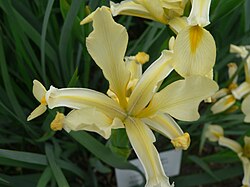
| |
Scientific classification 
| |
| Kingdom: | Plantae |
| Clade: | Embryophytes |
| Clade: | Tracheophytes |
| Clade: | Spermatophytes |
| Clade: | Angiosperms |
| Clade: | Monocots |
| Order: | Asparagales |
| Family: | Iridaceae |
| Genus: | Iris |
| Subgenus: | Iris subg. Limniris |
| Section: | Iris sect. Limniris |
| Series: | Iris ser. Spuriae |
| Species: | I. orientalis
|
| Binomial name | |
| Iris orientalis | |
| Synonyms1 | |
| |
Iris orientalis is a species in the genus Iris; it is also in the subgenus Limniris and in the series Spuriae. It is a rhizomatous perennial plant, from Turkey and Greece, with white flowers with a yellow mark or blotch. It was also known as Iris ochroleuca for a long time. It is commonly known as yellow banded iris in the U.S. and Turkish iris in the UK but also has some other less common names. It is very hardy and has been known to naturalize in various countries. It is widely cultivated as an ornamental plant in temperate regions.
Description
It has short, branching, stout, woody rhizomes.234 They can be up to 1.5 cm in diameter.25 Underneath, they have fleshy roots.2
Over a long period, they can form large clumps of plants.678
It has basal leaves,910 that are erect, between deep green and dark green, stiff and (lanceolate) sword-like.51112 They can grow up to 60–90 cm (24–35 in) long and 1–2 cm wide.10913 The leaves are not usually as long as the flowering stems.814
The flower stalk begins to grow in April and then reaches maturity in May.4
The solid, slightly flattened stems,2 about 1 cm wide,12 can generally grow up to between 40–90 cm (16–35 in) long.151617
Although, larger forms are known to be much bigger, growing up to between 90–170 cm (35–67 in) long.181920 It has normally one or more short branches.132122
The stems have two or three spathes (leaves of the flower bud),3512 which are papery (in form) and 9–12 cm (4–5 in) long.101213
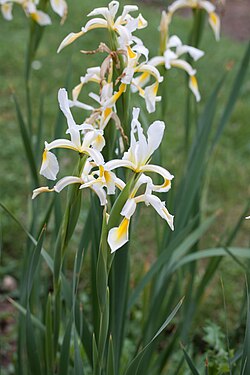
The stems (and branches) hold two to five terminal (top of stem) flowers, which open in succession, blooming in late spring,22 or summer,1319 between May and July.111921
The large flowers are 8–10 cm (3–4 in) in diameter,91012 and are white or near white.5811
It has two pairs of petals, three large sepals (outer petals), known as the 'falls' and three inner, smaller petals (or tepals, known as the 'standards'.20 The falls are spreading, arching downwards, with a large egg-yolk yellow central area.3413 They are 8–10 cm (3–4 in) long and 3–6 cm wide.235 The standards are erect, spatulate (spoon-like), with a yellow centre section surrounded in white.235 They are 4–8 cm (2–3 in) long and 1–1.5 cm wide.31213
The flowers are pollinated by insects.5
It has 1–2.5 cm long, white, funnel-form or cup shaped perianth tube,23 4–6 cm (2–2 in) long, white style branches,3510 and 2 lobed stigmas.2
After the iris has flowered, it produces an ovoid to oblong-elliptic, triangular in cross section, seed capsule, 4–6 cm (2–2 in) long and 2–2.5 cm wide, with a beaked top.235 The brown seed capsule has two ribs.235
Inside the seed capsule, are 2 rows of papery, wrinkled, white, flattened or wedged-shaped seeds, that are 4–5 mm across.2
Biochemistry
As most irises are diploid, having two sets of chromosomes. This can be used to identify hybrids and classification of groupings.20 It has been counted several times, 2n=39–40, Simonet in 1932 and 2n-40 by Lenz in 1963.12 It has been listed as 2n=39,4 or 2n=40.2
In 2012, five Iris species (Iris pseudacorus, Iris crocea, Iris spuria, Iris orientalis and Iris ensata) were studied, to measure the flavonoids and phenolics content with the rhizomes. Iris pseudacorus had the highest content and Iris crocea had the lowest content. 23
In 2014, eight Irises from the Limniris section (Iris crocea, Iris ensata, Iris orientalis, Iris pseudacorus, Iris setosa, Iris sibirica with its cultivars 'Supernatural' and 'Whiskey White', Iris spuria and Iris versicolor) were studied to find 12 chemical compounds (flavonoids, phenols, quinones, tannins, saponins, cardiac glycosides, terpenoids, alkaloids, steroids, glycosides and proteins.24
Taxonomy
Iris orientalis is pronounced as 'EYE-ris (Iris) or-ee-en-TAY-liss (Orientalis).18
It has several common names including; yellow band iris (in America),192125 oriental iris,2627 Turkish Iris in the UK,262829 eastern iris,5 and Russian beauty iris.27
It is also known as gullbandsiris in Sweden.26
It was first published and described by Philip Miller in The Gardeners Dictionary, ed.8. no9. on the 16 April 1768.22630
In 1788, Curtis's Botanical Magazine, table 61, described Iris orientalis using the name Iris ochroleuca.12 This was the start of the confusion between the two irises.3720 Because Iris ochroleuce was published later (by Carl Linnaeus in 177114), it is deemed unacceptable under the International Rules of Nomenclature.10 Later, Iris ochroleuca was classified as a synonym of Iris orientalis.1
An illustration of Iris orientalis was in Botanical Magazine 61 in 1793.13
It has been mistakenly thought to be a Japanese Iris, due to the name 'orientalis'.31
The Latin specific epithet orientalis refers to 'eastern' but sometimes is also translated as 'from the Orient'.3233
It was verified by United States Department of Agriculture Agricultural Research Service on 4 April 2003.26
Iris orientalis is an accepted name by the RHS.29
Distribution and habitat
Iris orientalis is native to Asia Minor.3427
Range

It is found in Turkey,679 and within south-eastern Europe, in Greece,132629 and Aegean Islands,1526 (Lesbos and Samos).91020
It is found in Greece near Alexandropoulos and within Turkey, east to Kayseri.9 It was once found by Pierre Edmond Boissier in the marshes to the west of Smyrna, in Greece.3
One reference mentions Syria, but this may mean a cultivated region not native.3
It has been naturalized in California, Connecticut, Missouri (in the US), along roadsides,219 and in old farms in Southern Italy,7 and in Yugoslavia.10 It has also naturalized in the UK, found on the edges of woodlands and in grasslands of the New Forest and around Abbotsbury in Dorset.11 The rivers of the Balkans are known for a diverse range of plants including Iris orientalis in Evros River delta.34
Habitat
Iris orientalis grows on saline marshy lands,3817 including damp meadows,49 and ditches,9 or irrigation channels.10
It grows at altitudes of between 150 and 1400 metres above sea level.910
Cultivation
Iris orientalis is widely grown in gardens and parks.5 It is hardy to between USDA Zone 4a and 9b. Between (−34.4 °C (−30 °F) to −3.8 °C (25 °F)).18 It is also hardy to WHZ 4–9,19 and within Europe H2.13 The leaves often survive the winter.22 Due to this hardiness it is assumed fairly easy to grow.410
Although it prefers saline soils, it is tolerant of many garden soils.1018 It prefers positions in full sun or partial shade.1018 Sometimes slugs can be a pest, and can nibble on the young shoots.4
It can take several years to start flowering again after being moved,9 but once settled, it can develop into a large round clump.7
It also could be grown within an orchard and is also good for use within a cutting garden.14
It has gained the Royal Horticultural Society's Award of Garden Merit.35
Propagation

It can also be propagated by division or by seed growing, after allowing the capsules to mature and then break to release the seeds.18
Toxicity
Like many other irises, most parts of the plant are poisonous (rhizome and leaves), if mistakenly ingested can cause stomach pains and vomiting. Also handling the plant may cause a skin irritation or an allergic reaction.18
Uses
It has been listed with Iris paradoxa and Iris spuria subsp. musulmanica as a suitable halophyte crop.36
Hybrids and cultivars
Iris orientalis has been extensively used in creating various hardy cultivars, due to its 'tough' nature.420
A well known cultivar is 'Shelford Giant',7 an extra large clone,917 which was found near Ephesus (in Greece).9 Published by Foster in 1913.37 It has long, erect, strap-like leaves that are evergreen and can survive the winter.38 It has stems that grow up to 2m tall.937 In early summer,3738 it produces yellow and white flowers,38 that are 6–8 cm in width.37 The falls have a deeper yellow central patch.37 It has gained the RHS's Award of Garden Merit (RHS AGM), since 1994.39
Another cultivar is 'Frigia', introduced in 1990 by Rodionenko from St. Petersburg.27 It has tall stems with up to 5 pure white flowers.40 It is vigorous and hardy but should not be transplanted too often.27
Iris orientalis has had the following registered American cultivars: 'Canari', 'Copa D'ora', 'Ochroleuca Double', 'Ochroleuca Ephesus', 'Ochroleuca Gigantea', 'Ochroleuca Innocence', 'Ochroleuca Queen Victoria', 'Ochroleuca Reflex', 'Ochroleuca Snowflake', 'Ochroleuca Sulphurea', 'Ochroleucha Warei', 'Rocky Mountain Park', 'Yellow Crest'.12
References
References
- "Iris orientalis Mill. is an accepted name". theplantlist.org (The Plant List). 23 March 2013. Retrieved 12 February 2015.
- "FNA Vol. 26 Page 374, 394". efloras (Flora of North America). Retrieved 18 February 2015.
- Richard Lynch The Book of the Iris, p. 85, at Google Books
- "Chapter II iris clump and other (part3)". irisbotanique.over-blog.com. Retrieved 17 February 2015.
- "White lily (Iris orientalis)". florabonaerense.blogspot.co.uk. 25 April 2014. Retrieved 18 February 2015.
- "Beardless Irises Two". pacificbulbsociety.org. 18 December 2014. Retrieved 14 January 2015.
- Porcelli, Angelo. "Beardless Irises Two". pacificbulbsociety.org. Retrieved 18 February 2015.
- "Spuria Irises". herbs2000. Retrieved 14 January 2015.
- Phillips, Roger; Rix, Martyn (1991). Perennials Vol. 1. Pan Books Ltd. p. 188. ISBN 9780330327749.
- Mathew, Brian (1989). "I. orientalis Miller (Syn. I. ochroleuca)". spuriairis.com. Retrieved 18 February 2015.
- "Turkish Iris". seasonalwildflowers.com. Retrieved 18 February 2015.
- Laurin, Terry (20 October 2014). "(SPEC) Iris orientalis Miller". wiki.irises.org (American Iris Society). Retrieved 4 February 2015.
- Stuart Max Walters (Editor) The European Garden Flora Flowering Plants: A Manual for the Identification (2003), p. 348, at Google Books
- Cassidy, George E.; Linnegar, Sidney (1987). Growing Irises (Revised ed.). Bromley: Christopher Helm. ISBN 0-88192-089-4.
- Kramb, D (9 November 2003). "Iris orientalis". signa.org (Species Iris Group of North America). Retrieved 14 January 2015.
- "Iris summary" (PDF). pacificbulbsociety.org. 14 April 2014. Retrieved 23 November 2014.
- Stebbings, Geoff (1997). The Gardener's Guide to Growing Irises. Newton Abbot: David and Charles. p. 61. ISBN 0715305395.
- "PlantFiles: Spuria Iris Iris orientalis". davesgarden.com. Retrieved 18 February 2015.
- "Legacy Bulbs Six". pacificbulbsociety.org. Retrieved 18 February 2015.
- Austin, Claire (2005). Irises: A Gardener's Encyclopedia. Timber Press, Incorporated. ISBN 978-0881927306. OL 8176432M.
- John Kirkegaard A Practical Handbook of Trees, Shrubs, Vines, and Herbaceous Perennials (1912), p. 218, at Google Books
- Christopher Brickell (Editor) RHS Encyclopedia of Plants and Flowers (5th Edition 2010), p. 612, at Google Books
- Kaššak, Pavol (13 September 2012). "Total Flavonoids And Phenolics Content Of The Chosen Genus Iris Species". Acta Universitatis Agriculturae et Silviculturae Mendelianae Brunensis. 60 (8): 119–126. doi:10.11118/actaun201260080119.
- Kaššák, Pavol (2014). "Screening of the chemical content of several Limniris group Irises" (PDF). Journal of Pharmacognosy and Phytochemistry. 3 (2): 11–14. Retrieved 2 February 2015.
- Goodnick, Billy (16 April 2011). "Alice By Morning Light: Rays of Optimism". edhat.com. Retrieved 18 February 2015.
- "Iris orientalis". Germplasm Resources Information Network. Agricultural Research Service, United States Department of Agriculture. Retrieved 18 February 2015.
- "Iris orientalis". wildstaudenzauber.de. Archived from the original on 28 January 2016. Retrieved 18 February 2015.
- "Iris orientalis Mill". discoverlife.org. Retrieved 18 February 2015.
- "Iris orientalis Mill". www.rhs.org.uk. Retrieved 18 February 2015.
- "Iridaceae Iris orientalis Mill". ipni.org (International Plant Names Index). Retrieved 12 February 2015.
- Benjamin Yoe Morrison Garden irises (1926), p. 32, at Google Books
- "Iris orientalis". nzpcn.org.nz. Retrieved 18 February 2015.
- Smith, A.W.; Stearn, William T. (1972). A Gardener's Dictionary of Plant Names (Revised ed.). Cassell and Company (published 1963). p. 236. ISBN 0304937215.
- Klement Tockner, Urs Uehlinger and Christopher T. Robinson Rivers of Europe, p. 468, at Google Books
- "Iris orientalis". www.rhs.org. Royal Horticultural Society. Retrieved 25 September 2020.
- M. Ajmal Khan, Benno Boer and Munir Ozturk (Editors)Sabkha Ecosystems: Volume Iv: Cash Crop Halophyte and Biodiversity Conservation, Volume 4 , p. 124, at Google Books
- "PlantFiles: Spuria Iris Iris spuria 'Shelford Giant'". davesgarden.com. Retrieved 18 February 2015.
- "Iris orientalis 'Shelford Giant'". plantadvice.co.uk. Retrieved 18 February 2015.
- "Search for AGM plants". rhs.org.uk. Retrieved 18 February 2015.
- "Iris orientalis 'Frigia' – Quilting Sword lily". allgaeustauden.de. Retrieved 18 February 2015.
Other sources
- Aldén, B., S. Ryman & M. Hjertson. 2009. Våra kulturväxters namn – ursprung och användning. Formas, Stockholm (Handbook on Swedish cultivated and utility plants, their names and origin).
- Botanical Society of the British Isles. BSBI taxon database (on-line resource).
- Davis, P. H., ed. 1965–1988. Flora of Turkey and the east Aegean islands.
- Integrated Botanical Information System (IBIS). Australian plant common name database (on-line resource).
- Mathew, B. 1981. The Iris. 114–115.
External links
External links
- Media related to Iris orientalis at Wikimedia Commons
- Data related to Iris orientalis at Wikispecies