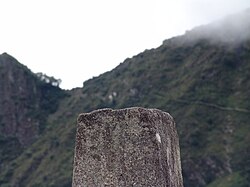
Intihuatana is a ritual stone in South America associated with the astronomic clock or calendar of the Inca. Its name is derived from the local Quechua language. The most notable Intihuantana1 is an archaeological site located at Machu Picchu2 in the Sacred Valley near Machu Picchu, Peru. The name of the stone (coined perhaps by Hiram Bingham) is derived from Quechua: inti means "sun", and wata- is the verb root "to tie, hitch (up)" (huata- is simply a Spanish spelling). The Quechua -na suffix derives nouns for tools or places. Hence inti watana is literally an instrument or place to "tie up the sun", often expressed in English as "The Hitching Post of the Sun".3
See also
See also
- Inti Watana, Ayacucho, an archaeological site in the Vilcas Huamán Province, Ayacucho Region, Peru
- Inti Watana, Calca, an archaeological site in the Pisac District, Calca Province, Cusco Region, Peru
- Inti Watana, Urubamba, an archaeological site in the Machupicchu District, Urubamba Province, Cusco Region, Peru
- Inti Watana II and III, also known as Usqunta I and II, an archaeological site in the Lucanas Province, Ayacucho Region, Peru
References
References
- "What Is The Intihuatana Stone At Machu Picchu?". Destination Peru. Retrieved 2017-02-07.
- "Whoa... That page has been archived. | CAST | University of Arkansas".
- "Machu Picchu". Sacred Sites. Retrieved 16 July 2012.