| Inner Meadow | |
|---|---|
| Stratigraphic range: late Ediacaran ~ | |
 3D reconstructions of Charnia brasieri from the Inner Meadow Lagerstätte, surrounded by Fractofusus andersoni | |
| Type | Formation |
| Unit of | Fermeuse Formation |
| Area | 40 m2 (430 sq ft) |
| Lithology | |
| Primary | Mudrock |
| Other | Sandstone, Siltstone |
| Location | |
| Region | Newfoundland and Labrador |
| Country | Canada |
| Type section | |
| Named by | McIlroy et al. |
| Year defined | 20261 |
The Inner Meadow is an Ediacaran aged fossiliferous deposit, and is found close to outcroppings of the Fermeuse Formation, near to Upper Island Cove on the island of Newfoundland and Labrador in Canada. Considered to be a lagerstätte, it contains biota most commonly found in the Avalon assemblage, showing that both the Avalon and White Sea assemblages are contemporaneous, with the only differences between the two being ecology.
History of research
The site was originally found by the Coombs family in 2023, who own the land the locality sits within, when trying to find where water was coming from after a storm had hit the area, finding a 20 cm (7.9 in) long petalonamid fossil in the process. An image of the fossil was posted to an online Facebook group known as "Newfound fossils", where it was picked up by local researchers, who were then given permission to excavate more of the site, discovering even more fossils.2
The site was immediately recognised for its great density of fossils, which was more than what is seen at the Mistaken Point Formation. The fossils are also on average notably larger and better preserved, which allowed for more scrutinised studies to be undertaken, which was noted would take 3–4 years.2
Multiple fossils were slowly described from the locality over the intervening years since the discovery of the site, such as Aninoides, a 1 m (3 ft 3.4 in) long petalonamid, and Charnia brasieri in 2025.345 The site itself would be formally described in January 2026, although research continues.1
Geology
The Inner Meadow site is primarily composed of thick, structureless mudrock, with a thin layer of sandstone and green siltstone, which is tuffaceous and calcareous in nature. The current known area of the locality is 40 m2 (430 sq ft), although it has been noted that any edge to the site has yet to be found, and as such this may increase with further excavations.1
The uncovered surface at Inner Meadow also shows that there was a notable extensive, thick mat-ground covering, which permitted a wide spread of "bubble fields", formed by the build-up and accumulation of gases beneath the mat-ground. When the mat-ground was buried and decayed, these trapped gasses would then be released, letting softer tuffaceous sediments into the hemispherical cavities left behind and preserving them. Later weathering of the overlaying sediments would then have occurred, leaving the surface at Inner Meadow covered in negative-relief hemispherical impressions, something that is unique compared to other formations and surfaces in Newfoundland, which only contain "bubble trains".6
Dating
The Inner Meadow site has been dated using U–Pb dating on several zircon samples, recovering at date of 550.78±0.60 Ma, placing the site, and the Avalon assemblage biota found in it, firmly within what is known as the White Sea assemblage. Alongside this, the site was also deposited just before what is known as the Kotlin Crisis, one of the first notable extinction events of the Ediacaran period, which previously was thought to only affect biota known from White Sea assemblage aged rocks.1
Paleobiota
The Inner Meadow contains a wealth of organisms previously only known from Avalon aged rocks on what is known as the EM Coombs surface, like Frondophyllas and Pectinifrons, in White Sea aged rocks, showing that the biota of the Avalon assemblage survived later than originally thought. Although it is noted, much like a majority of the biota from White Sea aged rocks, they did not survive beyond the Kotlin Crisis into Nama assemblage aged strata, showing also that this extinction event was far greater than previously suggested by affecting not just one, but two assemblage biotas, with 80% of known life lost.17 The exact cause of this extinction event still remains unknown, with a sudden drop in oxygen or increasing levels of predation from cnidarians being put forward as probable causes.8
Color key
|
Notes Uncertain or tentative taxa are in small text; |
Bilaterian
| Genus | Species | Notes | Images |
|---|---|---|---|
| Uncus1 |
|
Worm-like organism, first recorded appearance outside of Australia. | 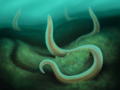 |
Petalonamae
| Genus | Species | Notes | Images |
|---|---|---|---|
| Arborea1 |
|
Sessile arboreomorph organism. | |
| Aninoides31 |
|
Sessile rangeomorph organism. | |
| Beothukis1 |
|
Sessile rangeomorph organism. | |
| Bradgatia1 |
|
Sessile rangeomorph organism. |  |
| Broccoliforma1 |
|
Sessile rangeomorph organism. | |
| Charnia51 |
|
Sessile rangeomorph organism. |  |
| Charniodiscus1 |
|
Sessile arboreomorph organism. |  |
| Fractofusus1 |
|
Sessile spindle-like rangeomorph organism. |  |
| Frondophyllas1 |
|
Sessile tree-like rangeomorph organism. | |
| Pectinifrons1 |
|
Sessile comb-like rangeomorph organism. | |
| Phyllozoon1 |
|
Sessile erniettomorph organism, first recorded appearance outside of Australia. | |
| Plumeropriscum1 |
|
Sessile rangeomorph organism. | |
| Primocandelabrum1 |
|
Sessile feather-duster rangeomorph organism. |  |
| Trepassia1 |
|
Sessile rangeomorph organism. |
incertae sedis
| Genus | Species | Notes | Images |
|---|---|---|---|
| Aspidella1 |
|
Enigmatic discoidal fossil. |  |
| Hadrynichorde1 |
|
Sea Whip-like frondose organism. | |
| Hiemalora1 |
|
Discoid organism, possibly holdfasts of petalonamids. |
Ivesheadiomorphs
| Genus | Species | Notes | Images |
|---|---|---|---|
| Ivesheadia1 |
|
Poorly preserved organism. |
Ichnogenera
| Genus | Species | Notes | Images |
|---|---|---|---|
| Helminthoidichnites1 |
|
Burrows. |
References
References
- McIlroy, D.; Denyszyn, S.; Olschewski, P.; Rosse-Guillevic, S.; Muirhead-Hunt, H.; Pérez-Pinedo, D.; McKean, C.; Pasinetti, G.; Rideout, B.; Steele, M.P.; Menon, L.R.; Neville, J.M.; Chida, N.; Taylor, R.S. (29 January 2026). "Ediacaran endlings from the Avalon Assemblage and the severity of the Kotlin Crisis: First documentation of the Inner Meadow Lagerstätte, Newfoundland, Canada". Geology. doi:10.1130/G54217.1.
- Foss, Kelly (14 June 2023). "Backyard treasure". Gazette - Memorial University of Newfoundland. Retrieved 30 January 2026.
- Rosse‐Guillevic, Simon; Muirhead‐Hunt, Heléna; McIlroy, Duncan (November 2025). "Aninoides: a new rangeomorph genus from the upper Ediacaran of Newfoundland". Papers in Palaeontology. 11 (6). doi:10.1002/spp2.70061.
- Pelley, Chad (30 January 2026). "Digging up history". Gazette - Memorial University of Newfoundland.
- McIlroy, D.; Pérez-Pinedo, D.; Rosse-Guillevic, S.; Muirhead-Hunt, H.; Taylor, R.S.; Dufour, S.C. (December 2025). "Growth and disparity of form in the Ediacaran genus Charnia, with description of Charnia brasieri sp. nov. from the Ediacaran of Avalonia". Precambrian Research. 431 107947. doi:10.1016/j.precamres.2025.107947.
- Chida, Nagi; Olschewski, Pascal; McKean, Christopher; Corlett, Hilary J.; Rosse‐Guillevic, Simon; Taylor, Rod S.; McIlroy, Duncan (6 April 2026). "Hemispherical MISS caused by gas‐trapping: Examples from the Trepassey and Fermeuse formations (Ediacaran) of Newfoundland". Sedimentology. doi:10.1111/sed.70107.
- Giles, Kea (February 26, 2026). "Exceptionally preserved 551-million-year-old site suggests Avalon biota lasted longer". Phys.org. Retrieved 2 March 2026.
- Brown, T.B. (13 March 2026). "Earth's first major extinction was worse than we thought". www.science.org. Retrieved 7 April 2026.