| Iniidae | |
|---|---|
| |
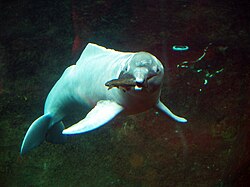
| An Amazon river dolphin at Duisburg Zoo holding an Armored catfish in the mouth. | |

| |
| Size compared to an average human | |
Scientific classification 
| |
| Kingdom: | Animalia |
| Phylum: | Chordata |
| Class: | Mammalia |
| Infraclass: | Placentalia |
| Order: | Artiodactyla |
| Infraorder: | Cetacea |
| Superfamily: | Inioidea |
| Family: | Iniidae Gray, 1846 |
| Genera | |
Iniidae is a family of river dolphins containing one living genus, Inia, and four extinct genera. The living genus lives in the river basins of South America, but the family formerly had a wider presence across the Atlantic Ocean.
Iniidae are highly morphologically different from marine dolphins due to adaptations suited to their freshwater river habitat.1 They display high amounts of sexual dimorphism through color and size.2 Seasonal movement between flooded plains and rivers is common, due to the variation of seasonal rain.3 There has been little research done on the family, in particular the species aside from the Amazon river dolphin.2
Evolution
The South American river basins were flooded by marine waters during the mid-Miocene era, creating a new brackish habitat that allowed marine mammals to move into them. Marine animals that could tolerate the osmotic difference in the salt and freshwater systems permeated these habitats and adapted. Over time, the sea level began to recede, trapping the mammals within the continent in the river basins.1
Morphology
Because their cervical vertebra are movable, the necks of Iniidae are flexible; this makes them unlike most whales, dolphins, and porpoises, which have fused neck vertebrae, rigidly aiming their heads forward.4 The Iniidae have other morphology common to species adapted to freshwater river habitats,5 including highly reduced or absent dorsal fins, which helps them avoid entanglement in vegetation from the flooded terrestrial plains, and large, wide, paddle-like pectoral fins that allow maneuverability in confined areas cramped by vegetation.4 Other adaptations including a long rostrum, skull, and jaw, and reduced orbits.6
Iniidae share other characteristics with their marine toothed whale relatives. Their stomachs include a fore-stomach, a single-chambered main stomach, and a pyloric stomach with connecting channels. They also share similarities with their marine ancestors in terms of lung shape, the position of the diaphragm, the position of the blowhole toward the back of the head, and the structure of the tympanic bulla. Iniidae have lost their fur and lack true vocal cords.7
Iniidae dolphins develop multiple sets of teeth, including small conical teeth that differ slightly in the front of the mouth. The teeth extend lingually in the back, and in the front have a small depression on each side. These mammals are carnivorous, finding prey via echolocation.
Speciation
There is scientific debate on the number of species within the genus Inia. The main issue is whether there are two or three (or even four) species, or whether any of them should be considered sub-species. According to some researchers, Inia geoffrensis, Inia humboldtiana, and Inia boliviensis are three separate species, while many consider I. geoffrensis and I. boliviensis to be the only two.893 Martin (2004) found evidence that genetic exchange occurs at multiple sites on the Amazon, even places hundreds of kilometres apart.10
Taxonomy
The family was described by John Edward Gray in 1846.11
Current classifications include a single living genus, Inia, with one to four species and several subspecies.1213 The family also includes three extinct genera described from fossils found in South America, Florida, Libya, and Italy.11
- Superfamily Inioidea
- Family Iniidae
- Genus †Goniodelphis
- G. hudsoni
- Genus Inia
- Inia araguaiaensis - Araguaian river dolphin
- Inia boliviensis - Bolivian river dolphin
- Inia geoffrensis - Amazon river dolphin
- Inia humboldtiana - Orinoco river dolphin
- Genus †Isthminia
- Genus †Meherrinia
- Genus †Ischyrorhynchus (syn. Anisodelphis)
- I. vanbenedeni (syn. Anisodelphis brevirostratus)
- Genus †Saurocetes (syn. Saurodelphis, Pontoplanodes)
- S. argentinus (syn. Pontoplanodes obliquus)
- S. gigas
- Genus †Goniodelphis
- Family Iniidae
References
References
- Hamilton, Healy; et al. (2001). "Evolution of river dolphins". Proceedings of the Royal Society of London B: Biological Sciences. 268 (1466): 549–556. doi:10.1098/rspb.2000.1385. PMC 1088639. PMID 11296868.
- Martin, A.R.; Silva, V.M. (2006). "Sexual dimorphism and body scarring in the boto (Amazon river dolphin) Inia geoffrensis". Marine Mammal Science. 22 (1): 25–33. Bibcode:2006MMamS..22...25M. doi:10.1111/j.1748-7692.2006.00003.x.
- Rice, Dale W. (1998). Marine Mammals of the World: Systematics and distribution. Society for Marine Mammalogy Special Publication. Vol. 4. Lawrence, KS: Society for Marine Mammalogy. pp. 1–231. ISBN 978-1-891276-03-3. ISBN 1891276034
- Gomez-Salazar, C. (2011). "Photo-identification: A reliable and noninvasive tool for studying pink river dolphins (Inia geoffrensis)". Aquatic Mammals. 37 (4): 472–485. Bibcode:2011AqMam..37..472G. doi:10.1578/am.37.4.2011.472.
- Gutstien, Carolina (2014). "The antiquity of riverine adaptations in Iniidae (Cetacea, Odontoceti) documented by a humerus from the Late Miocene of the Ituzaingo Formation, Argentina". The Anatomical Record. 297 (6): 1096–1102. doi:10.1002/ar.22901. PMID 24585575. S2CID 42361824.
- Pyenson, N.D.; Vélez-Juarbe, J.; Gutstein, C.S.; Little, H.; Vigil, D.; O'Dea, A. (1 September 2015). "Isthminia panamensis, a new fossil Inioid (Mammalia, Cetacea) from the Chagres Formation of Panama and the evolution of 'river dolphins' in the Americas". PeerJ. 3 e1227. PeerJ Inc. doi:10.7717/peerj.1227. PMC 4562255. PMID 26355720.
- Kaiya, Zhou (1982). "Classification and phylogeny of the superfamily Platanistoidea, with notes on evidence of the monophyly of the Cetacea". Sci. Rep. Whale Res. Inst. 34: 93–108.
- Gravena, Waleska; et al. (2014). "Looking to the past and the future: Were the Madeira River rapids a geographical barrier to the boto (Cetacea: Iniidae)?". Conservation Genetics. 15 (3): 619–629.
- Ruiz-García, M.; Banguera, E.; Cardenas, H. (2006). "Morphological analysis of three Inia (Cetacea: Iniidae) populations from Colombia and Bolivia". Acta Theriologica. 51 (4): 411–426. doi:10.1007/bf03195188. S2CID 22868836.
- Martin, A. R.; da Silva, V. M. F. (2004). "River dolphins and flooded forest: seasonal habitat use and sexual segregation of botos ( Inia geoffrensis ) in an extreme cetacean environment". Journal of Zoology. 263 (3): 295–305. doi:10.1017/S095283690400528X. ISSN 0952-8369.
- "Inia taxon description". The Paleobiology Database. Archived from the original on 2012-10-12. Retrieved 2022-09-21.
- Hrbek, Tomas; da Silva, Vera Maria Ferreira; Dutra, Nicole; Gravena, Waleska; Martin, Anthony R.; Farias, Izeni Pires (2014-01-22). "A new species of river dolphin from Brazil or: How little do we know our biodiversity?". PLOS ONE. 9 (1) e83623. Bibcode:2014PLoSO...983623H. doi:10.1371/journal.pone.0083623. PMC 3898917. PMID 24465386.
-
- "Inia boliviensis (id=1006455)". ASM Mammal Diversity Database. American Society of Mammalogists. Retrieved 2026-02-03.
- "Inia humboldtiana (id=1006502)". ASM Mammal Diversity Database. American Society of Mammalogists. Retrieved 2026-02-03.
- "Inia araguaiaensis (id=1006454)". ASM Mammal Diversity Database. American Society of Mammalogists. Retrieved 2026-02-03.
- "Inia geoffrensis (id=1006456)". ASM Mammal Diversity Database. American Society of Mammalogists. Retrieved 2026-02-03.