


An incunable or incunabulum (pl.: incunables or incunabula, respectively) is a book, pamphlet, or broadside that was printed in the earliest stages of printing in Europe, up to the year 1500.1 The specific date is essentially arbitrary, but the number of printed book editions exploded in the following century, so that all incunabula, produced before the printing press became widespread in Europe, are rare, where even some early 16th-century books are relatively common.
They are distinct from manuscripts, which are documents written by hand. Some authorities on the history of printing include block books from the same time period as incunabula, whereas others limit the term to works printed using movable type.
As of 2021, there are about 30,000 distinct incunable editions known.2 The probable number of surviving individual copies is much higher, estimated at 125,000 in Germany alone.3 Through statistical analysis, it is estimated that the number of lost editions is at least 20,000.4 Around 550,000 copies of around 27,500 different works have been preserved worldwide.5
Terminology
Incunable is the anglicised form of incunabulum,6 reconstructed singular of Latin incunabula,7 which meant "swaddling clothes", or "cradle",8 which could metaphorically refer to "the earliest stages or first traces in the development".9 A former term for incunable is fifteener, meaning "fifteenth-century edition".10
The term incunabula was first used in the context of printing by the Dutch physician and humanist Hadrianus Junius (Adriaen de Jonghe, 1511–1575), in a passage in his work Batavia (written in 1569; published posthumously in 1588). He referred to a period "inter prima artis [typographicae] incunabula" ("in the first infancy of the typographic art").1112 The term has sometimes been incorrectly attributed to Bernhard von Mallinckrodt (1591–1664), in his Latin pamphlet De ortu ac progressu artis typographicae ("On the rise and progress of the typographic art"; 1640), but he was quoting Junius.1314
The term incunabula came to denote printed books themselves in the late 17th century.15 It is not found in English before the mid-19th century.9
Junius set an end-date of 1500 to his era of incunabula, which remains the convention in modern bibliographical scholarship.1112 This convenient but arbitrary end-date for identifying a printed book as an incunable does not reflect changes in the printing process, and many books printed for some years after 1500 are visually indistinguishable from incunables. The term "post-incunable" is now used to refer to books printed after 1500 up to 1520 or 1540, without general agreement. From around this period the dating of any edition becomes easier, as the practice of printing the place and year of publication using a colophon or on the title page became more widespread.16
Types
There are two types of printed incunabula: the block book, printed from a single carved or sculpted wooden block for each page (the same process as the woodcut in art, called xylographic); and the typographic book, made by individual cast-metal movable type pieces on a printing press. Many authors reserve the term "incunabula" for the latter.17
The spread of printing to cities both in the North and in Italy ensured that there was great variety in the texts and the styles which appeared. Many early typefaces were modelled on local writing or derived from various European Gothic scripts, but there were also some derived from documentary scripts like Caxton's, and, particularly in Italy, types modelled on handwritten scripts and calligraphy used by humanists.
Printers congregated in urban centres where there were scholars, ecclesiastics, lawyers, and nobles and professionals who formed their major customer base. Standard works in Latin inherited from the medieval tradition formed the bulk of the earliest printed works, but as books became cheaper, vernacular works (or translations into vernaculars of standard works) began to appear.
Famous examples

Famous incunabula include two from Mainz, the Gutenberg Bible of 1455 and the Peregrinatio in terram sanctam of 1486, printed and illustrated by Erhard Reuwich; the Nuremberg Chronicle written by Hartmann Schedel and printed by Anton Koberger in 1493; and the Hypnerotomachia Poliphili printed by Aldus Manutius with important illustrations by an unknown artist.18
Other printers of incunabula were Günther Zainer of Augsburg, Johannes Mentelin and Heinrich Eggestein of Strasbourg, Heinrich Gran of Haguenau, Johann Amerbach of Basel, William Caxton of Bruges and London, and Nicolas Jenson of Venice. The first incunable to have woodcut illustrations was Ulrich Boner's Der Edelstein, printed by Albrecht Pfister in Bamberg in 1461.19
A finding in 2015 brought evidence of quires, as claimed by research, possibly printed in 1444–1446 and possibly assigned to Procopius Waldvogel of Avignon, France.20
Post-incunable
Many incunabula are undated, needing complex bibliographical analysis to place them correctly. The post-incunabula period marks a time of development during which the printed book evolved fully as a mature artefact with a standard format.21 After about 1540 books tended to conform to a pattern that included the author, title-page, date, seller, and place of printing. This makes it much easier to identify any particular edition.16
As noted above, the end date for identifying a printed book as an incunable is convenient but was chosen arbitrarily; it does not reflect any notable developments in the printing process around the year 1500. Books printed for a number of years after 1500 continued to look much like incunables, with the notable exception of the small format books printed in italic type introduced by Aldus Manutius in 1501. The term post-incunable is sometimes used to refer to books printed "after 1500—how long after, the experts have not yet agreed."22 For books printed in England, the term generally covers 1501–1520, and for books printed in mainland Europe, 1501–1540.23
One notable example from this period is Hakob Meghapart (Hagop Meghapart), who in 1512 became the first known printer of Armenian books. Working in Venice, he published Urbatagirk (The Book of Friday) and several other early Armenian printed works. His books retained characteristics of manuscript tradition, including red and black ink and decorative initials, aligning them stylistically with incunabula despite being post-incunable by definition.
Statistical data
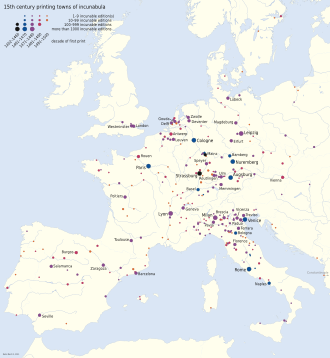


The data in this section were derived from the Incunabula Short-Title Catalogue (ISTC).24
The number of printing towns and cities stands at 282. These are situated in some 18 countries in terms of present-day boundaries. In descending order of the number of editions printed in each, these are: Italy, Germany, France, Netherlands, Switzerland, Spain, Belgium, England, Austria, the Czech Republic, Portugal, Poland, Sweden, Denmark, Turkey, Croatia, Serbia, Montenegro, and Hungary (see diagram).
The following table shows the 20 main 15th-century printing locations; as with all data in this section, exact figures are given, but should be treated as close estimates (the total editions recorded in ISTC at August 2016 is 30,518):
| Town or city | No. of editions | % of ISTC recorded editions |
|---|---|---|
| Venice25 | 3,549 | 12.5 |
| Paris26 | 2,764 | 9.7 |
| Rome27 | 1,922 | 6.8 |
| Cologne28 | 1,530 | 5.4 |
| Lyon29 | 1,364 | 4.8 |
| Leipzig30 | 1,337 | 4.7 |
| Augsburg31 | 1,219 | 4.3 |
| Strasbourg32 | 1,158 | 4.1 |
| Milan33 | 1,101 | 3.9 |
| Nuremberg34 | 1,051 | 3.7 |
| Florence | 801 | 2.8 |
| Basel | 786 | 2.8 |
| Deventer | 613 | 2.2 |
| Bologna | 559 | 2.0 |
| Antwerp | 440 | 1.5 |
| Mainz | 418 | 1.5 |
| Ulm | 398 | 1.4 |
| Speyer | 354 | 1.2 |
| Pavia | 337 | 1.2 |
| Naples | 323 | 1.1 |
| TOTAL | 22,024 | 77.6 |
The 18 languages that incunabula are printed in, in descending order, are: Latin, German, Italian, French, Dutch, Spanish, English, Hebrew, Catalan, Czech, Greek, Church Slavonic, Portuguese, Swedish, Breton, Danish, Frisian and Sardinian (see diagram).
Only about one edition in ten (i.e. just over 3,000) has any illustrations, woodcuts or metalcuts.
The "commonest" incunable is Schedel's Nuremberg Chronicle ("Liber Chronicarum") of 1493, with about 1,250 surviving copies (which is also the most heavily illustrated). Many incunabula are unique, but on average about 18 copies survive of each. This makes the Gutenberg Bible, at 48 or 49 known copies, a relatively common (though extremely valuable) edition. Counting extant incunabula is complicated by the fact that most libraries consider a single volume of a multi-volume work as a separate item, as well as fragments or copies lacking more than half the total leaves. A complete incunable may consist of a slip, or up to ten volumes.35
In terms of format, the 30,000-odd editions comprise: 2,000 broadsides, 9,000 folios, 15,000 quartos, 3,000 octavos, 18 12mos, 230 16mos, 20 32mos, and 3 64mos.
Apart from migration to mainly North American and Japanese universities, there has been little movement of incunabula in the last five centuries. None were printed in the Southern Hemisphere, and the latter appears to possess fewer than 2,000 copies, while about 97.75% remain north of the equator. However, many incunabula are sold at auction or through the rare book trade every year.
Major collections
The British Library's Incunabula Short Title Catalogue now records over 29,000 titles, of which around 27,400 are incunabula editions (not all unique works). Studies of incunabula began in the 17th century. Michel Maittaire (1667–1747) and Georg Wolfgang Panzer (1729–1805) arranged printed material chronologically in annals format, and in the first half of the 19th century, Ludwig Hain published the Repertorium bibliographicum—a checklist of incunabula arranged alphabetically by author: "Hain numbers" are still a reference point. Hain was expanded in subsequent editions, by Walter A. Copinger and Dietrich Reichling, but it is being superseded by the authoritative modern listing, a German catalogue, the Gesamtkatalog der Wiegendrucke, which has been under way since 1925 and is still being compiled at the Staatsbibliothek zu Berlin. North American holdings were listed by Frederick R. Goff and a worldwide union catalogue is provided by the Incunabula Short Title Catalogue.36
Notable collections with more than 1,000 incunabula include:
See also
See also
References
References
- Greenfield, Jane (2002). ABC of bookbinding: a unique glossary with over 700 illustrations for collectors and librarians. New Castle (Del.) Nottingham (GB): Oak Knoll press The Plough press. p. 37. ISBN 978-1-884718-41-0.
- The British Library Incunabula Short Title Catalogue (retrieved 16 August 2021) gives 30,518 editions, though this includes some which have been re-dated to the early 16th century. Archived 12 March 2011 at the Wayback Machine.
- According to Bettina Wagner: "Das Second-Life der Wiegendrucke. Die Inkunabelsammlung der Bayerischen Staatsbibliothek", in Griebel, Rolf; Ceynowa, Klaus (eds.): "Information, Innovation, Inspiration. 450 Jahre Bayerische Staatsbibliothek", K G Saur, Munich 2008, ISBN 978-3-598-11772-5, pp. 207–224 (207f.) the Incunabula Short Title Catalogue lists 30,375 titles published before 1501.
- J. Green, F. McIntyre, P. Needham (2011), "The Shape of Incunable Survival and Statistical Estimation of Lost Editions", Papers of the Bibliographical Society of America 105 (2), pp. 141–175. doi:https://doi.org/10.1086/680773
- Badische Landes-Bibliothek (in German)
- As late as 1891 Rogers in his technical glossary recorded only the form incunabulum: Rogers, Walter Thomas (1891). A Manual of Bibliography (2nd ed.). London: H. Grevel. p. 195.
- The word incunabula is a neuter plural only; the singular incunabulum is never found in Latin, and is no longer used in English by most bibliographers.
- C. T. Lewis and C. Short, A Latin Dictionary, Oxford 1879, p. 930.
- "incunabula". Oxford English Dictionary (Online ed.). Oxford University Press. (Subscription or participating institution membership required.)
- "Fifteener" was coined by bibliographer Thomas Frognall Dibdin, a term endorsed by William Morris and Robert Proctor. (Carter & Barker 2004, p. 130).
- Hadrianus Iunius, Batavia, [...], [Lugduni Batavorum], ex officina Plantiniana, apud Franciscum Raphelengium, 1588, p. 256, line 3.
- Glomski, J. (2001). "Incunabula Typographiae: seventeenth-century views on early printing". The Library. 2 (4): 336. doi:10.1093/library/2.4.336.
- Bernardus a Mallinkrot, De ortu ac progressu artis typographicae dissertatio historica, [...], Coloniae Agrippinae, apud Ioannem Kinchium, 1640 (in frontispiece: 1639), p. 9, line 16. The term appears within a long passage of several pages (pp. 27–33; corresponding to Batavia, pp. 253–58), set in italics to indicate a quotation, and attributed to Junius.
- Sordet, Yann (2009). "Le baptême inconscient de l'incunable: non pas 1640 mais 1569 au plus tard". Gutenberg Jahrbuch (in French). 84: 102–105.
- "incunabula | printing | Britannica". www.britannica.com. Retrieved 26 October 2022.
- Walsby & Kemp 2011, p. viii.
- Oxford Companion to the Book, ed. M. F. Suarez and H. R. Woudhuysen, OUP, 2010, s.v. 'Incunabulum', p. 815.
- Mansueto, Donato; Calogero, Elena Laura (2007). The Italian Emblem: A Collection of Essays. Librairie Droz. ISBN 978-0-85261-832-5.
- Daniel De Simone (ed), A Heavenly Craft: the Woodcut in Early Printed Books, New York, 2004, p. 48.
- "Was this Jewish prayer book printed before the Gutenberg Bible?". The Forward. 13 October 2022. Retrieved 1 May 2026.
- Walsby, Malcolm; Kemp, Graeme, eds. (2011). The Book Triumphant: Print in Transition in the Sixteenth and Seventeenth Centuries. Brill. p. viii. ISBN 978-90-04-20723-3.
- Carter, John; Barker, Nicolas (2004). ABC for Book Collectors (8th ed.). New Castle, Del.: Oak Knoll Press and the British Library. p. 172. ISBN 1-58456-112-2. Archived from the original (PDF) on 21 November 2017. Retrieved 28 May 2010.

- Carter & Barker 2004, p. 172.
- BL.uk, consulted in 2007. The figures are subject to slight change as new copies are reported. Exact figures are given but should be treated as close estimates; they refer to extant editions. Archived 12 March 2011 at the Wayback Machine.
- "Index: Place of Publication: Venice", Incunabula Short Title Catalogue, retrieved 3 December 2017
- "Index: Place of Publication: Paris", Incunabula Short Title Catalogue, retrieved 3 December 2017
- "Index: Place of Publication: Rome", Incunabula Short Title Catalogue, retrieved 3 December 2017
- "Index: Place of Publication: Cologne", Incunabula Short Title Catalogue, retrieved 3 December 2017
- "Index: Place of Publication: Lyons", Incunabula Short Title Catalogue, retrieved 3 December 2017
- "Index: Place of Publication: Leipzig", Incunabula Short Title Catalogue, retrieved 3 December 2017
- "Index: Place of Publication: Augsburg", Incunabula Short Title Catalogue, retrieved 3 December 2017
- "Index: Place of Publication: Strassburg", Incunabula Short Title Catalogue, retrieved 3 December 2017
- "Index: Place of Publication: Milan", Incunabula Short Title Catalogue, retrieved 3 December 2017
- "Index: Place of Publication: Nuremberg", Incunabula Short Title Catalogue, retrieved 3 December 2017
- "What Are Incunables? - YTread". youtuberead.com. Retrieved 2 April 2023.
- "ISTC". Archived from the original on 18 November 2021. Retrieved 16 May 2009.
- "Incunabula". Bayerische Staatsbibliothek. Retrieved 18 January 2023.
- "Early Printed Books". British Library. Archived from the original on 23 December 2019. Retrieved 18 January 2023.
- "Les Incunables". Bibliothèque nationale de France. Retrieved 7 September 2013.
- "All catalogues". Vatican Library. Retrieved 21 May 2013.
{{cite web}}: CS1 maint: deprecated archival service (link) - "2021 Jahresbericht" (PDF). Österreichische Nationalbibliothek. p. 53. Archived from the original (PDF) on 4 February 2023. Retrieved 18 January 2023.
- А.В. Лихоманова; Н.В. Николаев, eds. (2015). Путеводитель по фондам Отдела редких книг Российской национальной библиотеки. Санкт-Петербург: РНБ. p. 3. ISBN 978-5-8192-0483-2.
- "WLB in Zahlen 2021". Württembergische Landesbibliothek. Retrieved 18 January 2023.
- "Rare Books in Western Languages". Bodleian Library, University of Oxford. Retrieved 18 January 2023.
- "Rare Books and Special Collections: Europe". Library of Congress. Retrieved 3 September 2020.
- Выставочный проект На благое просвещение: Румянцевский музей, Московский период, Индрик, 2005, ISBN 978-5-85759-308-0
- "Early Printed Books and Printing History". The Huntington. The Huntington Library, Art Museum, and Botanical Gardens. Retrieved 3 September 2020.
- "Incunabula". Cambridge University Library. 10 October 2018. Retrieved 18 January 2023.
- "Biblioteca nazionale di Napoli "Vittorio Emanuele III"" (in Italian). Ministero per i beni e le attività culturali e per il turismo. Retrieved 3 September 2020.
- "Rare Books". Royal Danish Library. Retrieved 12 January 2021.
- "Guide to Special Collections: Printed books". The University of Manchester Library. Retrieved 12 January 2021.
- "Zahlen und Fakten" (in German). Staatsbibliothek zu Berlin. Archived from the original on 19 January 2021. Retrieved 18 January 2023.
- Whitesell, David (2006). First supplement to James E. Walsh's Catalogue of the fifteenth-century printed books in the Harvard University Library. Cambridge, Mass.: Houghton Library. p. xiii. ISBN 978-0-674-02145-7. OCLC 71691077.
- "Incunabula". National Library of the Czech Republic. Retrieved 18 January 2023.
- "La Biblioteca – Informazioni generali – Patrimonio librario" (in Italian). Biblioteca Nazionale Centrale di Firenze. Archived from the original on 18 July 2011. Retrieved 7 March 2011.
- "DRUCKE" (in German). Universitätsbibliothek Leipzig. Retrieved 3 September 2020.
- "The Jagiellonian University Library Collection". Biblioteka Jagiellońska. 31 December 2009. Archived from the original on 7 June 2011. Retrieved 7 March 2011.
- "Historic collections in figures". Universitätsbibliothek der LMU München. Retrieved 3 September 2020.
- "The State Library in Numbers". Bamberg State Library. Retrieved 3 September 2020.
- "Herzog August Library – Inkunabeln -Bestandsgeschichte" (in German). Archived from the original on 15 September 2015. Retrieved 3 September 2020.
- "The University Library in figures". Universitätsbibliothek Freiburg. Retrieved 3 September 2020.
- "Old Prints Department - Collections". bu.uni.wroc.pl. Retrieved 18 January 2023.
- "Biblioteca Nacional de España – Colecciones – Incunables" (in Spanish). Biblioteca Nacional de España. 11 March 2011. Retrieved 3 September 2020.
- "Inkunabeln und Seltene Drucke" (in German). Niedersächsische Staats- und Universitätsbibliothek Göttingen. Retrieved 3 September 2020.
- "Die Inkunabelsammlung der UB". Universitätsbibliothek Würzburg. Retrieved 3 September 2020.
- "Official Website of Palatina Library". Archived from the original on 13 September 2022. Retrieved 8 April 2023.
- "Alte Drucke" (in German). UB Basel. Retrieved 3 September 2020.
- "Patrimonio librario" (in Italian). Biblioteca Nazionale Marciana. 22 November 2010. Retrieved 3 September 2020.
- "Handschriften und Inkunabeln" (in German). Universitätsbibliothek Johann Christian Senckenberg. Retrieved 3 September 2020.
- "The Incunable Collection". Archived from the original on 14 April 2021. Retrieved 4 September 2020.
- "COLLECTIONS". Biblioteca comunale dell'Archiginnasio. Retrieved 4 September 2020.
- "Incunables" (in French). Bibliothèque Mazarine. Retrieved 4 September 2020.
- "Official Website of Braidense National Library".
- "Inkunabeln" (in German). Universitäts- und Stadtbibliothek Köln. Retrieved 3 September 2020.
- "Les collections" (in French). Les Dominicains – Bibliothèque patrimoniale Jacques Chirac. Retrieved 4 September 2020.
- "History of the Book". The Newberry. Retrieved 4 September 2020.
- "Official Website of Casanatense Library".
- "Incunables (printed works, until 1501)". KB. Archived from the original on 15 April 2021. Retrieved 3 September 2020.
- "Inkunabeln (Wiegendrucke)" (in German). Universitätsbibliothek Tübingen. Retrieved 3 September 2020.
- "Inkunabeln & Blockbücher" (in German). Universitäts- und Landesbibliothek Tirol. Archived from the original on 25 September 2020. Retrieved 3 September 2020.
- "Les incunables" (in French). Bibliothèque nationale et universitaire de Strasbourg. Retrieved 9 January 2020.
- "Inkunabeln" (in German). Stadtbibliothek Nürnberg. Retrieved 3 September 2020.
- "Official Website of the Library".
- "Inkunabeln" (in German). Universitätsbibliothek Erlangen-Nürnberg. Archived from the original on 29 September 2020. Retrieved 3 September 2020.
- "Collezioni" (in Italian). Biblioteca nazionale centrale di Roma. 23 December 2016. Archived from the original on 30 June 2020. Retrieved 3 September 2020.
- "Early Printed Books". National Széchényi Library. Retrieved 3 September 2020.
- "Heidelberger Inkunabeln – digital" (in German). Universitätsbibliothek Heidelberg. Retrieved 3 September 2020.
- "Official Website of Estense Library".
- Olivier Jacquot (8 June 2016). "Les incunables de l'Arsenal : un continent à découvrir" (in French). Bibliothèque nationale de France. doi:10.58079/m35t. Retrieved 23 May 2025.
- "Incunaboli" (in Italian). Biblioteca Nazionale Universitaria di Torino. 19 April 2013. Retrieved 3 September 2020.
- "Historische Sammlungen" (in German). Universitäts- und Landesbibliothek Sachsen-Anhalt. Retrieved 3 September 2020.
- "Incunabula". Biblioteca Nacional de Portugal. Retrieved 4 September 2020.
- "Storia e patrimonio" (in Italian). Biblioteca Universitaria di Padova. Retrieved 9 August 2022.
- "Alte Drucke und Rara" (in German). Zentralbibliothek Zürich. Retrieved 3 September 2020.
- "Concise history of the monastic library". Royal Canonry of Premonstratensians at Strahov. Retrieved 16 May 2014.
- "Nos collections" (in French). Bibliothèque Sainte-Geneviève. Retrieved 12 January 2021.
- "Collections, University Archives, Provenance Research" (in German). Universität Salzburg. Retrieved 4 September 2020.
- "Inkunabeln: Bestand" (in German). Badische Landesbibliothek. Retrieved 3 September 2020.
- "Inkunabeln" (in German). Universitäts- und Landesbibliothek Bonn. Retrieved 3 September 2020.
- "Augusta" (in Italian). Biblioteca Augusta. Retrieved 5 January 2024.
- "Catalogo alfabetico per autore degli Incunaboli - INDEX" (in Italian). University Library of Genoa. Retrieved 5 January 2024.
- "Official Website of Trivulziana Library".
- "La BmL en chiffres" (in French). Bibliothèque municipale de Lyon. Retrieved 3 September 2020.
- "Historische Drucke (1450–1830)" (in German). Universitätsbibliothek Eichstätt-Ingolstadt. Retrieved 3 September 2020.
- Roger Catlin (14 November 2014). "Walters Art Museum highlights the bumpy road of publishing, post-Gutenberg". The Washington Post. Retrieved 3 September 2020.
- "Official Website of Verona Municipal Library".
- "Fifteenth Century Printed Books at Bryn Mawr (BMC)". Tri-College Libraries. Retrieved 3 September 2020.
- "Official Website of the Library". Archived from the original on 11 April 2023. Retrieved 11 April 2023.
- "Bestände" (in German). Ratsschulbibliothek Zwickau. Retrieved 3 September 2020.
- "Distinctive Collections". Rare Book & Manuscript Library, University of Illinois. Retrieved 12 January 2021.
- "Starodruki" (in Polish). National Library of Poland. Retrieved 14 June 2024.
- "Incunables de la Biblioteca Colombina" (in Spanish). Institución Colombina. Archived from the original on 23 January 2021. Retrieved 3 September 2020.
- "Official Website of Queriniana Library".
- "Official Website of the Library". Archived from the original on 8 April 2023. Retrieved 8 April 2023.
- "Universitätsbibliothek der Karl-Franzens-Universität Graz: Jahresbericht 2017" (PDF) (in German). Universitätsbibliothek der Karl-Franzens-Universität Graz. 2017. p. 43. Archived from the original (PDF) on 18 January 2021. Retrieved 4 September 2020.
- "Official Website of the Library".
- "Glasgow Incunabula Project: A Catalogue of Fifteenth-century Printed Books in Glasgow". University of Glasgow. Retrieved 12 January 2021.
- "Official Website of University Library of Bologna".
- "Incunabula: Printing in Europe before 1501". Bridwell Library, Perkins School of Theology, Southern Methodist University. Retrieved 12 January 2021.
- "Official Website of the Library".
- "Recherche" (in German). Stiftsbibliothek St. Gallen. Retrieved 3 September 2020.
- "Official Website of the Library". Archived from the original on 8 March 2023. Retrieved 14 April 2023.
- Jensen, Kristian (2003). Incunabula and Their Readers - Printing, Selling and Using Books in the Fifteenth Century. British Library. ISBN 978-0-7123-4769-3.
- "British Library".
External links
External links
- Centre for the History of the Book
- British Library Incunabula Short Title Catalogue. Archived 12 March 2011 at the Wayback Machine.
- Gesamtkatalog der Wiegendrucke (GW), partially English version
- History of Incunabula Studies
- UIUC Rare Book & Manuscript Library
- Grand Valley State University Incunabula & 16th Century Printing digital collections
- Incunable Collection at the US Library of Congress
- Digital facsimiles of several incunabula from the website of the Linda Hall Library. Archived 8 June 2017 at the Wayback Machine.
- Kristian Jensen (2016). "Introduction to the study of incunabula". Lyon: Ecole Nationale Superieure des Sciences de l'information et des Bibliotheques, Institut d'histoire du livre. Archived from the original on 27 November 2017. (Includes annotated bibliography)
- "Rinascimento: Manuscripts & Incunabula". Research Guides. US: Harvard University Library.
- Pollard, Alfred W. (1911). . Encyclopædia Britannica. Vol. 14 (11th ed.). pp. 369–370.
- "An Introduction to Incunabula". Barber, Phil. Retrieved 6 July 2017.