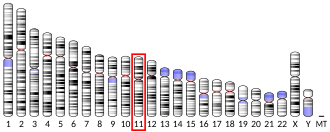



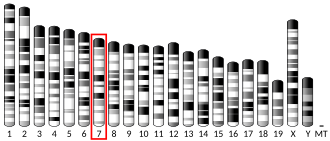

Interferon-induced transmembrane protein 3 (IFITM3) is a protein that in humans is encoded by the IFITM3 gene.567 It plays a critical role in the immune system's defense against Swine Flu, where heightened levels of IFITM3 keep viral levels low, and the removal of IFITM3 allows the virus to multiply unchecked.8 This observation has been further advanced by a recent study from Paul Kellam's lab that shows that a single nucleotide polymorphism in the human IFITM3 gene purported to increase influenza susceptibility is overrepresented in people hospitalised with pandemic H1N1.9 The prevalence of this mutation is thought to be approximately 1/400 in European populations.910
References
References
- GRCh38: Ensembl release 89: ENSG00000142089 – Ensembl, May 2017
- GRCm38: Ensembl release 89: ENSMUSG00000025492 – Ensembl, May 2017
- "Human PubMed Reference:". National Center for Biotechnology Information, U.S. National Library of Medicine.
- "Mouse PubMed Reference:". National Center for Biotechnology Information, U.S. National Library of Medicine.
- Lewin AR, Reid LE, McMahon M, Stark GR, Kerr IM (Aug 1991). "Molecular analysis of a human interferon-inducible gene family". Eur J Biochem. 199 (2): 417–423. doi:10.1111/j.1432-1033.1991.tb16139.x. PMID 1906403.
- Tanaka SS, Yamaguchi YL, Tsoi B, Lickert H, Tam PP (Dec 2005). "IFITM/Mil/fragilis family proteins IFITM1 and IFITM3 play distinct roles in mouse primordial germ cell homing and repulsion". Dev Cell. 9 (6): 745–756. doi:10.1016/j.devcel.2005.10.010. PMID 16326387.
- "Entrez Gene: IFITM3 interferon induced transmembrane protein 3 (1-8U)".
- "Natural swine flu defence found". Archived from the original on December 20, 2009.
- Everitt A.R.; et al. (March 2012). "IFITM3 restricts the morbidity and mortality associated with influenza". Nature. 484 (7395): 519–23. Bibcode:2012Natur.484..519.. doi:10.1038/nature10921. PMC 3648786. PMID 22446628.
- "Gene flaw linked to serious flu risk". BBC News. 25 March 2012.
Further reading
Further reading
- Vaarala MH, Porvari K, Kyllönen A, Vihko P (2000). "Differentially expressed genes in two LNCaP prostate cancer cell lines reflecting changes during prostate cancer progression". Lab. Invest. 80 (8): 1259–1268. doi:10.1038/labinvest.3780134. PMID 10950117.
- Hartley JL, Temple GF, Brasch MA (2001). "DNA cloning using in vitro site-specific recombination". Genome Res. 10 (11): 1788–1795. doi:10.1101/gr.143000. PMC 310948. PMID 11076863.
- Simpson JC, Wellenreuther R, Poustka A, et al. (2001). "Systematic subcellular localization of novel proteins identified by large-scale cDNA sequencing". EMBO Rep. 1 (3): 287–292. doi:10.1093/embo-reports/kvd058. PMC 1083732. PMID 11256614.
- Strausberg RL, Feingold EA, Grouse LH, et al. (2003). "Generation and initial analysis of more than 15,000 full-length human and mouse cDNA sequences". Proc. Natl. Acad. Sci. U.S.A. 99 (26): 16899–16903. Bibcode:2002PNAS...9916899M. doi:10.1073/pnas.242603899. PMC 139241. PMID 12477932.
- Gerhard DS, Wagner L, Feingold EA, et al. (2004). "The status, quality, and expansion of the NIH full-length cDNA project: the Mammalian Gene Collection (MGC)". Genome Res. 14 (10B): 2121–2127. doi:10.1101/gr.2596504. PMC 528928. PMID 15489334.
- Wiemann S, Arlt D, Huber W, et al. (2004). "From ORFeome to biology: a functional genomics pipeline". Genome Res. 14 (10B): 2136–2144. doi:10.1101/gr.2576704. PMC 528930. PMID 15489336.
- Kimura K, Wakamatsu A, Suzuki Y, et al. (2006). "Diversification of transcriptional modulation: large-scale identification and characterization of putative alternative promoters of human genes". Genome Res. 16 (1): 55–65. doi:10.1101/gr.4039406. PMC 1356129. PMID 16344560.
- Mehrle A, Rosenfelder H, Schupp I, et al. (2006). "The LIFEdb database in 2006". Nucleic Acids Res. 34 (Database issue): D415–D418. doi:10.1093/nar/gkj139. PMC 1347501. PMID 16381901.