| Hypsilurus longi | |
|---|---|
Scientific classification 
| |
| Kingdom: | Animalia |
| Phylum: | Chordata |
| Class: | Reptilia |
| Order: | Squamata |
| Suborder: | Iguania |
| Family: | Agamidae |
| Genus: | Hypsilurus |
| Species: | H. longi
|
| Binomial name | |
| Hypsilurus longi (Macleay, 1877)
| |
| Synonyms2 | |
| |
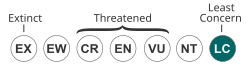
Hypsilurus longi, also known commonly as Long's forest dragon, is a species of lizard in the subfamily Amphibolurinae of the family Agamidae. The species is native to Papua New Guinea.2
Etymology
The specific name, longi, is in honor of Mark H. Long who donated to Macleay the specimen which became the holotype.3: 160
Description
H. longi is large for its genus, and has a long tail. It may attain a snout-to-vent length (SVL) of 23.5 cm (9.3 in), and a tail length three times SVL.2
Habitat
The preferred natural habitat of H. longi is forest, at altitudes from sea level to 500 m (1,600 ft).1
Reproduction
References
References
- Tallowin, O.; Allison, A. (2013). "Hypsilurus longi ". IUCN Red List of Threatened Species. 2013 e.T196554A2459122. doi:10.2305/IUCN.UK.2013-1.RLTS.T196554A2459122.en. Retrieved 20 November 2021.
- Hypsilurus longi at the Reptarium.cz Reptile Database. Accessed 2018-10-31.
- Beolens, B.; Watkins, M.; Grayson, M. (2011). The Eponym Dictionary of Reptiles. Baltimore: Johns Hopkins University Press. pp. xiii + 296. ISBN 978-1-4214-0135-5.
Further reading
Further reading
- Macleay, William (1877). "The Lizards of the "Chevert" Expedition". Proceedings of the Linnean Society of New South Wales. 2: 60–69, 97–104. (Tiaris Longii, new species, p. 103).
- Manthey, Ulrich; Denzer, Wolfgang (2006). "A revision of the Melanesian-Australian angle head lizards of the genus Hypsilurus (Sauria: Agamidae: Amphibolurinae), with description of four new species". Hamadryad. 30 (1 & 2): 1–40. (Hypsilurus longii, new combination, pp. 14–16, Figures 12–14).
- Shea, G.M. (2008). "Rejection of an Australian distribution of the Solomon Islands agamid lizard Hypsilurus longi (Macleay, 1877)". Hamadryad. 33: 127–129.