| Hypertragulus Temporal range:
| |
|---|---|
| |
Scientific classification 
| |
| Kingdom: | Animalia |
| Phylum: | Chordata |
| Class: | Mammalia |
| Infraclass: | Placentalia |
| Order: | Artiodactyla |
| Family: | †Hypertragulidae |
| Genus: | †Hypertragulus Cope, 1874 |
| Species | |
|
See text | |
| |
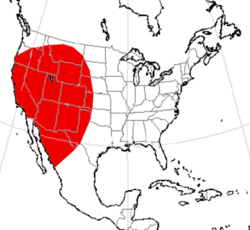
| Range of Hypertragulus based on fossil record | |
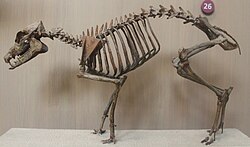
Hypertragulus is an extinct genus of hypertragulid ruminant endemic to North America. It lived from the Late Eocene to the Middle Miocene, living 37.2 to 16 million years ago, existing for approximately 21.2 million years.1
Hypertragulus were primitive and ancient ruminants, resembling small deer or musk deer, although they were more closely related to modern chevrotains. Its diet is stated to be that of a frugivore.
Species
- H. calcaratus
- H. chadronensis
- H. crawfordensis
- H. dakotensis
- H. heikeni
- H. hesperius
- H. minor
- H. minutus
- H. planiceps
- H. quadratus
- H. sequens
Fossil distribution
A partial list of fossil sites:
- Chihuahua, Mexico
- Cedar Creek Formation (Lower & Middle), Logan County, Colorado
- Fort Logan Formation, Meagher County, Montana
- Upper Pomerado Conglomerate Formation, San Diego County, California
- Turtle Cove Member of the John Day Formation, Grant County, Oregon
Palaeoecology
Because its fossils are found predominantly in semiarid palaeosols, it is believed that Hypertragulus hesperius primarily inhabited semiarid biomes.2
References
References
- PaleoBiology Database: Hypertragulus
- Retallack, Gregory J.; Samuels, Joshua X. (2 January 2020). "Paleosol-based inference of niches for Oligocene and early miocene fossils from the John Day Formation of Oregon". Journal of Vertebrate Paleontology. 40 (1) e1761823. doi:10.1080/02724634.2019.1761823. ISSN 0272-4634. Retrieved 12 October 2025 – via Taylor and Francis Online.