| Hydrangeaceae | |
|---|---|

| |
| Hydrangea macrophylla, a member of the subfamily Hydrangeoideae | |

| |
| Fendlera rupicola, a member of the subfamily Jamesioideae | |
Scientific classification 
| |
| Kingdom: | Plantae |
| Clade: | Embryophytes |
| Clade: | Tracheophytes |
| Clade: | Spermatophytes |
| Clade: | Angiosperms |
| Clade: | Eudicots |
| Clade: | Asterids |
| Order: | Cornales |
| Family: | Hydrangeaceae Dumort.1 |
| Genera | |
| Synonyms2 | |
| |
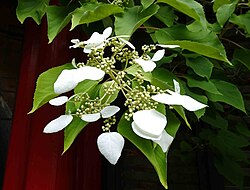
Hydrangeaceae is a family of flowering plants in the order Cornales, with a wide distribution in Asia and North America, and locally in southeastern Europe.3
Description
The genera are characterised by leaves in opposite pairs (rarely whorled or alternate), and regular, bisexual flowers with four (rarely 5–12) petals. The fruit is a capsule or berry containing several seeds, the seeds with a fleshy endosperm.4
Genera
The following genera are accepted:5
- Carpenteria Torr.
- Deutzia Thunb.
- Fendlera Engelm. & A.Gray
- Fendlerella A.Heller
- Hydrangea Gronov. ex L.
- Jamesia Torr. & A.Gray
- Kirengeshoma Yatabe
- Philadelphus L.
- Whipplea Torr.
Phylogeny
The family Hydrangeaceae has two subfamilies, namely Jamesioideae and Hydrangeoideae. The subfamily Jamesioideae comprises the genera Jamesia and Fendlera.67 They are the sister group to the remaining Hydrangeaceae.78 The subfamily Hydrangeoideae has two tribes:978 Hydrangeae consists of Hydrangea s.l.,9 and Philadelpheae consists of Philadelphus, Carpenteria, Deutzia, Kirengeshoma, Whipplea, and Fendlerella.78 Carpenteria is the sister group to Philadelphus. Deutzia is the sister group to Kirengeshoma, and Fendlerella is the sister group to Whipplea.867 However the relationships among those three clades within the tribe Philadelphae are a bit unclear.8 The following cladogram summarizes results from different studies, and for each node it is noted which studies support the sister group positions of the following branches:
References
References
- Angiosperm Phylogeny Group (2009). "An update of the Angiosperm Phylogeny Group classification for the orders and families of flowering plants: APG III". Botanical Journal of the Linnean Society. 161 (2): 105–121. doi:10.1111/j.1095-8339.2009.00996.x. hdl:10654/18083.
- "Family: Hydrangeaceae Dumort., nom. cons". Germplasm Resources Information Network. United States Department of Agriculture. 2003-01-17. Retrieved 2012-07-31.
- Christenhusz, M. J. M.; Byng, J. W. (2016). "The number of known plants species in the world and its annual increase". Phytotaxa. 261 (3): 201–217. Bibcode:2016Phytx.261..201C. doi:10.11646/phytotaxa.261.3.1.
- "Hydrangeaceae - FNA". floranorthamerica.org. Retrieved 2023-06-20.
- "Hydrangeaceae Dumort". Plants of the World Online. Board of Trustees of the Royal Botanic Gardens, Kew. Retrieved 30 June 2021.
- Kim, C., Deng, T., Wen, J., Nie, Z. L., & Sun, H. (2015). "Systematics, biogeography, and character evolution of Deutzia (Hydrangeaceae) inferred from nuclear and chloroplast DNA sequences." Molecular Phylogenetics and Evolution, 87, 91-104.
- Hufford, L., Moody, M. L., & Soltis, D. E. (2001). "A phylogenetic analysis of Hydrangeaceae based on sequences of the plastid gene matK and their combination with rbcL and morphological data." International Journal of Plant Sciences, 162(4), 835-846.
- Kubitzki, K. (2013). "Flowering Plants. Dicotyledons: Celastrales, Oxalidales, Rosales, Cornales, Ericales." p. 206. Springer Berlin Heidelberg.
- Samain, M. S., Wanke, S., & Goetghebeur, P. (2010). "Unraveling extensive paraphyly in the genus Hydrangea s.l. with implications for the systematics of tribe Hydrangeeae." Systematic Botany, 35(3), 593-600.