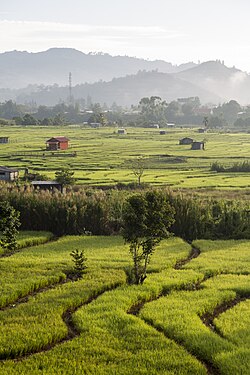
Huminodun is a character in the Nunuk Ragang legend of the Kadazan-Dusun. According to the legend, Huminodun was a maiden sacrificed to feed her famine-stricken people, and her sacrifice became the origin of the Kaamatan harvest festival and the beauty pageant of Unduk Ngadau, celebrated annually in the month of May by the Kadazan-Dusun community in the state of Sabah and the federal territory of Labuan in Malaysia.notes 19101112
The sacrifice story of Huminodun is also considered neither a folklore nor a legend, but more of a religious observance of the Kadazan-Dusun of Sabah and Labuan.13 It forms the origin of the community's earlier religion of Momolianism as well as the basis of rice planting rituals performed by the bobohizan for a continuous bountiful harvest and the significance of rice and ancestral reverence in the traditional beliefs of the Kadazan-Dusun community.123
Attributes and legends
Kinoingan (also referred as Kinorohingan in different sources),1415 the creator deity of the animistic Kadazan,notes 2 and his wife Suminundu (also referred as Sumundu in different sources)16 lived happily together in Pomogunan (mankind's world), and they were divine.81718 His wife created the earth, including the Kadazan-Dusun sacred mountain of Mount Kinabalu, (Gayo Ngaran or Nulu Nabalu), while Kinoingan filled it with the sky, cloud and all above the earth.1920 Together they had two children: a son named Ponompulan and a daughter named Ponompuan.1621 When Ponompulan began to rebel and corrupted the mind and heart of mankind, he was banished forever from Hibabou to his own creation of Kolungkud (equivalent to the underworld) that resulted from his own deeds, and the mankind world where his followers are located was cursed, which subsequently created the worst famine among the Kadazan-Dusun community since the land they lived in became so infertile that it could not grow even a single plant to produce food.42223 To end the curse, their only daughter Ponompuan who was kind-hearted, thoughtful and wise was then named Huminodun (lit. ''transferred sacrifice'') following her pure compassion to request herself to be made a sacrifice. Her father Kinoingan learned that the only way to end the famine was by sacrificing innocent blood, and his daughter Huminodun offered herself willingly.421 She willingly accepted her father's demand as she was determined to save her people from the famine.813 She told her father:
My body will give rise to all sorts of edible plants to feed the people. My flesh will give rise to rice, my head—the coconut, my bones—tapioca, my toes—ginger, my teeth—maize and my knees—yams. Our people will never go hungry again.5621
Following her sacrifice, her community had the most bountiful harvest that year.21 With deep sorrow after losing his most beloved daughter, her father, Kinoingan, went berserk and went to the paddy field, slashing every one of the young plant crops but was stopped when he heard her voice coming from the plants, asking him to stop hurting her further.24 The voice comforted the father by telling him that he would be able to see her again when the rice ripened.24 He must immediately select seven of the tallest stalks and tie them together, cut and bring each of them to their house after harvesting, with one stalk each placed into seven jars, and the jar tops must be covered with tarap (artocarpus odoratissimus) leaves.24 Her father followed everything as instructed, and one day, he and his wife Suminundu heard knocking inside the seven jars, and when they both began to open each of them, seven beautiful maidens, including their daughter, stood out from each jar with their beauty "resembling the sun at its brightest".24 Huminodun had fulfilled her promise when her spirit emerged from the large jar,2 where her bravery, grace, strength and beauty are commemorated through the annual beauty pageant of Unduk Ngadau.2526 It was after her further resurrection in another form called Bambazon (referred to as Bambarayon across Sabah)727 that spiritually rose from the paddy,25 the life of the entire Nunuk Ragang community, as it was then known, began to improve as there was an abundant supply of food.21
The legend is believed to be the origin of Momolianism, a type of indigenous animist-pagan religion.notes 320 It goes on to narrate that the spirit of Huminodun founded the bobohizan as she taught them the art of incantantion, rituals, taboos, law of sogit and customs, including the art of bamboo-beating and the sumazau dance.63233
The Penampang variant of the Nunuk Ragang story
A variation of the main Nunuk Ragang story exists, it has been recognised by the Kadazan Dusun Cultural Association (KDCA).923 According to the story, from among the Tangara (Kadazan) of Penampang, Nunuk Ragang,notes 4 as pointed out by the late Herman Luping,notes 5 begins with two children, a male and a female, who came out from a rock underneath a big tree called Nunuk Ragang. The rock split open at the banks of the Tompios River.3241 The two children's names were Kinoingan and Suminundu, and they were human beings who possessed supernatural powers, who were semi-divine.4142 God the Creator among the Kadazan-Dusun community is known as Minamangun, and it was Suminundu who sacrificed the daughter, not Kinoingan.41
In popular culture
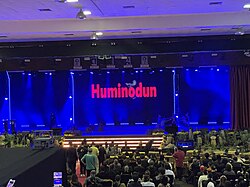
The legend of Huminodun inspired the films of Huminodun, directed and written by Aaron Cowan,434445 and Sinakagon, directed by Timothy Stephen.464748
In the 2025 edition of the Queen's Commonwealth Essay Competition that was organised by the Royal Commonwealth Society (RCS) under the patronage of King Charles III, an essay on Huminodun won first place through the submission by Ferdiana Osmund, a native Sabahan and first-year automotive technology student at the Keningau Vocational College (KVC) at the time.49
See also
See also
- Ceres (mythology), ancient Roman goddess of agriculture, grain crops, fertility, and motherly relationships
- Dewi Sri, Javanese rice goddess
- Phosop, Thai rice goddess
- Thiên Y A Na, Vietnamese goddess
Notes
Notes
- The legend of Huminodun is the root of the annual harvest festival of Kaamatan and the Unduk Ngadau beauty pageant celebrated annually in the month of May by the Kadazan-Dusun community.45678
- The worship of Kinoingan is deeply entrenched among the animistic Kadazan-Dusun community that when the Christian missionaries first came to evangelise them in North Borneo, they borrowed the term "Kinoingan" to denote the Christian God in the translation of the Bible into the Kadazan language.13
- Momolianism is the agama asal (animist-pagan religion) of the Kadazan-Dusun community before embracing Christianity or Islam.728293031
- The Tangara of Penampang and Papar is a Kadazan-Dusun tribe who resists the term "Dusun" once coined by early Chinese and Brunei overlords due to a previous dark history related to the Tagahas Dusun for betrayals during a conflict with Mat Salleh in Tambunan.343536 Similarly, the Lotud Dusun of Tuaran were also against the term of "Kadazan" to referring the Tangaah of Penampang and Papar until the problem of the "Kadazan" and "Dusun" term were settled with the recognition of each other.343738
- Herman Luping was a deputy chief minister of Sabah, lawyer and politician.39 He died on 11 December 2020.40
References
References
- Kok On 2012, p. 75.
- Wilson & Osman 2024, p. 51.
- Gimbad 2020, pp. 12 & 70.
- "Kaamatan, A Celebration of Culture". Sabah Tourism. Archived from the original on 24 April 2025. Retrieved 24 April 2025.
- Ismail, Melissa Suraya (1 June 2022). "Unduk Ngadau, The Beauty Pageant Of The Sabahans". The Rakyat Post. Archived from the original on 1 June 2022. Retrieved 24 April 2025.
- Hong Chieh, Yow (30 May 2024). "What Is Kaamatan and Why Is It Celebrated?". Explore AirAsia. Archived from the original on 24 April 2025. Retrieved 24 April 2025.
- "Kaamatan: How it's celebrated today and why it's a highlight". Borneo Eco Tours. 9 June 2023. Archived from the original on 26 April 2025. Retrieved 26 April 2025.
- Lee, Stephanie (8 May 2023). "Celebrating a princess' loving sacrifice". The Star. Archived from the original on 24 April 2025. Retrieved 25 April 2025.
- "The Kaamatan cultural meanings and purposes". Kadazan-Dusun Cultural Association (KDCA). Archived from the original on 26 April 2025. Retrieved 27 April 2025.
- "Events Calendar [Public Holiday]". Government of Sabah. 2025. Retrieved 28 April 2025.
- "STATE OF SABAH [HOLIDAYS ORDINANCE] (Sabah Cap. 56)]" (PDF). The State Attorney-General's Chambers of Sabah. 2010. p. 4. Retrieved 28 April 2025.
- "JADUAL HARI KELEPASAN AM PERSEKUTUAN 2025" [FEDERAL GENERAL HOLIDAY SCHEDULE 2025] (PDF). Cabinet, Constitutional and Intergovernmental Relations Division, Prime Minister's Department, Malaysia (in Malay). 2025. Archived (PDF) from the original on 27 April 2025. Retrieved 27 April 2025.
- Gontusan, Richard A. (17 December 2017). "Huminodun: Making the ultimate sacrifice to save her people". The Borneo Post. Retrieved 26 April 2025 – via PressReader.
- Low 2005, p. 108.
- Martin, Maryanah (23 September 2015). "Legenda Huminodun" [Huminodun Legend]. Berita Harian (in Malay). Archived from the original on 25 April 2025. Retrieved 25 April 2025.
- Leigh 2000, p. 382.
- Leigh 2000, p. 374.
- Low 2005, p. 111.
- Backhaus 2006, p. 107.
- "Kadazandusun Genesis". Kadazan-Dusun Cultural Association (KDCA). Archived from the original on 26 April 2025. Retrieved 26 April 2025.
- Thiessen 2012, p. 29.
- Leigh 2000, p. 375.
- "Celestials [1.0 Ponompulan's rebellion against Kinoingan & 2.0 Kinoingan]". Kadazan-Dusun Cultural Association (KDCA). Archived from the original on 24 April 2025. Retrieved 26 April 2025.
- Yaw Chong, Kan (9 June 2019). "Mythological character, beauty of Unduk Ngadau". Daily Express. Archived from the original on 26 April 2025. Retrieved 26 April 2025.
- Gin 2010, p. 254.
- Sokial, Sandra (6 May 2024). "Celebrating a rich rice culture". The Star. Archived from the original on 26 April 2025. Retrieved 27 April 2025.
- Leong 1992, p. 73.
- Widiyanto, Baiquni & Wahid 2018, p. 324.
- Widiyanto & Agra 2019, pp. 84, 89 & 91.
- Leigh 2000, p. 385.
- Guntarik 2023, p. 187.
- Luping, Herman (8 June 2013). "Looking at origins of the Bobohizan". Daily Express. Archived from the original on 26 April 2025. Retrieved 26 April 2025.
But the legend of the Bobohizan or religious group started with the first Kadazandusun Murut "mother" known as Suminundu. She was the wife of Kingaan the first ancestor. Kingaan and Suminundu came out from a boulder that had rolled down from Nabahu and settled at Tompios – known as Nunuk Ragang. They were semi-divine and had supernatural powers.
- Marinsah et al. 2020, p. 9387.
- Luping, Herman (27 March 2011). "Why the label Dusun wasn't chosen". Daily Express. Archived from the original on 26 May 2025. Retrieved 26 May 2025.
- Kok On 2006, pp. 29–31.
- Thien, David (30 December 2019). "'Brits asked Mat Salleh to become Sultan in Tambunan'". Daily Express. Archived from the original on 26 May 2025. Retrieved 26 May 2025.
- Tangit 2005, pp. 48–65.
- Barlocco 2008, p. 58.
- "In Memory : Tan Sri Datuk Seri Panglima Herman Luping KIS Board of Trustees". Kinabalu International School. 17 December 2020. Archived from the original on 28 April 2025. Retrieved 29 April 2025.
- "Herman Luping passes away". The Borneo Post. 11 December 2020. Archived from the original on 28 April 2025. Retrieved 29 April 2025.
- Luping, Herman (4 September 2011). "The Kinoingan question". Daily Express. Archived from the original on 28 April 2025. Retrieved 29 April 2025.
- Low 2005, p. 133.
- "Sabahan legend comes to life in "Huminodun"". The Hive Asia. 28 November 2017. Retrieved 26 April 2025 – via Yahoo! News.
- Huminodun at IMDb
- "Huminodun". Huminodun Movie. Retrieved 24 April 2025.
- Kaur, Dian Pasquinal (26 June 2024). "Sinakagon: Malaysia's first Dusun-language movie celebrates cultural heritage and community pride". Options (The Edge). Archived from the original on 26 April 2025. Retrieved 26 April 2025.
- Sinakagon at IMDb
- Nawawi, Nikita (13 June 2024). "Timothy Stephen of Sinakagon Does Not Scare Easily". Grazia. Retrieved 26 April 2025.
- Binisol, Lorena (25 November 2025). "Sabah student's Huminodun story wins Gold at Queen's Commonwealth Essay Competition". Daily Express. Archived from the original on 25 November 2025. Retrieved 25 November 2025.
Bibliography
- Leong, G. (1992). Festivals of Malaysia. Pelanduk Publications (M). ISBN 978-967-978-388-9.
- Leigh, Michael B. (2000). Borneo 2000: Ethnicity, culture & society. Sarawak Development Institute, Universiti Malaysia Sarawak. ISBN 978-983-9257-02-1 – via the University of Michigan, Borneo Research Council (Williamsburg, Va.). Conference.
- Low, K.O. (2005). Membaca mitos dan legenda Kadazandusun [Reading Kadazandusun myths and legends]. Siri etnografi UKM (in Malay). Penerbit Universiti Kebangsaan Malaysia. ISBN 978-967-942-735-6.
- Tangit, Trixie M. (2005). PLANNING KADAZANDUSUN (SABAH, MALAYSIA): LABELS, IDENTITY, AND LANGUAGE (PDF). Master of Arts in Linguistics (Thesis). p. 1–147. Archived from the original on 26 May 2025 – via ScholarSpace of University of Hawaiʻi.
- Backhaus, N. (2006). Tourism and Nature Conservation in Malaysian National Parks. Culture, Society, Environment Series. Lit. ISBN 978-3-8258-9037-7.
- Kok On, Low (2006). "READING SYMBOLS AND MYTHICAL LANDSCAPE IN THE "TAMBUNAN DUSUN ORIGIN MYTH" OF NORTH BORNEO" (PDF). International Journal of Asia Pacific Studies. 2 (2): 29–50. Archived (PDF) from the original on 16 September 2025 – via Universiti Sains Malaysia.
- Barlocco, Fausto (2008). Between the local and the state: practices and discourses of identity among the Kadazan of Sabah (East Malaysia) (PDF). Doctor of Philosophy, Loughborough University (Thesis). Loughborough University's Institutional Repository. CORE output ID 40043589. Archived (PDF) from the original on 21 September 2025.
- Gin, O.K. (2010). The A to Z of Malaysia. The A to Z Guide Series. Scarecrow Press. ISBN 978-1-4616-7199-2.
- Thiessen, T. (2012). Borneo: Sabah, Brunei, Sarawak. Bradt Guides. Bradt Travel Guides. ISBN 978-1-84162-390-0.
- Kok On, Low (2012). "BELIEF IN BAMBARAYON (PADDY SPIRITS) AMONG THE KADAZANDUSUN OF NORTH BORNEO" (PDF). Borneo Research Journal. 6. Universiti Malaysia Sabah: 78 – via University of Malaya.
- Widiyanto, Nur; Baiquni, M.; Wahid, Abdul (2018). "Heterotopic Tourism and Cultural Revivalism of Dusun Community in Bundu Tuhan, Sabah, Malaysia" (PDF). Metahumaniora. 8 (3): 323–334. doi:10.24198/metahumaniora.v8i3.20711. eISSN 2657-2176 – via Padjadjaran University.
- Widiyanto, Nur; Agra, Emanuela (2019). "Tourism Development and the New Path of Migration in Sabah, Malaysia" (PDF). Borneo Research Journal. 13 (1). Tourism Department, Ambarrukmo Tourism Institute, Yogyakarta, Indonesia: 81–97. doi:10.22452/brj.vol13no1.5. eISSN 2600-8645 – via University of Malaya.
- Gimbad, Elizabeth (2020). "Cultivating Rice and Identity: An Ethnography of the Dusun People in Sabah, Malaysia" (PDF). Western Sydney University. Archived (PDF) from the original on 10 May 2025.
- Marinsah, Syamsul Azizul; Sintang, Suraya; Beddu Asis, Abdul Hair; Abg Muis, Abg Mohd Razif; Ramli, Mohd Anuar (2020). "INCANTATION IN SOGIT RITUAL : A PRELIMINARY STUDY" (PDF). Palarch's Journal of Archaeology of Egypt/Egyptology. 17 (7). Centre for the Promotion of Knowledge and Language, Universiti Malaysia Sabah.
- Guntarik, O. (2023). Indigenous Resistance in the Digital Age: On Radical Hope in Dark Times. Springer International Publishing. ISBN 978-3-031-17295-3.
- Wilson, B.; Osman, S.A. (2024). The Asian Family in Literature and Film: Challenges and Contestations-South Asia, Southeast Asia and Asian Diaspora, Volume II. Asia-Pacific and Literature in English. Springer Nature Singapore. ISBN 978-981-972227-3.
Further reading
Further reading
- "Who is Huminodun (brief)? [The Legend of Huminodun] – The Unduk Ngadau of Kaamatan Beauty Queen". Kadazan-Dusun Cultural Association (KDCA). 7 December 2004. Archived from the original on 18 May 2010.
- Shim, P.S. (2007). Inland People of Sabah: Before, During and After Nunuk Ragang. Borneo Cultural Heritage Publisher. ISBN 978-983-42395-0-3.
- Barlocco, Fausto (2011). "A Tale of Two Celebrations: The Pesta Kaamatan as a Site of Struggle between a Minority and the State in Sabah, East Malaysia". Asian Journal of Social Science. 39 (5): 605–626. doi:10.1163/156853111X609266. ISSN 1568-4849.
- Barlocco, Fausto (4 December 2013). Identity and the State in Malaysia. Routledge. ISBN 978-1-317-93238-3.
- Pindah, Chrisna; Azraie Bebit, Mohd Ali; Amin, Halina (23 March 2016). "Thematic Analysis as a Basis in Giving Meanings to Myths of Nunuk Ragang and Huminodun Folktales of Kadazandusun Tribe in Sabah". Proceedings of the 2nd International Colloquium of Art and Design Education Research (I-CADER 2015). Springer. pp. 577–579. doi:10.1007/978-981-10-0237-3_57. ISBN 978-981-10-0237-3.
- Tati, K.S. (2018). Tales from Our Ancestors. Partridge Publishing Singapore. ISBN 978-1-5437-4866-6.
- "Huminodun – the virtuous 'goddess' that begets Kaamatan, Unduk Ngadau". Daily Express. 9 June 2024. Archived from the original on 26 April 2025.
- "MALAYSIA: The Rice Soul – Myths, History and Folklore of Rice – Beras or Nasi". earthstoriez. Archived from the original on 24 April 2025.
- Gontusan, Richard A. (1 June 2025). "Story of Huminodun and meaning of Kaamatan". The Borneo Post. Archived from the original on 9 June 2025.