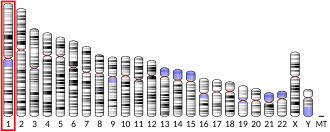



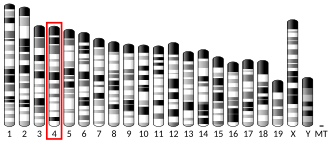

HuD otherwise known as ELAV-like protein 4 is a protein that in humans is encoded by the ELAVL4 gene.56
The HuD/ELAVL4 protein is an RNA-binding protein.7 HuD contains three RRM protein domains, enabling RNA binding.8
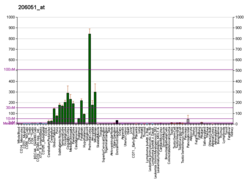
HuD is expressed only in neurons and it binds to AU-rich element-containing mRNAs. As a result of this interaction the half-life of the transcript is increased. HuD is important in neurons during brain development and plasticity.910
Interactions
HuD (protein) has been shown to interact with NXF1.11
References
References
- GRCh38: Ensembl release 89: ENSG00000162374 – Ensembl, May 2017
- GRCm38: Ensembl release 89: ENSMUSG00000028546 – Ensembl, May 2017
- "Human PubMed Reference:". National Center for Biotechnology Information, U.S. National Library of Medicine.
- "Mouse PubMed Reference:". National Center for Biotechnology Information, U.S. National Library of Medicine.
- Muresu R, Baldini A, Gress T, Posner JB, Furneaux HM, Siniscalco M (December 1993). "Mapping of the gene coding for a paraneoplastic encephalomyelitis antigen (HuD) to human chromosome site 1p34". Cytogenetics and Cell Genetics. 65 (3): 177–178. doi:10.1159/000133626. PMID 8222755.
- "Entrez Gene: ELAVL4 ELAV (embryonic lethal, abnormal vision, Drosophila)-like 4 (Hu antigen D)".
- Szabo A, Dalmau J, Manley G, Rosenfeld M, Wong E, Henson J, et al. (October 1991). "HuD, a paraneoplastic encephalomyelitis antigen, contains RNA-binding domains and is homologous to Elav and Sex-lethal". Cell. 67 (2): 325–333. doi:10.1016/0092-8674(91)90184-Z. PMID 1655278. S2CID 26037558.
- Lukong KE, Chang KW, Khandjian EW, Richard S (August 2008). "RNA-binding proteins in human genetic disease". Trends in Genetics. 24 (8): 416–425. doi:10.1016/j.tig.2008.05.004. PMID 18597886.
- Perrone-Bizzozero N, Bolognani F (April 2002). "Role of HuD and other RNA-binding proteins in neural development and plasticity". Journal of Neuroscience Research. 68 (2): 121–126. doi:10.1002/jnr.10175. PMID 11948657.
- Bolognani F, Perrone-Bizzozero NI (February 2008). "RNA-protein interactions and control of mRNA stability in neurons". Journal of Neuroscience Research. 86 (3): 481–489. doi:10.1002/jnr.21473. PMID 17853436. S2CID 27076039.
- Saito K, Fujiwara T, Katahira J, Inoue K, Sakamoto H (August 2004). "TAP/NXF1, the primary mRNA export receptor, specifically interacts with a neuronal RNA-binding protein HuD". Biochemical and Biophysical Research Communications. 321 (2): 291–297. doi:10.1016/j.bbrc.2004.06.140. PMID 15358174.
Further reading
Further reading
- Dalmau J, Furneaux HM, Cordon-Cardo C, Posner JB (October 1992). "The expression of the Hu (paraneoplastic encephalomyelitis/sensory neuronopathy) antigen in human normal and tumor tissues". The American Journal of Pathology. 141 (4): 881–886. PMC 1886624. PMID 1415481.
- Graus F, Ferrer I (1990). "Analysis of a neuronal antigen (Hu) expression in the developing rat brain detected by autoantibodies from patients with paraneoplastic encephalomyelitis". Neuroscience Letters. 112 (1): 14–18. doi:10.1016/0304-3940(90)90314-Y. PMID 2166930. S2CID 24113954.
- Sekido Y, Bader SA, Carbone DP, Johnson BE, Minna JD (September 1994). "Molecular analysis of the HuD gene encoding a paraneoplastic encephalomyelitis antigen in human lung cancer cell lines". Cancer Research. 54 (18): 4988–4992. PMID 8069866.
- Torà M, Graus F, de Bolòs C, Real FX (1997). "Cell surface expression of paraneoplastic encephalomyelitis/sensory neuronopathy-associated Hu antigens in small-cell lung cancers and neuroblastomas". Neurology. 48 (3): 735–741. doi:10.1212/wnl.48.3.735. PMID 9065557. S2CID 23410604.
- Lazarova DL, Spengler BA, Biedler JL, Ross RA (1999). "HuD, a neuronal-specific RNA-binding protein, is a putative regulator of N-myc pre-mRNA processing/stability in malignant human neuroblasts". Oncogene. 18 (17): 2703–2710. doi:10.1038/sj.onc.1202621. PMID 10348344. S2CID 55875.
- Park S, Myszka DG, Yu M, Littler SJ, Laird-Offringa IA (July 2000). "HuD RNA recognition motifs play distinct roles in the formation of a stable complex with AU-rich RNA". Molecular and Cellular Biology. 20 (13): 4765–4772. doi:10.1128/MCB.20.13.4765-4772.2000. PMC 85909. PMID 10848602.
- Wang X, Tanaka Hall TM (2001). "Structural basis for recognition of AU-rich element RNA by the HuD protein". Nature Structural Biology. 8 (2): 141–145. doi:10.1038/84131. PMID 11175903. S2CID 12462183.
- Beckel-Mitchener AC, Miera A, Keller R, Perrone-Bizzozero NI (2002). "Poly(A) tail length-dependent stabilization of GAP-43 mRNA by the RNA-binding protein HuD". The Journal of Biological Chemistry. 277 (31): 27996–28002. doi:10.1074/jbc.M201982200. PMID 12034726.
- Behrends U, Jandl T, Golbeck A, Lechner B, Müller-Weihrich S, Schmid I, et al. (August 2002). "Novel products of the HUD, HUC, NNP-1 and alpha-internexin genes identified by autologous antibody screening of a pediatric neuroblastoma library". International Journal of Cancer. 100 (6): 669–677. doi:10.1002/ijc.10550. PMID 12209604. S2CID 35369661.
- Aronov S, Aranda G, Behar L, Ginzburg I (2003). "Visualization of translated tau protein in the axons of neuronal P19 cells and characterization of tau RNP granules". Journal of Cell Science. 115 (Pt 19): 3817–3827. doi:10.1242/jcs.00058. PMID 12235292. S2CID 16710393.
- Angenstein F, Evans AM, Settlage RE, Moran ST, Ling SC, Klintsova AY, et al. (October 2002). "A receptor for activated C kinase is part of messenger ribonucleoprotein complexes associated with polyA-mRNAs in neurons". The Journal of Neuroscience. 22 (20): 8827–8837. doi:10.1523/JNEUROSCI.22-20-08827.2002. PMC 6757688. PMID 12388589.
- Deschenes-Furry J, Belanger G, Perrone-Bizzozero N, Jasmin BJ (2003). "Post-transcriptional regulation of acetylcholinesterase mRNAs in nerve growth factor-treated PC12 cells by the RNA-binding protein HuD". The Journal of Biological Chemistry. 278 (8): 5710–5717. doi:10.1074/jbc.M209383200. PMID 12468554.
- Plonquet A, Garcia-Pons F, Fernandez E, Philippe C, Marquet J, Rouard H, et al. (September 2003). "Peptides derived from the onconeural HuD protein can elicit cytotoxic responses in HHD mouse and human". Journal of Neuroimmunology. 142 (1–2): 93–100. doi:10.1016/S0165-5728(03)00269-8. PMID 14512168. S2CID 12038485.
- Rousseau A, Benyahia B, Dalmau J, Connan F, Guillet JG, Delattre JY, et al. (February 2005). "T cell response to Hu-D peptides in patients with anti-Hu syndrome". Journal of Neuro-Oncology. 71 (3): 231–236. doi:10.1007/s11060-004-1723-1. PMC 2586925. PMID 15735910.
- Noureddine MA, Qin XJ, Oliveira SA, Skelly TJ, van der Walt J, Hauser MA, et al. (June 2005). "Association between the neuron-specific RNA-binding protein ELAVL4 and Parkinson disease". Human Genetics. 117 (1): 27–33. doi:10.1007/s00439-005-1259-2. PMID 15827745. S2CID 22359866.
- Rual JF, Venkatesan K, Hao T, Hirozane-Kishikawa T, Dricot A, Li N, et al. (October 2005). "Towards a proteome-scale map of the human protein-protein interaction network". Nature. 437 (7062): 1173–1178. Bibcode:2005Natur.437.1173R. doi:10.1038/nature04209. PMID 16189514. S2CID 4427026.