  | |
| Observation data Epoch J2000 Equinox J2000 | |
|---|---|
| Constellation | Cassiopeia1 |
| Right ascension | 01h 47m 44.83444s2 |
| Declination | +63° 51′ 09.0110″2 |
| Apparent magnitude (V) | 5.633 |
| Characteristics | |
| Evolutionary stage | main sequence2 |
| Spectral type | K0 V4 |
| U−B color index | +0.403 |
| B−V color index | +0.804 |
| Astrometry | |
| Radial velocity (Rv) | +2.62±0.122 km/s |
| Proper motion (μ) | RA: +581.684 mas/yr2 Dec.: −246.462 mas/yr2 |
| Parallax (π) | 99.5902±0.0438 mas2 |
| Distance | 32.75 ± 0.01 ly (10.041 ± 0.004 pc) |
| Absolute magnitude (MV) | 5.615 |
| Details | |
| Mass | 0.825±0.0216 M☉ |
| Radius | 0.819±0.0247 R☉ |
| Luminosity | 0.516±0.0106 L☉ |
| Temperature | 5,407±4.08 K |
| Metallicity [Fe/H] | −0.029 dex |
| Rotation | 21.67 days10 |
| Rotational velocity (v sin i) | 2.010 km/s |
| Age | 2.2 - 3.510 Gyr |
| Other designations | |
| V987 Cassiopeiae, BD+63°238, GJ 75, HD 10780, HIP 8362, HR 511, SAO 11983, LHS 1297, LTT 1061911 | |
| Database references | |
| SIMBAD | data |
| ARICNS | data |
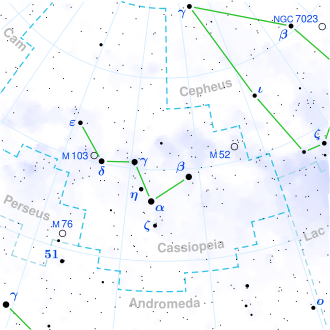
HR 511 (also designated V987 Cassiopeiae and Gliese 75 among others) is an orange dwarf of spectral type K0V in the constellation Cassiopeia. With an apparent magnitude of 5.63,3 it is faintly visible to the naked eye. The star is relatively close, 32.8 light-years from the Sun, just above 10 parsecs.2
This star is estimated to be about the same age as the Sun, with 83% of the mass of the Sun and 82% of the Sun's radius. It has not been identified as a member of any moving star groups. This star has displayed unusual emissions of Ca II and is much more x-ray luminous than the Sun. It is considered a relatively active star.10 Based on an iron abundance of [Fe/H] = −0.02, the metallicity of this star appears to be similar to that of the Sun.9
References
References
- Anderson, E.; Francis, Ch. (May 2012), "XHIP: An extended hipparcos compilation", Astronomy Letters, 38 (5): 331–346, arXiv:1108.4971, Bibcode:2012AstL...38..331A, doi:10.1134/S1063773712050015, eISSN 1562-6873, ISSN 1063-7737, S2CID 119257644
- Vallenari, A.; et al. (Gaia collaboration) (2023). "Gaia Data Release 3. Summary of the content and survey properties". Astronomy and Astrophysics. 674: A1. arXiv:2208.00211. Bibcode:2023A&A...674A...1G. doi:10.1051/0004-6361/202243940. S2CID 244398875. Gaia DR3 record for this source at VizieR.
- Mermilliod, J.-C. (1986), "Compilation of Eggen's UBV data, transformed to UBV (unpublished)", Catalogue of Eggen's UBV Data. SIMBAD, Bibcode:1986EgUBV........0M
- White, Russel J.; Gabor, Jared M.; Hillenbrand, Lynne A. (June 2007), "High-Dispersion Optical Spectra of Nearby Stars Younger Than the Sun", The Astronomical Journal, 133 (6): 2524–2536, arXiv:0706.0542, Bibcode:2007AJ....133.2524W, doi:10.1086/514336, S2CID 122854
- Holmberg, J.; et al. (July 2009), "The Geneva-Copenhagen survey of the solar neighbourhood. III. Improved distances, ages, and kinematics", Astronomy and Astrophysics, 501 (3): 941–947, arXiv:0811.3982, Bibcode:2009A&A...501..941H, doi:10.1051/0004-6361/200811191, S2CID 118577511
- Boyajian, Tabetha S.; et al. (February 2012), "Stellar Diameters and Temperatures. I. Main-sequence A, F, and G Stars", The Astrophysical Journal, 746 (1): 101, arXiv:1112.3316, Bibcode:2012ApJ...746..101B, doi:10.1088/0004-637X/746/1/101, S2CID 18993744. See Table 10.
- Demory, B.-O.; et al. (October 2009), "Mass-radius relation of low and very low-mass stars revisited with the VLTI", Astronomy and Astrophysics, 505 (1): 205–215, arXiv:0906.0602, Bibcode:2009A&A...505..205D, doi:10.1051/0004-6361/200911976, S2CID 14786643
- Kovtyukh, V. V.; et al. (2003), "High precision effective temperatures for 181 F-K dwarfs from line-depth ratios", Astronomy and Astrophysics, 411 (3): 559–564, arXiv:astro-ph/0308429, Bibcode:2003A&A...411..559K, doi:10.1051/0004-6361:20031378, S2CID 18478960
- Feltzing, S.; Gonzalez, G. (2001), "The nature of super-metal-rich stars. Detailed abundance analysis of 8 super-metal-rich star candidates", Astronomy and Astrophysics, 367 (1): 253–265, Bibcode:2001A&A...367..253F, doi:10.1051/0004-6361:20000477
- Gaidos, E. J.; Henry, G. W.; Henry, S. M. (2000), "Spectroscopy and Photometry of Nearby Young Solar Analogs", The Astronomical Journal, 120 (2): 1006–1013, Bibcode:2000AJ....120.1006G, CiteSeerX 10.1.1.43.4478, doi:10.1086/301488, S2CID 16930014
- "HR 511", SIMBAD, Centre de données astronomiques de Strasbourg, retrieved 2016-07-09
External links
External links
- "ARICNS 4C00155". ARI Data Base for Nearby Stars. Astronomisches Rechen-Institut. March 4, 1998. Archived from the original on 2008-10-17. Retrieved 2008-02-27.
- SolStation