| The Holocaust | |
|---|---|
| Part of World War II | |
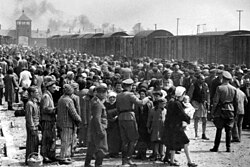 Jews arriving at Auschwitz II in German-occupied Poland, May 1944. Most were selected for execution in gas chambers. | |
| Location | Europe, primarily German-occupied Poland and the Soviet Union |
| Date | 1941–1945 |
Attack type | Genocide, ethnic cleansing, mass murder, mass shooting, death marches, poison gas, hate crime, slavery |
| Deaths | Around 6 million Jewsa |
| Perpetrators | Nazi Germany along with its collaborators and allies |
The Holocaust,b known in Hebrew as the Shoah,c was the genocide of European Jews during World War II. From 1941 to 1945, Nazi Germany and its collaborators systematically murdered around six million Jews across German-occupied Europe, approximately two-thirds of Europe's Jewish population. The murders were committed primarily through mass shootings across Eastern Europe and poison gas chambers in extermination camps, chiefly Auschwitz-Birkenau, Treblinka, Belzec, Sobibor, Chełmno and Majdanek death camps in occupied Poland. Concurrent Nazi persecutions killed millions of other non-Jewish civilians and prisoners of war (POWs); the term Holocaust is sometimes used to include the murder and persecution of non-Jewish groups, such as the Romani and Soviet POWs.
The Nazis developed their ideology based on racism and pursuit of "living space", and seized power in early 1933. Meant to force all German Jews to emigrate, regardless of means, the regime passed anti-Jewish laws, encouraged violence, and orchestrated a nationwide pogrom known as Kristallnacht in November 1938. After Germany's invasion of Poland in September 1939, occupation authorities began to establish ghettos to segregate Jews. Following the June 1941 invasion of the Soviet Union, 1.5 to 2 million Jews were murdered by German forces and local collaborators. The Nazis first targeted Jewish Red Army POWs and male civilians, but quickly escalated to murdering Jewish women and children.
By early 1942, following the Wannsee Conference, the Nazis' Final Solution was implemented to murder all Jews in Europe. Some historians note that Adolf Hitler frequently communicated major policy decisions verbally to Heinrich Himmler rather than through written directives. Victims were deported to extermination camps where those who had survived the trip were gassed, while others were sent to forced labor camps where many died from starvation, abuse, exhaustion, or being used as test subjects in experiments. Property belonging to murdered Jews was redistributed to the German occupiers and other non-Jews. The murder rate was most intense during Operation Reinhard from March 1942 to November 1943. Although the majority of Holocaust victims died in 1942, the mass murders continued until the end of the war in 1945.
Many Jewish survivors emigrated from Europe after the war. A few Holocaust perpetrators faced criminal trials. Billions of dollars in reparations have been paid, although falling short of the losses suffered by the European Jews. The Holocaust has also been commemorated in museums, memorials, and culture. It is considered to be the single deadliest genocide in human history, and has become central to Western historical consciousness as a symbol of the ultimate human evil.
Terminology and scope
The term holocaust, derived from a Greek word meaning 'burnt offering',2 was an ordinary English word for centuries also meaning 'destruction or sacrifice by fire' or, figuratively, 'massacre'. During the 1950s, it started to become a proper noun and the most common word used to describe the Nazi extermination of Jews in English and many other languages.d The term Holocaust is sometimes used to refer to the persecution of other groups that the Nazis targeted,e especially those targeted on a biological basis, in particular the Roma and Sinti, as well as Soviet prisoners of war and Polish and Soviet civilians.345 All of these groups, however, were targeted for different reasons.6 By the 1970s, the adjective Jewish was dropped as redundant and Holocaust, now capitalized, became the default term for the destruction of European Jews.7 The Hebrew word Shoah ('catastrophic destruction') exclusively refers to Jewish victims.893 The perpetrators used the phrase "Final Solution" as a euphemism for their genocide of Jews.10
Background
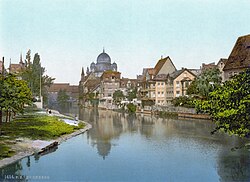
Jews have lived in Europe for more than two thousand years.11 Throughout the Middle Ages in Europe, Jews were subjected to antisemitism based on Christian theology, which blamed them for killing Jesus.1213 In the 19th century many European countries granted full citizenship rights to Jews in hopes that they would assimilate.14 By the early 20th century, most Jews in central and western Europe were well integrated into society, while in eastern Europe, where emancipation had arrived later, many Jews continued to live in small towns, spoke Yiddish, and practiced Orthodox Judaism.15 Political antisemitism positing the existence of a Jewish question and usually an international Jewish conspiracy emerged in the 18th and 19th centuries due to the rise of nationalism in Europe and industrialization that increased economic conflicts between Jews and non-Jews.1617 Some scientists began to categorize humans into different races and argued that there was a life or death struggle between them.18 Many racists argued that Jews were a separate racial group alien to Europe.1920
The turn of the twentieth century saw a major effort to establish a German colonial empire overseas, leading to the Herero and Nama genocide and subsequent racial apartheid regime in South West Africa.2122 World War I (1914–1918) intensified nationalist and racist sentiments in Germany and other European countries.23 Jews in eastern Europe were targeted by widespread pogroms.24 Germany had two million war dead and lost a substantial territory;23 opposition to the postwar settlement united Germans across the political spectrum.2526 The military promoted the untrue but compelling idea that, rather than being defeated on the battlefield, Germany had been stabbed in the back by socialists and Jews.2527
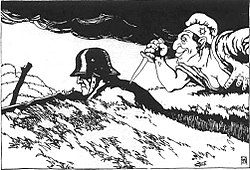
The Nazi Party was founded in the wake of the war,28 and its ideology is often cited as the main factor explaining the Holocaust.29 From the beginning, the Nazis—not unlike other nation-states in Europe—dreamed of a world without Jews, whom they identified as "the embodiment of everything that was wrong with modernity".6 The Nazis defined the German nation as a racial community unbounded by Germany's physical borders30 and sought to purge it of racially foreign and socially deficient elements.2531 The Nazi Party and its leader, Adolf Hitler, were also obsessed with reversing Germany's territorial losses and acquiring additional Lebensraum (living space) in Eastern Europe for colonization.3233 These ideas appealed to many Germans.34 The Nazis promised to protect European civilization from the Soviet threat.35 Hitler believed that Jews controlled the Soviet Union, as well as the Western powers, and were plotting to destroy Germany.363738
Rise of Nazi Germany

Amidst a worldwide economic depression and political fragmentation, the Nazi Party rapidly increased its support, reaching a high of 37 percent in mid-1932 elections,3940 by campaigning on issues such as anticommunism and economic recovery.4142 Hitler was appointed chancellor in January 1933 in a backroom deal supported by right-wing politicians.39 Within months, all other political parties were banned, the regime seized control of the media,43 tens of thousands of political opponents—especially communists—were arrested, and a system of camps for extrajudicial imprisonment was set up.44 The Nazi regime cracked down on crime and social outsiders—such as Roma and Sinti, homosexual men, and those perceived as workshy—through a variety of measures, including imprisonment in concentration camps.45 The Nazis forcibly sterilized 400,000 people and subjected others to forced abortions for real or supposed hereditary illnesses.464748
Although the Nazis sought to control every aspect of public and private life,49 Nazi repression was directed almost entirely against groups perceived as outside the national community. Most Germans had little to fear provided they did not oppose the new regime.5051 The new regime built popular support through economic growth, which partly occurred through state-led measures such as rearmament.43 The annexations of Austria (1938), Sudetenland (1938), and Bohemia and Moravia (1939) also increased the Nazis' popular support.52 Germans were inundated with propaganda both against Jews43 and other groups targeted by the Nazis.47
Persecution of Jews
The roughly 500,000 German Jews made up less than 1 percent of the country's population in 1933. They were wealthier on average than other Germans and largely assimilated, although a minority were recent immigrants from eastern Europe.535455 Various German government agencies, Nazi Party organizations, and local authorities instituted about 1,500 anti-Jewish laws.56 In 1933, Jews were banned or restricted from several professions and the civil service.52 After hounding the German Jews out of public life by the end of 1934, the regime passed the Nuremberg Laws in 1935.57 The laws reserved full citizenship rights for those of "German or related blood", restricted Jews' economic activity, and criminalized new marriages and sexual relationships between Jews and non-Jewish Germans.5859 Jews were defined as those with three or four Jewish grandparents; many of those with partial Jewish descent were classified as Mischlinge, with varying rights.60 The regime also sought to segregate Jews with a view to their ultimate disappearance from the country.57 Jewish students were gradually forced out of the school system. Some municipalities enacted restrictions governing where Jews were allowed to live or conduct business.61 In 1938 and 1939, Jews were barred from additional occupations, and their businesses were expropriated to force them out of the economy.59
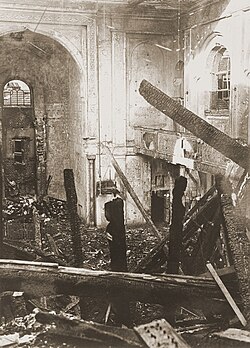
Anti-Jewish violence, largely locally organized by members of Nazi Party institutions, took primarily non-lethal forms from 1933 to 1939.62 Jewish stores, especially in rural areas, were often boycotted or vandalized.63 As a result of local and popular pressure, many small towns became entirely free of Jews and as many as a third of Jewish businesses may have been forced to close.64 Anti-Jewish violence was even worse in areas annexed by Nazi Germany.65 On 9–10 November 1938, the Nazis organized Kristallnacht (Night of Broken Glass), a nationwide pogrom. Over 7,500 Jewish shops (out of 9,000) were looted, more than 1,000 synagogues were damaged or destroyed,66 at least 90 Jews were murdered,67 and as many as 30,000 Jewish men were arrested,6869 although many were released within weeks.70 German Jews were levied a special tax that raised more than 1 billion Reichsmarks (RM).71f
The Nazi government wanted to force all Jews to leave Germany.74 Out of the 560,000 Jews in the country, 130,000 were able to emigrate between 1933 and 1937, most of them towards South Africa, Mandatory Palestine, and South America. Some went back to Eastern Europe. Another 120,000 left Germany in 1938 and 1939. Almost no country lowered the restrictions to immigrate, so obtaining the necessary documents was difficult. By the end of 1939, most Jews who could emigrate had already done so; those who remained behind were disproportionately elderly, poor, or female.75 Until 1939 100,000 were in USA; 50,000 each in Palestine, UK, Argentina; 30,000 each in the Netherlands, Belgium, France, South Africa, and Shanghai.176 Germany collected emigration taxes of nearly 1 billion RM,f mostly from Jews.77 The policy of forced emigration continued into 1940.78
Besides Germany, a significant number of other European countries abandoned democracy for some kind of authoritarian or fascist rule.35 Many countries, including Bulgaria, Hungary, Poland, Romania, and Slovakia, passed antisemitic legislation in the 1930s and 1940s.79 In October 1938, Germany deported many Polish Jews in response to a Polish law that enabled the revocation of citizenship for Polish Jews living abroad.8081
Start of World War II

The German Wehrmacht (armed forces) invaded Poland on 1 September 1939, triggering declarations of war from the United Kingdom and France.82 During the five weeks of fighting, as many as 16,000 civilians, hostages, and prisoners of war may have been shot by the German invaders;83 there was also a great deal of looting.84 Special units known as Einsatzgruppen followed the army to eliminate any possible resistance.85 Around 50,000 Polish and Polish Jewish leaders and intellectuals were arrested or executed.8687 The Auschwitz concentration camp was established to hold those members of the Polish intelligentsia not killed in the purges.88 Around 400,000 Poles were expelled from the Wartheland in western Poland to the General Governorate occupation zone from 1939 to 1941, and the area was resettled by ethnic Germans from eastern Europe.89
The rest of Poland was occupied by the Soviet Union, which invaded Poland from the east on 17 September pursuant to the German–Soviet pact.90 The Soviet Union deported hundreds of thousands of Polish citizens to the Soviet interior, including as many as 260,000 Jews who largely survived the war.9192 Although most Jews were not communists, some accepted positions in the Soviet administration, contributing to a pre-existing perception among many non-Jews that Soviet rule was a Jewish conspiracy.93 In 1940, Germany invaded much of western Europe including the Netherlands, Belgium, Luxembourg, France, and Denmark and Norway.82 In 1941, Germany invaded Yugoslavia and Greece.82 Some of these new holdings were fully or partially annexed into Germany while others were placed under civilian or military rule.83
The war provided cover for "Aktion T4", the murder of around 70,000 institutionalized Germans with mental or physical disabilities at specialized killing centers using poison gas.899495 The victims included all 4,000 to 5,000 institutionalized Jews.96 Despite efforts to maintain secrecy, knowledge of the killings leaked out and Hitler ordered a halt to the centralized killing program in August 1941.979899 Decentralized killings via denial of medical care, starvation, and poisoning caused an additional 120,000 deaths by the end of the war.98100 Many of the same personnel and technologies were later used for the mass murder of Jews.101102
Ghettoization and resettlement
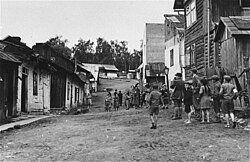
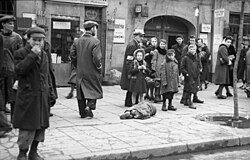
Germany gained control of 1.7 million Jews in Poland.55103 The Nazis tried to concentrate Jews in the Lublin District of the General Governorate. 45,000 Jews were deported by November and left to fend for themselves, causing many deaths.104 Deportations stopped in early 1940 due to the opposition of Hans Frank, the leader of the General Governorate, who did not want his fiefdom to become a dumping ground for unwanted Jews.105106 After the conquest of France, the Nazis considered deporting Jews to French Madagascar, but this proved impossible.107108 The Nazis planned that harsh conditions in these areas would kill many Jews.107106 In September 1939, around 7,000 Jews were killed, alongside thousands of Poles, however, they were not systematically targeted as they would be later, and open mass killings would subside until June 1941.109
During the invasion, synagogues were burned and thousands of Jews fled or were expelled into the Soviet occupation zone.110 Various anti-Jewish regulations were soon issued. In October 1939, adult Jews in the General Governorate were required to perform forced labor.111 In November 1939 they were ordered to wear white armbands.112 Laws decreed the seizure of most Jewish property and the takeover of Jewish-owned businesses. When Jews were forced into ghettos, they lost their homes and belongings.111
The first Nazi ghettos were established in the Wartheland and General Governorate in 1939 and 1940 on the initiative of local German administrators.113114 The largest ghettos, such as Warsaw and Łódź, were established in existing residential neighborhoods and closed by fences or walls. In many smaller ghettos, Jews were forced into poor neighborhoods but with no fence.115 Forced labor programs provided subsistence to many ghetto inhabitants, and in some cases protected them from deportation. Workshops and factories were operated inside some ghettos, while in other cases Jews left the ghetto to work outside it.116 Because the ghettos were not segregated by sex some family life continued.117 A Jewish community leadership (Judenrat) exercised some authority and tried to sustain the Jewish community while following German demands. As a survival strategy, many tried to make the ghettos useful to the occupiers as a labor reserve.118119 Jews in western Europe were not forced into ghettos but faced discriminatory laws and confiscation of property.120121122
Rape and sexual exploitation of Jewish and non-Jewish women in eastern Europe was common.123
Invasion of the Soviet Union
Germany and its allies Slovakia, Hungary, Romania, and Italy invaded the Soviet Union on 22 June 1941.124106 Although the war was launched more for strategic than ideological reasons,125 what Hitler saw as an apocalyptic battle against the forces of Jewish Bolshevism126 was to be carried out as a war of extermination with complete disregard for the laws and customs of war.127128 A quick victory was expected129 and was planned to be followed by a massive demographic engineering project to remove 31 million people and replace them with German settlers.130 To increase the speed of conquest the Germans planned to feed their army by looting, exporting additional food to Germany, and to terrorize the local inhabitants with preventative killings.131132 The Germans foresaw that the invasion would cause a food shortfall and planned the mass starvation of Soviet cities and some rural areas.133134135 Although the starvation policy was less successful than planners hoped,136 the residents of some cities, particularly in Ukraine, and besieged Leningrad, as well as the Jewish ghettos, endured human-made famine, during which millions of people died of starvation.137138
By mid-June 1941, about 30,000 Jews had died, 20,000 of whom had starved to death in the ghettos.139
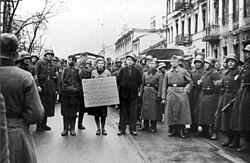
Soviet prisoners of war in the custody of the German Army were intended to die in large numbers. Sixty percent—3.3 million people—died, primarily of starvation,140141 making them the second largest group of victims of Nazi mass killing after European Jews.142143 Jewish prisoners of war and commissars were systematically executed.144145 About a million civilians were killed by the Nazis during anti-partisan warfare, including more than 300,000 in Belarus.146147 From 1942 onwards, the Germans and their allies targeted villages suspected of supporting the partisans, burning them and killing or expelling their inhabitants.148 During these operations, nearby small ghettos were liquidated and their inhabitants shot.149 By 1943, anti-partisan operations aimed for the depopulation of large areas of Belarus.150151 Jews and those unfit for work were typically shot on the spot with others deported.149152 Although most of those killed were not Jews,147150 anti-partisan warfare often led to the deaths of Jews.153
Mass murder
Most historians agree that Hitler issued an explicit order to kill all Jews across Europe,154 but there is disagreement as to when.155156 Some historians cite inflammatory statements by Hitler and other Nazi leaders as well as the concurrent mass shootings of Serbian Jews, plans for extermination camps in Poland, and the beginning of the deportation of German Jews as indicative of the final decision having been made before December 1941.155157 Others argue that these policies were initiatives by local leaders and that the final decision was made later.155 On 5 December 1941, the Soviet Union launched its first major counteroffensive. On 11 December, Hitler declared war on the United States after Japan attacked Pearl Harbor.158159 The next day, he told leading Nazi party officials, referring to his 1939 prophecy, "The world war is here; the annihilation of the Jews must be the necessary consequence."159160
It took the Nazis several months after this to organize a continent-wide genocide.159 Reinhard Heydrich, head of the Reich Main Security Office (RSHA), convened the Wannsee Conference on 20 January 1942. This high-level meeting was intended to coordinate anti-Jewish policy.161 The majority of Holocaust killings were carried out in 1942, with it being the peak of the genocide, as over 3 million Jews were murdered, with 20 or 25 percent of Holocaust victims dying before early 1942 and the same number surviving by the end of the year.162163
Mass shooting
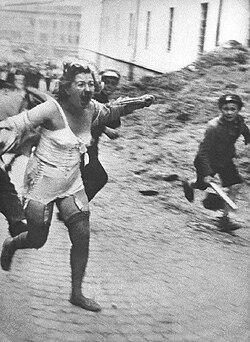
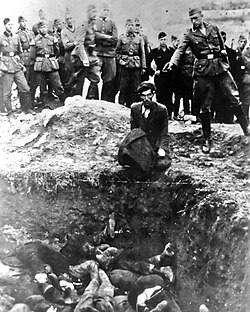
The systematic murder of Jews began in the Soviet Union in 1941.165 During the invasion, many Jews were conscripted into the Red Army. Out of 10 or 15 million Soviet civilians who fled eastwards to the Soviet interior, 1.6 million were Jews.166118 Local inhabitants killed as many as 50,000 Jews in pogroms in Latvia, Lithuania, eastern Poland, Ukraine, and the Romanian borderlands.167168 Although German forces tried to incite pogroms, their role in causing violence is controversial.169170 Romanian soldiers killed tens of thousands of Jews from Odessa by April 1942.171172
Prior to the invasion, the Einsatzgruppen were reorganized in preparation for mass killings and instructed to shoot Soviet officials and Jewish state and party employees.173 The shootings were justified on the basis of Jews' supposed central role in supporting the communist system, but it was not initially envisioned to kill all Soviet Jews.174175 The occupiers relied on locals to identify Jews to be targeted.176 The first German mass killings targeted adult male Jews who had worked as civil servants or in jobs requiring education. Tens of thousands were shot by the end of July. The vast majority of civilian victims were Jews.171 In July and August Heinrich Himmler, the leader of the SS (Schutzstaffel), made several visits to the death squads' zones of operation, relaying orders to kill more Jews.177 At this time, the killers began to murder Jewish women and children, too.177178 Executions peaked at 40,000 a month in Lithuania in August and September and in October and November reached their height in Belarus.179
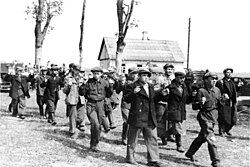
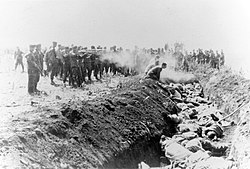
The executions often took place a few kilometers from a town. Victims were rounded up and marched to the execution site, forced to undress, and shot into previously dug pits.181 The favored technique was a shot in the back of the neck with a single bullet.182 In the chaos, many victims were not killed by the gunfire but instead buried alive. Typically, the pits would be guarded after the execution but sometimes a few victims managed to escape afterwards.181 Executions were public spectacles and the victims' property was looted both by the occupiers and local inhabitants.183 Around 200 ghettos were established in the occupied Soviet Union, with many existing only briefly before their inhabitants were executed. A few large ghettos such as Vilna, Kovno, Riga, Białystok, and Lwów lasted into 1943 because they became centers of production.118
Victims of mass shootings included Jews deported from elsewhere.184 Besides Germany, Romania killed the largest number of Jews.185186 Romania deported about 154,000–170,000 Jews from Bessarabia and Bukovina to ghettos in Transnistria from 1941 to 1943.187 Jews from Transnistria were also imprisoned in these ghettos, where the total death toll may have reached 160,000.188 Hungary expelled thousands of Carpathian Ruthenian and foreign Jews in 1941, who were shortly thereafter shot in Ukraine.189190 At the beginning of September, all German Jews were required to wear a yellow star, and in October, Hitler decided to deport them to the east and ban emigration.191192 Between mid-October and the end of 1941, 42,000 Jews from Germany and its annexed territories and 5,000 Romani people from Austria were deported to Łódź, Kovno, Riga, and Minsk.193194 In late November, 5,000 German Jews were shot outside of Kovno and another 1,000 near Riga, but Himmler ordered an end to such massacres and some in the senior Nazi leadership voiced doubts about killing German Jews.184195 Executions of German Jews in the Baltics resumed in early 1942.196
After the expansion of killings to target the entire Soviet Jewish population, the 3,000 men of the Einsatzgruppen proved insufficient and Himmler mobilized 21 battalions of Order Police to assist them.177 In addition, Wehrmacht soldiers, Waffen-SS brigades, and local auxiliaries shot many Jews.181197198 By the end of 1941, more than 80 percent of the Jews in central Ukraine, eastern Belarus, Russia, Latvia, and Lithuania had been shot, but less than 25 percent of those living farther west where 900,000 remained alive.199 By the end of the war, around 1.5 to 2 million Jews were shot200 and as many as 225,000 Roma.201 The murderers found the executions distressing and logistically inconvenient, which influenced the decision to switch to other methods of killing.202
Deportation
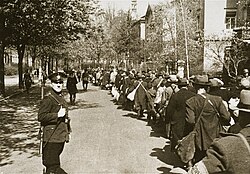
Unlike the killing areas in the east, the deportation from elsewhere in Europe was centrally organized from Berlin, although it depended on the outcome of negotiations with allied governments and popular responses to deportation.163 Beginning in late 1941, local administrators responded to the deportation of Jews to their area by massacring local Jews in order to free up space in ghettos for the deportees.203 If the deported Jews did not die of harsh conditions, they were killed later in extermination camps.204 Jews deported to Auschwitz were initially entered into the camp; the practice of conducting selections and murdering many prisoners upon arrival began in July 1942.205 In May and June, German and Slovak Jews deported to Lublin began to be sent directly to extermination camps.205
In Western Europe, almost all Jewish deaths occurred after deportation.206 The occupiers often relied on local policemen to arrest Jews, limiting the number who were deported.207 In 1942, nearly 100,000 Jews were deported from Belgium, France, and the Netherlands.208 In France, 25 percent of the Jews were killed,209 most of whom were either non-citizens or recent immigrants. Si Kaddour Benghabrit and Abdelkader Mesli saved hundreds of Jews by hiding them in the basements of the Grand Mosque of Paris and other resistance efforts in France.210211 The death rate in the Netherlands was higher than neighboring countries, which scholars have attributed to difficulty in hiding or increased collaboration of the Dutch police.212
The German government sought the deportation of Jews from allied countries.205213 The first to hand over its Jewish population was Slovakia, which arrested and deported about 58,000 Jews to Poland from March to October 1942.214215216 The Independent State of Croatia had already shot or killed in concentration camps the majority of its Jewish population (along with a larger number of Serbs),217218 and later deported several thousand Jews in 1942 and 1943.219 The Bulgaria government cooperated by deporting 11,000 Jews from Bulgarian-occupied Greece and Yugoslavia, who were murdered at Treblinka, but declined to allow the deportation of Jews from its prewar territory, due to widespread opposition from prominent individuals and groups within Bulgaria itself.220
Until German occupation of Hungary in March 1944, the Hungarian government did not deport very many of its approximately 846,000 people considered Jewish by the racial laws of that time (although Jews were murdered in raids and incidents). Also, Romania did not send many Jews; the Romanian and Hungarian Jewish populations were the largest surviving European Jewish populations after 1942.221 But between March 1944 and 9 July 1944, 434,000 of the still 825,000 Hungarian Jews were deported on trains, mostly to Auschwitz where the great majority of them were murdered immediately. Roughly 255,000 Jewish Hungarians (29.6 percent) are estimated to somehow have survived the war and Holocaust.
Prior to the German occupation of Italy in September 1943, there were no serious attempt to deport Italian Jews, and Italy refused to allow the deportation of Jews in many Italian-occupied areas.222223 Nazi Germany did not attempt the destruction of the Finnish Jews224 and the North African Jews living under French or Italian rule.225
Extermination camps
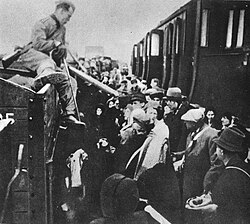
Gas vans developed from those used to kill mental patients since 1939 were assigned to the Einsatzgruppen and first used in November 1941; victims were forced into the van and killed with engine exhaust.226 The first extermination camp was Chełmno in the Wartheland, established on the initiative of the local civil administrator Arthur Greiser with Himmler's approval; it began operations in December 1941 using gas vans.227228229 In October 1941, Higher SS and Police Leader of Lublin Odilo Globocnik230 began work planning Belzec—the first purpose-built extermination camp to feature stationary gas chambers using carbon monoxide based on the previous Aktion T4 programme231232—amid increasing talk among German administrators in Poland of large-scale murder of Jews in the General Governorate.233227 In late 1941 in East Upper Silesia, Jews in forced-labor camps operated by the Schmelt Organization deemed "unfit for work" began to be sent in groups to Auschwitz where they were murdered.234235 In early 1942, Zyklon B became the preferred killing method in extermination camps236 after gassing experiments were conducted on Russian POWs in late August 1941.237232
The camps were located on rail lines to make it easier to transport Jews to their deaths, but in remote places to avoid notice.230 The stench caused by mass killing operations was noticeable to anyone nearby.238 Except in the deportations from western and central Europe, people were typically deported to the camps in overcrowded cattle cars. As many as 150 people were forced into a single boxcar. Many died en route, partly because of the low priority accorded to these transports.239240 Shortage of rail transport sometimes led to postponement or cancellation of deportations.241 Upon arrival, the victims were robbed of their remaining possessions, forced to undress, had their hair cut, and were chased into the gas chamber.242 Death from the gas was agonizing and could take as long as 30 minutes.243159 The gas chambers were primitive and sometimes malfunctioned. Some prisoners were shot because the gas chambers were not functioning.244 At other extermination camps, nearly everyone on a transport was killed on arrival, but at Auschwitz around 20–25 percent were separated out for labor,245 although many of these prisoners died later on246 through starvation, mass shooting, torture,247 and medical experiments.248
Belzec, Sobibor, and Treblinka reported a combined revenue of RM 178.7 million from belongings stolen from their victims, far exceeding costs.249250 Combined, the camps required the labor of less than 3,000 Jewish prisoners, 1,000 Trawniki men (largely Ukrainian auxiliaries), and very few German guards.251240 About half of the Jews killed in the Holocaust died by poison gas.252 Thousands of Romani people were also murdered in the extermination camps.253 Prisoner uprisings at Treblinka and Sobibor meant that these camps were shut down earlier than envisioned.254255
| Camp | Location | Number of Jews killed | Killing technology | Planning began | Mass gassing duration |
|---|---|---|---|---|---|
| Chełmno | Wartheland256 | 150,000256 | Gas vans256 | July 1941256 | 8 December 1941 – April 1943 and April–July 1944257 |
| Belzec | Lublin District256 | 440,823–596,200258 | Stationary gas chamber, engine exhaust256 | October 1941257 | 17 March 1942 – December 1942257 |
| Sobibor | Lublin District256 | 170,618–238,900258 | Stationary gas chamber, engine exhaust256 | Late 1941 or March 1942259 | May 1942 – October 1942259 |
| Treblinka | Warsaw District256 | 780,863–951,800258 | Stationary gas chamber, engine exhaust256 | April 1942256 | 23 July 1942 – October 1943256 |
| Auschwitz II–Birkenau | East Upper Silesia256 | 900,000–1,000,000256 | Stationary gas chamber, hydrogen cyanide256 | September 1941 (built as POW camp)236256 |
February 1942 – October 1944256 |
Liquidation of the ghettos in Poland
Plans to kill most of the Jews in the General Governorate were affected by various goals of the SS, military, and civil administration to reduce the amount of food consumed by Jews, enable a slight increase in rations to non-Jewish Poles, and combat the black market.260 In March 1942, killings began in Belzec, targeting Jews from Lublin who were not capable of work. This action reportedly reduced the black market and was deemed a success to be replicated elsewhere.261262 By mid-1942, Nazi leaders decided to allow only 300,000 Jews to survive in the General Governorate by the end of the year for forced labor;260 for the most part, only those working in armaments production were spared.263 The majority of ghettos were liquidated in mass executions nearby, especially if they were not near a train station. Larger ghettos were more commonly liquidated during multiple deportations to extermination camps.264262 During this campaign, 1.5 million Polish Jews were murdered in the largest killing operation of the Holocaust.265
In order to reduce resistance, the ghetto would be raided without warning, usually in the early morning, and the extent of the operation would be concealed as long as possible.266 Trawniki men would cordon off the ghetto while the Order Police and Security Police carried out the action.267 In addition to local non-Jewish collaborators, the Jewish councils and Jewish ghetto police were often ordered to assist with liquidation actions, although these Jews were in most cases murdered later.268 Chaotic, capriciously executed selections determined who would be loaded onto the trains. Many Jews were shot during the action, often leaving ghettos strewn with corpses. Jewish forced laborers had to clean it up and collect any valuables from the victims.266
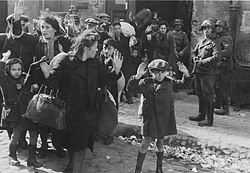
The Warsaw Ghetto was cleared between 22 July and 12 September 1942. Of the original population of 350,000 Jews, 250,000 were killed at Treblinka, 11,000 were deported to labor camps, 10,000 were shot in the ghetto, 35,000 were allowed to remain in the ghetto after a final selection, and around 20,000 or 25,000 managed to hide in the ghetto. Misdirection efforts convinced many Jews that they could avoid deportation until it was too late.269 During a six-week period beginning in August, 300,000 Jews from the Radom District were sent to Treblinka.270271
At the same time as the mass killing of Jews in the General Governorate, Jews who were in ghettos to the west and east were targeted. Tens of thousands of Jews were deported from ghettos in the Warthegau and East Upper Silesia to Chełmno and Auschwitz.272 300,000 Jews—largely skilled laborers—were shot in Volhynia, Podolia, and southwestern Belarus.273274 Deportations and mass executions in the Bialystok District and Galicia killed many Jews.275 Although there was practically no resistance in the General Governorate in 1942, some Soviet Jews improvised weapons, attacked those attempting to liquidate the ghetto, and set it on fire.276 These ghetto uprisings were only undertaken when the inhabitants began to believe that their death was certain.277 In 1943, larger uprisings in Warsaw, Białystok, and Glubokoje necessitated the use of heavy weapons.278 The uprising in Warsaw prompted the Nazi leadership to liquidate additional ghettos and labor camps in German-occupied Poland with their inhabitants massacred, such as the Wola Massacre, or deported to extermination camps for fear of additional Jewish resistance developing.279 Nevertheless, in early 1944, more than 70,000 Jews were performing forced labor in the General Governorate.280
Forced labor
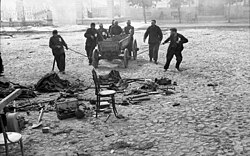
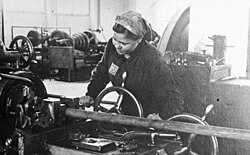
Beginning in 1938—especially in Germany and its annexed territories—many Jews were drafted into forced-labor camps and segregated work details. These camps were often of a temporary nature and typically overseen by civilian authorities. Initially, mortality did not increase dramatically.281282 After mid-1941, conditions for Jewish forced laborers drastically worsened and death rates increased; even private companies deliberately subjected workers to murderous conditions.283 Beginning in 1941 and increasingly as time went on, Jews capable of employment were separated from others—who were usually killed.284285 They were typically employed in non-skilled jobs and could be replaced easily if non-Jewish workers were available, but those in skilled positions had a higher chance of survival.286287 Although conditions varied widely between camps, Jewish forced laborers were typically treated worse than non-Jewish prisoners and suffered much higher mortality rates.288
In mid-1943, Himmler sought to bring surviving Jewish forced laborers under the control of the SS in the concentration camp system.289290g Some of the forced-labor camps for Jews and some ghettos, such as Kovno, were designated concentration camps, while others were dissolved and surviving prisoners sent to a concentration camp.295 Despite many deaths, as many as 200,000 Jews survived the war inside the concentration camps.296 Although most Holocaust victims were never imprisoned in a concentration camp, the image of these camps is a popular symbol of the Holocaust.297
Including the Soviet prisoners of war, 13 million people were brought to Germany for forced labor.298 The largest nationalities were Soviet and Polish299 and they were the worst-treated groups except for Roma and Jews.300 Soviet and Polish forced laborers endured inadequate food and medical treatment, long hours, and abuse by employers. Hundreds of thousands died.301 Many others were forced to work for the occupiers without leaving their country of residence.302 Some of Germany's allies, including Slovakia and Hungary, agreed to deport Jews to protect non-Jews from German demands for forced labor.303 East European women were also kidnapped, via lapanka, to serve as sex slaves of German soldiers in military and camp brothels304305306 despite the prohibition of relationships, including fraternization, between German and foreign workers,307308 which imposed the penalty of imprisonment308 and death.309310
Perpetrators and beneficiaries
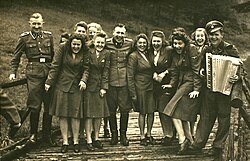
An estimated 200,000 to 250,000 Germans were directly involved in killing Jews, and if one includes all those involved in the organization of extermination, the number rises to 500,000.311 Genocide required the active and tacit consent of millions of Germans and non-Germans.312313 The motivation of Holocaust perpetrators varied and has led to historiographical debate.312314 Studies of the SS officials who organized the Holocaust have found that most had strong ideological commitment to Nazism.315316 In addition to ideological factors, many perpetrators were motivated by the prospect of material gain and social advancement.317318319 German SS, police, and regular army units rarely had trouble finding enough men to shoot Jewish civilians, even though punishment for refusal was absent or light.320321
Non-German perpetrators and collaborators included Dutch, French, and Polish policemen, Romanian soldiers, foreign SS and police auxiliaries, Ukrainian Insurgent Army partisans, and some civilians.312322323 Some were coerced into committing violence against Jews, but others killed for entertainment, material rewards, the possibility of better treatment from the occupiers, or ideological motivations such as nationalism and anti-communism.324325326 According to historian Christian Gerlach, non-Germans "not under German command" caused 5 to 6 percent of the Jewish deaths, and their involvement was crucial in other ways.327
Millions of Germans and others benefited from the genocide.312 Corruption was rampant in the SS despite the proceeds of the Holocaust being designated as state property.328 Different German state agencies vied to receive property stolen from Jews murdered at the death camps.329 Many workers were able to obtain better jobs vacated by murdered Jews.330 Businessmen benefitted from eliminating their Jewish competitors or taking over Jewish-owned businesses.331 Others took over housing and possessions that had belonged to Jews.332 Some Poles living near the extermination camps later dug up human remains in search of valuables.332333 The property of deported Jews was also appropriated by Germany's allies and collaborating governments. Even puppet states such as Vichy France and Norway were able to successfully lay claim to Jewish property.334 In the decades after the war, Swiss banks became notorious for harboring gold deposited by Nazis who had stolen it during the Holocaust, as well as profiting from unclaimed deposits made by Holocaust victims.335
Several companies benefited from the Holocaust, including several companies that are prominent in the modern day. Some of the largest examples are Bayer, BMW, and Volkswagen.336
Escape and hiding
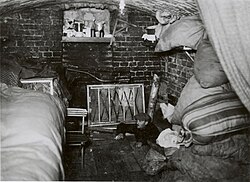
Gerlach estimates that 200,000 Jews survived in hiding across Europe.337 Knowledge of German intentions was essential to take action, but many struggled to believe the news.338 Many attempted to jump from trains or flee ghettos and camps, but successfully escaping and living in hiding was extremely difficult and often unsuccessful.339340341
The support, or at least absence of active opposition, of the local population was essential but often lacking in Eastern Europe.342 Those in hiding depended on the assistance of non-Jews.343 Having money,344 social connections with non-Jews, a non-Jewish appearance, perfect command of the local language, determination, and luck played a major role in determining survival.345 Jews in hiding were hunted down with the assistance of local collaborators and rewards offered for their denunciation.346322347 The death penalty was sometimes enforced on people hiding them, especially in eastern Europe.348349350 Rescuers' motivations varied on a spectrum from altruism to expecting sex or material gain; it was not uncommon for helpers to betray or murder Jews if their money ran out.351349352 Gerlach argues that hundreds of thousands of Jews may have died because of rumors or denunciations, and many others never attempted to escape because of a belief it was hopeless.353
Jews participated in resistance movements in most European countries, and often were overrepresented.354 Jews were not always welcome, particularly in nationalist resistance groups—some of which killed Jews.355356 Particularly in Belarus, with its favorable geography of dense forests, many Jews joined the Soviet partisans—an estimated 20,000 to 25,000 across the Soviet Union.357 An additional 10,000 to 13,000 Jewish non-combatants lived in family camps in Eastern European forests, of which the most well known was the Bielski partisans.358359
International reactions
The Nazi leaders knew that their actions would bring international condemnation.360 On 26 June 1942, BBC services in all languages publicized a report by the Jewish Social-Democratic Bund and other resistance groups and transmitted by the Polish government-in-exile, documenting the killing of 700,000 Jews in Poland. In December 1942, the Allies, then known as the United Nations, adopted a joint declaration condemning the systematic murder of Jews.361 Most neutral countries in Europe maintained a pro-German foreign policy during the war. Nevertheless, some Jews were able to escape to neutral countries, whose policies ranged from rescue to non-action.362
During the war the American Jewish Joint Distribution Committee (JDC) raised $70 million and in the years after the war it raised $300 million. This money was spent aiding emigrants and providing direct relief in the form of parcels and other assistance to Jews living under German occupation, and after the war to Holocaust survivors. The United States banned sending relief into German-occupied Europe after entering the war, but the JDC continued to do so. From 1939 to 1944, 81,000 European Jews emigrated with the JDC's assistance.363
Throughout the war, no detailed photo intelligence study was carried out on any of the major concentration or extermination camps.364 Appeals from Jewish representatives to the American and British governments to bomb rail lines leading to the camps or crematoriums was rejected, with little to no input from the War Departments of the United States or United Kingdom.365 However, debate exists on whether a military response would have impacted on the Holocaust.366
Second half of the war
Continuing killings
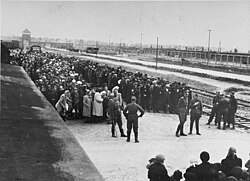
After German military defeats in 1943, it became increasingly evident that Germany would lose the war.368369 In early 1943, 45,000 Jews were deported from German-occupied northern Greece, primarily Salonica, to Auschwitz, where nearly all were killed.370 After Italy switched sides in late 1943, Germany deported several thousand Jews from Italy and the former Italian occupation zones of France, Yugoslavia, Albania, and Greece, with limited success.371372 Attempts to continue deportations in Western Europe after 1942 often failed because of Jews going into hiding and the increasing recalcitrance of local authorities.373 Most Danish Jews escaped to Sweden with the help of the Danish resistance in the face of a half-hearted German deportation effort in late 1943.374 Additional killings in 1943 and 1944 eliminated all remaining ghettos and most surviving Jews in Eastern Europe.200 Belzec, Sobibor, and Treblinka were shut down and destroyed.375376
The largest murder action after 1942 was that against the Hungarian Jews.377 After the German invasion of Hungary in 1944, the Hungarian government cooperated closely in the deportation of 437,000 Jews in eight weeks, mostly to Auschwitz.378367379 The expropriation of Jewish property was useful to achieve Hungarian economic goals and sending the Jews as forced laborers avoided the need to send non-Jewish Hungarians.380 Those who survived the selection were forced to provide construction and manufacturing labor as part of a last-ditch effort to increase the production of fighter aircraft.285381 Although the Nazis' goal of eliminating any Jewish population from Germany had largely been achieved in 1943, it was reversed in 1944 as a result of the importation of these Jews for labor.382
Death marches and liberation
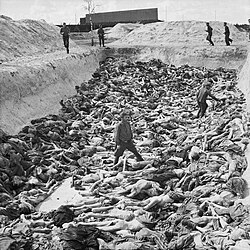
In July 1944, Soviet forces advancing through occupied Poland liberated Majdanek concentration camp, and the atrocities discovered there were publicized. Shortly after this, Heinrich Himmler ordered that all concentration camp prisoners be evacuated to the interior of the Reich. There were three primary motivations for this order. The SS did not want liberated inmates to fall into enemy hands and give testimony to the Allies. It also wanted to hold onto forced laborers to keep up armament production as much as possible. In addition, Himmler hoped to use Jewish concentration camp prisoners as hostages for a peace deal with the Western Allies that would preserve the Nazi regime as it continued to fight the Soviets. Over the summer and early autumn months of 1944, mass evacuations of concentration camp inmates were carried out by train, and in the case of the Baltics which had been cut off, by ship. However, as winter approached, Allied forces came closer to Germany's borders, and Allied air superiority grew, concentration camp inmates were increasingly evacuated on foot in forced marches. Weak and sick prisoners were often killed in the camp and those forced to evacuate were usually given no or inadequate food.383384385386387387 Those who could not keep up during the marches were shot.388 In October and November 1944, 90,000 Jews were deported from Budapest to the Austrian border.389390 The transfer of prisoners from Auschwitz began in mid-1944. The last mass gassing at a killing center during the Holocaust took place at Auschwitz in November 1944, after which the gas chambers were shut down and destroyed, and in January most of the remaining 67,000 Auschwitz prisoners were sent on a death march westwards.388391383392
In January 1945, more than 700,000 people were imprisoned in the concentration camp system, of whom as many as a third died before the end of the war.337 At this time, most concentration camp prisoners were Soviet and Polish civilians, either arrested for real or supposed resistance or for attempting to escape forced labor.337 The death marches led to the breakdown of supplies for the camps that continued to exist, causing additional deaths.393 Although there was no systematic killing of Jews during the death marches,394 around 70,000 to 100,000 Jews died in the last months of the war.395 Over the following months, Soviet forces liberated concetration camps as they pushed into the Baltics and Poland, by which time most prisoners had been evacuated, though some remained behind. Soviet troops liberated Auschwitz on 27 January 1945 and discovered a few thousand inmates still in the camp. Concentration camps in Germany, where the death march survivors were evacuated to, were liberated during the Western Allied invasion of Germany. The liberators found piles of corpses that they had to bulldoze into mass graves.396397398399 Some survivors were freed there398 and others had been liberated by the Red Army during its march westwards.400
Death toll
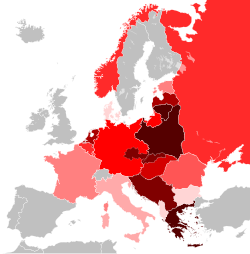
Around six million Jews were killed,401402403 with a conservative estimate being 5.7 million Jews killed by the Germans and Romanians, of which 5.4 million were killed under Nazi occupation.404 Of the six million victims, the vast majority of those killed were from Eastern Europe, and with half from Poland, and 2.6 million within the 1941 Soviet borders.405406404 Around 1.3 million Jews who had once lived under Nazi rule or in one of Germany's allies survived the war.407 One-third of the Jewish population worldwide, and two-thirds of European Jews, had been wiped out.408 Death rates varied widely due to a variety of factors and approached 100 percent in some areas.409 Some reasons why survival chances varied was the availability of emigration410 and protection from Germany's allies—which saved around 600,000 Jews.411 Jewish children and the elderly faced even lower survival rates than adults.412 It is considered to be the single largest genocide in human history.413414415
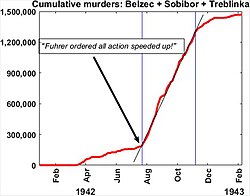
The deadliest phase of the Holocaust was Operation Reinhard, which was marked by the introduction of extermination camps. Roughly two million Jews in the General Government district of occupied Poland were killed from March 1942 to November 1943.416 Biologist Lewi Stone calculated that around 1.47 million Jews were murdered in Europe in just 100 days from late July to early November 1942, a rate that is approximately 83 percent higher than the commonly suggested figure for the Rwandan genocide.417 Between July and October 1942, two million Jews were murdered, including Operation Reinhard and other killings, with over three million Jews killed in 1942 alone, as stated by historian Christian Gerlach.418 Similarly, historian Alex J. Kay states that over two million Jews were murdered from late July to mid-November, and that "these three-and-a-half months were the most intense, the deadliest of the entire Holocaust".419 It was probably the fastest rate of genocidal killing in history.420
On 3 November 1943, around 18,400 Jews were murdered at Majdanek over the course of nine hours, in what was the largest number ever killed in a death camp on a single day.421 It was part of Operation Harvest Festival, the murder of some 43,000 Jews, the single largest massacre of Jews by German forces, occurring from 3 to 4 November 1943.422 In some countries, such as Hungary, Jews were a majority of civilian deaths; in Poland, they were either a majority423 or about half.406
Further Nazi persecutions from 1933 to 1945 killed a large number of non-Jewish civilians and POWs; estimated by Gerlach at 6 to 8 million, and at more than 10 million by Gilbert.424 The United States Holocaust Memorial Museum documents that several million non-Jewish victims, primarily Soviet prisoners of war and ethnic Poles, were killed in Nazi occupied Europe.425 Donald L. Niewyk and Francis R. Nicosia suggest the possibility of a broader definition of the Holocaust that includes as many as 17 million total victims.426 In countries such as the Soviet Union, France, Greece, and Yugoslavia, non-Jewish civilian losses outnumbered Jewish deaths.423
Aftermath and legacy
Return home and emigration
After liberation, many Jews attempted to return home. Limited success in finding relatives, the refusal of many non-Jews to return property,427 and violent attacks such as the Kielce pogrom convinced many survivors to leave eastern Europe.428398 Antisemitism was reported to increase in several countries after the war, in part due to conflicts over property restitution.429 When the war ended, there were less than 28,000 German Jews and 60,000 non-German Jews in Germany. By 1947, the number of Jews in Germany had increased to 250,000 owing to emigration from eastern Europe allowed by the communist authorities; Jews made up around 25 percent of the population of displaced persons camps.430 Although many survivors were in poor health, they attempted to organize self-government in these camps, including education and rehabilitation efforts.431 Due to the reluctance of other countries to allow their immigration, many survivors remained in Germany until the establishment of Israel in 1948.430 Others moved to the United States around 1950 due to loosened immigration restrictions.432
Criminal trials
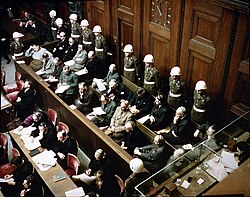
Most Holocaust perpetrators were never put on trial for their crimes.400 During and after World War II, many European countries launched widespread purges of real and perceived collaborators that affected possibly as much as 2–3 percent of the population of Europe, although most of the resulting trials did not emphasize crimes against Jews.433 Nazi atrocities led to the United Nations' Genocide Convention in 1948, but it was not used in Holocaust trials due to the non-retroactivity of criminal laws.434
In 1945 and 1946, the International Military Tribunal tried 23 Nazi leaders primarily for waging wars of aggression, which the prosecution argued was the root of Nazi criminality;435 nevertheless, the systematic murder of Jews came to take center stage.436 This trial and others held by the Allies in occupied Germany—the United States Army alone charged 1,676 defendants in 462 war crimes trials437—were widely perceived as an unjust form of political revenge by the German public.438 West Germany later investigated 100,000 people and tried more than 6,000 defendants, mainly low-level perpetrators.439440 The high-level organizer Adolf Eichmann was kidnapped and tried in Israel in 1961. Instead of convicting Eichmann on the basis of documentary evidence, Israeli prosecutors asked many Holocaust survivors to testify, a strategy that increased publicity but has proven controversial.441442
Reparations
Historians estimate that property losses to Jews of Germany, Austria, the Netherlands, France, Poland, and Hungary amounted to around 10 billion in 1944 dollars,443 or $180 billion in 2025.73 This estimate does not include the value of labor extracted.444 Overall, the amount of Jewish property looted by the Nazis was about 10 percent of the total stolen from occupied countries.444 Efforts by survivors to receive reparations for their losses began immediately after World War II. There was an additional wave of restitution efforts in the 1990s connected to the fall of Communism in eastern Europe.445
Between 1945 and 2018, Germany paid $86.8 billion in restitution and compensation to Holocaust survivors and heirs. In 1952, West Germany negotiated an agreement to pay DM 3 billion (around $714 million) to Israel and DM 450 million (around $107 million) to the Claims Conference.446 Germany paid pensions and other reparations for harm done to some Holocaust survivors.447 Other countries have paid restitution for assets stolen from Jews from these countries. Most Western European countries restored some property to Jews after the war, while communist countries nationalized many formerly Jewish assets, meaning that the overall amount restored to Jews has been lower in those countries.448449 Poland is the only member of the European Union that never passed any restitution legislation.450 Many restitution programs fell short of restoration of prewar assets, and in particular, large amounts of immovable property were never returned to survivors or their heirs.451452
Remembrance and historiography
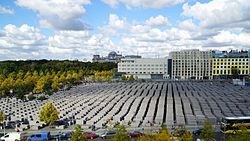
In the decades after the war, Holocaust memory was largely confined to the survivors and their communities.453 The popularity of Holocaust memory peaked in the 1990s after the fall of Communism, and became central to Western historical consciousness454455 as a symbol of the ultimate human evil.456 Genocide scholar A. Dirk Moses asserted that "the Holocaust has gradually supplanted genocide as modernity's icon of evil",457 while political scientist Scott Straus declared that "the Holocaust, perhaps more than any other event in the past century, represents the pinnacle of evil".458 The Holocaust has been described as "perhaps the most savage and significant single crime in recorded history" and that of the most barbaric events in the twentieth century "the Holocaust probably ranks as the very worst".459 Renowned German historian Wolfgang Benz described it as "the singularly most monstrous crime committed in the history of mankind".460 Holocaust education, in which its advocates argue promotes citizenship while reducing prejudice generally, became widespread at the same time.461462 International Holocaust Remembrance Day is commemorated each year on 27 January, while some other countries have set a different memorial day.463 It has been commemorated in memorials, museums, and speeches, as well as works of culture such as novels, poems, films, and plays.464 Holocaust denial is a criminal offense in some countries;465 though various Middle Eastern governments, figures and media promote it.
Although many are convinced that there are lessons or some kind of redemptive meaning to be drawn from the Holocaust, whether this is the case and what these lessons are is disputed.466467461 Communist states marginalized the topic of antisemitic persecution while eliding their nationals' collaboration with Nazism, a tendency that continued into the post-communist era.468469 In West Germany, a self-critical memory of the Holocaust developed in the 1970s and 1980s, and spread to some other western European countries.470 The national memories of the Holocaust were extended to the European Union as a whole, in which Holocaust memory has provided both shared history and an emotional rationale for committing to human rights. Participation in this memory is required of countries seeking entry.471472 In contrast to Europe, in the United States the memory of the Holocaust tends to be more abstract and universalized.473 During South African apartheid, the Holocaust was evoked widely and divergently, by Jews and non-Jews alike.474 Whether Holocaust memory actually promotes human rights is disputed.461475 In Israel, the memory of the Holocaust has been used at times to justify the use of force and violation of international human rights norms, in particular as part of the Israeli–Palestinian conflict.471
The Holocaust is the most well-known genocide in history, and is considered to be the single most infamous case of genocide in European history as well.476 It is the single most documented and studied genocide in history.477478 It is also seen as the archetype of genocide and the benchmark in genocide studies.479480
The scholarly literature on the Holocaust is massive, encompassing thousands of books.481 The tendency to see the Holocaust as a unique or incomprehensible event continues to be popular among the broader public after being largely rejected by historians.482483484 Scholar Omer Bartov points out how the Holocaust was unique in that it was "the industrial killing of millions of human beings in factories of death, ordered by a modern state, organized by a conscientious bureaucracy, and supported by a law-abiding, patriotic 'civilized' society."485 Another debate concerns whether the Holocaust emerged from Western civilization or was an aberration of it.486
The Jewish population still remains below pre-Holocaust levels. According to the Central Bureau of Statistics of Israel, the world Jewish population reached 15.2 million by the end of 2020—approximately 1.4 million less than on the eve of the Holocaust in 1939, when the number was 16.6 million.487
Notes
Notes
- Scholarly estimates fall in a range between 5.7 million and 6.2 million
- /ˈhɒləkɔːst/ ⓘ HOL-ə-kawst)1
- /ˈʃoʊə/ ⓘ SHOH-ə; Hebrew: שׁוֹאָה, romanized: Shoah, IPA: [ʃoˈʔa], lit. 'Catastrophe'
-
Bartov 2023a, pp. 18–19: "Much of this debate curiously boils down to a very specific historical question, namely, did the Nazis target the Jews for genocide in a manner that was essentially different from their treatment of any other group under their rule? ... There can be little doubt that the Jews played a singular role in the Nazi imaginaire and that German Jewish policies distinguished them within the Nazi universe of murder and fantasy; but other groups clearly have been similarly targeted in other genocides ... 'the extent of the 'final solution' was ... shaped by an antisemitism that was colored by a different element over and above the racism and ethno-nationalism that explains the murder of other groups by Nazi Germany—that element being the view of 'the Jews' as an implacable, collective world enemy.' To be sure, this makes the Holocaust unique only within the context of the Nazi empire ...."
Smith 2023, p. 36: "The Holocaust is particular to Jews and yet has had increasing relevance for those who do not identify as Jewish. ... All Jews everywhere were to be murdered because of their racial heritage was 'put into state policy' on January 20, 1942 at the Wannsee conference.... Witness to the genocide of the Jews is a uniquely Jewish experience, because only Jews were targeted by that policy, even if other groups were targeted for genocide under other policies. The Nazi regime committed genocide against the Roma and Sinti, governed by separate policies. They also committed war crimes against Soviet Prisoners of War under other policies. So too the mass murder of disabled and the mentally ill had their own policies. The Nazis committed multiple genocides and crimes against humanity, at the same time, sometimes in the same place, governed by different laws, policies, and practices. It is not correct to say that there were many victim types during 'the Holocaust,' if by 'the Holocaust' we mean the genocide of the Jews."
Stone 2023, "Introduction: What is the Holocaust?": "This is why the focus here is on the Jews. Roma, the disabled, Soviet POWs, homosexuals and other groups were victims of the Nazis, and it is entirely legitimate to study their fate alongside one another. But using the term 'Holocaust' to encompass all of these groups with the aim of being inclusive and not prioritizing one group's suffering, actually does a disservice to groups other than Jews. For the Nazis persecuted these groups for different reasons, reasons we fail to appreciate if we collapse them all together."
Engel 2021, pp. 3, 5: "This book is about an encounter between two sets of human beings: on one hand, the people who acted on behalf of the German state, its agencies, or its almost 66 million citizens between 30 January 1933 and 8 May 1945; on the other, the more than 9 million Jews ...." And: "Those discoveries about the encounter between the Third Reich and the Jews made that encounter stand out in the minds of many from other instances of Nazi persecution and encouraged observers to assign it its own special name."
Jackson 2021, pp. 199–200: "The Nazis killed some people almost exclusively due to their supposed genetic inferiority (the mentally and physically handicapped, Slavs, Roma); they killed others almost exclusively due to their perceived cultural decadence (communists, democrats, modernist authors and artists); but only the Jews were indicted on both grounds simultaneously and with equal vigor. ... This is not to say that Roma, communists, and others were not hated and murdered by the Nazis, but it is to note that the Jews were unique in being despised and assaulted in every dimension of their identity, corporeal and psychic."
Sahlstrom 2021, p. 291: "the established understanding of the Holocaust today as the genocide of six million Jews".
Bartrop 2019, p. 50: "it must always be remembered that the Holocaust was a premeditated action by the Nazis to permanently eradicate a Jewish presence in Europe. Others—the disabled, Roma, Poles and other Slavs, Jehovah's Witnesses, homosexuals, dissenting clergy, communists, socialists, 'asocials,' and political opponents of all sorts—were also persecuted and in many cases murdered in huge numbers; however, it was the campaign against the Jews that was the ideological 'ground zero' for Nazi racial ideology. Others besides Jews were murdered, often on a genocidal scale, and should be remembered and acknowledged: but it was only the Jews who were all to be killed as part of a calculated policy of genocide."
Beorn 2018, p. 4: "I will use the term 'Holocaust' to refer mainly to the Nazi attempt to murder the Jews of Europe; however, I will also use the more inclusive term 'Nazi genocidal project' to capture the larger murderous vision of which the Jews were such a large part. This includes Sinti/Roma (gypsies), the handicapped, political 'enemies,' Soviet prisoners of war, and—particularly in the East—entire ethnic groups such as the Slavs. One cannot understand the Holocaust in Eastern Europe without placing it in the context of this larger Nazi genocidal project that foresaw murder and demographic engineering on a colossal scale."
Cesarani 2016, p. xxxix: "This book deals with the fate of the Jews, not of 'other victims' of Nazi political repression and racial-biological policies. Several other groups endured social exclusion, incarceration in concentration camps, and mass murder. However, the rationale for the persecution of these groups differed radically from the intentions that underlay anti-Jewish policy. Even though homosexual men and women, Germans of African descent, and the severely mentally and physically disabled were all disparaged in Nazi racial thinking, and depicted as a threat to the strength and purity of the Volk, only the Jews were characterized as an implacable, powerful, global enemy that had to be fought at every turn and finally eliminated."
Hayes 2015, p. xiii: "This book also reflects another of its editor's convictions: the Holocaust was National Socialist Germany's assault on the Jews of Europe. Nazism attacked many groups, but none for the same reason that it attacked the Jews, none with the same urgency, and none to the same extent."
Hayes & Roth 2010, p. 2:
"Other groups—for example, Sinti and Roma, homosexuals, and Slavs—were swept up in the maelstrom of the Holocaust, but not for the same reasons as Jews and not with the same consequences .... In none of these cases, however, was the target group considered dangerous or coherent enough to warrant complete or immediate extirpation. This circumstance constitutes a significant difference from policies pursued toward the Jews, a difference that helps to clarify and define the Holocaust itself."
Stone 2010, pp. 1–2: "For the purpose of this book, the Holocaust is understood as the genocide of the Jews .... 'Holocaust', then, refers to the genocide of the Jews, which by no means excludes an understanding that other groups—notably Romanies and Slavs—were victims of genocide."
Bloxham 2009, p. 1: "Between 5,100,000 and 6,200,000 Jews were murdered during the Second World War, an episode the Nazis called the 'final solution of the Jewish question'. The world today knows it as the Holocaust."
Niewyk & Nicosia 2000, pp. 45, 51: "The Holocaust is commonly defined as the mass murder of more than 5,000,000 Jews by the Germans during World War II. Not everyone finds this a fully satisfactory definition." And: "the traditional view that it was the genocide of the Jews alone" -
King 2023, pp. 26–27: "Rather than one big thing, the Holocaust might now be described as an array of event categories. In Christopher Browning's terms, the Holocaust involved three separate "clusters of genocidal projects": euthanasia and "racial purification" directed against the disabled and Sinti and Roma (at the time referred to collectively as "Gypsies") within the Third Reich; the eradication of Slavic populations living in countries east of Germany; and the Final Solution proper—that is, the attempted mass murder of every Jew residing anywhere within Germany's sphere of influence (Browning 2010, 407). (The list of persecuted categories—people targeted by the Nazis in ways short of genocide—would of course be longer.)"
Engel 2021, p. 6: "Echoing this view, some have contended that the expression 'the Holocaust' ought to refer not only to the encounter between the Third Reich and the Jews but also to 'the horrors that Poles, other Slavs, and Gypsies endured at the hands of the Nazis' (Lukas, 1986: 220). Others have extended the term to encompass the Third Reich's treatment of homosexuals, the mentally ill or infrm, and Jehovah's Witnesses, speaking of 11 or 12 million victims of the Holocaust, half of whom were Jews. Still others have employed the word 'holocaust' also when referring to cases of mass murder not perpetrated by the Third Reich."
Kay 2021, pp. 1–2: "For perhaps the first time, all major victim groups where the death tolls reached at least into the tens of thousands will be considered together: Jewish and non-Jewish .... [I]t makes a great deal of sense to consider the different strands of Nazi mass killing together rather than in isolation from one another. This of course means going against the grain of most scholarship on the subject by examining the genocide of the European Jews alongside other Nazi mass-murder campaigns."
Gerlach 2016, pp. 14–15: "There are a number of words I will try to avoid because of the serious misconceptions they might lead to. The terms Holocaust and Shoah are not useful since neither has any analytical value. 'Holocaust' (derived from the Greek holókauton, or 'burned sacrifice') has a religious connotation unbefitting of the event it is supposed to refer to, and users of this term may mean by it either the persecution and murder of Jews alone, or Nazi German violence against any group more generally .... Importantly, Holocaust and Shoah have also been criticized as 'teleological and anachronistic' terms that convey a retrospective view that makes complex processes appear 'as a single event.'"
Niewyk & Nicosia 2000, p. 51: "The authors of this volume have adopted the third approach to a working definition: The Holocaust—that is, Nazi genocide—was the systematic, state-sponsored murder of entire groups determined by heredity. This applied to Jews, Gypsies, and the handicapped. This section also makes it clear that other definitions are defended by scholars who deserve a respectful hearing." - Equivalent to $400 million at the time,72 or $8 billion in 2025.73
- The Nazi concentration camp system administered by the SS Main Economic and Administrative Office (SS-WVHA)291 was administratively separate from other forced-labor camps292293 and from the single-purpose extermination camps.294
References
References
- Wells, John C. (2008). Longman Pronunciation Dictionary (3rd ed.). Longman. ISBN 978-1-4058-8118-0.
- Gerlach 2016, p. 14.
- Cesarani 2016, p. xxix.
- Niewyk & Nicosia 2000, pp. 45–52.
- Peck & Berenbaum 2002, p. 311.
- Stone 2023, Introduction: What is the Holocaust?.
- Calimani 2018, pp. 70–100, 78–79, 86–87, 94–95, xxix.
- Hayes & Roth 2010, p. 2.
- Beorn 2018, p. 4.
- Gerlach 2016, p. 15.
- Gilbert 2015, p. 22.
- Bergen 2016, pp. 14–17.
- Weitz 2010, p. 58.
- Gerlach 2016, pp. 20–21.
- Gerlach 2016, pp. 21–22.
- Bartov 2023b, p. 195.
- Beorn 2018, pp. 21–23.
- Beorn 2018, p. 25.
- Gerlach 2016, p. 146.
- Bartov 2023b, p. 196.
- Weitz 2010, p. 62.
- Gerlach 2016, p. 37.
- Weitz 2010, pp. 64–65.
- Beorn 2018, p. 24.
- Weitz 2010, p. 65.
- Bloxham 2009, p. 133.
- Bloxham 2009, p. 135.
- Bartov 2023b, p. 197.
- Gerlach 2016, p. 143.
- Beorn 2018, p. 57.
- Stone 2020, pp. 61, 65.
- Beorn 2018, p. 42.
- Bergen 2016, pp. 52–54.
- Stone 2020, pp. 62–63, 65.
- Stone 2010, p. 17.
- Evans 2019, pp. 120–121, 123.
- Beorn 2018, p. 59.
- Stone 2010, p. 18.
- Bloxham 2009, pp. 138–139.
- Beorn 2018, p. 33.
- Gerlach 2016, p. 151.
- Beorn 2018, pp. 33–34.
- Gerlach 2016, p. 39.
- Wachsmann 2015, pp. 32–38.
- Stone 2020, p. 66.
- Stone 2020, p. 67.
- Gerlach 2016, p. 55.
- Longerich 2010, pp. 47–48.
- Beorn 2018, p. 35.
- Bloxham 2009, p. 148.
- Stone 2020, p. 65.
- Gerlach 2016, p. 40.
- Cesarani 2016, p. 7.
- Longerich 2010, p. 43.
- Beorn 2018, p. 96.
- Gerlach 2016, pp. 39, 41.
- Longerich 2010, p. 52.
- Longerich 2010, pp. 52, 60.
- Gerlach 2016, p. 41.
- Cesarani 2016, p. 106.
- Gerlach 2016, p. 42.
- Gerlach 2016, pp. 43–44.
- Gerlach 2016, pp. 44–45.
- Gerlach 2016, p. 45.
- Gerlach 2016, p. 46.
- Cesarani 2016, pp. 184–185.
- Cesarani 2016, pp. 184, 187.
- Gerlach 2016, p. 44.
- Longerich 2010, p. 112.
- Cesarani 2016, p. 200.
- Longerich 2010, pp. 117, 119.
- Foreign Claims Settlement Commission 1968, p. 655.
- "Consumer Price Index, 1800–". Federal Reserve Bank of Minneapolis. Retrieved 29 November 2019.
- Gerlach 2016, p. 48.
- Gerlach 2016, pp. 49, 53.
- Gerlach 2016, p. 52.
- Gerlach 2016, p. 50.
- Gerlach 2016, p. 51.
- Gerlach 2016, pp. 332–334.
- Gerlach 2016, p. 49.
- Longerich 2010, pp. 109–110.
- Gerlach 2016, p. 56.
- Gerlach 2016, p. 57.
- Beorn 2018, p. 98.
- Beorn 2018, pp. 99, 101.
- Gerlach 2016, pp. 57–58.
- Beorn 2018, pp. 102–103.
- Hayes 2017, p. 241.
- Gerlach 2016, p. 58.
- Beorn 2018, pp. 46, 73.
- Beorn 2018, p. 86.
- Cesarani 2016, p. 362.
- Beorn 2018, pp. 89–90.
- Kay 2021, p. 38.
- Bergen 2016, p. 162.
- Kay 2021, p. 37.
- Cesarani 2016, p. 284.
- Gerlach 2016, p. 59.
- Kay 2021, pp. 37–38.
- Kay 2021, p. 254.
- Beorn 2018, p. 207.
- Kay 2021, p. 40.
- Longerich 2010, p. 148.
- Beorn 2018, p. 108.
- Beorn 2018, pp. 107–109.
- Bartov 2023b, p. 201.
- Longerich 2010, p. 164.
- Beorn 2018, pp. 109, 117.
- Gerlach 2016, p. 63, 437.
- Beorn 2018, pp. 87, 103.
- Beorn 2018, p. 116.
- Beorn 2018, p. 115.
- Miron 2020, pp. 247, 251, 254.
- Beorn 2018, p. 117.
- Miron 2020, p. 252.
- Miron 2020, p. 253.
- Miron 2020, pp. 253–254.
- Miron 2020, p. 254.
- Engel 2020, p. 240.
- Longerich 2010, p. 272.
- Cesarani 2016, pp. 314–315.
- Miron 2020, pp. 247–248.
- Westermann 2020, pp. 127–128.
- Gerlach 2016, p. 67.
- Cesarani 2016, p. 351.
- Gerlach 2016, p. 172.
- Beorn 2018, pp. 121–122.
- Bartov 2023b, pp. 201–202.
- Longerich 2010, p. 179.
- Beorn 2018, pp. 63–64.
- Gerlach 2016, p. 68.
- Longerich 2010, p. 180.
- Gerlach 2016, pp. 67–68.
- Beorn 2018, p. 67.
- Longerich 2010, pp. 181–182.
- Gerlach 2016, pp. 221–222.
- Bloxham 2009, pp. 182–183.
- Kay 2021, pp. 142, 294.
- Gerlach 2016, pp. 65.
- Beorn 2018, p. 125.
- Gerlach 2016, p. 72.
- Gerlach 2016, p. 5.
- Kay 2021, p. 294.
- Gerlach 2016, pp. 231–232.
- Kay 2021, p. 161.
- Gerlach 2016, p. 288.
- Kay 2021, p. 190.
- Gerlach 2016, pp. 297–298.
- Gerlach 2016, pp. 298–299.
- Gerlach 2016, p. 298.
- Kay 2021, pp. 182–183.
- Kay 2021, p. 182.
- Gerlach 2016, pp. 300, 310.
- Evans 2019, p. 120.
- Gerlach 2016, p. 78.
- Bartov 2023b, p. 204.
- Longerich 2010, p. 303.
- Gerlach 2016, pp. 79–80.
- Kay 2021, p. 199.
- Longerich 2010, p. 306.
- Gerlach 2016, pp. 84–85.
- Beorn 2018, p. 202.
- Gerlach 2016, p. 99.
- Beorn 2020, pp. 162–163.
- Kay 2021, pp. 13–14; Beorn 2018, p. 128.
- Gerlach 2016, pp. 72–73.
- Gerlach 2016, pp. 69, 440.
- Kopstein 2023, pp. 105, 107–108.
- Kopstein 2023, p. 107.
- Bartov 2023b, p. 202.
- Gerlach 2016, p. 69.
- Beorn 2018, p. 185.
- Beorn 2018, p. 129.
- Longerich 2010, p. 190.
- Gerlach 2016, p. 66.
- Beorn 2018, pp. 259–260.
- Beorn 2018, p. 132.
- Longerich 2010, p. 207.
- Gerlach 2016, pp. 69–70.
- Russell 2018, pp. 135–136.
- Gerlach 2016, p. 70.
- Bloxham 2009, p. 203.
- Bartov 2023b, p. 203.
- Gerlach 2016, p. 79.
- Gerlach 2016, p. 372.
- Bartov 2023b, p. 207.
- Stone 2010, p. 36.
- Gerlach 2016, p. 371.
- Gerlach 2016, p. 380.
- Longerich 2010, p. 224.
- Gerlach 2016, pp. 75–77.
- Longerich 2010, pp. 284–285.
- Gerlach 2016, p. 76.
- Longerich 2010, p. 286.
- Longerich 2010, pp. 298–299.
- Longerich 2010, p. 300.
- Beorn 2018, p. 142.
- Bartov 2023b, pp. 205–206.
- Gerlach 2016, p. 71.
- Beorn 2018, p. 128.
- Bergen 2016, p. 200.
- Beorn 2018, pp. 146–147.
- Longerich 2010, pp. 299–300, 331.
- Longerich 2010, p. 321.
- Gerlach 2016, p. 97.
- Welch 2020, p. 460.
- Gerlach 2016, pp. 375–376.
- Gerlach 2016, pp. 96–97.
- Gerlach 2016, p. 366.
- De Bengy, Raphael (18 February 2015). "Mohamed Mesli : « Mon père, l'imam sauveur de juifs »" [Mohamed Mesli: "My father, the imam who saved the Jews"]. Le Parisien (in French). Retrieved 26 May 2024.
- Gerlach 2016, pp. 95–96, 387.
- Gerlach 2016, p. 257.
- Longerich 2010, pp. 324, 360.
- Stone 2010, pp. 33–34.
- Gerlach 2016, pp. 373, 379.
- Longerich 2010, pp. 325–326.
- Stone 2010, p. 35.
- Gerlach 2016, pp. 306, 368, 372.
- Longerich 2010, pp. 366, 389.
- Longerich 2010, p. 392.
- Gerlach 2016, pp. 97, 102, 371–372.
- Longerich 2010, p. 396.
- Gerlach 2016, p. 387.
- Gerlach 2016, p. 105.
- Gerlach 2016, pp. 115–116, 382.
- Longerich 2010, p. 279.
- Gerlach 2016, p. 74.
- Beorn 2018, p. 209.
- Longerich 2010, pp. 290–291.
- Beorn 2018, p. 210.
- Peter Longerich, Holocaust, the Nazi Persecution and Murder of the Jews, p. 280
- Henry Friedlander The Origins of Nazi Genocide, From Euthanasia to the Final Solution, pp. 96, 99
- Longerich 2010, pp. 280, 293–294, 302.
- Longerich 2010, pp. 280–281, 292.
- Gerlach 2016, pp. 208–209.
- Longerich 2010, pp. 281–282.
- Browning 2004, pp. 526–527.
- Bergen 2016, pp. 247, 251.
- Gerlach 2016, pp. 286–287.
- Kay 2021, p. 204.
- Gerlach 2016, p. 283.
- Kay 2021, pp. 204–205.
- Longerich 2010, p. 330.
- Stone 2010, pp. 153–154.
- Gerlach 2016, p. 199.
- Gerlach 2016, p. 211.
- Borkin, Joseph (1978). The Crime and Punishment of IG Farben. New York City: Free Press. ISBN 978-0-02-904630-2.
- Weindling, Paul; von Villiez, Anna; Loewenau, Aleksandra; Farron, Nichola (2016). "The victims of unethical human experiments and coerced research under National Socialism". Endeavour. 40 (1). Elsevier BV: 1–6. doi:10.1016/j.endeavour.2015.10.005. ISSN 0160-9327. PMC 4822534. PMID 26749461.
- Gerlach 2016, p. 273.
- Kay 2021, p. 209.
- Gerlach 2016, p. 274.
- Gerlach 2016, p. 121.
- Kay 2021, p. 247.
- Gerlach 2016, p. 111.
- Kay 2021, p. 208.
- Gerlach 2016, p. 120.
- Gerlach 2016, pp. 74, 120.
- Lehnstaedt 2021, p. 63.
- Gerlach 2016, pp. 93–94, 120.
- Gerlach 2016, p. 91.
- Gerlach 2016, p. 243.
- Kay 2021, p. 200.
- Longerich 2010, p. 342.
- Beorn 2018, p. 220.
- Longerich 2010, p. 340.
- Longerich 2010, p. 339.
- Longerich 2010, p. 338.
- Bartov 2023b, p. 209.
- Longerich 2010, pp. 335–336.
- Kay 2021, p. 203.
- Longerich 2010, p. 337.
- Longerich 2010, p. 343.
- Gerlach 2016, pp. 93, 249.
- Longerich 2010, p. 352.
- Longerich 2010, pp. 338, 352–353.
- Longerich 2010, pp. 341, 353–354.
- Engel 2020, pp. 241–242.
- Gerlach 2016, p. 110.
- Longerich 2010, pp. 378–380.
- Gerlach 2016, p. 214.
- Dean 2020, pp. 265, 267.
- Spoerer 2020, pp. 141–143.
- Spoerer 2020, pp. 142–143.
- Gerlach 2016, pp. 196–197.
- Spoerer 2020, p. 142.
- Gerlach 2016, p. 207.
- Spoerer 2020, p. 143.
- Dean 2020, p. 270.
- Longerich 2010, pp. 379, 383.
- Dean 2020, pp. 271–272.
- Wachsmann 2015, p. 290.
- Wachsmann 2015, p. 456.
- Dean 2020, p. 274.
- Wachsmann 2015, p. 293.
- Dean 2020, pp. 265, 272.
- Dean 2020, p. 265.
- Dean 2020, pp. 264–265.
- Gerlach 2016, p. 194.
- Gerlach 2016, p. 187.
- Gerlach 2016, p. 189.
- Gerlach 2016, pp. 189–190.
- Gerlach 2016, p. 195.
- Gerlach 2016, pp. 392–393.
- Herbermann, Nanda; Baer, Hester; Roberts Baer, Elizabeth (2000). The Blessed Abyss (Google Books). Detroit: Wayne State University Press. pp. 33–34. ISBN 0-8143-2920-9. Retrieved 12 January 2011.
- Lenten, Ronit (2000). Israel and the Daughters of the Shoah: Reoccupying the Territories of Silence. Berghahn Books. pp. 33–34. ISBN 1-57181-775-1..
- Ostrowska, Joanna; Zaremba, Marcin (30 May 2009). "Do burdelu, marsz!" [To the brothel, march!]. Polityka (in Polish). Vol. 22, no. 2707. pp. 70–72. Archived from the original on 5 December 2010.
- "'Sonderbehandlung erfolgt durch Strang'" [Special treatment is done by train]. ns-archiv.de (in German).
- Hertzstein, Robert Edwin (1978). The War That Hitler Won: The Most Infamous Propaganda Campaign in History. Putnam. ISBN 9780399118456.
- Gellately, Robert (2001). Backing Hitler: Consent and Coercion in Nazi Germany. Oxford University Press. p. 155. doi:10.1093/acprof:oso/9780198205609.001.0001. ISBN 9780191676697.
- Majer, Diemut (2014). "Non-Germans" Under the Third Reich. Texas Tech University Press. p. 369. ISBN 978-0896728370.
- Kay 2021, p. 2.
- Westermann 2020, p. 117.
- Burzlaff 2020, p. 1055.
- Bloxham 2009, p. 264.
- Westermann 2020, pp. 124–125.
- Bloxham 2009, p. 265.
- Westermann 2020, p. 121.
- Bloxham 2009, p. 269.
- Bartov 2023b, p. 213.
- Bartov 2023b, p. 211.
- Bloxham 2009, p. 280.
- Beorn 2018, p. 260.
- Burzlaff 2020, pp. 1064, 1066.
- Bloxham 2009, p. 281.
- Beorn 2018, pp. 259, 264.
- Burzlaff 2020, p. 1067.
- Gerlach 2016, p. 13.
- Wachsmann 2015, pp. 340, 376–377.
- Wachsmann 2015, p. 379.
- Gerlach 2016, p. 340.
- Gerlach 2016, p. 450.
- Gerlach 2016, p. 349.
- Beorn 2020, p. 166.
- Gerlach 2016, pp. 334–335.
- Messenger 2020, p. 383.
- "List of Major Companies Involved in the Concentration Camps". www.jewishvirtuallibrary.org. Retrieved 13 March 2025.
- Gerlach 2016, p. 117.
- Gerlach 2016, pp. 424–425.
- Beorn 2018, p. 236.
- Burzlaff 2020, p. 1064.
- Gerlach 2016, p. 413.
- Beorn 2018, pp. 236–237.
- Gerlach 2016, p. 419.
- Gerlach 2016, p. 420.
- Gerlach 2016, p. 423.
- Longerich 2010, p. 382.
- Burzlaff 2020, p. 1066.
- Gerlach 2016, p. 360.
- Bartov 2023b, p. 206.
- Beorn 2018, p. 269.
- Beorn 2018, pp. 269–270.
- Burzlaff 2020, pp. 1065, 1075.
- Gerlach 2016, p. 417.
- Gerlach 2016, p. 290.
- Cesarani 2016, p. 648.
- Beorn 2018, p. 242.
- Beorn 2018, pp. 237, 242–243.
- Beorn 2018, p. 243.
- Burzlaff 2020, p. 1074.
- Evans 2019, p. 140.
- Láníček 2012, pp. 74–75, 81.
- Messenger 2020, p. 393.
- "American Jewish Joint Distribution Committee and Refugee Aid". United States Holocaust Memorial Museum. Archived from the original on 29 September 2023. Retrieved 28 April 2023.
- Neufeld & Berenbaum 2000, p. 55.
- Neufeld & Berenbaum 2000, p. 61.
- Neufeld & Berenbaum 2000, p. 2.
- Longerich 2010, p. 408.
- Bergen 2016, p. 266.
- Gerlach 2016, p. 196.
- Longerich 2010, p. 391.
- Longerich 2010, pp. 402–403.
- Gerlach 2016, p. 113.
- Gerlach 2016, p. 102.
- Gerlach 2016, p. 302.
- Longerich 2010, pp. 410–412.
- Beorn 2018, p. 221.
- Gerlach 2016, p. 103.
- Gerlach 2016, pp. 114, 368.
- Beorn 2018, p. 193.
- Gerlach 2016, p. 114.
- Wachsmann 2015, p. 457.
- Gerlach 2016, p. 188.
- Death Marches
- An Architect of Terror: Heinrich Himmler and the Holocaust
- Longerich 2010, pp. 414–418.
- Gerlach 2016, p. 116.
- Kay 2021, p. 234.
- Longerich 2010, p. 415.
- Longerich 2010, pp. 409–410.
- Dean 2020, p. 272.
- Kay 2021, p. 233.
- Germans Stop Gassings at Auschwitz
- Longerich 2010, p. 414.
- Kay 2021, p. 235.
- Longerich 2010, p. 418.
- Stone 2020, p. 69.
- Priemel 2020, p. 178.
- Bartov 2023b, p. 215.
- Liberation of Nazi Camps
- Bartov 2023b, p. 214.
- Landau, Ronnie S. (2016). The Nazi Holocaust: Its History and Meaning (3rd ed.). I.B. Tauris. pp. 3, 124, 126, 265–266. ISBN 978-0-85772-843-2.
- Benz, Wolfgang (2023). Der Holocaust (in German) (10th ed.). Munich, Germany: C. H. Beck. pp. 14, 111–112. ISBN 978-3-406-80881-4.
- Herf, Jeffrey C. (2024). "The Long Term and the Short Term: Antisemitism and the Holocaust". In Weitzman, Mark; Williams, Robert J.; Wald, James (eds.). The Routledge History of Antisemitism (1st ed.). Abingdon and New York: Routledge. p. 278. doi:10.4324/9780429428616. ISBN 978-1-138-36944-3.
- Snyder 2010, p. 335.
- Beorn 2018, p. 1.
- Bergen 2016, p. 155.
- Gerlach 2016, p. 404.
- "Jewish Population of Europe in 1945". United States Holocaust Memorial Museum. Retrieved 10 May 2023.
- Gerlach 2016, p. 407.
- Gerlach 2016, pp. 407–408.
- Gerlach 2016, pp. 118, 409–410.
- Gerlach 2016, pp. 428–429.
- Rosenberg, Alan (1979). "The Genocidal Universe: A Framework for Understanding the Holocaust". European Judaism: A Journal for the New Europe. 13 (1): 29–34. ISSN 0014-3006. JSTOR 41442658.
- Krammer, Arnold (2010). War Crimes, Genocide, and the Law: A Guide to the Issues. Contemporary Military, Strategic, and Security Issues. Praeger. p. 60. ISBN 978-0-313-35937-8.
- Richie, Alexandra (27 January 2024). "The Origins of International Holocaust Remembrance Day". The National WWII Museum | New Orleans. Retrieved 11 April 2024.
- Yad Vashem (2013). "Aktion Reinhard" (PDF). Shoah Resource Center, The International School for Holocaust Studies. Document size 33.1 KB. Retrieved 31 October 2013.
- Stone, Lewi (2019). "Quantifying the Holocaust: Hyperintense kill rates during the Nazi genocide". Science Advances. 5 (1) eaau7292. Bibcode:2019SciA....5.7292S. doi:10.1126/sciadv.aau7292. ISSN 2375-2548. PMC 6314819. PMID 30613773.
- Gerlach 2016, p. 100.
- Kay 2021, p. 207.
- Stone 2023, p. 191.
- Stone 2023, p. 210.
- "Aktion 'Erntefest' (Operation 'Harvest Festival')". United States Holocaust Memorial Museum. Archived from the original on 4 June 2024. Retrieved 12 April 2024.
- Gerlach 2016, p. 3.
- Gilbert, Martin (2014). "Epilogue - 'I will tell the world'". The Holocaust: The Human Tragedy. Rosetta Books. ISBN 978-0-7953-3719-2.
As well as the six million Jews who were murdered, more than ten million other non-combatants were killed by the Nazis.
- "Documenting numbers of victims of the Holocaust and Nazi persecution". United States Holocaust Memorial Museum.
- Niewyk & Nicosia 2000, p. 45.
- Beorn 2018, pp. 273–274.
- Beorn 2018, pp. 275–276.
- Gerlach 2016, pp. 353–355.
- Kochavi 2010, p. 509.
- Kochavi 2010, pp. 512–513.
- Kochavi 2010, p. 521.
- Priemel 2020, p. 174.
- Wittmann 2010, p. 524.
- Priemel 2020, p. 176.
- Priemel 2020, p. 177.
- Wittmann 2010, p. 525.
- Wittmann 2010, p. 534.
- Priemel 2020, p. 184.
- Wittmann 2010, pp. 534–535.
- Priemel 2020, pp. 182–183.
- Bartov 2023b, pp. 215–216.
- Goschler & Ther 2007, p. 7.
- Hayes 2010, p. 548.
- Goschler & Ther 2007, pp. 13–14.
- "The JUST Act Report: Germany". United States Department of State. Retrieved 2 May 2023.
- Hayes 2010, pp. 549–550.
- Bazyler et al. 2019, pp. 482–483.
- Hayes 2010, p. 552.
- Bazyler et al. 2019, p. 487.
- Bazyler et al. 2019, p. 485.
- Hayes 2010, p. 556.
- Assmann 2010, p. 97.
- Assmann 2010, pp. 98, 107.
- Rosenfeld 2015, pp. 15, 346.
- Assmann 2010, p. 110.
- Moses, A. Dirk (2021). The Problems of Genocide: Permanent Security and the Language of Transgression (1st ed.). Cambridge University Press. pp. 481–482. ISBN 978-1-107-10358-0.
- Straus, Scott (2022). Graziosi, Andrea; Sysyn, Frank E. (eds.). Genocide: The Power and Problems of a Concept. McGill-Queen's University Press. p. 240. ISBN 978-0-2280-0951-1.
- Landau, Ronnie S. (2016). The Nazi Holocaust: Its History and Meaning (3rd ed.). I.B. Tauris. pp. 3, 287. ISBN 978-0-85772-843-2.
- Benz, Wolfgang (1999). The Holocaust: A German Historian Examines the Genocide (1st ed.). New York: Columbia University Press. p. 2. ISBN 0-231-11215-7.
- Stone 2010, p. 288.
- Sutcliffe 2022, p. 8.
- Assmann 2010, p. 104.
- Rosenfeld 2015, p. 14.
- Priemel 2020, p. 185.
- Rosenfeld 2015, p. 93.
- Bartov 2023b, pp. 190–191.
- Rosenfeld 2015, p. 22.
- Bartov 2023b, p. 191.
- Kansteiner 2017, pp. 306–307.
- Kansteiner 2017, p. 308.
- Assmann 2010, pp. 100, 102–103.
- Assmann 2010, p. 103.
- Gilbert, Shirli (2010). "Jews and the Racial State: Legacies of the Holocaust in Apartheid South Africa, 1945–60". Jewish Social Studies. 16 (3): 32. doi:10.2979/jewisocistud.16.3.32.
- Kansteiner 2017, p. 305.
- Lieberman, Benjamin (2013). The Holocaust and Genocides in Europe (1st ed.). Bloomsbury Publishing. pp. 9, 138, 161, 230. ISBN 978-1-4411-4655-7.
- Rummel, R.J. (1998). "The Holocaust in Comparative and Historical Perspective". The Journal of Social Issues. 3 (2).
- Aharon, Eldad Ben (2020). How Do We Remember the Armenian Genocide and the Holocaust? A Global View of an Integrated Memory of Perpetrators, Victims and Third-party Countries (PDF). Frankfurt am Main: Peace Resesarch Institute Frankfurt. p. 3. ISBN 978-3-946459-59-0. Archived from the original (PDF) on 17 February 2024.
- Boender, Barbara; ten Have, Wichert, eds. (2012). The Holocaust and Other Genocides: An Introduction (1st ed.). Amsterdam: Amsterdam University Press. pp. 7–10. ISBN 978-90-8964-381-0.
- Moses, A. Dirk (2021). The Problems of Genocide: Permanent Security and the Language of Transgression (1st ed.). Cambridge University Press. pp. 18–19, 34, 204, 396, 452, 480. ISBN 978-1-107-10358-0.
- Stone 2010, p. 6.
- Stone 2010, pp. 206–207.
- Rosenfeld 2015, p. 119.
- Sutcliffe 2022, p. 2.
- Bartov, Omer (2003). Germany's War and the Holocaust. Cornell University Press. p. 135. ISBN 978-0801486814.
- Stone 2010, pp. 163, 219, 239.
- "World Jewish population nears pre-Holocaust numbers at 15.2 million". The Jerusalem Post. 25 April 2022. ISSN 0792-822X. Retrieved 30 June 2024.
Works cited
Books
- Bartrop, Paul R. (2019). The Holocaust: The Basics. Routledge. ISBN 978-1-351-32989-7.
- Bartov, Omer (2023a). Genocide, the Holocaust and Israel-Palestine: First-Person History in Times of Crisis. Bloomsbury Publishing. ISBN 978-1-350-33234-8.
- Bazyler, Michael J.; Boyd, Kathryn Lee; Nelson, Kristen L. (2019). Searching for Justice After the Holocaust: Fulfilling the Terezin Declaration and Immovable Property Restitution. Oxford University Press. ISBN 978-0-19-092306-8.
- Beorn, Waitman Wade (2018). The Holocaust in Eastern Europe: At the Epicenter of the Final Solution. Bloomsbury Academic. ISBN 978-1-4742-3219-7.
- Bergen, Doris (2016). War & Genocide: A Concise History of the Holocaust. Rowman & Littlefield. ISBN 978-1-4422-4228-9.
- Bloxham, Donald (2009). The Final Solution: A Genocide. Oxford University Press. ISBN 978-0-19-955034-0.
- Calimani, Anna Vera Sullam (2018). I Nomi dello sterminio: Definizioni di una tragedia [The Names of Extermination: Definitions of a Tragedy] (in Italian). Marietti 1820. ISBN 978-8-821-19615-7.
- Browning, Christopher R. (2004). The Origins of the Final Solution: The Evolution of Nazi Jewish Policy, September 1939–March 1942. University of Nebraska Press and Yad Vashem. ISBN 978-0-8032-0392-1.
- Cesarani, David (2016). Final Solution: The Fate of the Jews 1933–1949. St. Martin's Press. ISBN 978-0-230-76891-8.
- Engel, David (2021). The Holocaust: The Third Reich and the Jews. Routledge. ISBN 978-0-429-77837-7.
- Foreign Claims Settlement Commission (1968). Foreign Claims Settlement Commission of the United States: Decisions and Annotations. Washington, D.C.: U.S. Government Printing Office. OCLC 1041397012.
- Gilbert, Martin (2015) [2000]. Never Again: A History of the Holocaust. RosettaBooks. ISBN 978-0-7953-4674-3.
- Gerlach, Christian (2016). The Extermination of the European Jews. Cambridge University Press. ISBN 978-0-521-70689-6.
- Hayes, Peter (2017). Why? Explaining the Holocaust. New York: W. W. Norton & Company.
- Hayes, Peter (2015). How Was It Possible?: A Holocaust Reader. University of Nebraska Press. ISBN 978-0-8032-7491-4.
- Jackson, Timothy P. (2021). Mordecai Would Not Bow Down: Anti-Semitism, the Holocaust, and Christian Supersessionism. Oxford University Press. ISBN 978-0-19-753807-4.
- Kay, Alex J. (2021). Empire of Destruction: A History of Nazi Mass Killing. Yale University Press. ISBN 978-0-300-26253-7.
- Longerich, Peter (2010). Holocaust: The Nazi Persecution and Murder of the Jews. Oxford University Press. ISBN 978-0-19-280436-5.
- Neufeld, Michael; Berenbaum, Michael (2000). The Bombing of Auschwitz: Should the Allies have attempted it?. New York: University Press of Kansas. ISBN 0-7006-1280-7.
- Niewyk, Donald L.; Nicosia, Francis R. (2000). The Columbia Guide to the Holocaust. Columbia University Press. ISBN 978-0-231-52878-8.
- Peck, Abraham J.; Berenbaum, Michael, eds. (2002). The Holocaust and History: The Known, the Unknown, the Disputed, and the Reexamined. Indiana University Press. ISBN 978-0-253-21529-1.
- Rosenfeld, Gavriel D. (2015). Hi Hitler! How the Nazi Past is Being Normalized in Contemporary Culture. Cambridge University Press. ISBN 978-1-107-07399-9.
- Russell, Nestar (2018). Understanding Willing Participants. Vol. 2: Milgram's Obedience Experiments and the Holocaust. Springer. doi:10.1007/978-3-319-97999-1. ISBN 978-3-319-97999-1. S2CID 151138604.
- Smith, Stephen D. (2023). The Trajectory of Holocaust Memory: The Crisis of Testimony in Theory and Practice. Taylor & Francis. ISBN 978-1-000-83062-0.
- Snyder, Timothy (2010). Bloodlands. Basic Books. ISBN 978-0465031474.
- Stone, Dan (2010). Histories of the Holocaust. Oxford University Press. ISBN 978-0-19-956679-2.
- Stone, Dan (2023). The Holocaust: An Unfinished History. Penguin Publishing Group. ISBN 978-0-241-38870-9.
- Wachsmann, Nikolaus (2015). KL: A History of the Nazi Concentration Camps. Farrar, Straus and Giroux. ISBN 978-0-374-11825-9.
Book chapters
- Assmann, Aleida (2010). "The Holocaust – a Global Memory? Extensions and Limits of a New Memory Community". Memory in a Global Age: Discourses, Practices and Trajectories. Palgrave Macmillan UK. pp. 97–117. ISBN 978-0-230-28336-7.
- Bartov, Omer (2023b). "The Holocaust". The Oxford History of the Third Reich. Oxford University Press. pp. 190–216. ISBN 978-0-19-288683-5.
- Beorn, Waitman Wade (2020). "All the Other Neighbors: Communal Genocide in Eastern Europe". A Companion to the Holocaust. Wiley. pp. 153–172. ISBN 978-1-118-97052-2.
- Dean, Martin C. (2020). "Survivors of the Holocaust within the Nazi Universe of Camps". A Companion to the Holocaust. John Wiley & Sons. pp. 263–277. ISBN 978-1-118-97049-2.
- Engel, David (2020). "A Sustained Civilian Struggle: Rethinking Jewish Responses to the Nazi Regime". A Companion to the Holocaust. Wiley. pp. 233–245. ISBN 978-1-118-97052-2.
- Evans, Richard J. (2019). "The Decision to Exterminate the Jews of Europe". The Jews, the Holocaust, and the Public: The Legacies of David Cesarani. Springer International Publishing. pp. 117–143. ISBN 978-3-030-28675-0.
- Goschler, Constantin; Ther, Philipp (2007). "Introduction: A History Without Boundaries: the Robbery and Restitution of Jewish Property in Europe". Robbery and Restitution: The Conflict over Jewish Property in Europe. Berghahn Books. pp. 1–18. ISBN 978-0-85745-564-2.
- Hayes, Peter; Roth, John K. (2010). "Introduction". The Oxford Handbook of Holocaust Studies. Oxford University Press. pp. 1–20. ISBN 978-0-19-921186-9.
- Hayes, Peter (2010). "Plunder and Restitution". The Oxford Handbook of Holocaust Studies. Oxford University Press. pp. 540–559. ISBN 978-0-19-921186-9.
- Kansteiner, Wulf (2017). "Transnational Holocaust Memory, Digital Culture and the End of Reception Studies". The Twentieth Century in European Memory: Transcultural Mediation and Reception. Brill. pp. 305–343. ISBN 978-90-04-35235-3.
- King, Charles (2023). "Can – or Should – There Be a Political Science of the Holocaust?". In Kopstein, Jeffrey S. (ed.). Politics, Violence, Memory: The New Social Science of the Holocaust. Cornell University Press. ISBN 978-1-5017-6676-3.
- Kochavi, Arieh J. (2010). "Liberation and Dispersal". The Oxford Handbook of Holocaust Studies. Oxford University Press. pp. 509–523. ISBN 978-0-19-921186-9.
- Kopstein, Jeffrey S. (2023). "A Common History of Violence?: The Pogroms of Summer 1941 in Comparative Perspective". Politics, Violence, Memory: The New Social Science of the Holocaust. Cornell University Press. pp. 104–123. ISBN 978-1-5017-6676-3.
- Messenger, David A. (2020). "The Geopolitics of Neutrality: Diplomacy, Refuge, and Rescue during the Holocaust". A Companion to the Holocaust. Wiley. pp. 381–396. ISBN 978-1-118-97052-2.
- Miron, Guy (2020). "Ghettos and Ghettoization – History and Historiography". A Companion to the Holocaust. Wiley. pp. 247–261. ISBN 978-1-118-97052-2.
- Priemel, Kim Christian (2020). "War Crimes Trials, the Holocaust, and Historiography, 1943–2011". A Companion to the Holocaust. Wiley. pp. 173–189. ISBN 978-1-118-97052-2.
- Sahlstrom, Julia (2021). "Recognition, Justice, and Memory: Swedish-Jewish Reactions to the Holocaust and the Major Trials". In Heuman, Johannes; Rudberg, Pontus (eds.). Early Holocaust Memory in Sweden: Archives, Testimonies and Reflections. The Holocaust and its Contexts. Springer International Publishing. pp. 287–313. doi:10.1007/978-3-030-55532-0_11. ISBN 978-3-030-55532-0. S2CID 229432191. Retrieved 28 January 2024.
- Spoerer, Mark (2020). "The Nazi War Economy, the Forced Labor System, and the Murder of Jewish and Non-Jewish Workers". A Companion to the Holocaust. Wiley. pp. 135–151. ISBN 978-1-118-97052-2.
- Stone, Dan (2020). "Ideologies of Race". A Companion to the Holocaust. Wiley. pp. 59–74. doi:10.1002/9781118970492.ch3. ISBN 978-1-118-97052-2.
- Weitz, Eric D. (2010). "Nationalism". The Oxford Handbook of Holocaust Studies. Oxford University Press. pp. 54–67. ISBN 978-0-19-921186-9.
- Westermann, Edward B. (2020). "Old Nazis, Ordinary Men, and New Killers: Synthetic and Divergent Histories of Perpetrators". A Companion to the Holocaust. Wiley. pp. 117–133. ISBN 978-1-118-97052-2.
- Wittmann, Rebecca (2010). "Punishment". The Oxford Handbook of Holocaust Studies. Oxford University Press. pp. 524–539. ISBN 978-0-19-921186-9.
Journal articles
- Burzlaff, Jan (2020). "Confronting the Communal Grave: a Reassessment of Social Relations During the Holocaust in Eastern Europe". The Historical Journal. 63 (4): 1054–1077. doi:10.1017/S0018246X19000566.
- Láníček, Jan (2012). "Governments-in-exile and the Jews during and after the Second World War". Holocaust Studies. 18 (2–3): 73–94. doi:10.1080/17504902.2012.11087307.
- Lehnstaedt, Stephan (2021). "Aktion Reinhardt – Sources, Research and Commemoration in the last 30 years". Témoigner. Entre histoire et mémoire. Revue pluridisciplinaire de la Fondation Auschwitz. 132 (132): 62–70. doi:10.4000/temoigner.9886. ISSN 2031-4183. S2CID 256347577.
- Sutcliffe, Adam (2022). "Whose Feelings Matter? Holocaust Memory, Empathy, and Redemptive Anti-Antisemitism". Journal of Genocide Research. 26 (2): 222–242. doi:10.1080/14623528.2022.2160533.
- Welch, Susan (2020). "Gender and Selection During the Holocaust: Transports of Western European Jews to the East". Journal of Genocide Research. 22 (4): 459–478. doi:10.1080/14623528.2020.1764743.