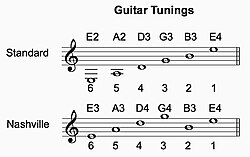
Nashville tuning (also high-strung) is the practice of replacing the heavy lower strings of a guitar with lighter ones that sound an octave higher.34
The six strings of a guitar are normally tuned to the notes E2-A2-D3-G3-B3-E4.1 The lowest four strings, numbers 6–3, are wound. On a high-strung guitar, these strings are replaced with lighter gauge strings, often from the higher string from each course of a twelve-string guitar set.5
Because the note names are the same, the chord shapes do not change, making high-strung guitars relatively easy to play for most guitarists. The resulting sound is bright and distinctive.6 It is common practice for sessions in Nashville to have a rhythm guitarist playing in Nashville tuning.2
The practice emerged in the 1950s. Ray Edenton is often mistakenly credited with inventing it after he broke a string. Edenton recalls that he merely adopted the practice from Chet Atkins. The high-strung sound became a signature in Edenton's prolific session work.6
Pink Floyd used Nashville tuning on "Hey You", as did Kansas on "Dust in the Wind".7 David Gilmour slightly modified the practice by using identical high Es for both the 6th and the 1st string of his Ovation Custom Legend.8 Mick Taylor plays in Nashville tuning on the Rolling Stones' "Wild Horses". "Jumpin' Jack Flash" featured two acoustic guitars overdriven through a cassette recorder. The main riff is played on a guitar in open tuning. The second part is played on a high-strung guitar.9 James Williamson used Nashville tuning on "Gimme Danger"10 on Raw Power by the Stooges. Elliott Smith used a variant of Nashville tuning with a twelve-string guitar on XO for the song "Tomorrow Tomorrow."11 Andy Fairweather Low used a high-strung guitar on his 1975 UK hit single "Wide Eyed and Legless", taken from his La Booga Rooga album.1213 The Smiths used Nashville tuning on "William, It Was Really Nothing" and "The Headmaster Ritual".141516
Pat Metheny is known for using Nashville tuning on several occasions, notably his song "Phase Dance" from his group's debut album.1714 Metheny also applied a "half-Nashville tuning" to a baritone guitar, where the 3rd and 4th string only are raised an octave.18 Frank Gambale uses a version of Nashville tuning a fifth lower.18
References
References
- Adler, Samuel. The Study of Orchestration. W.W. Norton, 1989. 105.
- Weissman, Dick. Guitar Tunings: A Comprehensive Guide. Taylor & Francis Group, 2006. xiii, 76ff.
- Leslie, Jimmy. "High Chimes and Crisp Demeanors." Guitar Player, vol. 54, no. 1. January 2020. 88.
- "High-strung/ Nashville tuning" (PDF). Daddario.com. Archived from the original on 2018-06-30. Retrieved 2017-03-05.
{{cite web}}: CS1 maint: bot: original URL status unknown (link) - McLean, Terri Bocklund. New Harmonies: Choosing Contemporary Music for Worship. Bloomsbury Academic, 1999. 97.
- Young, Doug. "String 'Em High!" Acoustic Guitar, vol. 18, no. 3, Sept., 2007, pp. 98-101.
- "Kansas' Kerry Livgren Shares The Story Behind "Dust In The Wind"". Guitarworld.com. Archived from the original on 2015-03-30. Retrieved 2017-03-05.
{{cite web}}: CS1 maint: bot: original URL status unknown (link) - Guesdon, Jean-Michel and Philippe Margotin. Pink Floyd All the Songs: The Story Behind Every Track. Workman Publishing Company, 2017. 489.
- "Jumping Jack Flash". July 2, 2007. Archived from the original on 2007-07-02.
- "The Stooges' James Williamson – Guitar Moves – Episode 1". YouTube. 13 May 2013. Retrieved 2017-03-05.
- ""Heaven Adores You" Elliott Smith Documentary". Video.billboard.com. Retrieved 2017-03-05.
- La Booga Rooga (record sleeve). UK: A&M Records. 1975.
- William Ruhlmann. "La Booga Rooga – Andy Fairweather Low | Songs, Reviews, Credits". AllMusic. Retrieved 2017-03-05.
- "What is Nashville Tuning? - Strings Direct". Strings Direct -. March 14, 2019.
- "The Smiths' 20 greatest guitar moments, ranked". August 17, 2021.
- Songs That Saved Your Life – the Art of the Smiths 1982–87 (Revised ed.). Titan Books. February 2013. ISBN 978-1-78116-259-0.
- "Pat Metheny: Question & Answer". www.patmetheny.com. Retrieved 2018-09-26.
- Jones, Lee A. (2018). Exploration of Unorthodox Tunings and Muscle Memory Practice for the Electric Guitar (Thesis). University of Salford. p. 12. Retrieved 21 January 2026.