| Hexagon prism | |
|---|---|
 | |
| Type | prism, parallelohedron |
| Symmetry group | prismatic symmetry of order 24 |
| Dual polyhedron | hexagonal bipyramid |

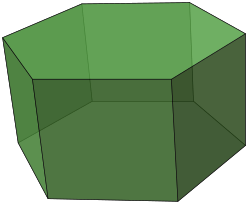
In geometry, the hexagonal prism is a prism with hexagonal base. this polyhedron has 8 faces, 18 edges, and 12 vertices.
Properties
A hexagonal prism has twelve vertices, eighteen edges, and eight faces. Every prism has two faces known as its bases, and the bases of a hexagonal prism are hexagons. The hexagons has six vertices, each of which pairs with another hexagon's vertex, forming six edges. These edges form three parallelograms as other faces.1 A prism is said to be right if the edges are of the same length and perpendicular to the base.
If faces are all regular, the hexagonal prism is a semiregular polyhedron—more generally, a uniform polyhedron—and the fourth in an infinite set of prisms formed by square sides and two regular polygon caps. It can be seen as a truncated hexagonal hosohedron, represented by Schläfli symbol t{2,6}. Alternately it can be seen as the Cartesian product of a regular hexagon and a line segment, and represented by the product {6}×{}. The symmetry group of a right hexagonal prism is prismatic symmetry of order 24, consisting of rotation around an axis passing through the regular hexagon bases' center, and reflection across a horizontal plane.2 The dual of a hexagonal prism is a hexagonal bipyramid, both of which have the same three-dimensional symmetry group.
As in most prisms, the volume is found by taking the area of the base, with a side length of , and multiplying it by the height , giving the formula:3 and its surface area is by summing the area of two regular hexagonal bases and the lateral faces of six squares:
Honeycombs
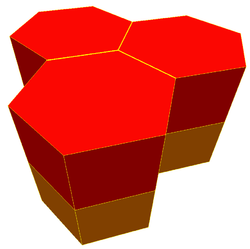
The hexagonal prism is one of the parallelohedra, a polyhedral class that can be translated without rotations in Euclidean space, producing honeycombs; this class was discovered by Evgraf Fedorov in accordance with his studies of crystallography systems. The hexagonal prism is generated from four line segments, three of them parallel to a common plane and the fourth not.4 Its most symmetric form is the right prism over a regular hexagon, forming the hexagonal prismatic honeycomb.5
The hexagonal prism also exists as cells of four prismatic uniform convex honeycombs in 3 dimensions:
Triangular-hexagonal prismatic honeycomb     
|
Snub triangular-hexagonal prismatic honeycomb
|
Rhombitriangular-hexagonal prismatic honeycomb
|

|

|

|
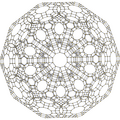
It also exists as cells of a number of four-dimensional uniform 4-polytopes, including:




References
References
- Pugh, Anthony (1976), Polyhedra: A Visual Approach, University of California Press, pp. 21, 27, 62, ISBN 9780520030565.
- Flusser, J.; Suk, T.; Zitofa, B. (2017), 2D and 3D Image Analysis by Moments, John Wiley & Sons, p. 126, ISBN 978-1-119-03935-8
- Wheater, Carolyn C. (2007), Geometry, Career Press, pp. 236–237, ISBN 9781564149367
- Alexandrov, A. D. (2005), "8.1 Parallelohedra", Convex Polyhedra, Springer, pp. 349–359
- Delaney, Gary W.; Khoury, David (February 2013), "Onset of rigidity in 3D stretched string networks", The European Physical Journal B, 86 (2): 44, Bibcode:2013EPJB...86...44D, doi:10.1140/epjb/e2012-30445-y
External links
External links
- Uniform Honeycombs in 3-Space VRML models
- The Uniform Polyhedra
- Virtual Reality Polyhedra The Encyclopedia of Polyhedra Prisms and antiprisms
- Weisstein, Eric W. "Hexagonal prism". MathWorld.
- Hexagonal Prism Interactive Model -- works in your web browser