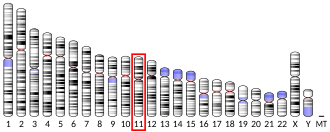
Hepatocellular carcinoma, down-regulated 1 is a protein that in humans is encoded by the HEPN1 gene.3
Function
This gene is expressed in the liver, and encodes a short peptide that is localized predominantly to the cytoplasm. Transient transfection studies showed that expression of this gene significantly inhibited cell growth, and it may have a role in apoptosis. Expression of this gene is downregulated or lost in hepatocellular carcinomas (HCC), suggesting that loss of this gene is involved in carcinogenesis of hepatocytes.4 Also to note is that this gene maps to the 3'-noncoding region of the HEPACAM gene (GeneID:220296) on the antisense strand.5
References
References
- GRCh38: Ensembl release 89: ENSG00000221932 – Ensembl, May 2017
- "Human PubMed Reference:". National Center for Biotechnology Information, U.S. National Library of Medicine.
-
"Entrez Gene: Hepatocellular carcinoma, down-regulated 1". Retrieved 2017-09-12.
- Moh MC, Lee LH, Yang X, Shen S (2003). "HEPN1, a novel gene that is frequently down-regulated in hepatocellular carcinoma, suppresses cell growth and induces apoptosis in HepG2 cells". J Hepatol. 39 (4): 580–6. doi:10.1016/s0168-8278(03)00359-3. PMID 12971969.
- Chung Moh M, Hoon Lee L, Shen S (2005). "Cloning and characterization of hepaCAM, a novel Ig-like cell adhesion molecule suppressed in human hepatocellular carcinoma". J Hepatol. 42 (6): 833–41. doi:10.1016/j.jhep.2005.01.025. PMID 15885354.
Further reading
Further reading
This article incorporates text from the United States National Library of Medicine, which is in the public domain.