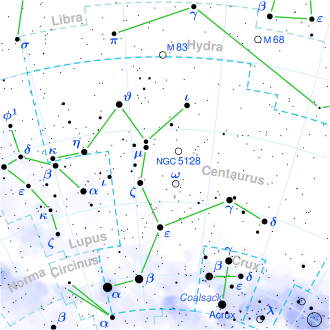
  | |
| Observation data Epoch J2000.0 Equinox J2000.0 | |
|---|---|
| Constellation | Centaurus1 |
| Right ascension | 14h 43m 39.44s2 |
| Declination | −35° 10′ 25.2″2 |
| Apparent magnitude (V) | +4.063 |
| Characteristics | |
| Evolutionary stage | red giant branch4 |
| Spectral type | K3III3 |
| U−B color index | +1.53 |
| B−V color index | +1.3563 |
| Variable type | none |
| Astrometry | |
| Radial velocity (Rv) | −38 km/s |
| Proper motion (μ) | RA: −61.46±0.152 mas/yr Dec.: −176.84±0.142 mas/yr |
| Parallax (π) | 15.57±0.16 mas2 |
| Distance | 209 ± 2 ly (64.2 ± 0.7 pc) |
| Absolute magnitude (MV) | −0.203 |
| Details | |
| Mass | 1.235 M☉ |
| Radius | 256 R☉ |
| Luminosity | 1745 L☉ |
| Surface gravity (log g) | 1.867 cgs |
| Temperature | 4,2405 K |
| Metallicity [Fe/H] | −0.205 dex |
| Other designations | |
| HR 5485, HD 129456, CD−34°9868, FK5 544, HIP 72010, SAO 205871, GC 198208 | |
| Database references | |
| SIMBAD | data |
HD 129456, also known by its Bayer designation c1 Centauri (c1 Cen), is a star in the constellation Centaurus. c¹ Centauri is an orange K-type giant with an apparent magnitude of +4.06. It is approximately 209 light years from Earth.
References
References
- Roman, Nancy G. (1987). "Identification of a constellation from a position". Publications of the Astronomical Society of the Pacific. 99 (617): 695. Bibcode:1987PASP...99..695R. doi:10.1086/132034. Constellation record for this object at VizieR.
- van Leeuwen, Floor (13 August 2007). "Validation of the new Hipparcos reduction". Astronomy & Astrophysics. 474 (2): 653–664. arXiv:0708.1752. Bibcode:2007A&A...474..653V. doi:10.1051/0004-6361:20078357. eISSN 1432-0746. ISSN 0004-6361. Vizier catalog entry
- Jasniewicz, G.; et al. (February 1999). "Late-type giants with infrared excess. I. Lithium abundances". Astronomy and Astrophysics. 342: 831–838. Bibcode:1999A&A...342..831J.
- Jura, M. (1999). "Dust around First-Ascent Red Giants". The Astrophysical Journal. 515 (2): 706. Bibcode:1999ApJ...515..706J. doi:10.1086/307064.
- Charbonnel, C.; Lagarde, N.; Jasniewicz, G.; North, P. L.; Shetrone, M.; Krugler Hollek, J.; Smith, V. V.; Smiljanic, R.; Palacios, A.; Ottoni, G. (2020). "Lithium in red giant stars: Constraining non-standard mixing with large surveys in the Gaia era". Astronomy and Astrophysics. 633: A34. arXiv:1910.12732. Bibcode:2020A&A...633A..34C. doi:10.1051/0004-6361/201936360.
- Stassun, Keivan G.; et al. (2019). "The Revised TESS Input Catalog and Candidate Target List". The Astronomical Journal. 158 (4): 138. arXiv:1905.10694. Bibcode:2019AJ....158..138S. doi:10.3847/1538-3881/ab3467.
- Allende Prieto, C.; Lambert, D. L. (1999). "Fundamental parameters of nearby stars from the comparison with evolutionary calculations: Masses, radii and effective temperatures". Astronomy and Astrophysics. 352: 555. arXiv:astro-ph/9911002. Bibcode:1999A&A...352..555A.
- "HD 129456". SIMBAD. Centre de données astronomiques de Strasbourg. Retrieved 2025-05-22.