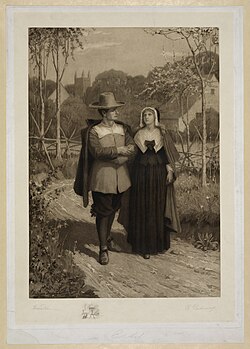
Handfasting (Irish: ceangal na lámh, lit. 'binding of the hands'; Scottish Gaelic: pòsadh-bliadhna, lit. 'year-marriage'1 [ˈpʰɔːs̪əɣ ˈb̥liən̪ˠə]) is a traditional marriage or betrothal practice in which a couple make a pledge by joining, clasping, or symbolically binding their hands.
The terminology and practice are associated with several medieval and early modern European contexts, including Ireland, Scotland, England, and Germanic-speaking regions. In Ireland and Scotland, modern usage often connects handfasting with Gaelic and Celtic-inspired marriage customs; in England, the term was historically used for betrothal or irregular marriage; and in later Scottish tradition it was associated with temporary or probationary marriage.
Etymology
The verb to handfast in the sense of "to formally promise, to make a contract" is recorded for Late Old English, especially in the context of a contract of marriage. The derived handfasting as for a ceremony of engagement or betrothal, is recorded in Early Modern English. The term was presumably loaned into English from Old Norse handfesta "to strike a bargain by joining hands"; there are also comparanda from the Ingvaeonic languages: Old Frisian hondfestinge and Middle Low German hantvestinge. The term is derived from the verb to handfast, used in Middle to Early Modern English for the making of a contract.2 In modern Dutch, "handvest" is the term for "pact" or "charter" (e.g., "Atlantisch handvest", "Handvest der Verenigde Naties"); cf. also the Italian loan word manifesto in English.
Ireland
In Ireland, handfasting is commonly associated in modern usage with Gaelic and Celtic-inspired wedding traditions, particularly the symbolic joining or binding of a couple's hands. In Irish, the ritual may be described as Irish: ceangal na lámh, lit. 'binding of the hands', a descriptive phrase based on Irish: ceangal, lit. 'binding, tie' and Irish: lámh, lit. 'hand'.3
The evidence for medieval Irish marriage customs is broader than the modern hand-binding ceremony. Early Irish law treated marriage as a contractual and property relationship, with legal texts distinguishing several forms of Irish: lánamnas, lit. 'marriage union' according to the contributions of the spouses to marital property.4 Donnchadh Ó Corráin notes that early Irish legal sources divide principal marriages into categories including Irish: lánamnas comthinchuir, lit. 'marriage of common contribution', Irish: lánamnas for ferthinchur, lit. 'marriage on man-contribution', and Irish: lánamnas for bantinchur, lit. 'marriage on woman-contribution'.5
In medieval Ireland, marriage practice existed within overlapping Gaelic legal custom and western Christian canon law. Art Cosgrove notes that medieval Ireland was divided between areas under English law and Gaelic Irish areas where older brehon law still operated.6 Under canon law, the matrimonial bond was created by the freely given consent of the two parties, preferably expressed publicly, but a public ceremony was not required for validity.7 Gaelic Irish marriage behaviour, however, was repeatedly criticised by medieval church reformers because older Irish legal custom allowed practices such as divorce, remarriage, and forms of union that did not fully conform to canon-law marriage.8
Modern claims that handfasting was a fixed, universal, pre-Christian Irish wedding rite are difficult to verify from the surviving legal and ecclesiastical evidence. A more cautious interpretation is that modern Irish handfasting draws on older Gaelic concepts of contractual marriage, public consent, and symbolic binding, while the specific ribbon- or cord-binding ceremony is largely a modern ceremonial form.
Scotland
In Scotland, handfasting was used in several related but distinct senses, including formal betrothal, irregular marriage, and, in some later Highland and Hebridean accounts, a temporary or probationary union. The Scottish Gaelic term Scottish Gaelic: pòsadh-bliadhna, lit. 'year-marriage' refers specifically to the latter idea of a marriage or union lasting for a year.9
One recorded elite example occurred in February 1539, when Marie Pieris, a French lady-in-waiting to Mary of Guise, was married by handfasting to Lord Seton at Falkland Palace. The ceremony appears in the Scottish royal accounts through a payment to an apothecary for his work on the day of "Lord Seytounis handfasting".10
Separate from such formal handfasting ceremonies, later sources describe a custom in parts of the Hebrides, especially Skye, in which a couple might live together for a year before entering a permanent marriage. Martin Martin, writing in the late seventeenth century, described an island custom by which a man could take a woman as his wife for a year and then either marry her permanently or return her to her parents.11 This type of account is commonly linked with the later idea of handfasting as a "year and a day" or trial marriage, although the extent, legal status, and antiquity of the custom remain disputed.
The issue also intersected with efforts to regulate Highland and Island society. The Statutes of Iona of 1609 and subsequent regulations sought to suppress practices regarded by authorities as disorderly or irregular, including marriages contracted for limited terms. The article currently states that those disregarding this regulation were to be punished "as fornicators"; this should remain, but should be placed after the Martin Martin/Skye material because it concerns the regulation of that alleged temporary-marriage practice rather than handfasting generally.
Scottish marriage law also recognised forms of irregular marriage for longer than English law did. Even where the Kirk disapproved of marriages formed by mutual consent and subsequent sexual intercourse, Scottish civil law could still recognise them. Public ceremony and witnesses reduced later disputes. Irregular marriage remained part of Scots law until reforms in the twentieth century, with the article currently noting the Marriage (Scotland) Act 1939 as the point at which handfasting was no longer recognised as a legal form of marriage.12
Historians have disagreed over whether Scottish handfasting should be treated as evidence of a distinct institution of trial marriage. A. E. Anton argued in 1958 that the popular idea of Scottish handfasting as trial marriage rested heavily on late and romanticised sources, especially Thomas Pennant and Walter Scott.13 However, Martin Martin's seventeenth-century account predates Pennant by almost a century. A cautious summary is therefore that temporary unions were reported in some Highland and Island sources, but that their relationship to the broader legal and ceremonial practice of handfasting remains contested.
Medieval and Tudor England
The Fourth Lateran Council (1215) forbade clandestine marriage, and required marriages to be publicly announced in churches by priests. In the sixteenth century, the Council of Trent legislated more specific requirements, such as the presence of a priest and two witnesses, as well as promulgation of the marriage announcement thirty days prior to the ceremony. These laws did not extend to the regions affected by the Protestant Reformation. In England, clergy performed many clandestine marriages, such as so-called Fleet Marriage, which were held legally valid;a and in Scotland, unsolemnised common-law marriage was still valid.
From about the 12th to the 17th century, "handfasting" in England was simply a term for "engagement to be married", or a ceremony held on the occasion of such a contract, usually about a month prior to a church wedding, at which the marrying couple formally declared that each accepted the other as spouse. Handfasting was legally binding: as soon as the couple made their vows to each other they were validly married. It was not a temporary arrangement. Just as with church weddings of the period, the union which handfasting created could only be dissolved by death. English legal authorities held that even if not followed by intercourse, handfasting was as binding as any vow taken in church before a priest.15
During handfasting, the man and woman, in turn, would take the other by the right hand and declare aloud that they there and then accepted each other as husband and wife. The words might vary but traditionally consisted of a simple formula such as "I (Name) take thee (Name) to my wedded husband/wife, till death us depart, and thereto I plight thee my troth".15 Because of this, handfasting was also known in England as "troth-plight".15 Gifts were often exchanged, especially rings:bc a gold coin broken in half between the couple was also common. Other tokens recorded include gloves, a crimson ribbon tied in a knot, and even a silver toothpick.15 Handfasting might take place anywhere, indoors or out.15 It was frequently in the home of the bride, but according to records handfastings also took place in taverns, in an orchard and even on horseback. The presence of a credible witness or witnesses was usual.15
For much of the relevant period, church courts dealt with marital matters. Ecclesiastical law recognised two forms of handfasting, sponsalia per verba de praesenti and sponsalia per verba de futuro. In sponsalia de praesenti, the most usual form, the couple declared they there and then accepted each other as man and wife. The sponsalia de futuro form was less binding, as the couple took hands only to declare their intention to marry each other at some future date. The latter was closer to a modern engagement and could, in theory, be ended with the consent of both parties – but only providing intercourse had not occurred. If intercourse did take place, then the sponsalia de futuro "was automatically converted into de iure marriage".15
Despite the validity of handfasting, it was expected to be solemnised by a church wedding fairly soon afterwards. Penalties might follow for those who did not comply.19 Ideally the couple were also supposed to refrain from intercourse until then.15 Complaints by preachers suggest that they often did not wait,15 but at least until the early 1600s the common attitude to this kind of anticipatory behaviour seems to have been lenient.d
Handfasting remained an acceptable way of marrying in England throughout the Middle Ages but declined in the early modern period.20 In some circumstances handfasting was open to abuse, with persons who had undergone "troth-plight" occasionally refusing to proceed to a church wedding, creating ambiguity about their former betrothed's marital status.15 Shakespeare negotiated and witnessed a handfasting in 1604, and was called as a witness in the suit Bellott v Mountjoy about the dowry in 1612. Historians speculate that his own marriage to Anne Hathaway was so conducted when he was a young man in 1582, as the practice still had credence in Warwickshire at the time.1521
After the beginning of the 17th century, gradual changes in English law meant the presence of an officiating priest or magistrate became necessary for a marriage to be legal.22 Finally the 1753 Marriage Act, aimed at suppressing clandestine marriages by introducing more stringent conditions for validity, effectively ended the handfasting custom in England.23
Neopaganism
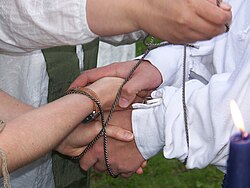
The term "handfasting" or "hand-fasting" was appropriated into modern Celtic neopaganism and Wicca for wedding ceremonies from at least the late 1960s, apparently first used in print by Hans Holzer.24
Handfasting was mentioned in the 1980 Jim Morrison biography No One Here Gets Out Alive and again in the 1991 film The Doors, where a version of the real 1970 handfasting ceremony of Morrison and Patricia Kennealy25 was depicted (with the actual Kennealy-Morrison portraying the Celtic neopagan priestess).25
Handfasting ribbon
The term has entered the English-speaking mainstream, most likely from neopagan wedding ceremonies during the early 2000s, often erroneously being described as "pre-Christian" by wedding planners.26 Evidence that the term "handfasting" had been re-interpreted as describing this ceremony specifically is found in the later 2000s, e.g. "handfasting—the blessed marriage rite in which the hands of you and your beloved are wrapped in ribbon as you 'tie the knot'."27
By the 2010s, "handfasting ceremonies" were on offer by commercial wedding organizers and had mostly lost their neopagan association (apart from occasional claims that attributes the ceremony to the "ancient Celts").28 The term "handfasting ribbon" appears from about 2005.29
-
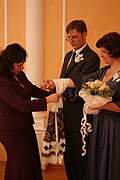 Civil wedding ceremony in Ukraine. The cloth is a ceremonial rushnyk decorated with traditional Ukrainian embroidery.
 -
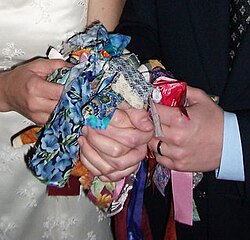 An example of a modern handfasting knot where each wedding guest has tied a ribbon around the clasped hands of the couple.
See also
See also
Notes
Notes
- In 1601 the poet John Donne married clandestinely in a private room where only he, his bride, his friend Christopher Brooke and Brooke's brother Samuel, a clergyman, were present. No banns were called and the bride's parents did not give consent; nevertheless, the bride's father did not later legally dispute the validity of the marriage.14
- The rings might be plain – one was made on the spot out of a rush lying on the floor – or elaborate. They often had a posy engraved. One surviving example is a "gimmal" ring, a double ring which twists apart to become two rings interlinked. It is in the shape of two clasped hands and has the posy "As handes doe shut/so hart be knit."1617
- Some rings incorporated "memento mori" devices, to remind the wearer the marriage was till death.18
- In Shakespeare's 1604 comedy Measure for Measure a young man sleeps with his betrothed wife before his church wedding. Judged technically guilty of fornication, under puritanical laws he is condemned to die. The plot is driven by the need to rescue him, and audience sympathy is clearly expected to be on his side.
References
References
- "pòsadh-bliadhna". Am Faclair Beag. Retrieved 29 December 2025.
- "handfast". Oxford English Dictionary (Online ed.). Oxford University Press. (Subscription or participating institution membership required.), n., v. and adj. and "handfasting". Oxford English Dictionary., v. and n. "Old Norse hand-festa to strike a bargain by joining hands, to pledge, betroth" The earliest cited English use in connection with marital status is from a manuscript of c. 1200, when Mary is described as "handfast (to) a good man called Joseph". "?c1200 Ormulum (Burchfield transcript) l. 2389 "Ȝho wass hanndfesst an god mann Þatt iosæp wass ȝehatenn."
- "Ceangal". Teanglann. Foras na Gaeilge. Retrieved 7 May 2026.
- Ó Corráin, Donnchadh. "Marriage in Early Ireland". CELT: Corpus of Electronic Texts. University College Cork. Retrieved 7 May 2026.
- Ó Corráin, Donnchadh. "Marriage in Early Ireland". CELT: Corpus of Electronic Texts. University College Cork. Retrieved 7 May 2026.
- Cosgrove, Art. "Marriage in Medieval Ireland". History Ireland. Retrieved 7 May 2026.
- Cosgrove, Art. "Marriage in Medieval Ireland". History Ireland. Retrieved 7 May 2026.
- Cosgrove, Art. "Marriage in Medieval Ireland". History Ireland. Retrieved 7 May 2026.
- "pòsadh-bliadhna". Am Faclair Beag. Retrieved 29 December 2025.
- Paul, James Balfour (1907). Accounts of the Treasurer of Scotland. Vol. 7. Edinburgh. p. 140.
{{cite book}}: CS1 maint: location missing publisher (link) - Martin, Martin (1703). A Description of the Western Islands of Scotland. London: Andrew Bell. p. 114.
- [existing citation]
- Anton, A. E. (1958). "'Handfasting' in Scotland". The Scottish Historical Review. 37 (124): 89–102. JSTOR 25526477.
- Colclough, David (May 2011). "Donne, John (1572–1631)". Donne, John (1572–1631), poet and Church of England clergyman. Oxford Dictionary of National Biography (online ed.). Oxford University Press. doi:10.1093/ref:odnb/7819. Retrieved 23 April 2012.
- Nicholl, Charles (2007). "Chapter 27: A handfasting". The Lodger: Shakespeare on Silver Street. London: Allen Lane. pp. 251-258. ISBN 978-0-713-99890-0.
- Richardson, Catherine (2011). Shakespeare and Material Culture. Oxford Shakespeare Topics. Oxford: Oxford University Press. p. 2. ISBN 978-0-19-956228-2.
- Cooper, Tarnya (2006). Searching for Shakespeare. Yale University Press. p. 87. ISBN 978-0-300-11611-3.
- Scarisbrick, Diana (1995). Tudor and Jacobean Jewellery. Tate Publishing.
[Thomas Gresham's] wedding-ring has a twin 'gimmal' hoop inscribed in Latin 'Let not man put asunder those whom God has joined together', and beneath the ruby and diamond bezel there are cavities enclosing an infant and a skeleton alluding to the vanity of riches.
- Laurence, Anne (1994). Women in England, 1500–1760: A Social History. London: Phoenix Press.
A public church marriage was necessary to ensure the inheritance of property.
- Laurence, Anne (1994). Women in England, 1500–1760: A Social History. London: Phoenix Press.
Between the mid-sixteenth century and the mid-seventeenth century the number of spousal actions in the church courts declined markedly, partly because of the increasing belief that the only proper form of marriage was one solemnized in church.
- Greer, Germaine (2009). Shakespeare's Wife. Harper Perennial. pp. 108-110. ISBN 978-0747590194.
- Laurence, Anne (1994). Women in England, 1500–1760: A Social History. London: Phoenix Press.
- Laurence, Anne (1994). Women in England, 1500–1760: A Social History. London: Phoenix Press.
From 1754...Pre-contracts (promises to marry someone in the future) and oral spousals ceased to have any force...
- "My wife and I were married by the handfasting ceremony, and it was most controversial." – Hans Holzer, The Truth about Witchcraft (1969), p. 172; "Then I learned that the "special meeting" was, in effect, a wedding ceremony called "hand-fasting" in Wicca." Hans Holzer, Heather: confessions of a witch, Mason & Lipscomb, 1975, p. 101.
- Kennealy, Patricia (1992). Strange Days: My Life With And Without Jim Morrison. New York: Dutton/Penguin. p. 63. ISBN 0-525-93419-7.
- Mary Neasham, Handfasting: A Practical Guide. Green Magic, 2000, ISBN 9780954296315
- cover blurb of Kendra Vaughan Hovey, Passages Handfasting: A Pagan Guide to Commitment Rituals, Adams Media, 2007.
- Wendy Haynes, "Handfasting Ceremonies" (wendyhaynes.com), January 2010: "It was used to acknowledge the beginning of a trial period of a year and a day during which time a couple were literally bound together – hand fasted."
- Handfasting ribbon, finished Archived 2014-10-25 at the Wayback Machine (wormspit.com) 4 July 2005; Jacquelyn Frank, Jacob: The Nightwalkers, Zebra Books, 2006, p. 320.
- Probert, Rebecca (2009). Marriage Law and Practice in the Long Eighteenth Century: A Reassessment. Cambridge: Cambridge University Press. ISBN 978-0521516150.
- Nicolson, Alexander (1930). History of Skye. 60 Aird Bhearnasdail, by Portree, Isle of Skye: MacLean Press. pp. 73, 86, 120.
{{cite book}}: CS1 maint: location (link) - Wilson, Rachel (2015). "Chapter 1". Elite Women in Ascendancy Ireland, 1690-1745: Imitation and Innovation. Woodbridge: Boydell and Brewer. ISBN 978-1-78327-039-2.
- Stearns, Peter N. Encyclopedia of European Social History: from 1350 to 2000. Scribner, 2001.
- Dolan, Frances E. Renaissance Quarterly, vol. 50, no. 2, 1997, pp. 653–655. JSTOR, www.jstor.org/stable/3039244.