Hand games are games played using only the hands of the players.1 Hand games exist in a variety of cultures internationally, and are of interest to academic studies in ethnomusicology and music education.12 Hand games are used to teach music literacy skills and socio-emotional learning in elementary music classrooms internationally.345
Examples of hand games
- Arm wrestling
- Bloody knuckles
- Chopsticks (sticks)
- The circle game
- Clapping games (Pat-a-cake and variations like Mary Mack)
- Fingerhakeln
- Hand cricket
- Mercy
- Morra (finger counting)
- Odds and evens
- Red hands (or hand-slap game)
- Rock paper scissors
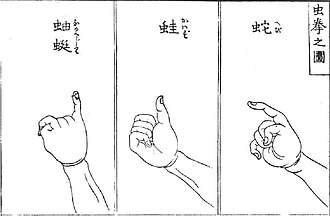
- Sansukumi-ken
- Thumb war (or thumb wrestling)
- "Where are your keys?" (language acquisition game)
Less strictly, the following may be considered hand games:
- Fingers (drinking game, but debatable since game can be played without the drink)
- Jacks (uses jacks)
- Knife game (uses knife)
- Spellbinder (uses paper and pencil)
- Stick gambling (uses a stick)
- String games, such as cat's cradle
References
References
- Edward Norbeck, Claire R. Farrer, ed. (1977). "Forms of play of native North Americans". Proceedings of the American Ethnological Society. St. Paul, Minnesota: West.
- Catherine McLaughlin (2009). "Cultural hand games inspire students". Alberta Sweetgrass. 4 (16): 8.
- Gluschankof, Claudia; Kenney, Susan Hobson (2011). "Music Literacy in an Israeli Kindergarten". General Music Today. 25 (1): 45–49. doi:10.1177/1048371311414880. S2CID 144182018.
- Jacobi, Bonnie S (December 1, 2012). "Opportunities for Socioemotional Learning in Music Classrooms". Music Educators Journal. 99 (2): 68–74.
- Lau, Wai-Tong (October 1, 2005). "Twentieth-century school music literature in China: a departure from tradition". Journal of Historical Research in Music Education. 17 (1): 33.