| Hamadasuchus Temporal range: Late Cretaceous
| |
|---|---|
| |
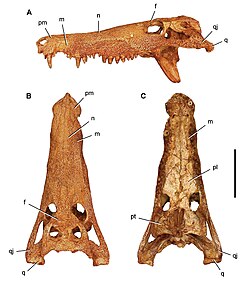
| Assigned H. rebouli skull | |
Scientific classification 
| |
| Kingdom: | Animalia |
| Phylum: | Chordata |
| Class: | Reptilia |
| Clade: | Pseudosuchia |
| Clade: | Crocodylomorpha |
| Clade: | †Notosuchia |
| Family: | †Peirosauridae |
| Genus: | †Hamadasuchus Buffetaut, 1994 |
| Species | |
| |
| Synonyms | |
| |
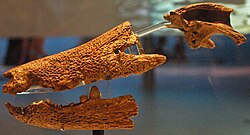
Hamadasuchus is an extinct genus of sebecian crocodylomorph. Fossils have been found from the Kem Kem Formation outcropping in southeastern Morocco.1 These beds date back to the Albian and Cenomanian stages of the Late Cretaceous. It was first assigned to the family Trematochampsidae.2 Diagnostic features of the genus include its lateromedially compressed and serrated teeth. It was deep-snouted and had a slightly heterodont dentition with three distinct tooth morphologies present from sections of the lower jaw.3
References
References
- Larsson, H. C. E. and Sues, H.-D. (2007). Cranial osteology and phylogenetic relationships of Hamadasuchus rebouli (Crocodyliformes: Mesoeucrocodylia) from the Cretaceous of Morocco. Zoological Journal of the Linnean Society 149(4):533-567.
- Buffetaut, E. (1994). A new crocodilian from the Cretaceous of southern Morocco. Comptes rendus de l'Académie des sciences. Série 2. Sciences de la terre et des planètes 319(2):1563–1568.
- Larsson, H. C. E. and Sidor, C. A. (1999). Unusual crocodyliform teeth from the Late Cretaceous (Cenomanian) of southeastern Morocco. Journal of Vertebrate Paleontology 19(2):398-401. JSTOR 4524001