| Halvaria | |
|---|---|
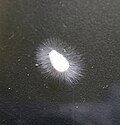   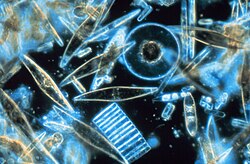   | |
| Important halvarian groups. Clockwise from top-left: a water mold (Oomycetes), a brown alga (Phaeophyta), some diatoms (Bacillariophyta), some dinoflagellates (Miozoa), some ciliates (Ciliophora) and an opalinid (Bigyra). | |
Scientific classification 
| |
| Domain: | Eukaryota |
| Clade: | Sar |
| Clade: | Halvaria Cavalier-Smith, 2010 |
| Subgroups1 | |
| |
Halvaria is a taxonomic grouping of protists that includes Alveolata and Stramenopiles (Heterokonta).2
Analyses in 2007 and 2008 revealed that the Stramenopiles and the Alveolata are related, and form a reduced clade of what were seen to be a paraphyletic group, the chromalveolates. The two clades together with the Rhizaria (originally one of the six major eukaryote groups) form a clade dubbed the SAR supergroup.345
A phylogenomic analysis from 2016 cast doubt on Halvaria, suggesting that Alveolata is the sister group to Rhizaria (making the R + A clade) through new rhizarian sequence data, and that support for Halvaria might be an artifact of low taxon sampling as well as long branch attraction.6
However, later analyses from 2021 support Halvaria as a solid clade.7
| SAR |
| ||||||


References
References
- Cavalier-Smith, Thomas (2017). "Kingdom Chromista and its eight phyla: a new synthesis emphasising periplastid protein targeting, cytoskeletal and periplastid evolution, and ancient divergences". Protoplasma. 255 (1): 297–35 7. doi:10.1007/s00709-017-1147-3. PMC 5756292. PMID 28875267.
- Cavalier-Smith, Thomas (June 2010). "Kingdoms Protozoa and Chromista and the eozoan root of the eukaryotic tree". Biology Letters. 6 (3): 342–345. doi:10.1098/rsbl.2009.0948. PMC 2880060. PMID 20031978.
- Burki, F.; Shalchian-Tabrizi; K. Minge, M.; et al. (August 2007). "Phylogenomics reshuffles the eukaryotic supergroups". PLOS ONE. 2 (8) e790. doi:10.1371/journal.pone.0000790. PMC 1949142. PMID 17726520.

- Burki, F.; Shalchian-Tabrizi; Pawlowski, J. (August 2008). "Phylogenomics reveals a new 'megagroup' including most photosynthetic eukaryotes". Biology Letters. 4 (4): 366–369. doi:10.1098/rsbl.2008.0224. PMC 2610160. PMID 18522922.
- Kim, E.; Graham, L.E. (July 2008). "EEF2 analysis challenges the monophyly of Archaeplastida and Chromalveolata". PLOS ONE. 3 (7) e2621. doi:10.1371/journal.pone.0002621. PMC 2440802. PMID 18612431.
- He, D.; Sierra, R.; Pawlowski, J.; Baldauf, S.L. (August 2016). "Reducing long-branch effects in multi-protein data uncovers a close relationship between Alveolata and Rhizaria". Molecular Phylogenetics and Evolution. 101: 1–7. doi:10.1016/j.ympev.2016.04.033. PMID 27132173.
- Strassert, J.F.; Irisarri, I.; Williams, T.A.; Burki, F. (March 2021). "A molecular timescale for eukaryote evolution with implications for the origin of red algal-derived plastids". Nature Communications. 12 (1): 1879. doi:10.1038/s41467-021-22044-z. PMC 7994803. PMID 33767194.