In mathematics, a half-exponential function is a functional square root of an exponential function. That is, a function such that composed with itself results in an exponential function:12 for some constants and .
Hellmuth Kneser first proposed a holomorphic construction of the solution of in 1950.
Impossibility of a closed-form formula
If a function is defined using the standard arithmetic operations, exponentials, logarithms, and real-valued constants, then is either subexponential or superexponential.3 Thus, a Hardy L-function cannot be half-exponential.
Construction
Any exponential function can be written as the self-composition for infinitely many possible choices of . In particular, for every in the open interval and for every continuous strictly increasing function from onto , there is an extension of this function to a continuous strictly increasing function on the real numbers such that .4 The function is the unique solution to the functional equation
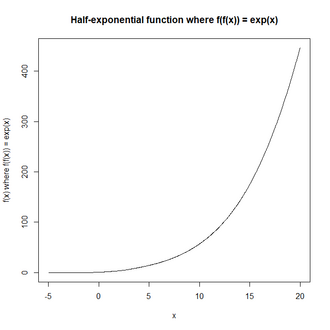
A simple example, which leads to having a continuous first derivative everywhere, and also causes everywhere (i.e. is concave-up, and increasing, for all real ), is to take and , giving Crone and Neuendorffer claim that there is no semi-exponential function f(x) that is both (a) analytic and (b) always maps reals to reals. The piecewise solution above achieves goal (b) but not (a). Achieving goal (a) is possible by writing as a Taylor series based at a fixpoint Q (there are an infinitude of such fixpoints, but they all are nonreal complex, for example ), making Q also be a fixpoint of f, that is , then computing the Maclaurin series coefficients of one by one. This results in Kneser's holomorphic solution.
The construction of Kneser's solution is closely related to the problem of extending tetration to non-integer values; the value of can be understood as the value of , where satisfies . Example values from Kneser's solution of include and .567
Application
Half-exponential functions are used in computational complexity theory for growth rates "intermediate" between polynomial and exponential.2 A function grows at least as quickly as some half-exponential function (its composition with itself grows exponentially) if it is non-decreasing and , for every .8
See also
See also
- Iterated function – Result of repeatedly applying a mathematical function
- Schröder's equation – Equation for fixed point of functional composition
- Abel equation – Equation for function that computes iterated values
References
References
- Kneser, H. (1950). "Reelle analytische Lösungen der Gleichung φ(φ(x) = ex und verwandter Funktionalgleichungen". Journal für die reine und angewandte Mathematik. 187: 56–67. doi:10.1515/crll.1950.187.56. MR 0035385.
- Miltersen, Peter Bro; Vinodchandran, N. V.; Watanabe, Osamu (1999). "Super-polynomial versus half-exponential circuit size in the exponential hierarchy". In Asano, Takao; Imai, Hiroshi; Lee, D. T.; Nakano, Shin-ichi; Tokuyama, Takeshi (eds.). Computing and Combinatorics, 5th Annual International Conference, COCOON '99, Tokyo, Japan, July 26–28, 1999, Proceedings. Lecture Notes in Computer Science. Vol. 1627. Springer. pp. 210–220. doi:10.1007/3-540-48686-0_21. ISBN 978-3-540-66200-6. MR 1730337.
- van der Hoeven, J. (2006). Transseries and Real Differential Algebra. Lecture Notes in Mathematics. Vol. 1888. Springer-Verlag, Berlin. doi:10.1007/3-540-35590-1. ISBN 978-3-540-35590-8. MR 2262194. See exercise 4.10, p. 91, according to which every such function has a comparable growth rate to an exponential or logarithmic function iterated an integer number of times, rather than the half-integer that would be required for a half-exponential function.
- Crone, Lawrence J.; Neuendorffer, Arthur C. (1988). "Functional powers near a fixed point". Journal of Mathematical Analysis and Applications. 132 (2): 520–529. doi:10.1016/0022-247X(88)90080-7. MR 0943525.
- Paulsen, W.; Cowgill, S. (March 2017). "Solving in the complex plane" (PDF). Advances in Computational Mathematics. 43: 1–22. doi:10.1007/s10444-017-9524-1. S2CID 9402035. Archived from the original (PDF) on 2019-04-12.
- Kneser, H. (1950). "Reelle analytische Lösungen der Gleichung und verwandter Funktionalgleichungen". Journal für die reine und angewandte Mathematik (in German). 187: 56–67.
- Kouznetsov, D. (July 2009). "Solution of in complex -plane" (PDF). Mathematics of Computation. 78 (267): 1647–1670. doi:10.1090/S0025-5718-09-02188-7. Archived (PDF) from the original on 2012-11-08.
- Razborov, Alexander A.; Rudich, Steven (1997). "Natural proofs". Journal of Computer and System Sciences. 55 (1): 24–35. doi:10.1006/jcss.1997.1494. MR 1473047.