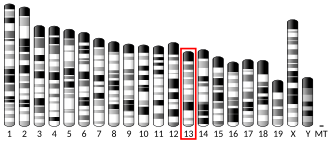
| H2BC8 |
|---|
|
|
| Identifiers |
|---|
| Aliases | H2BC8, H2B.1A, H2B/a, H2BFA, dJ221C16.8, histone cluster 1, H2bg, histone cluster 1 H2B family member g, HIST1H2BG, H2B clustered histone 8, H2BC10, H2BC7, H2BC6, H2BC4 |
|---|
| External IDs | OMIM: 602798; MGI: 2448383; HomoloGene: 136770; GeneCards: H2BC8; OMA:H2BC8 - orthologs |
|---|
|
|
|
|
|
| Wikidata |
|
Histone H2B type 1-C/E/F/G/I is a protein that in humans is encoded by the HIST1H2BG gene.567
Histones are basic nuclear proteins that are responsible for the nucleosome structure of the chromosomal fiber in eukaryotes. Nucleosomes consist of approximately 146 bp of DNA wrapped around a histone octamer composed of pairs of each of the four core histones (H2A, H2B, H3, and H4). The chromatin fiber is further compacted through the interaction of a linker histone, H1, with the DNA between the nucleosomes to form higher order chromatin structures. This gene is intronless and encodes a member of the histone H2B family. Transcripts from this gene lack polyA tails; instead, they contain a palindromic termination element. This gene is found in the large histone gene cluster on chromosome 6p22-p21.3.7
References
References
- GRCh38: Ensembl release 89: ENSG00000273802 – Ensembl, May 2017
- GRCm38: Ensembl release 89: ENSMUSG00000069268 – Ensembl, May 2017
- "Human PubMed Reference:". National Center for Biotechnology Information, U.S. National Library of Medicine.
- "Mouse PubMed Reference:". National Center for Biotechnology Information, U.S. National Library of Medicine.
- Albig W, Kardalinou E, Drabent B, Zimmer A, Doenecke D (Nov 1991). "Isolation and characterization of two human H1 histone genes within clusters of core histone genes". Genomics. 10 (4): 940–8. doi:10.1016/0888-7543(91)90183-F. PMID 1916825.
- Marzluff WF, Gongidi P, Woods KR, Jin J, Maltais LJ (Oct 2002). "The human and mouse replication-dependent histone genes". Genomics. 80 (5): 487–98. doi:10.1016/S0888-7543(02)96850-3. PMID 12408966.
- "Entrez Gene: HIST1H2BG histone cluster 1, H2bg".
Further reading
Further reading
- Ohe Y, Hayashi H, Iwai K (1979). "Human spleen histone H2B. Isolation and amino acid sequence". J. Biochem. 85 (2): 615–24. doi:10.1093/oxfordjournals.jbchem.a132371. PMID 422550.
- Frohm M, Gunne H, Bergman AC, et al. (1996). "Biochemical and antibacterial analysis of human wound and blister fluid". Eur. J. Biochem. 237 (1): 86–92. doi:10.1111/j.1432-1033.1996.0086n.x. PMID 8620898.
- Díaz-Jullien C, Pérez-Estévez A, Covelo G, Freire M (1996). "Prothymosin alpha binds histones in vitro and shows activity in nucleosome assembly assay". Biochim. Biophys. Acta. 1296 (2): 219–27. doi:10.1016/0167-4838(96)00072-6. PMID 8814229.
- Albig W, Kioschis P, Poustka A, et al. (1997). "Human histone gene organization: nonregular arrangement within a large cluster". Genomics. 40 (2): 314–22. doi:10.1006/geno.1996.4592. PMID 9119399.
- Albig W, Doenecke D (1998). "The human histone gene cluster at the D6S105 locus". Hum. Genet. 101 (3): 284–94. doi:10.1007/s004390050630. PMID 9439656. S2CID 38539096.
- El Kharroubi A, Piras G, Zensen R, Martin MA (1998). "Transcriptional activation of the integrated chromatin-associated human immunodeficiency virus type 1 promoter". Mol. Cell. Biol. 18 (5): 2535–44. doi:10.1128/mcb.18.5.2535. PMC 110633. PMID 9566873.
- Piredda L, Farrace MG, Lo Bello M, et al. (1999). "Identification of 'tissue' transglutaminase binding proteins in neural cells committed to apoptosis". FASEB J. 13 (2): 355–64. doi:10.1096/fasebj.13.2.355. PMID 9973324. S2CID 16417170.
- Deng L, de la Fuente C, Fu P, et al. (2001). "Acetylation of HIV-1 Tat by CBP/P300 increases transcription of integrated HIV-1 genome and enhances binding to core histones". Virology. 277 (2): 278–95. doi:10.1006/viro.2000.0593. PMID 11080476.
- Deng L, Wang D, de la Fuente C, et al. (2001). "Enhancement of the p300 HAT activity by HIV-1 Tat on chromatin DNA". Virology. 289 (2): 312–26. doi:10.1006/viro.2001.1129. PMID 11689053.
- Andersen JS, Lyon CE, Fox AH, et al. (2002). "Directed proteomic analysis of the human nucleolus". Curr. Biol. 12 (1): 1–11. Bibcode:2002CBio...12....1A. doi:10.1016/S0960-9822(01)00650-9. PMID 11790298. S2CID 14132033.
- Kim HS, Cho JH, Park HW, et al. (2002). "Endotoxin-neutralizing antimicrobial proteins of the human placenta". J. Immunol. 168 (5): 2356–64. doi:10.4049/jimmunol.168.5.2356. PMID 11859126.
- Strausberg RL, Feingold EA, Grouse LH, et al. (2003). "Generation and initial analysis of more than 15,000 full-length human and mouse cDNA sequences". Proc. Natl. Acad. Sci. U.S.A. 99 (26): 16899–903. Bibcode:2002PNAS...9916899M. doi:10.1073/pnas.242603899. PMC 139241. PMID 12477932.
- Cheung WL, Ajiro K, Samejima K, et al. (2003). "Apoptotic phosphorylation of histone H2B is mediated by mammalian sterile twenty kinase". Cell. 113 (4): 507–17. doi:10.1016/S0092-8674(03)00355-6. PMID 12757711. S2CID 21854.
- Tollin M, Bergman P, Svenberg T, et al. (2004). "Antimicrobial peptides in the first line defence of human colon mucosa". Peptides. 24 (4): 523–30. doi:10.1016/S0196-9781(03)00114-1. PMID 12860195. S2CID 7435936.
- Mungall AJ, Palmer SA, Sims SK, et al. (2003). "The DNA sequence and analysis of human chromosome 6". Nature. 425 (6960): 805–11. Bibcode:2003Natur.425..805M. doi:10.1038/nature02055. PMID 14574404.
- Coleman MA, Miller KA, Beernink PT, et al. (2004). "Identification of chromatin-related protein interactions using protein microarrays". Proteomics. 3 (11): 2101–7. doi:10.1002/pmic.200300593. PMID 14595808. S2CID 23471253.
- Lusic M, Marcello A, Cereseto A, Giacca M (2004). "Regulation of HIV-1 gene expression by histone acetylation and factor recruitment at the LTR promoter". EMBO J. 22 (24): 6550–61. doi:10.1093/emboj/cdg631. PMC 291826. PMID 14657027.
- Howell SJ, Wilk D, Yadav SP, Bevins CL (2004). "Antimicrobial polypeptides of the human colonic epithelium". Peptides. 24 (11): 1763–70. doi:10.1016/j.peptides.2003.07.028. PMID 15019208. S2CID 28953527.