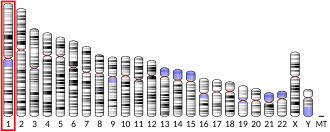
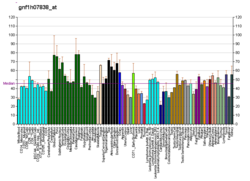
Histone H2A type 2-B is a protein that in humans is encoded by the HIST2H2AB gene.56
Histones are basic nuclear proteins that are responsible for the nucleosome structure of the chromosomal fiber in eukaryotes. Nucleosomes consist of approximately 146 bp of DNA wrapped around a histone octamer composed of pairs of each of the four core histones (H2A, H2B, H3, and H4). The chromatin fiber is further compacted through the interaction of a linker histone, H1, with the DNA between the nucleosomes to form higher order chromatin structures. This gene is intronless and encodes a member of the histone H2A family. Transcripts from this gene contain a palindromic termination element.6
References
References
Further reading
Further reading
- El Kharroubi A, Piras G, Zensen R, Martin MA (1998). "Transcriptional Activation of the Integrated Chromatin-Associated Human Immunodeficiency Virus Type 1 Promoter". Mol. Cell. Biol. 18 (5): 2535–44. doi:10.1128/mcb.18.5.2535. PMC 110633. PMID 9566873.
- Deng L, de la Fuente C, Fu P, et al. (2001). "Acetylation of HIV-1 Tat by CBP/P300 increases transcription of integrated HIV-1 genome and enhances binding to core histones". Virology. 277 (2): 278–95. doi:10.1006/viro.2000.0593. PMID 11080476.
- Deng L, Wang D, de la Fuente C, et al. (2001). "Enhancement of the p300 HAT activity by HIV-1 Tat on chromatin DNA". Virology. 289 (2): 312–26. doi:10.1006/viro.2001.1129. PMID 11689053.
- Chen A, Kleiman FE, Manley JL, et al. (2002). "Autoubiquitination of the BRCA1*BARD1 RING ubiquitin ligase". J. Biol. Chem. 277 (24): 22085–92. doi:10.1074/jbc.M201252200. PMID 11927591.
- Lusic M, Marcello A, Cereseto A, Giacca M (2004). "Regulation of HIV-1 gene expression by histone acetylation and factor recruitment at the LTR promoter". EMBO J. 22 (24): 6550–61. doi:10.1093/emboj/cdg631. PMC 291826. PMID 14657027.
- Zhang Y, Griffin K, Mondal N, Parvin JD (2004). "Phosphorylation of histone H2A inhibits transcription on chromatin templates". J. Biol. Chem. 279 (21): 21866–72. doi:10.1074/jbc.M400099200. PMID 15010469.
- Aihara H, Nakagawa T, Yasui K, et al. (2004). "Nucleosomal histone kinase-1 phosphorylates H2A Thr 119 during mitosis in the early Drosophila embryo". Genes Dev. 18 (8): 877–88. doi:10.1101/gad.1184604. PMC 395847. PMID 15078818.
- Wang H, Wang L, Erdjument-Bromage H, et al. (2004). "Role of histone H2A ubiquitination in Polycomb silencing". Nature. 431 (7010): 873–8. Bibcode:2004Natur.431..873W. doi:10.1038/nature02985. PMID 15386022. S2CID 4344378.
- Hagiwara T, Hidaka Y, Yamada M (2005). "Deimination of histone H2A and H4 at arginine 3 in HL-60 granulocytes". Biochemistry. 44 (15): 5827–34. doi:10.1021/bi047505c. PMID 15823041.
- Cao R, Tsukada Y, Zhang Y (2006). "Role of Bmi-1 and Ring1A in H2A ubiquitylation and Hox gene silencing". Mol. Cell. 20 (6): 845–54. doi:10.1016/j.molcel.2005.12.002. PMID 16359901.
- Bergink S, Salomons FA, Hoogstraten D, et al. (2006). "DNA damage triggers nucleotide excision repair-dependent monoubiquitylation of histone H2A". Genes Dev. 20 (10): 1343–52. doi:10.1101/gad.373706. PMC 1472908. PMID 16702407.
- Gregory SG, Barlow KF, McLay KE, et al. (2006). "The DNA sequence and biological annotation of human chromosome 1". Nature. 441 (7091): 315–21. Bibcode:2006Natur.441..315G. doi:10.1038/nature04727. PMID 16710414.