
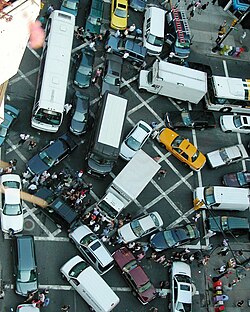
Gridlock is a form of traffic congestion where continuous queues of vehicles block an entire network of intersecting streets, bringing traffic in all directions to a complete standstill. 1 The term originates from a situation possible in a grid plan where intersections are blocked, preventing vehicles from either moving forwards through the intersection or backing up to an upstream intersection.
The term gridlock is also used to describe high traffic congestion with minimal flow (which is simply a traffic jam), where a blocked grid system is not involved. By extension, the term has been applied to situations in other fields where flow is stalled by excess demand, or in which competing interests prevent progress.
Cause
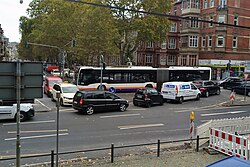

Traditional gridlock is caused by cars entering an intersection on a green light without enough room on the other side of the intersection at the time of entering to go all the way through. This can lead to the car being trapped in the intersection when the light turns green in the other direction. If the same situation occurs simultaneously in multiple intersections, these cars can be trapped in the intersections indefinitely.
In many jurisdictions, drivers are therefore prohibited from entering an intersection at a green light if there is no room for them to clear the intersection. If all drivers follow this rule, gridlock is impossible.2
Another type of gridlock can occur during traffic surges between highway on-ramps and off-ramps located within a quarter mile of each other. Traffic exiting the highway may back up and block the entering vehicles. Those entering vehicles in turn back up and block the exiting vehicles.
Gridlock is sometimes cited as an example of the prisoner's dilemma (from game theory).3 Mutual cooperation among drivers would give the maximum benefit (prevention of gridlock), but this may not happen because of the desire to maximize one's own benefit (shortest travel time) given the uncertainty about the other drivers' commitment to equal cooperation.
Worst episodes
The August 2010 China National Highway 110 traffic jam in Hebei province caught media attention for its severity, stretching more than 100 kilometres (62 mi) from August 14 to 26, including at least 11 days of total gridlock.456 The event was caused by a combination of road works and thousands of coal trucks from Inner Mongolia's coalfields that travel daily to Beijing. The New York Times has called this event the "Great Chinese Gridlock of 2010."67
The Hebei gridlock episode is regarded as the worst in history by duration, and is one of the longest in length after the 175 kilometres (109 mi) long Lyon-Paris traffic jam on the A6 autoroute in France on February 16, 1980. Thousands of vacationing skiers were returning from the French Alps, traveling north along A6, along with normal Saturday traffic.8 Starting with the 1981 edition of the Guinness Book of World Records, the incident was reported under the category of "Longest Traffic Jam".9
New York City suffered severe traffic gridlock episodes during the 1965, 1977, and 2003 blackouts that immediately paralyzed the city. With total traffic lights failure, bridges and tunnels locked up, and stranded subway commuters flooding the avenues, local intersections devolved into massive, motionless jams.101112
Enforcement
New York City

In New York City, drivers who "block the box" are subject to a moving violation that comes with a US$90.00 penalty. Mayor Michael Bloomberg, noting that the ten-minute ticketing process actually contributes to overall traffic congestion, has asked the New York State Legislature to remove "blocking the box" from the moving violation category. This reclassification would give more traffic agents authority to write tickets and change the current ticketing procedure, which requires that the issuing officer physically stop the violating car in traffic.13
Virginia Beach, Virginia
In Virginia Beach, Virginia, roads around the oceanfront feature signs at every intersection stating "Don't Block the Box", and threatening a $200 fine.
Texas
In Austin, Texas, a "Don't Block the Box" initiative began in 2015.1415 A similar program was piloted in San Antonio in 2017.16
Effects
The obvious effects are driver frustration and trip delay. Another effect in cities is exacerbated by the presence of urban street canyons, which effectively trap air pollution and increase air pollution exposures of motorists as well as the general urban population. Noise pollution can be aggravated by excessive starting and stopping noise of gridlocked facilities.17
Alleviating gridlock
To make a traffic system less susceptible to gridlock, a traffic metering system can be introduced. These systems determine the optimal number of vehicles allowed in a traffic system, and prevent any extra vehicles from entering. This can be done with traffic control devices, such as traffic lights or warning signs, or a better public transportation system. This type of system is used in Zurich, Switzerland.18
Etymology
According to The New York Times, the word gridlock was coined in New York City in the early 1970s.19 The word appeared in an IEEE publication in 1971 in a different context.20 The first appearances of gridlock in newspapers occurred during the 1980 New York City transit strike. The word is attributed to Sam Schwartz, who was then the chief traffic engineer for the New York City Department of Transportation at the time of the strike.21 Schwartz said the word gridlock was used internally in his department during the 1970s, perhaps as early as 1971.22 Writing up a memo of emergency recommendations for senior officials, he recalled the words of a colleague several years earlier who had been analyzing a proposal to close Broadway to vehicular traffic. His colleague gave the plan the thumbs-down, worrying that it would simply "lock up the grid". Schwartz was always struck by that image and titled his 1980 memo "Gridlock Prevention Plan".23 In another interview Mr. Schwartz said that he coined the term in the mid 1970s with fellow traffic engineer, Roy Cottam, who "was a little paranoid and thought he would be blamed for gridlock and so he gave me all the credit".24
See also
See also
- Box junction
- Deadlock - computer software analogy
- Journal of Transport and Land Use
- Roadway air dispersion modeling
- Rush Hour (puzzle)
References
References
- "Gridlock". Oxford English Dictionary. Oxford University Press. Retrieved 2011-05-03.
- Stringer, Scott M. Thinking outside the box: an analysis of Manhattan gridlock and spillback enforcement, Office of Manhattan Borough President, July 2006.
- Heath, Joseph (1999). Normative economics Archived 2007-11-18 at the Wayback Machine, Chapter 2, Section 3. Retrieved 2007-03-19.
- Leo Hickman (August 23, 2010). "Welcome to the world's worst traffic jam". The Guardian. Archived from the original on October 17, 2015. Retrieved September 20, 2010.
- "The great crawl of China". The Economist. August 26, 2010. Archived from the original on October 22, 2010. Retrieved September 20, 2010.
- Michael Wines (August 27, 2010). "China's Growth Leads to Problems Down the Road". The New York Times. Archived from the original on January 21, 2012. Retrieved September 20, 2010.
- Jonathan Watts (August 24, 2010). "Gridlock is a way of life for Chinese". The Guardian. Archived from the original on September 15, 2013. Retrieved September 20, 2010.
- Rocque, Melony (February 6, 2017). "Getting out of a jam". Smart Cities World.
- "According to Guinness". Vancouver Sun. December 17, 1980. p. B8.
- 'Whether rich or poor, it was the longest of nights': How a 2003 blackout brought New York City to a standstill
- CBS News Radio flashback: New York City blackout of 1977
- The NYC Blackouts | That Was the News Then: Episode 17
- "metro". Archived from the original on 2008-12-14. Retrieved 2007-10-26.
- Schwaller, Kevin (25 April 2015). "Some drivers feel trapped by 'Don't Block the Box' enforcement". KXAN. Archived from the original on 2015-07-03. Retrieved 2015-06-30.
- Vega, Jackie (21 April 2015). "More than 800 tickets issued for 'blocking the box'". KXAN. Archived from the original on 2015-07-03. Retrieved 2015-06-30.
- "Enforcement Begins Today for Don't Block the Box Pilot Program". City of San Antonio. 1 May 2017. Archived from the original on 2017-08-10. Retrieved 2017-05-04.
- C. Michael Hogan and Gary L. Latshaw, The relationship between highway planning and urban noise Archived 2007-05-18 at the Wayback Machine, :Proceedings of the ASCE, Urban Transportation Division specialty conference, May 21–23, 1973, Chicago, Illinois. by American Society of Civil Engineers. Urban Transportation Division
- Daganzo, Carlos F. (2007). "Urban gridlock: Macroscopic modeling and mitigation approaches". Transportation Research Part B: Methodological. 41 (1): 49–62. Bibcode:2007TRPB...41...49D. doi:10.1016/j.trb.2006.03.001.
- James Gleick (1988-05-08). "National Gridlock". New York Times. Archived from the original on 2015-05-25. Retrieved 2010-09-26.
- Letton, Winsor (1971). "Engineering in the Ocean Environment: A Method for Reducing Gridlock Errors". Google Books. Archived from the original on 2022-04-07. Retrieved 2020-09-14.
- Schwartz, Sam. About Gridlock Sam Archived 2005-08-24 at the Wayback Machine, GridlockSam.com. Retrieved 2007-03-19.
- Popik, Barry (July 21, 2004). Gridlock Archived 2006-10-28 at the Wayback Machine. Retrieved 2007-03-19.
- Kluger, Jeffrey: "Simplexity: Why Simple Things Become Complex (And How Complex Things Can Be Made Simple)", Hyperion, 2008, ISBN 978-1-4013-0301-3, pp.65-66.
- "Gridlock Sam Interview". SimCity 4. Archived from the original on 2011-03-18. Retrieved 2010-09-26.