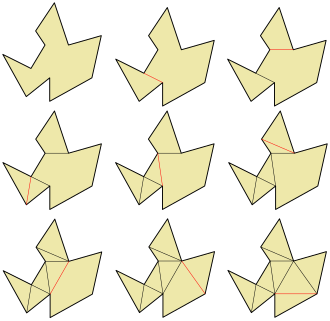
 Polygon Greedy triangulation steps. On each step a new edge (red) is added joining the nearest pair of vertex, without crossing a previously edge | |
| Class | Search algorithm |
|---|---|
| Data structure | |
| Worst-case performance | |
| Best-case performance | |
The greedy triangulation is a method to compute a polygon triangulation or a point set triangulation using a greedy algorithm, which adds edges one by one to the solution in strict increasing order by length, with the condition that an edge cannot cut a previously inserted edge.12
References
References
- J. Loera, J. Rambau and F. Santos (2010), Triangulations: Structures and Algorithms (2nd revised ed.), Springer-Verlag, ISBN 9783642129711 Chapter 3: Polygon Triangulation: pp.103.
-
Mark de Berg, Marc van Kreveld, Mark Overmars, and Otfried Schwarzkopf (2000), Computational Geometry (2nd revised ed.), Springer-Verlag, ISBN 3-540-65620-0
{{citation}}: CS1 maint: multiple names: authors list (link)