
Video random-access memory (VRAM) is dedicated computer memory used to store the pixels and other graphics data as a framebuffer to be rendered on a computer monitor.1 It often uses a different technology than other computer memory, in order to be read quickly for display on a screen.
Relation to GPUs
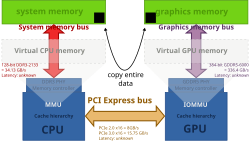


Many modern GPUs rely on VRAM. In contrast, a GPU that does not use VRAM, and relies instead on system RAM, is said to have a unified memory architecture, or shared graphics memory.
System RAM and VRAM have been segregated due to the bandwidth requirements of GPUs,23 and to achieve lower latency, since VRAM is physically closer to the GPU die.4
Modern VRAM is typically found in a BGA package5 soldered onto a graphics card.6 The VRAM is cooled along with the GPU by the GPU heatsink.7
Technologies
- Dual-ported video RAM, used in the 1990s and at the time often called VRAM
- SGRAM
- GDDR SDRAM
- High Bandwidth Memory (HBM)8
See also
See also
- Graphics processing unit
- Tiled rendering, a method to reduce VRAM bandwidth requirements9
References
References
- Foley, James D.; van Dam, Andries; Feiner, Steven K.; Hughes, John F. (1997). Computer Graphics: Principles and Practice. Addison-Wesley. p. 859. ISBN 0-201-84840-6.
- "What is VRAM: The Memory Power Behind Real-time Ray-Tracing". Archived from the original on 2022-05-22. Retrieved 2022-05-16.
- "Relationship Between RAM and VRAM Bandwidth and Their Latency". 17 May 2021.
- "RAM vs. VRAM: What's the Difference?". makeuseof.com. 16 July 2021.
- "Encapsulated in CPUs, GPUs, RAM and Flash: Types and Uses". 23 March 2021.
- "Graphics Card Components & Connectors Explained". 29 March 2017.
- "Different Types of Graphics Card Cooling Solutions for GPU, VRAM & VRM". 17 January 2017.
- "HBM Graphics Cards - 7 GPUs with HBM Memory". Axiom Gaming. 16 August 2025.
- "GPU Framebuffer Memory: Understanding Tiling".