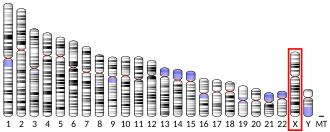
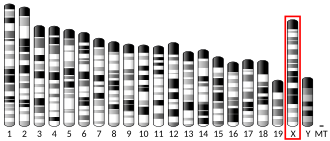
G protein-coupled receptor 112 is a protein encoded by the ADGRG4 gene.56 GPR112 is a member of the adhesion GPCR family.78
Adhesion GPCRs are characterized by an extended extracellular region often possessing N-terminal protein modules that is linked to a TM7 region via a domain known as the GPCR-Autoproteolysis INducing (GAIN) domain.9
GPR112 is expressed in human enterochromaffin cells10 and in the mouse intestine.11 The N-terminal fragment (NTF) of GPR112 contains pentraxin (PTX)-like modules.11 GPR112 gene expression has been identified as a marker for neuroendocrine carcinoma cells.10
References
References
- GRCh38: Ensembl release 89: ENSG00000156920 – Ensembl, May 2017
- GRCm38: Ensembl release 89: ENSMUSG00000053852 – Ensembl, May 2017
- "Human PubMed Reference:". National Center for Biotechnology Information, U.S. National Library of Medicine.
- "Mouse PubMed Reference:". National Center for Biotechnology Information, U.S. National Library of Medicine.
- "Entrez Gene: GPR112 G protein-coupled receptor 112".
- Hamann J, Aust G, Araç D, Engel FB, Formstone C, Fredriksson R, et al. (April 2015). "International Union of Basic and Clinical Pharmacology. XCIV. Adhesion G protein-coupled receptors". Pharmacological Reviews. 67 (2): 338–367. doi:10.1124/pr.114.009647. PMC 4394687. PMID 25713288.
- Stacey M, Yona S (2011). Adhesion-GPCRs: Structure to Function (Advances in Experimental Medicine and Biology). Berlin: Springer. ISBN 978-1-4419-7912-4.
- Langenhan T, Aust G, Hamann J (May 2013). "Sticky signaling--adhesion class G protein-coupled receptors take the stage". Science Signaling. 6 (276): re3. doi:10.1126/scisignal.2003825. PMID 23695165. S2CID 6958640.
- Araç D, Boucard AA, Bolliger MF, Nguyen J, Soltis SM, Südhof TC, et al. (March 2012). "A novel evolutionarily conserved domain of cell-adhesion GPCRs mediates autoproteolysis". The EMBO Journal. 31 (6): 1364–1378. doi:10.1038/emboj.2012.26. PMC 3321182. PMID 22333914.
- Leja J, Essaghir A, Essand M, Wester K, Oberg K, Tötterman TH, et al. (February 2009). "Novel markers for enterochromaffin cells and gastrointestinal neuroendocrine carcinomas". Modern Pathology. 22 (2): 261–272. doi:10.1038/modpathol.2008.174. PMID 18953328. S2CID 22334557.
- Hamann J, Aust G, Araç D, Engel FB, Formstone C, Fredriksson R, et al. (Apr 2015). "International Union of Basic and Clinical Pharmacology. XCIV. Adhesion G protein-coupled receptors". Pharmacological Reviews. 67 (2): 338–367. doi:10.1124/pr.114.009647. PMC 4394687. PMID 25713288.
External links
External links