| Gomphidae Temporal range:
| |
|---|---|

| |
| Bladetail, male, Lindenia tetraphylla North Macedonia | |
Scientific classification 
| |
| Kingdom: | Animalia |
| Phylum: | Arthropoda |
| Clade: | Pancrustacea |
| Class: | Insecta |
| Order: | Odonata |
| Infraorder: | Anisoptera |
| Superfamily: | Gomphoidea Rambur, 18421 |
| Family: | Gomphidae Rambur, 18421 |
| Genera | |
|
See text | |
| Synonyms2 | |
| |
Gomphidae is a family of dragonflies commonly referred to as clubtails or club-tailed dragonflies.3 It is the only family in the superfamily Gomphoidea.24
The family contains about 90 genera and more than 900 species distributed across North and South America, Europe, Asia, Australia and Africa.5
The common name refers to the club-like widening near the end of the abdomen. This club is generally less pronounced in females and is absent in some species.
Characteristics
Clubtails are usually medium-sized to large dragonflies with a slender abdomen that is often expanded near the tip. Many species have distinctive striped thoracic patterns, although coloration varies considerably across the family.6
Some clubtails spend much time at rest, perching on the ground or on vegetation and darting out to capture flying insects.6
Many species perch with the abdomen sloping upward and the tip curled slightly downward, while larger species may perch with the abdomen hanging down or resting flat against a surface. Some species also adopt an "obelisk" posture in exposed conditions, raising the abdomen vertically.6
Many clubtails breed in streams, rivers and lakes. The nymphs are typically burrowing predators that live in sediment or debris at the bottom of the water body, although some species live among leaf litter.78
The nymphs usually have a flat mentum and antennae with four segments, although morphology varies across the family.8
Phylogeny
Phylogenetic studies support Gomphoidea as a distinct evolutionary lineage of dragonflies represented solely by the family Gomphidae.29
Gomphoidea is generally recovered as the sister group to all other modern dragonflies except Petaluridae.92
| Anisoptera |
| ||||||||||||
Etymology
The family and superfamily names are derived from the type genus Gomphus, with the standard zoological suffixes -idae used for families and -oidea used for superfamilies.
The genus name Gomphus is derived from the Greek γόμφος (gomphos, "bolt" or "nail"), referring to the shape of the abdomen, likened to a bolt used in shipbuilding.1011
Gallery
-
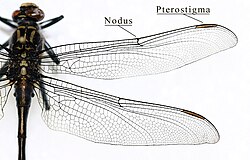 Gomphidae wing structure: note the similar-sized triangles of the front and hind wings and the widely separated eyes.
 -
 Pair of yellow-striped hunters mating
 -
 Common clubtail, Ictinogomphus rapax
 -
 Gomphus vulgatissimus, showing the characteristic clubbed abdomen
 -
 Head of Gomphus vulgatissimus showing widely separated eyes
 -
 Paragomphus lineatus, male
 -
 Paragomphus lineatus, female
Genera
These genera belong to the family Gomphidae.4
- Acrogomphus Laidlaw, 1925
- Agriogomphus Selys, 1869
- Amphigomphus Chao, 1954
- Anisogomphus Selys, 1858
- Anomalophlebia Belle, 1995
- Anormogomphus Selys, 1854
- Antipodogomphus Fraser, 1951
- Aphylla Selys, 1854
- Archaeogomphus Williamson, 1919
- Arigomphus Needham, 1897
- Armagomphus Carle, 1986
- Asiagomphus Asahina, 1985
- Austroepigomphus Fraser, 1951
- Austrogomphus Selys, 1854
- Brasiliogomphus Belle, 1995
- Burmagomphus Williamson, 1907
- Cacoides Cowley, 1934
- Ceratogomphus Selys, 1854
- Cinitogomphus Pinhey, 1964
- Cornigomphus Martin, 1907
- Crenigomphus Selys, 1892
- Cyanogomphus Selys, 1873
- Cyclogomphus Selys, 1854
- Davidioides Fraser, 1924
- Davidius Selys, 1878
- Desmogomphus Williamson, 1920
- Diaphlebia Selys, 1854
- Diastatomma Burmeister, 1839
- Dromogomphus Selys, 1854
- Dubitogomphus Fraser, 1940
- Ebegomphus Needham, 1944
- Eogomphus Needham, 1941
- Epigomphus Hagen in Selys, 1854
- Erpetogomphus Selys, 1858
- Euthygomphus Kosterin, 2016
- Fukienogomphus Chao, 1954
- Gastrogomphus Needham, 1941
- Gomphidia Selys, 1854
- Gomphidictinus Fraser, 1942
- Gomphoides Selys, 1854
- Gomphurus Needham, 1901
- Gomphus Leach in Brewester, 1815
- Hagenius Selys, 1854
- Heliogomphus Laidlaw, 1922
- Hemigomphus Selys, 1854
- Hylogomphus Needham, Westfall & May, 2000
- Ictinogomphus Cowley, 1934
- Idiogomphoides Belle, 1984
- Isomma Selys, 1892
- Labrogomphus Needham, 1931
- Lamelligomphus Fraser, 1922
- Lanthus Needham, 1897
- Leptogomphus Selys, 1878
- Lestinogomphus Martin, 1911
- Lindenia de Haan, 1826
- Macrogomphus Selys, 1858
- Malgassogomphus Cammaerts, 1987
- Mastigogomphus Cammaerts, 2004
- Megalogomphus Campion, 1923
- Melanocacus Belle, 1986
- Melligomphus Chao, 1990
- Merogomphus Martin, 1904
- Microgomphus Selys, 1858
- Mitragomphus Needham, 1944
- Neogomphus Selys, 1858
- Nepogomphoides Fraser, 1934
- Nepogomphus Fraser, 1934
- Neurogomphus Karsch, 1890
- Nihonogomphus Oguma, 1926
- Notogomphus Selys, 1858
- Nychogomphus Carle, 1986
- Octogomphus Selys, 1873
- Odontogomphus Watson, 1991
- Onychogomphus Selys, 1854
- Ophiogomphus Selys, 1854
- Orientogomphus Chao & Xu, 1987
- Paragomphus Cowley, 1934
- Perigomphus Belle, 1972
- Perissogomphus Laidlaw, 1922
- Peruviogomphus Klots, 1944
- Phaenandrogomphus Lieftinck, 1964
- Phanogomphus Carle, 1986
- Phyllocycla Calvert, 1948
- Phyllogomphoides Belle, 1970
- Phyllogomphus Selys, 1854
- Platygomphus Selys, 1854
- Praeviogomphus Belle, 1995
- Progomphus Selys, 1854
- Scalmogomphus Chao, 1990
- Shaogomphus Chao, 1984
- Sieboldius Selys, 1854
- Sinictinogomphus Fraser, 1939
- Sinogomphus May, 1935
- Stenogomphurus Carle, 1986
- Stylogomphus Fraser, 1922
- Stylurus Needham, 1897
- Tibiagomphus Belle, 1992
- Tragogomphus Sjöstedt, 1899
- Trigomphus Bartenev, 1911
- Zephyrogomphus Watson, 1991
- Zonophora Selys, 1854
Fossil genera

- †Auroradraco Archibald & Cannings, 2019 Kamloops Group, Canada, Ypresian12
- †Burmalindenia Schädel & Bechly, 2016 Burmese amber, Cenomanian
- †Cratohagenius Bechly, 2010 Crato Formation, Brazil, Aptian13
- †Cratolindenia Bechly, 2000 Crato Formation, Brazil, Aptian
- †Gunterbechlya Huang et al., 2019 Burmese amber, Cenomanian14
- ?†Nannogomphus Handlirsch, 1906 (potentially related to early dragonfly lineages)15
Fossil families
The following extinct families are also considered part of Gomphoidea:14
- †Araripegomphidae Bechly, 1996
- †Burmagomphidae Zheng et al., 201716
- †Libanogomphidae Azar & Nel, 202317
- †Paraburmagomphidae Zheng et al., 201818
- †Proterogomphidae Bechly et al., 199819
References
References
- Rambur, Jules (1842). Histoire naturelle des insectes. Névroptères (in French). Paris: Librairie Encyclopédique de Roret. pp. 534 [24] – via Gallica.
- Dijkstra, Klaas-Douwe B.; Bechly, Günter; Bybee, Seth M.; Dow, Rory A.; Dumont, Henri J.; Fleck, Günther; Garrison, Rosser W.; Hämäläinen, Matti; Kalkman, Vincent J.; Karube, Haruki; May, Michael L.; Orr, Albert G.; Paulson, Dennis R.; Rehn, Andrew C.; Theischinger, Günther; Trueman, John W.H.; Van Tol, Jan; von Ellenrieder, Natalia; Ware, Jessica (2013). "The classification and diversity of dragonflies and damselflies (Odonata). In: Zhang, Z.-Q. (Ed.) Animal Biodiversity: An Outline of Higher-level Classification and Survey of Taxonomic Richness (Addenda 2013)". Zootaxa. 3703 (1): 36–45. doi:10.11646/zootaxa.3703.1.9.
- "Family GOMPHIDAE". Australian Faunal Directory. Australian Biological Resources Study. 2022. Retrieved 1 May 2026.
- Paulson, D.; Schorr, M.; Abbott, J.; Bota-Sierra, C.; Deliry, C.; Dijkstra, K.-D.; Lozano, F. "World Odonata List". OdonataCentral. University of Alabama.
- "New Hampshire PBS web article"
- Paulson, Dennis (2009). Dragonflies and Damselflies of the West. Princeton University Press. p. 237. ISBN 978-1-4008-3294-1.
- Abbott, J.C. (2009). "Odonata (Dragonflies and Damselflies)". Encyclopedia of Inland Waters. pp. 394–404. doi:10.1016/B978-012370626-3.00183-6. ISBN 978-0-12-370626-3.
- John L. Capinera (2008). Encyclopedia of Entomology. Springer Science & Business Media. p. 1245. ISBN 978-1-4020-6242-1.
- Bybee, S.M.; Ogden, T.H.; Branham, M.A.; Whiting, M.F. (2008). "Molecules, morphology and fossils: a comprehensive approach to odonate phylogeny and the evolution of the odonate wing". Cladistics. 24 (4): 477–514. doi:10.1111/j.1096-0031.2007.00191.x. PMID 34879634.
- "Etymology". National Museums Ireland. Retrieved 13 October 2024.
- Endersby, Ian; Fliedner, Heinrich (2015). The Naming of Australia's Dragonflies. Eltham, Victoria, Australia: Busybird Publishing. ISBN 9781925260625.
- Archibald, S. Bruce; Cannings, Robert A. (2019-10-21). "Fossil dragonflies (Odonata: Anisoptera) from the early Eocene Okanagan Highlands, western North America". The Canadian Entomologist. 151 (6): 783–816. doi:10.4039/tce.2019.61.
- Bechly, Günter (2010). "Additions to the fossil dragonfly fauna from the Lower Cretaceous Crato Formation of Brazil (Insecta: Odonata)". Palaeodiversity. 3: 11–77.
- Huang, Diying; Fu, Yanzhe; Nel, André (2019). "A possible true Mesozoic Gomphidae s. str. from the mid-Cretaceous Burmese amber (Odonata: Anisoptera)". Cretaceous Research. 95: 341–345. doi:10.1016/j.cretres.2018.11.001.
- Nel, André; Huang, Diying (2015). "A new family of 'libelluloid' dragonflies from the Middle Jurassic of Daohugou, northeastern China (Odonata: Anisoptera: Cavilabiata)". Alcheringa. 39 (4): 525–529. doi:10.1080/03115518.2015.1050316.
- Zheng, Daran; Nel, André; Chang, Su-Chin; Jarzembowski, Edmund A.; Zhang, Haichun; Wang, Bo (2018). "A well-preserved true dragonfly (Anisoptera: Gomphides: Burmagomphidae fam. nov.) from Cretaceous Burmese amber". Journal of Systematic Palaeontology. 16 (10): 881–889. doi:10.1080/14772019.2017.1365100.
- Azar, Dany; Nel, André (2023). "Libanogomphidae, a new extraordinary dragonfly family from the Upper Cretaceous of Lebanon (Odonata, Anisoptera)". Cretaceous Research. 148 105501. doi:10.1016/j.cretres.2023.105501.
- Zheng, Daran; Jiang, Tian; Nel, André; Jarzembowski, Edmund A.; Chang, Su-Chin; Zhang, Haichun; Wang, Bo (2018). "Paraburmagomphidae fam. nov., a new gomphid dragonfly family (Odonata: Anisoptera) from mid-Cretaceous Burmese amber". Cretaceous Research. 92: 214–219. doi:10.1016/j.cretres.2018.08.017.
- Kohli, Manpreet Kaur; Ware, Jessica L.; Bechly, Günter (2016). "How to date a dragonfly: Fossil calibrations for odonates". Palaeontologia Electronica 19.1.1FC. doi:10.26879/576.