Gilgit-Baltistan Assembly گلگت بلتستان اسمبلی | |
|---|---|
| 4th Assembly of Gilgit-Baltistan | |
 | |
| Type | |
| Type | |
| Leadership | |
Speaker | |
Deputy Speaker | Malik Kifayatur Rehman, PML(N) since 22 June 2026 |
Leader of the Opposition | |
| Structure | |
| Seats | 33 |
Political groups | Government of Gilgit-Baltistan (14)
Opposition (17) Vacant (2) |
| Elections | |
| Mixed member majoritarian: | |
Last election | 7 June 2026 |
Next election | 2027 |
| Meeting place | |
| Gilgit-Baltistan Assembly Building, Jutial | |
| Website | |
| Assembly website | |
| Constitution | |
| Gilgit-Baltistan Empowerment and Self-Governance Order | |
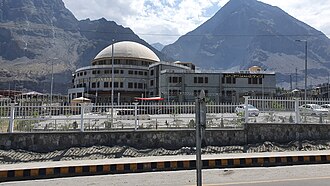
The Gilgit-Baltistan Assembly (GBA), formerly known as Gilgit-Baltistan Legislative Assembly (GBLA), is a unicameral legislature of elected representatives of the Pakistani territory (de facto province) of Gilgit-Baltistan which is located in Jutial neighbourhood in the city of Gilgit, the capital of Gilgit-Baltistan.
It was established under the Gilgit-Baltistan Empowerment and Self-Governance Order in 2009 which granted the region self-rule and an elected legislature, having a total of 33 seats, with 24 general seats, 6 seats reserved for women and 3 reserved for Technocrats and Professionals.
The third Gilgit-Baltistan Elections was held on 15 November 2020.
History
The Gilgit-Baltistan Legislative Assembly was formed as a part of the Gilgit-Baltistan Empowerment and Self-Governance Order in 2009 which granted the region self-rule and an elected legislative assembly.2 The first Gilgit-Baltistan Assembly elections were held on 12 November 2009 which Pakistan Peoples Party won by 20 seats.
List of Assemblies
| Order | Terms |
|---|---|
| First Assembly | November 2009 to April 2015 |
| Second Assembly | June 2015 to June 2020 |
| Third Assembly | November 2020 to November 2025 |
| Fourth Assembly | June 2026 to present |
Speakers of Gilgit-Baltistan Assembly
| No. | Names | Successive term of each |
|---|---|---|
| 1 | Mir Wazir Baig | 11 December 2009 to 23 June 2015 |
| 2 | Haji Fida Muhammad Nashad | 24 June 2015 to 25 November 2020 |
| 3 | Amjad Zaidi | 26 November 2020 to 7 June 2023 |
| 4 | Nazir Ahmed | 7 June 2023 to 22 June 2026 |
| 5 | Imran Nadeem3 | 22 June 2026 to present |
Chief Ministers of Gilgit-Baltistan
| Sr no. | Name of Chief Minister | Entered office | Left office | Political Party/Notes |
|---|---|---|---|---|
| 1 | Syed Mehdi Shah | 11 December 2009 | 11 December 2014 | PPP |
| . | Sher Jehan Mir | 12 December 2014 | 26 June 2015 | Caretaker |
| 2 | Hafiz Hafeezur Rehman | 26 June 2015 | 23 June 2020 | PMLN |
| . | Mir Afzal | 24 June 2020 | 30 November 2020 | Caretaker |
| 3 | Muhammad Khalid Khurshid Khan | 30 November 2020 | 4 July 2023 | PTI |
| 4 | Gulbar Khan | 13 July 2023 | 24 November 2025 | PTI |
| . | Yar Muhammad | 26 November 2025 | 22 June 2026 | Caretaker |
| 5 | Amjad Hussain Azar | 22 June 20263 | Incumbent | PPP |
List of Opposition Leaders
| Sr no. | Name of Opposition Leader | Entered office | Left office | Political Party/Notes |
|---|---|---|---|---|
| 1 | Bashir Ahmad | 11 December 2009 | 11 December 2014 | PML(Q) |
| 2 | Shah Baig | 2 July 2015 | 14 November 2017 | JUI(F) |
| 3 | Capt.(R) Muhammad Shafi | 14 November 2017 | 23 June 2020 | ITP |
| 4 | Amjad Hussain Azar | 30 November 2020 | 13 July 202345 | PPP |
| 5 | Muhammad Kazim Maisam | 19 July 2023 | 24 November 2025 | MWM |
| 6 | Hafiz Hafeezur Rehman | 22 June 20263 | PML(N) |
Elections
2009 Elections
In the 2009 elections, Pakistan Peoples Party had won 20 seats, Jamiat Ulema-e-Islam (Fazl) with 4 and Pakistan Muslim League (Q) with 3 seats.
| Party | Elected | Reserved | Total |
|---|---|---|---|
| Pakistan Peoples Party | 14 | 6 | 20 |
| Jamiat Ulema-e-Islam (Fazl) | 2 | 2 | 4 |
| Pakistan Muslim League (Q) | 2 | 1 | 3 |
| Pakistan Muslim League (N) | 2 | 0 | 2 |
| Balawaristan National Front | 1 | 0 | 1 |
| Muttahida Qaumi Movement | 1 | 0 | 1 |
| Others | 2 | 0 | 2 |
| Total | 24 | 9 | 33 |
2015 Elections
In the 2015 elections, Pakistan Muslim League (N) won 22 seats,6 Islami Tehreek Pakistan with 4 and Majlis Wahdat-e-Muslimeen with 3 seats.
| Party | Elected | Reserved | Total |
|---|---|---|---|
| Pakistan Muslim League (N) | 15 | 6 | 21 |
| Islami Tehreek Pakistan | 2 | 2 | 4 |
| Majlis Wahdat-e-Muslimeen | 2 | 1 | 3 |
| Pakistan Peoples Party | 1 | 0 | 1 |
| Pakistan Tehreek-e-Insaf | 1 | 0 | 1 |
| Balawaristan National Front | 1 | 0 | 1 |
| Jamiat Ulema-e-Islam (F) | 1 | 0 | 1 |
| Others | 1 | 0 | 1 |
| Total | 24 | 9 | 33 |
2020 Elections
| Party | Elected | Reserved | Total |
|---|---|---|---|
| Pakistan Tehreek-e-Insaf | 16 | 6 | 22 |
| Pakistan Peoples Party | 3 | 2 | 5 |
| Pakistan Muslim League (N) | 2 | 1 | 3 |
| Majlis Wahdat-e-Muslimeen | 1 | 0 | 1 |
| Jamiat Ulema-e-Islam (F) | 1 | 0 | 1 |
| Independent | 1 | 0 | 1 |
| Total | 24 | 9 | 33 |
Incumbent members
Notes
Notes
- The sole independent in the Assembly, Syed Sohail Abbas Shah, was elected as an independent supported by Pakistan Tehreek-e-Insaf (PTI). PTI could not nominate candidates to the 2026 elections because the Election Commission Gilgit-Baltistan prohibited the PTI election symbol.1
References
References
- Latif, Aamir (2026-06-06). "Pakistan's Gilgit-Baltistan region set for Sunday's polls". Anadolu Agency. Retrieved 2026-06-15.
- Shigri, Manzar (November 12, 2009). "Pakistan's disputed Northern Areas go to polls". Reuters.
- Nagri, Jamil (2026-06-22). "PPP's Amjad Hussain elected as GB chief minister after members take oath". Dawn. Retrieved 2026-06-22.
- Nagri, Jamil (2023-07-11). "GB opposition leader quits ahead of new CM election". DAWN. Retrieved 2023-07-14.
- "PTI forward bloc's Gulbar elected G-B CM". The Express Tribune. 2023-07-13. Retrieved 2023-07-14.
- "PML (N) emerges as largest party in GB polls". SUCH TV. June 9, 2015.