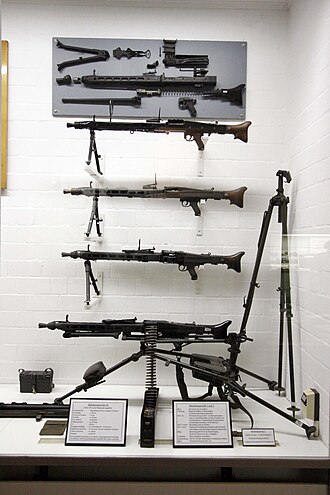
A general-purpose machine gun (GPMG) is an air-cooled, usually belt-fed machine gun that can be adapted flexibly to various tactical roles.1 Many medium machine guns are also considered general-purpose machine guns as they are broadly useful across a variety of infantry roles and can be mounted to a wide range of vehicles, aircraft, or static mounts; however the overlap is not complete, as not all MMGs are GPMGs and not all GPMGs are MMGs. A GPMG typically features a quick-change barrel design calibered for various fully powered cartridges such as the 7.62×51mm NATO, 7.62×54mmR, 7.5×54mm French, 7.5×55mm Swiss and 7.92×57mm Mauser,2 and can be configured for mounting to different stabilizing platforms from bipods and tripods to vehicles, aircraft, boats and fortifications, usually as an infantry support weapon or squad automatic weapon.
History
An early GPMG was the MG 34, designed in 1934 by Heinrich Vollmer of Mauser on the commission of Nazi Germany to circumvent the restrictions on machine guns imposed by the Treaty of Versailles. It was introduced into the Wehrmacht as an entirely new concept in automatic firepower, dubbed the Einheitsmaschinengewehr, meaning "universal machine gun" in German.345 In itself the MG 34 was an excellent weapon for its time: an air-cooled, recoil-operated machine gun that could run through belts of 7.92×57mm Mauser ammunition at a rate of 850 rounds per minute, with lethality at ranges of more than 1,000 meters.45 The main feature of the MG 34 is that simply by changing its mount, sights and feed mechanism, the operator could radically transform its function: on its standard bipod it was a light machine gun ideal for infantry assaults; on a tripod it could serve as a sustained-fire medium machine gun; mounting on aircraft or vehicles turned it into an air defence weapon, and it also served as the coaxial machine gun on numerous German tanks.45 During World War II, the MG 34 was supplemented by a new GPMG, the MG 42, although it remained in combat use.678 The MG 42 was more efficient and cheaper to manufacture, and more robust, as well as having an extremely high cyclic rate of fire of 1,200 to 1,500 rounds per minute.678 One of the Einheitsmaschinengewehr GPMG roles was to provide low level anti-aircraft coverage. A high cyclic rate of fire is advantageous for use against targets typically exposed to fire for a limited time span, like aircraft or targets minimizing their exposure by quickly moving from cover to cover689 Following the war the victorious Allied nations took an interest in the MG 34 and MG 42, influencing many post-war general-purpose machine guns, many still in use today. They lent design elements to the Belgian FN MAG and the American M60, while spawning the Zastava M53, Swiss M51, and Austrian MG 74. The MG 42's qualities of firepower and usability meant that it became the foundation of an entire series of postwar machine guns, including the MG 1 and MG 3; the latter, as of 2023, is still in production.67810
Post-WWII examples
- German Rheinmetall MG 3, a direct descendant of the MG 42, still in service with the German Army and others and widely exported.
- German Heckler & Koch HK21, is based on the Heckler & Koch G3 rifle and widely exported.
- German Heckler & Koch MG5, the new (2015) standard machine gun of the German Army.
- Belgian FN MAG, which copied the MG 42's feed-system and trigger-mechanism. It is the most widely used GPMG among western armies. The American M240 machine gun is another common FN MAG variant.
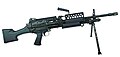
- Belgian/American Mk 48/Minimi 7.62, is a GPMG based on the FN Minimi light machine gun and M249 SAW.
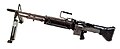
- American M60, which is based on the German FG 42 and uses the MG 42's feed system and stamp-steel construction.1112
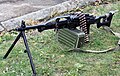
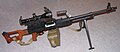
- Russian PK/PKM, family of multi-purpose machine guns, is based on the AKM assault rifle featuring stamped receivers, widely exported.
- Chinese Type 67, and later improved models.
- Chinese Type 88 Machine Gun
- Chinese QJY-201
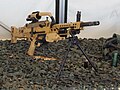
- South Korean S&T Motiv K16, is based on the K3 light machine gun.
- Swiss SIG MG 710-3
- Swiss SIG MG 50
- Israeli Negev NG7, is a GPMG based on the IWI Negev light machine gun.
- Belgian FN EVOLYS, is a multi-caliber, 3D printing and polymers material lightweight machine gun.
Gallery
-
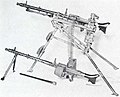 MG 34 belt-fed tripod version (top) and saddle-drum magazine bipod version (below)
 -
 MG 42/59
 -
-
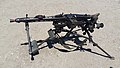 MG 74 mounted on its tripod
 -
-
-
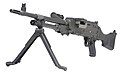 FN MAG (Fabrique Nationale de Herstal)
 -
-
-
-
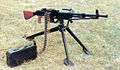 Type 67 on a tripod field mount
 -
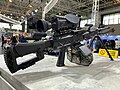 QJY-201 at Airshow China 2022
 -

-
-
-
-
-
-
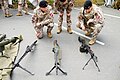 Latvian soldiers with MG3, FN MAG and HK21 machine guns
See also
See also
References
References
- James H. Willbanks (2004). Machine Guns: An Illustrated History of Their Impact. ABC-CLIO. p. 226. ISBN 978-1-85109-480-6.
- "General Purpose Machine Gun". UK Army. Archived from the original on January 10, 2013.
- Jane's Guns Recognition Guide. Ian Hogg & Terry Gander. HarperCollins Publishers. 2005. page 375
- Military Small Arms of the 20th Century. 7th Edition. Ian V. Hogg & John S. Weeks. Krause Publications. 2000. page 326
- The Encyclopedia of Weapons of World War II. Chris Bishop. Sterling Publishing Company. 2002. page 245 & 246
- Jane's Guns Recognition Guide. Ian Hogg & Terry Gander. HarperCollins Publishers. 2005. page 376
- Military Small Arms of the 20th Century. 7th Edition. Ian V. Hogg & John S. Weeks. Krause Publications. 2000. page 329
- The Encyclopedia of Weapons of World War II. Chris Bishop. Sterling Publishing Company. 2002. page 247
- Military Small Arms of the 20th Century. 7th Edition. Ian V. Hogg & John S. Weeks. Krause Publications. 2000. page 328 & 329
- MG 34 and MG 42 Machine Guns. by Chris McNab. Published by Random House Publishing Group. October 23, 2012. Quote taken from leaf.
- Military Small Arms Of The 20th Century. Ian Hogg & John Weeks. Krause Publications. 2000. p379
- Weapons: An International Encyclopedia From 5000 B.C. To 2000 A.D. Diagram Visual, p. 217. ISBN 0-312-03950-6.