Gary Cooper | |
|---|---|
 Cooper in 1952 | |
| Born | Frank James Cooper (1901-05-07)May 7, 1901 Helena, Montana, U.S. |
| Died | May 13, 1961(1961-05-13) (aged 60) Los Angeles, California, U.S. |
Resting place | Sacred Hearts Cemetery, New York, U.S. |
| Other name | Coop |
| Occupation | Actor |
| Years active | 1925–1961 |
Political party | Republican1 |
| Spouse | |
| Children | 1 |
| Father | Charles H. Cooper |
| Family | Cedric Gibbons (uncle-in-law) |
| Website | garycooper |
| Signature | |
 | |
Gary Cooper (born Frank James Cooper; May 7, 1901 – May 13, 1961) was an American actor known for his strong, silent screen persona and understated acting style. He was one of the top-10 film personalities for 23 consecutive years and one of the top money-making stars for 18 years. The American Film Institute (AFI) ranked Cooper at number 11 on its list of the 50 greatest screen legends. He won the Academy Award for Best Actor for Sergeant York (1941) and High Noon (1952) and an Academy Honorary Award in 1961.
Cooper's career spanned 36 years, from 1925 to 1961, and included leading roles in 84 feature films. He was a major movie star from the end of the silent film era through almost the end of the golden age of classical Hollywood. His screen persona appealed strongly to both men and women, and his range included roles in most major film genres. His ability to project his own personality onto the characters he played contributed to his natural and authentic appearance on screen. Throughout his career, he sustained a screen persona that represented the ideal American hero.
Cooper began his career as a film extra and stunt rider, but soon landed acting roles. After establishing himself as a Western hero in his early silent films, he became a movie star with his first sound picture, playing the title role in 1929's The Virginian. In the early 1930s, he expanded his heroic image to include more cautious characters in adventure films and dramas such as A Farewell to Arms (1932) and The Lives of a Bengal Lancer (1935). During the height of his career, Cooper portrayed a new type of hero, a champion of the common man in films such as Mr. Deeds Goes to Town (1936), Meet John Doe, Ball of Fire (both 1941), The Pride of the Yankees (1942), and For Whom the Bell Tolls (1943). He later portrayed more mature characters at odds with the world in films such as The Fountainhead (1949). In his final films, he played nonviolent characters searching for redemption in films such as Friendly Persuasion (1956) and Man of the West (1958).
Early life

Frank James Cooper was born in Helena, Montana, on May 7, 1901, the younger of two sons of English immigrant parents Alice (née Brazier) and Charles Henry Cooper.2 His brother, Arthur, was six years his senior. Cooper's father came from Houghton Regis, Bedfordshire, England,3 and was a prominent lawyer, rancher, and Montana Supreme Court justice.4 His mother hailed from Gillingham, Kent, England, and married Charles in Montana.5 In 1906, Charles purchased the 600-acre (240 ha) Seven-Bar-Nine cattle ranch,67 about fifty miles (80 km) north of Helena, near Craig.8 Cooper and Arthur spent their summers at the ranch and learned to ride horses, hunt and fish.910 Cooper attended Central Grade School in Helena.11
Alice wanted their sons to have a British education, so she took them back to the United Kingdom in 1909 to enroll them in Dunstable Grammar School in Dunstable, England. While there, Cooper and his brother lived with their father's cousins, William and Emily Barton, at their home in Houghton Regis.1213 Cooper studied Latin, French and English history at Dunstable until 1912.14 While he adapted to English school discipline and learned the requisite social graces, he never adjusted to the formal Eton collars he was required to wear.15 He received his confirmation in the Church of England at the Church of All Saints in Houghton Regis on December 3, 1911.1617 His mother accompanied their sons back to the U.S. in August 1912 and Cooper resumed his education in Montana, at Johnson Grammar School in Helena.11
At age 15, Cooper injured his hip in a car accident. On his doctor's recommendation, he returned to the Seven-Bar-Nine ranch to recuperate with horseback riding.18 The misguided therapy left Cooper with his characteristic stiff, off-balanced walk and slightly angled horse-riding style.19 He left Helena High School after two years in 1918 and returned to the family ranch to work full-time as a cowboy.19 In 1919, his father arranged for his son to attend Gallatin County High School in Bozeman,2021 where English teacher Ida Davis encouraged him to focus on academics and participate in debating and dramatics.2122 Cooper later called Davis "the woman partly responsible for [his] giving up cowboy-ing and going to college".22
While in high school in 1920, Cooper took three art courses at Montana Agricultural College (now Montana State University) in Bozeman.21 His interest in art was inspired years earlier by the Western paintings of Charles Marion Russell and Frederic Remington.23 Cooper especially admired and studied Russell's Lewis and Clark Meeting Indians at Ross' Hole (1910), which still hangs in the state capitol building in Helena.23

In 1922, to continue his art education, Cooper enrolled in Grinnell College in Grinnell, Iowa. He did well academically in most of his courses24 but was not accepted into the school's drama club.24 His drawings and watercolor paintings were exhibited throughout the dormitory and he was named art editor for the college yearbook.25 During the summers of 1922 and 1923, Cooper worked at Yellowstone National Park as a tour guide driving the yellow open-top buses.2627 Despite a promising first 18 months at Grinnell, he left college suddenly in February 1924, spent a month in Chicago looking for work as an artist, and then returned to Helena,28 where he sold editorial cartoons to the local Independent newspaper.29
In autumn 1924, Cooper's father left the state supreme court bench and moved with his wife to Los Angeles to administer the estates of two relatives,3031 and Cooper joined his parents there in November at his father's request.30 After briefly working a series of unpromising jobs, he met two friends from Montana,3233 who were working as film extras and stunt riders in low-budget Western films for the small movie studios on Poverty Row.34 They introduced him to another Montana cowboy, rodeo champion Jay "Slim" Talbot, who took him to see a casting director.32 Wanting money for a professional art course,30 Cooper worked as a film extra for five dollars a day and as a stunt rider for $10. Cooper and Talbot became close friends and hunting companions; Talbot later worked as Cooper's stuntman and stand-in for over three decades.34
Career
Silent films, 1925–1928

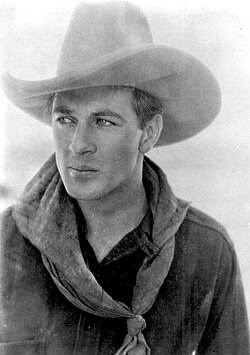
In early 1925, Cooper began his film career in silent pictures such as The Thundering Herd and Wild Horse Mesa with Jack Holt,35 Riders of the Purple Sage and The Lucky Horseshoe with Tom Mix,3637 and The Trail Rider with Buck Jones.36 He worked for several Poverty Row studios, but also the already emergent major studios, Famous Players–Lasky and Fox Film Corporation.38 While his skilled horsemanship led to steady work in Westerns, Cooper found the stunt work, which sometimes injured horses and riders, "tough and cruel".35 Hoping to move beyond the risky stunt work and obtain acting roles, Cooper paid for a screen test and hired casting director Nan Collins to work as his agent.39 Knowing that other actors were using the name "Frank Cooper", Collins suggested he change his first name to "Gary" after her hometown of Gary, Indiana.404142 Cooper immediately liked the name.43Note 1
Cooper also found work in a variety of non-Western films, appearing, for example, as a masked Cossack in The Eagle (1925), as a Roman guard in Ben-Hur (1925), and as a flood survivor in The Johnstown Flood (1926).36 Gradually, he began to land credited roles that offered him more screen time, in films such as Tricks (1925), in which he played the film's antagonist, and the short film Lightnin' Wins (1926).45 As a featured player, he began to attract the attention of major film studios.46 On June 1, 1926, Cooper signed a contract with Samuel Goldwyn Productions for $50 a week.47
Cooper's first important film role was a supporting part in The Winning of Barbara Worth (1926) starring Ronald Colman and Vilma Bánky,47 in which he plays a young engineer who helps a rival suitor save the woman he loves and her town from an impending dam disaster.48 Cooper's experience living among the Montana cowboys gave his performance an "instinctive authenticity", according to biographer Jeffrey Meyers.49 The film was a major success.50 Critics singled out Cooper as a "dynamic new personality" and future star.5152 Goldwyn rushed to offer Cooper a long-term contract, but he held out for a better deal – a five-year contract with Jesse L. Lasky at Paramount Pictures for $175 a week.51 In 1927, with help from Clara Bow, Cooper landed high-profile roles in Children of Divorce and Wings (both 1927), the latter being the first film to win an Academy Award for Best Picture.53 That year, Cooper also appeared in his first starring roles in Arizona Bound and Nevada, both films directed by John Waters.54
Paramount paired Cooper with Fay Wray in The Legion of the Condemned and The First Kiss (both 1928), advertising them as the studio's "glorious young lovers".55 Their on-screen chemistry failed to generate much excitement with audiences.555657 With each new film, Cooper's acting skills improved and his popularity continued to grow, especially among female movie-goers.57 During this time, he was earning as much as $2,750 per film58 and receiving 1,000 fan letters a week.59 Looking to exploit Cooper's growing audience appeal, the studio placed him opposite popular leading ladies such as Evelyn Brent in Beau Sabreur, Florence Vidor in Doomsday, and Esther Ralston in Half a Bride (all 1928).60 Around the same time, Cooper made Lilac Time (1928) with Colleen Moore for First National Pictures, his first movie with synchronized music and sound effects. It became one of the most commercially successful films of 1928.60
Hollywood stardom, 1929–1935

Cooper became a major movie star in 1929 playing the lead role in his first talking picture, The Virginian (1929), which was directed by Victor Fleming and co-starred Mary Brian and Walter Huston. Based on the popular novel by Owen Wister, The Virginian was one of the first sound films to define the Western code of honor and helped establish many of the conventions of the Western movie genre that persist to the present day.61 According to biographer Jeffrey Meyers, the romantic image of the tall, handsome, and shy cowboy hero who embodied male freedom, courage, and honor was created in large part by Cooper in the film.62 Unlike some silent-film actors who had trouble adapting to the new sound medium, Cooper transitioned naturally, with his "deep and clear" and "pleasantly drawling" voice, which perfectly suited the characters he portrayed on screen.63 Looking to capitalize on Cooper's growing popularity, Paramount cast him in several Westerns and wartime dramas, including Only the Brave, The Texan, Seven Days' Leave, A Man from Wyoming, and The Spoilers (all released in 1930).64 Norman Rockwell depicted Cooper in his role as The Texan for the cover of The Saturday Evening Post on May 24, 1930.65

One of the most important performances in Cooper's early career was his portrayal of a sullen legionnaire in Josef von Sternberg's film Morocco (also 1930)66 with Marlene Dietrich in her introduction to American audiences.67 During production, von Sternberg focused his energies on Dietrich and treated Cooper dismissively.67 Tensions came to a head after von Sternberg yelled directions at Cooper in German. The 6-foot-3-inch (191 cm) actor approached the 5-foot-4-inch (163 cm) director, picked him up by the collar, and said, "If you expect to work in this country, you'd better get on to the language we use here."6869 Despite the tensions on the set, Cooper produced "one of his best performances", according to Thornton Delehanty of the New York Evening Post.70
After returning to the Western genre in Zane Grey's Fighting Caravans (1931) with French actress Lili Damita,71 Cooper appeared in the Dashiell Hammett crime film City Streets (also 1931), co-starring Sylvia Sidney and Paul Lukas, playing a westerner who gets involved with big-city gangsters to save the woman he loves.72 Cooper concluded the year with appearances in two unsuccessful films: I Take This Woman (also 1931) with Carole Lombard, and His Woman with Claudette Colbert.73 The demands and pressures of making 10 films in two years left Cooper exhausted and in poor health, suffering from anemia and jaundice.6774 He had lost 30 lb (14 kg),7475 and felt lonely, isolated, and depressed by his sudden fame and wealth.7677 In May 1931, Cooper left Hollywood and sailed to Algiers and then Italy, where he lived for the next year.76
During his time abroad, Cooper stayed with the Countess Dorothy di Frasso, the former Dorothy Cadwell Taylor, at the Villa Madama in Rome, where she taught him about good food and vintage wines, how to read Italian and French menus, and how to socialize among Europe's nobility and upper classes.78 After guiding him through the great art museums and galleries of Italy,78 she accompanied him on a 10-week big-game hunting safari on the slopes of Mount Kenya in East Africa,79 where he was credited with more than 60 kills, including two lions, a rhinoceros, and various antelopes.8081 His safari experience in Africa had a profound influence on Cooper and intensified his love of the wilderness.81 After returning to Europe, the countess and he set off on a Mediterranean cruise of the Italian and French Rivieras.82 Rested and rejuvenated by his year-long exile, a healthy Cooper returned to Hollywood in April 193283 and negotiated a new contract with Paramount for two films per year, a salary of $4,000 a week, and director and script approval.84

In 1932, after completing Devil and the Deep with Tallulah Bankhead to fulfill his old contract,85 Cooper appeared in A Farewell to Arms,86 the first film adaptation of an Ernest Hemingway novel.87 Co-starring Helen Hayes, a leading New York theatre star and Academy Award winner,88 and Adolphe Menjou, the film presented Cooper with one of his most ambitious and challenging dramatic roles,88 playing an American ambulance driver wounded in Italy, who falls in love with an English nurse during World War I.86 Critics praised his highly intense and emotional performance,8990 and the film became one of the year's most commercially successful pictures.88 In 1933, after making Today We Live with Joan Crawford and One Sunday Afternoon with Fay Wray, Cooper appeared in the Ernst Lubitsch comedy film Design for Living, based on the successful Noël Coward play.9192 Co-starring Miriam Hopkins and Fredric March, the film was a box-office success,93 ranking as one of the top-10 highest-grossing films of 1933. All three of the lead actors—March, Cooper, and Hopkins—received attention from this film, as they were all at the peak of their careers. Cooper's performance as an American artist in Europe competing with his playwright friend for the affections of a beautiful woman was singled out for its versatility94 and revealed his genuine ability to do light comedy.95 Cooper changed his name legally to "Gary Cooper" in August 1933.96

In 1934, Cooper was lent out to MGM for the Civil War drama film Operator 13 with Marion Davies, about a beautiful Union spy who falls in love with a Confederate soldier.97 Despite Richard Boleslawski's imaginative direction and George J. Folsey's lavish cinematography, the film did poorly at the box office.98
Back at Paramount, Cooper appeared in his first of seven films by director Henry Hathaway,99 Now and Forever, with Carole Lombard and Shirley Temple.100 In the film, he plays a confidence man who tries to sell his daughter to the relatives who raised her, but is eventually won over by the adorable girl.101 Impressed by Temple's intelligence and charm, Cooper developed a close rapport with her, both on and off screen.99Note 2 The film was a box-office success.98
In 1935, Cooper was lent to Samuel Goldwyn Productions to appear in King Vidor's romance film The Wedding Night with Anna Sten,102 who was being groomed as "another Garbo".103104 In the film, Cooper plays an alcoholic novelist who retreats to his family's New England farm, where he meets and falls in love with a beautiful Polish neighbor.102 Cooper delivered a performance of surprising range and depth, according to biographer Larry Swindell.105 Despite receiving generally favorable reviews,106 the film was not popular with American audiences, who may have been offended by the film's depiction of an extramarital affair and its tragic ending.105
Also in 1935, Cooper appeared in two Henry Hathaway films: the melodrama Peter Ibbetson with Ann Harding, about a man caught up in a dream world created by his love for a childhood sweetheart,107 and the adventure film The Lives of a Bengal Lancer, about a daring British officer and his men who defend their stronghold at Bengal against rebellious local tribes.108 While the former, championed by the surrealists109 became more successful in Europe than in the United States, the latter was nominated for seven Academy Awards110 and became one of Cooper's most popular and successful adventure films.111112 Hathaway had the highest respect for Cooper's acting ability, calling him "the best actor of all of them".99
American folk hero, 1936–1943
From Mr. Deeds to The Real Glory, 1936–1939

Cooper's career took an important turn in 1936.113 After making Frank Borzage's romantic comedy film Desire at Paramount, in which he co-starred again with Marlene Dietrich and delivered a performance considered by some contemporary critics as one of his finest,113 he returned to Poverty Row for the first time since his early silent-film days to make Frank Capra's Mr. Deeds Goes to Town with Jean Arthur for Columbia Pictures.114 In the film, Cooper plays Longfellow Deeds, a quiet, innocent writer of greeting cards who inherits a fortune, leaves behind his idyllic life in Vermont, and travels to New York City, where he faces a world of corruption and deceit.115 Capra and screenwriter Robert Riskin were able to use Cooper's well-established screen persona as the "quintessential American hero"113—a symbol of honesty, courage, and goodness116117118—to create a new type of "folk hero" for the common man.113119 Of Cooper's impact on the character and the film, Capra said:120
As soon as I thought of Gary Cooper, it wasn't possible to conceive anyone else in the role. He could not have been any closer to my idea of Longfellow Deeds, and as soon as he could think in terms of Cooper, Bob Riskin found it easier to develop the Deeds character in terms of dialogue. So it just had to be Cooper. Every line in his face spelled honesty. Our Mr. Deeds had to symbolize incorruptibility, and in my mind Gary Cooper was that symbol.
Both Desire and Mr. Deeds opened in April 1936 to critical praise and were major box-office successes.121 In his review in The New York Times, Frank Nugent wrote that Cooper was "proving himself one of the best light comedians in Hollywood".122 For his performance in Mr. Deeds, Cooper received his first Academy Award nomination for Best Actor.123

Cooper appeared in two other Paramount films in 1936. In Lewis Milestone's adventure film The General Died at Dawn with Madeleine Carroll, he plays an American soldier of fortune in China who helps the peasants defend themselves against the oppression of a cruel warlord.124125 Written by playwright Clifford Odets, the film was a critical and commercial success.124126
In Cecil B. DeMille's sprawling frontier epic The Plainsman, his first of four films with the director, Cooper portrays Wild Bill Hickok in a highly fictionalized version of the opening of the American western frontier.127 The film was an even greater box-office hit than its predecessor,128 due in large part to Jean Arthur's definitive depiction of Calamity Jane and Cooper's inspired portrayal of Hickok as an enigmatic figure of "deepening mythic substance".129 That year, Cooper appeared for the first time on the Motion Picture Herald exhibitor's poll of top-10 film personalities, where he remained for the next 23 years.130
In late 1936, Paramount was preparing a new contract for Cooper that would raise his salary to $8,000 a week,131 when Cooper signed a contract with Samuel Goldwyn for six films over six years with a minimum guarantee of $150,000 per picture.132 Paramount brought suit against Goldwyn and Cooper, and the court ruled that Cooper's new Goldwyn contract afforded the actor sufficient time to also honor his Paramount agreement.133 Cooper continued to make films with both studios, and by 1939, the United States Treasury reported that Cooper was the country's highest wage earner, at $482,819 (equivalent to $11.18 million in 2025).132134135
In contrast to his output the previous year, Cooper appeared in only one picture in 1937, Henry Hathaway's adventure film Souls at Sea.136 A critical and box-office failure,137 Cooper called it an "almost picture", saying, "It was almost exciting, and almost interesting. And I was almost good."137 In 1938, he appeared in Archie Mayo's biographical film The Adventures of Marco Polo.138 Plagued by production problems and a weak screenplay,139 the film became Goldwyn's biggest failure to date, losing $700,000.140 During this period, Cooper turned down several important roles,141 including that of Rhett Butler in Gone with the Wind.142 Cooper was producer David O. Selznick's first choice for the part.142 Selznick made several overtures to Cooper,143 but Cooper had doubts about the project143 and did not feel suited to the role.130 He later said: "It was one of the best roles ever offered in Hollywood ... But I said no. I didn't see myself as quite that dashing, and later, when I saw Clark Gable play the role to perfection, I knew I was right."130Note 3

Back at Paramount, Cooper returned to a more comfortable genre in Ernst Lubitsch's romantic comedy Bluebeard's Eighth Wife (1938) with Claudette Colbert.140146 Cooper plays a wealthy American businessman in France who falls in love with an impoverished aristocrat's daughter and persuades her to become his eighth wife.147 Despite the clever screenplay by Charles Brackett and Billy Wilder148 and solid performances by Cooper and Colbert,146 American audiences had trouble accepting Cooper in the role of a shallow philanderer. It succeeded only at the European box-office market.148
In the fall of 1938, Cooper appeared in H. C. Potter's romantic comedy The Cowboy and the Lady with Merle Oberon, about a sweet-natured rodeo cowboy who falls in love with the wealthy daughter of a presidential hopeful, believing her to be a poor, hard-working lady's maid.149 While more successful than its predecessor, the film was Cooper's fourth consecutive box-office failure in the American market.150
In the next two years, Cooper was more discerning about the roles he accepted and made four successful large-scale adventure and cowboy films.150 In William A. Wellman's adventure film Beau Geste (1939), he plays one of three daring English brothers who join the French Foreign Legion in the Sahara to fight local tribes.151 Filmed in the same Mojave Desert locations as the original 1926 version with Ronald Colman,150152 Beau Geste provided Cooper with magnificent sets, exotic settings, high-spirited action, and a role tailored to his personality and screen persona.153 This was the last film in Cooper's contract with Paramount.153
In Henry Hathaway's The Real Glory (1939), Cooper plays a military doctor who accompanies a small group of U.S. Army officers to the Philippines to help the Christian Filipinos defend themselves against Muslim radicals.154 Many critics praised Cooper's performance, including author and film critic Graham Greene, who said he "never acted better".155
From The Westerner to For Whom the Bell Tolls, 1940–1943
Cooper returned to the Western genre in William Wyler's The Westerner (1940) with Walter Brennan and Doris Davenport, about a drifting cowboy who defends homesteaders against Roy Bean, a corrupt judge known as the "law west of the Pecos".155156 Screenwriter Niven Busch relied on Cooper's extensive knowledge of Western history while working on the script.157 The film received positive reviews and did well at the box office,158 with reviewers praising the two lead actors' performances.159 That same year, Cooper appeared in his first all-Technicolor feature,160 Cecil B. DeMille's adventure film North West Mounted Police (1940).161Note 4 Cooper plays a Texas Ranger who pursues an outlaw into western Canada, where he joins forces with the Royal Canadian Mounted Police who are after the same man, a leader of the North-West Rebellion.163 While not as popular with critics as its predecessor,164 the film was another box-office success, the sixth-highest grossing film of 1940.158165

The early 1940s were Cooper's prime years as an actor.166 In a relatively short period, he appeared in five critically successful and popular films that produced some of his finest performances.166 When Frank Capra offered him the lead role in Meet John Doe before Robert Riskin even developed the script, Cooper accepted the offer, saying, "It's okay, Frank, I don't need a script."167 Cooper plays Long John Willoughby, a down-and-out bush-league pitcher hired by a newspaper to pretend to be a man who promises to commit suicide on Christmas Eve to protest all the hypocrisy and corruption in the country.168 Considered by some critics to be Capra's best film at the time,169 Meet John Doe was received as a "national event"169 with Cooper appearing on the front cover of Time on March 3, 1941.170 In his review in the New York Herald Tribune, Howard Barnes called Cooper's performance a "splendid and utterly persuasive portrayal"171 and praised his "utterly realistic acting which comes through with such authority".170 In The New York Times, Bosley Crowther wrote, "Gary Cooper, of course, is 'John Doe' to the life and in the whole—shy, bewildered, nonaggressive, but a veritable tiger when aroused."172
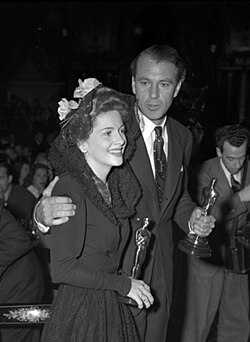
That same year, Cooper made two films his good friend director Howard Hawks.173 In the biographical film Sergeant York, Cooper plays war hero Alvin C. York,174 one of the most decorated American soldiers in World War I.175 The film chronicles York's early backwoods days in Tennessee, his religious conversion and subsequent piety, his stand as a conscientious objector, and finally his heroic actions at the Battle of the Argonne Forest, which earned him the Medal of Honor.174176 Initially, Cooper was nervous and uncertain about playing a living hero, so he traveled to Tennessee to visit York at his home, and the two men established a rapport and discovered they had much in common.177 Inspired by York's encouragement, Cooper delivered a performance that Howard Barnes of the New York Herald Tribune called "one of extraordinary conviction and versatility" and that Archer Winston of the New York Post called "one of his best".178 After the film's release, Cooper was awarded the Distinguished Citizenship Medal by the Veterans of Foreign Wars for his "powerful contribution to the promotion of patriotism and loyalty".179 York admired Cooper's performance and helped promote the film for Warner Bros.180 Sergeant York became the top-grossing film of the year and was nominated for 11 Academy Awards.179181 Accepting his first Academy Award for Best Actor from his friend James Stewart, Cooper said, "It was Sergeant Alvin York who won this award. Shucks, I've been in the business 16 years and sometimes dreamed I might get one of these. That's all I can say ... Funny when I was dreaming I always made a better speech."181

Cooper concluded the year back at Goldwyn with Hawks to make the romantic comedy Ball of Fire with Barbara Stanwyck.182 Cooper plays a shy linguistics professor who leads a team of seven scholars who are writing an encyclopedia. While researching slang, he meets Stanwyck's flirtatious burlesque stripper Sugarpuss O'Shea, who blows the dust off their staid life of books.183 The screenplay, by Charles Brackett and Billy Wilder, gave Cooper the opportunity to exercise the full range of his light comedy skills.183 In the New York Herald Tribune, Howard Barnes wrote that Cooper handled the role with "great skill and comic emphasis" and called his performance "utterly delightful".184 Though small in scale, Ball of Fire was one of the top-grossing films of the year185 and Cooper's fourth consecutive picture to make the top 20.185
Cooper's only film appearance in 1942 was also his last under his Goldwyn contract.186 In Sam Wood's biographical film The Pride of the Yankees,187 Cooper portrays baseball star Lou Gehrig, who established a record with the New York Yankees for playing in 2,130 consecutive games.188 Cooper was reluctant to play the seven-time All-Star, who had died only the previous year from ALS (now commonly called "Lou Gehrig's disease").189 Beyond the challenges of effectively portraying such a popular and nationally recognized figure, Cooper knew very little about baseball190 and was not left-handed like Gehrig.189
After Gehrig's widow visited the actor and expressed her desire that he portray her husband,189 Cooper accepted the role that covered a 20-year span of Gehrig's life: his early love of baseball, his rise to greatness, his loving marriage, and his struggle with illness, culminating in his farewell speech at Yankee Stadium on July 4, 1939, before 62,000 fans.191 Cooper quickly learned the physical movements of a baseball player and developed a fluid, believable swing.192 The handedness issue was solved by reversing the print for certain batting scenes.193 The film was one of the year's top-10 pictures194 and received 11 Academy Award nominations, including Best Picture and Best Actor (Cooper's third).195
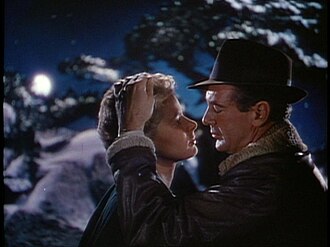
Soon after the publication of Ernest Hemingway's novel For Whom the Bell Tolls, Paramount paid $150,000 for the film rights with the express intent of casting Cooper in the lead role of Robert Jordan,196 an American explosives expert who fights alongside the Republican loyalists during the Spanish Civil War.197 The original director, Cecil B. DeMille, was replaced by Sam Wood, who brought in Dudley Nichols for the screenplay.196 After the start of principal photography in the Sierra Nevada in late 1942, Ingrid Bergman was brought in to replace ballerina Vera Zorina as the female lead, a change supported by Cooper and Hemingway.198 The love scenes between Bergman and Cooper were "rapturous" and passionate.199200 In the New York Herald Tribune Howard Barnes wrote that both actors performed with "the true stature and authority of stars".201 While the film distorted the novel's original political themes and meaning,202203 For Whom the Bell Tolls was a critical and commercial success and received 10 Academy Award nominations, including Best Picture and Best Actor (Cooper's fourth).200
World War II related activities

Due to his age and health, Cooper did not serve in the military during World War II,166 but like many of his colleagues, he got involved in the war effort by entertaining the troops.194 In June 1943, he visited military hospitals in San Diego,194 and often appeared at the Hollywood Canteen serving food to the servicemen.204 In late 1943, Cooper undertook a 23,000-mile (37,000 km) tour of the South West Pacific with actresses Una Merkel and Phyllis Brooks and accordionist Andy Arcari.194204205
Traveling on a B-24A Liberator bomber,194 the group toured the Cook Islands, Fiji, New Caledonia, Queensland, Brisbane—where General Douglas MacArthur told Cooper he was watching Sergeant York in a Manila theater when Japanese bombs began falling194—New Guinea, and Jayapura, then throughout the Solomon Islands.206
The group often shared the same sparse living conditions and K-rations as the troops.207 Cooper met with the servicemen and women, visited military hospitals, introduced his colleagues, and participated in occasional skits.207 The shows concluded with Cooper's moving recitation of Lou Gehrig's farewell speech.207 When he returned to the U.S., he visited military hospitals throughout the country.207 Cooper later called his time with the troops the "greatest emotional experience" of his life.205
Mature roles, 1944–1952

In 1944, Cooper appeared in Cecil B. DeMille's wartime adventure film The Story of Dr. Wassell, his third movie with DeMille.208 Cooper plays American doctor and missionary Corydon M. Wassell, who leads a group of wounded sailors through the jungles of Java to safety.209 Despite poor reviews, Dr. Wassell was one of the year's top-grossing films.210 With his Goldwyn and Paramount contracts concluded, Cooper formed his own production company, International Pictures, with Leo Spitz, William Goetz, and Nunnally Johnson.211 The fledgling studio's first offering was Sam Wood's romantic comedy Casanova Brown, about a man who learns his soon-to-be ex-wife is pregnant with his child just as he is about to marry another woman.212 The film received poor reviews,213 with the New York Daily News calling it "delightful nonsense",214 and Bosley Crowther, in The New York Times, criticizing Cooper's "somewhat obvious and ridiculous clowning".215 The film was barely profitable.216
In 1945, Cooper starred in and produced Stuart Heisler's Western comedy Along Came Jones for International.217 In this lighthearted parody of his past heroic image,218 Cooper plays comically inept cowboy Melody Jones, who is mistaken for a ruthless killer.218 Audiences embraced Cooper's character, and the film was one of the year's top box-office pictures—a testament to Cooper's still vital audience appeal.219 It was also International's biggest financial success during its brief history before being sold off to Universal Studios in 1946.220
Cooper's career during the postwar years drifted in new directions as American society was changing. While he still played conventional heroic roles, his films now relied less on his heroic screen persona and more on novel stories and exotic settings.221 In November 1945, Cooper appeared in Sam Wood's 19th-century period drama Saratoga Trunk, about a Texas cowboy and his relationship with a beautiful fortune hunter.222 Filmed in early 1943, the movie's release was delayed due to increased demand for war movies.223 Despite poor reviews, Saratoga Trunk did well at the box office224 and became one of the year's top moneymakers for Warner Bros.225 Cooper's only film in 1946 was Fritz Lang's romantic thriller Cloak and Dagger, about a mild-mannered physics professor recruited by the Office of Strategic Services during the last years of World War II to investigate the German atomic-bomb program.226 Playing a part loosely based on physicist J. Robert Oppenheimer, Cooper was uneasy with the role and unable to convey the "inner sense" of the character.227 The film received poor reviews and was a box-office failure.228 In 1947, Cooper appeared in Cecil B. DeMille's epic adventure film Unconquered, about an 18th-century Virginia militiaman who defends settlers against an unscrupulous gun trader and hostile Indians on the Western frontier.229 The film received mixed reviews, but even long-time DeMille critic James Agee acknowledged the picture had "some authentic flavor of the period".230 This last of four films made with DeMille was Cooper's most lucrative, earning him over $300,000 (equal to $4,325,633 today) in salary and percentage of profits.231 Unconquered was his last unqualified box-office success for the next five years.230

In 1948, after making Leo McCarey's romantic comedy Good Sam,232 Cooper sold his company to Universal Studios and signed a long-term contract with Warner Bros. that gave him script and director approval and a guaranteed $295,000 (equal to $3,953,082 today) per picture.233 His first film under the new contract was King Vidor's drama The Fountainhead (1949) with Patricia Neal and Raymond Massey.234 Cooper plays the idealistic and uncompromising architect Howard Roark, who struggles to maintain his integrity and individualism in the face of societal pressures to conform to popular standards.235 Based on the novel by Ayn Rand, who also wrote the screenplay, the film reflects her philosophy and attacks the concepts of collectivism while promoting the virtues of individualism.236 For most critics, Cooper was hopelessly miscast as Roark.237 In his review for The New York Times, Bosley Crowther concluded he was "Mr. Deeds out of his element".238 Cooper returned to his element in Delmer Daves's war drama Task Force (1949), about a retiring rear admiral who reminisces about his long career as a naval aviator and his role in the development of aircraft carriers.239 Cooper's performance and the Technicolor newsreel footage supplied by the United States Navy made the film one of Cooper's most popular during this period.240 In the next two years, Cooper made four poorly received films: Michael Curtiz's period drama Bright Leaf (1950), Stuart Heisler's Western melodrama Dallas (1950), Henry Hathaway's wartime comedy You're in the Navy Now (1951), and Raoul Walsh's Western action film Distant Drums (1951).241

Cooper's most important film during the postwar years was Fred Zinnemann's Western drama High Noon (1952), for United Artists.242 Cooper plays retiring sheriff Will Kane, who is preparing to leave town on his honeymoon when he learns that an outlaw he helped put away and his three henchmen are returning to seek their revenge. Unable to gain the support of the frightened townspeople, and abandoned by his bride, Kane stays to face the outlaws alone.243 During the filming, Cooper was in poor health and in considerable pain from stomach ulcers.244 His ravaged face and discomfort in some scenes "photographed as self-doubt", according to biographer Hector Arce,245 and contributed to the effectiveness of his performance.244 Considered one of the first "adult" Westerns for its theme of moral courage,246 High Noon received enthusiastic reviews for its artistry, with Time ranking it with Stagecoach and The Gunfighter.247 In The New York Times, Bosley Crowther wrote that Cooper was "at the top of his form",248 and John McCarten, in The New Yorker, wrote that Cooper was never more effective.249 The film earned $3.75 million in the United States247 and $18 million worldwide.250 Following the example of his friend James Stewart,251 Cooper accepted a lower salary in exchange for a percentage of the profits, and made $600,000.250 His understated performance was widely praised,245249 and earned him his second Academy Award for Best Actor.252Note 5
Later films, 1953–1959
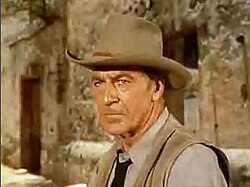
After appearing in Andre de Toth's Civil War drama Springfield Rifle (1952)254—a standard Warner Bros. film overshadowed by the success of its predecessor255—Cooper made four films outside the U.S.256 In Mark Robson's drama Return to Paradise (1953), Cooper plays an American wanderer who liberates the inhabitants of a Polynesian island from the puritanical rule of a misguided pastor.257 Cooper endured spartan living conditions, long hours, and ill health during the three-month shoot on the island of Upolu in Western Samoa.258 Despite its beautiful cinematography, the film received poor reviews.259 Cooper's next three films were shot in Mexico.256 In Hugo Fregonese's action adventure film Blowing Wild (1953), he plays a wildcatter in Mexico, who gets involved with an oil-company executive and his unscrupulous wife with whom he once had an affair.260
In 1954, Cooper appeared in Henry Hathaway's Western drama Garden of Evil, about three soldiers of fortune in Mexico hired to rescue a woman's husband.261 That same year, he appeared in Robert Aldrich's Western adventure Vera Cruz. Cooper plays an American adventurer hired by Emperor Maximilian I to escort a countess to Vera Cruz during the Mexican Rebellion of 1866.262 All these films received poor reviews but did well at the box office.263 For his work in Vera Cruz, Cooper earned $1.4 million in salary and a percentage of the gross.264

During this period, Cooper struggled with health problems. He suffered a severe shoulder injury during the filming of Blowing Wild when he was hit by metal fragments from a dynamited oil well, as well as his ongoing treatment for ulcers.264 During the filming of Vera Cruz, he reinjured his hip by falling from a horse, and was burned when Lancaster fired his rifle too close and the wadding from the blank shell pierced his clothing.264
Cooper appeared in Otto Preminger's 1955 biographical war drama The Court-Martial of Billy Mitchell, about the World War I general who tried to convince government officials of the importance of air power, and was court-martialed after blaming the War Department for a series of air disasters.265 Some critics felt Cooper was miscast,266 and that his dull, tight-lipped performance did not reflect Mitchell's dynamic and caustic personality.267 In 1956, Cooper was more effective playing a gentle Indiana Quaker in William Wyler's Civil War drama Friendly Persuasion with Dorothy McGuire.268 Like Sergeant York and High Noon, the film addresses the conflict between religious pacifism and civic duty.269 For his performance, Cooper received his second Golden Globe nomination for Best Motion Picture Actor.270 The film was nominated for six Academy Awards, was awarded the Palme d'Or at the 1957 Cannes Film Festival, and went on to earn $8 million worldwide.269271

Cooper traveled to France in 1956 to make Billy Wilder's romantic comedy Love in the Afternoon with Audrey Hepburn and Maurice Chevalier.272 In the film, Cooper plays a middle-aged American playboy in Paris who is pursued by—and eventually falls in love with—a much younger woman.273 Despite receiving some positive reviews, including from Crowther, who praised the film's "charming performances",274 most reviewers concluded that Cooper was simply too old for the part.275 While audiences may not have welcomed seeing Cooper's heroic screen image tarnished by his playing an aging roué having an affair with a young girl, the film was still a box-office success.275 In 1957, Cooper appeared in Philip Dunne's romantic drama Ten North Frederick,276 based on the novel by John O'Hara.277 Cooper plays an attorney whose life is ruined by a double-crossing politician and his own secret affair with his daughter's roommate.276 While Cooper brought "conviction and controlled anguish" to his performance, according to biographer Jeffrey Meyers,277 it was not enough to save what Crowther called a "hapless film".278

Despite his ongoing health problems and several operations for ulcers and hernias, Cooper continued to work in action films.279 In 1958, he appeared in Anthony Mann's Western drama Man of the West (1958) with Julie London and Lee J. Cobb, about a reformed outlaw and killer who is forced to confront his violent past when the train in which he is riding is held up by his former gang members.280 The film has been called Cooper's "most pathological Western", with its themes of impotent rage, sexual humiliation, and sadism.277 According to Meyers, Cooper, who struggled with moral conflicts in his personal life, "understood the anguish of a character striving to retain his integrity ... [and] brought authentic feeling to the role of a tempted and tormented, yet essentially decent man".281 Mostly ignored by critics at the time, the film is now well-regarded by film scholars282 and is considered Cooper's last great film.278
After his Warner Bros. contract ended, Cooper formed his own production company, Baroda Productions, and made three unusual films in 1959 about redemption.283 In Delmer Daves's Western drama The Hanging Tree, Cooper plays a frontier doctor who saves a criminal from a lynch mob, and later tries to exploit his sordid past.284 Cooper delivered a "powerful and persuasive" performance of an emotionally scarred man whose need to dominate others is transformed by the love and sacrifice of a woman.285 In Robert Rossen's historical adventure They Came to Cordura with Rita Hayworth, he plays an army officer who is found guilty of cowardice and assigned the degrading task of recommending soldiers for the Medal of Honor during the Pancho Villa Expedition of 1916.286 While Cooper received positive reviews, Variety and Films in Review felt he was too old for the part.287
In Michael Anderson's action drama The Wreck of the Mary Deare with Charlton Heston, Cooper plays a disgraced merchant-marine officer who decides to stay aboard his sinking cargo ship to prove the vessel was deliberately scuttled and to redeem his good name.288 Like its two predecessors, the film was physically demanding.289 Cooper, who was a trained scuba diver, did most of his own underwater scenes.289 Biographer Jeffrey Meyers observed that in all three roles Cooper effectively conveyed the sense of lost honor and desire for redemption290—what Joseph Conrad in Lord Jim called the "struggles of an individual trying to save from the fire his idea of what his moral identity should be".290291
Personal life
Marriage and family
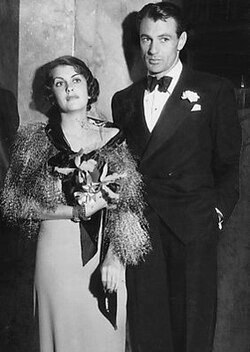
Cooper was formally introduced to his future wife, 20-year-old New York debutante Veronica Balfe,Note 6 on Easter Sunday 1933 at a party given by her uncle, art director Cedric Gibbons.293294295 Called "Rocky" by her family and friends, she grew up on Park Avenue and attended finishing schools.296 Her stepfather was Wall Street tycoon Paul Shields.296 Cooper and Rocky were quietly married at her parents' Park Avenue residence on December 15, 1933.297 According to his friends, the marriage had a positive impact on Cooper, who turned away from past indiscretions and took control of his life.298 Athletic and a lover of the outdoors, Rocky shared many of Cooper's interests, including riding, skiing, and skeet-shooting.299 While she organized their social life, her wealth and social connections provided Cooper access to New York high society.300 Cooper and his wife owned homes in the Los Angeles area in Encino (1933–36),298 Brentwood (1936–53),298 and Holmby Hills (1954–61),301 and owned a vacation home in Aspen, Colorado (1949–53).302Note 7
Gary and Veronica Cooper's daughter, Maria Veronica Cooper, was born on September 15, 1937.303 By all accounts, he was a patient and affectionate father, teaching Maria to ride a bicycle, play tennis, ski, and ride horses.303 Sharing many of her parents' interests, she accompanied them on their travels and was often photographed with them.303 Like her father, she developed a love for art and drawing.304Note 8 As a family, they vacationed together in Sun Valley, Idaho, spent time at Rocky's parents' country house in Southampton, New York, and took frequent trips to Europe.300 Cooper and Rocky were legally separated on May 16, 1951, when Cooper moved out of their home.305 For over two years, they maintained a fragile and uneasy family life with their daughter.306 Cooper moved back into their home in November 1953,307308 and their formal reconciliation occurred in February 1954.264
Romantic relationships

Before his marriage, Cooper had a series of romantic relationships with leading actresses, beginning in 1927 with Clara Bow, who advanced his career by helping him get one of his first leading roles in Children of Divorce.309Note 9 Bow also got Cooper a role in Wings, which generated an enormous amount of fan mail for him.313 In 1928, he had a relationship with another experienced actress, Evelyn Brent, whom he met while filming Beau Sabreur.314 In 1929, while filming The Wolf Song, Cooper began an intense affair with Lupe Vélez, the most important romance of his early life.315 During their two years together, Cooper also had brief affairs with Marlene Dietrich while filming Morocco in 1930316 and with Carole Lombard while making I Take This Woman in 1931.317 During his year abroad in 1931–32, Cooper had an affair with the married Countess Dorothy di Frasso, the former Dorothy Cadwell Taylor, while staying at her Villa Madama near Rome.78
After he was married in December 1933, Cooper remained faithful to his wife until 1942, when he began an affair with Ingrid Bergman during the production of For Whom the Bell Tolls.318 Their relationship lasted through the completion of filming Saratoga Trunk in June 1943.319 In 1948, after finishing work on The Fountainhead, Cooper began an affair with Patricia Neal, his co-star.320 At first, they kept their affair discreet, but eventually it became an open secret in Hollywood, and Cooper's wife confronted him with the rumors, which he admitted were true. He also confessed that he was in love with Neal, and continued to see her.321322 Cooper and his wife legally separated in May 1951,305 but he did not seek a divorce.323 Neal later said that Cooper hit her after she went on a date with Kirk Douglas, and that he arranged for her to have an abortion when she became pregnant with Cooper's child.324 Neal ended their relationship in December 1951.325 During his three-year separation from his wife, Cooper was rumored to have had affairs with Grace Kelly,326 Lorraine Chanel,327 and Gisèle Pascal.328
Cooper biographers have explored his relationship in the late 1920s with the actor Anderson Lawler, with whom Cooper shared a house on and off for a year, while at the same time seeing Clara Bow, Evelyn Brent, and Lupe Vélez.329330331332 Vélez once told Hedda Hopper of Lawler's alleged affair with Cooper; whenever he would come home after seeing Lawler, she would sniff for Lawler's cologne.333 Vélez's biographer Michelle Vogel wrote that Vélez consented to Cooper's alleged sexual behavior with Lawler, but only as long as she, too, could participate.334
In later life, Cooper became involved with costume designer Irene, and was, according to her, "the only man she ever loved". A year after his death in 1961, Irene committed suicide by jumping from the 11th floor of the Knickerbocker Hotel, after telling Doris Day of her grief over Cooper's death.335
Friendships, interests, and character
According to Cooper336
... the really satisfying things I do are offered me, free, for nothing. Ever go out in the fall and do a little hunting? See the frost on the grass and the leaves turning? Spend a day in the hills alone, or with good companions? Watch a sunset and a moonrise? Notice a bird in the wind? A stream in the woods, a storm at sea, cross the country by train, and catch a glimpse of something beautiful in the desert, or the farmlands? Free to everybody ...

Cooper's 20-year friendship with Ernest Hemingway began at Sun Valley in October 1940.337 In 1939, Hemingway had drawn upon Cooper's image in creating the character Robert Jordan in his novel For Whom the Bell Tolls.338 Hemingway and Cooper shared a passion for the outdoors,337 and for years they hunted duck and pheasant and skied together in Sun Valley. Both men admired the work of Rudyard Kipling—Cooper kept a copy of the poem "If—" in his dressing room—and had Kipling's sense of adventure.339
As well as admiring Cooper's hunting skills and knowledge of the outdoors, Hemingway believed his character matched his screen persona,337 once telling a friend, "If you made up a character like Coop, nobody would believe it. He's just too good to be true."339 They saw each other often, and their friendship remained strong through the years.340Note 10
Cooper's social life generally centered on sports, outdoor activities, and dinner parties with his family and friends from the film industry, including directors Henry Hathaway, Howard Hawks, William Wellman, and Fred Zinnemann, and actors Joel McCrea, Barbara Stanwyck, James Stewart, and Robert Taylor.342343344 In addition to hunting, Cooper enjoyed riding, fishing, skiing, and, later in life, scuba diving.345346 He never abandoned his early love for art and drawing, and he and his wife acquired a private collection of modern paintings, including works by Pierre-Auguste Renoir, Paul Gauguin, and Georgia O'Keeffe.347 Cooper owned several works by Pablo Picasso, whom he met in 1956.347 He also had a lifelong passion for automobiles, with a collection that included a 1930 Duesenberg.348349
Cooper was naturally reserved and introspective, and loved the solitude of outdoor activities.350 Not unlike his screen persona, his communication style frequently consisted of long silences350 with an occasional "yup" and "shucks".351352 He once said, "If others have more interesting things to say than I have, I keep quiet."353 His friends said that Cooper was also an articulate, well-informed conversationalist on topics ranging from horses, guns, and Western history to film production, sports cars, and modern art.353 He was modest and unpretentious,350 frequently downplaying his acting abilities and career accomplishments.354 His friends and colleagues described him as charming, well-mannered, and thoughtful, with a lively, boyish sense of humor.353 He maintained a sense of propriety, never misused his movie-star status, and never sought special treatment or refused to work with a director or leading lady.355 Cooper's close friend Joel McCrea recalled, "Coop never fought, he never got mad, he never told anybody off that I know of; everybody [who] worked with him liked him."355
Political views
Like his father, Cooper was a conservative Republican; he voted for Calvin Coolidge in 1924 and Herbert Hoover in 1928 and 1932, and campaigned for Wendell Willkie in 1940.233 When Franklin D. Roosevelt ran for an unprecedented fourth presidential term in 1944, Cooper campaigned for Thomas E. Dewey and criticized Roosevelt for being dishonest and adopting "foreign" ideas.356 In a radio address he had paid for himself just before the election,356 Cooper said, "I disagree with the New Deal belief that the America all of us love is old and worn-out and finished and has to borrow foreign notions that don't even seem to work any too well where they come from ... Our country is a young country that just has to make up its mind to be itself again."356357 He also attended a Republican rally at the Los Angeles Memorial Coliseum that drew 93,000 Dewey supporters.358 In 1952, Cooper, Glenn Ford, Adolphe Menjou, and John Wayne supported Robert A. Taft over Dwight D. Eisenhower in the Republican primaries.359360
Cooper lent his name to, but was not active in, the Motion Picture Alliance for the Preservation of American Ideals,361 a conservative organization dedicated, according to its statement of principles, to preserving the "American way of life" and opposing communism and fascism.362 Members included Walter Brennan, Laraine Day, Walt Disney, Clark Gable, Hedda Hopper, Ronald Reagan, Barbara Stanwyck, and John Wayne. The organization advised the United States Congress to investigate communist influence in the motion-picture industry.363
On October 23, 1947, Cooper was subpoenaed to appear before the House Un-American Activities Committee (HUAC) and asked whether he had observed any "communistic influence" in Hollywood.364 He recounted statements he had heard suggesting the Constitution was out of date and that Congress was an unnecessary institution, comments Cooper said he found "very un-American", and testified that he had rejected several scripts because he thought they were "tinged with communist ideas".364 Unlike some other witnesses, Cooper found ways to avoid naming any individuals or scripts.364365
In 1951, while making High Noon, Cooper befriended the film's screenwriter, Carl Foreman, who had been a member of the Communist Party. When Foreman was subpoenaed by the HUAC, Cooper put his career on the line to defend Foreman. When John Wayne and others threatened Cooper with blacklisting and the loss of his passport if he did not walk off the film, Cooper gave a statement to the press in support of Foreman, calling him "the finest kind of American". When producer Stanley Kramer removed Foreman's name as screenwriter, Cooper and director Fred Zinnemann threatened to walk off the film if Foreman's name were not restored. Foreman later said that of all his friends and allies and colleagues in Hollywood, "Cooper was the only big one who tried to help. The only one."366 Cooper offered to testify on Foreman's behalf before the committee, but character witnesses were not allowed. Foreman always sent future scripts to Cooper for first refusal, including The Bridge on the River Kwai, The Key, and The Guns of Navarone. Cooper had to turn them down because of his age.367
Religion
Cooper was baptized in the Church of All Saints, Houghton Regis, in Bedfordshire, England, in December 1911,16 and was raised in the Episcopal Church in the United States.368 While he was not an observant Christian for most of his adult life, many of his friends believed he had a deeply spiritual side.369
On June 26, 1953, Cooper accompanied his wife and daughter, who were devout Catholics, to Rome, where they had an audience with Pope Pius XII.370371 Cooper and his wife were still separated at the time, but the papal visit marked the beginning of their reconciliation.372 In the following years, Cooper contemplated his mortality and his personal behavior, and started discussing Catholicism with his family.369370373 He began attending Mass with them regularly, and met with their parish priest, who offered Cooper spiritual guidance.369373 After several months of study, Cooper was baptized as a Catholic on April 9, 1959, before a small group of family and friends at the Church of the Good Shepherd in Beverly Hills.368373
Final years and death

Cooper was diagnosed with prostate cancer in 1960. On April 14, 1960, he underwent surgery at Massachusetts General Hospital in Boston as the cancer metastasized to his colon.374 He fell ill again on May 13 and underwent further surgery at Cedars of Lebanon Hospital in Los Angeles in early June to remove a malignant tumor from his large intestine.374 After recuperating over the summer, Cooper took his family on vacation to the south of France375 before traveling to the UK in the fall to star in The Naked Edge.374 In December 1960, he worked on the NBC television documentary The Real West,376 which was part of the company's Project 20 series.377Note 11
On December 27, his wife learned from their family doctor that Cooper's cancer had metastasized to his lungs and bones and was inoperable.379 His family decided not to tell him immediately.380
On January 9, 1961, Cooper attended a dinner given in his honor and hosted by Frank Sinatra and Dean Martin at the Friars Club.376 The dinner was attended by many of his industry friends381 and concluded with a brief speech by Cooper, who said, "The only achievement I'm proud of is the friends I've made in this community."382
In mid-January, Cooper took his family to Sun Valley for their last vacation together.380 Cooper and Ernest Hemingway hiked through the snow together for the last time.383 On February 27, after returning to Los Angeles, Cooper learned that he was dying.384 He later told his family, "We'll pray for a miracle; but if not, and that's God's will, that's all right, too."385 On April 17, Cooper watched the Academy Awards ceremony on television and saw his good friend James Stewart, who had presented Cooper with his first Oscar 19 years earlier, accept on Cooper's behalf an honorary award for lifetime achievement—his third Oscar.386 Holding back tears, Stewart said, "Coop, I'll get this to you right away. And Coop, I want you to know this: that with this goes all the warm friendship and the affection and the admiration and the deep, the deep respect of all of us. We're very, very proud of you, Coop. All of us are tremendously proud."386Note 12 The next day, newspapers around the world announced that Cooper was dying.340 He received numerous messages of appreciation and encouragement, including telegrams from Pope John XXIII388 and Queen Elizabeth II351388 and a telephone call from President John F. Kennedy.351388
In his last public statement on May 4, 1961, Cooper said, "I know that what is happening is God's will. I am not afraid of the future."389 He received the last rites on May 12 and died quietly the next day.390
A requiem was held on May 18 at the Church of the Good Shepherd, attended by many of Cooper's friends, including Fred Astaire, Jack Benny, Marlene Dietrich, John Ford, Henry Hathaway, Audrey Hepburn, Bob Hope, Dean Martin, Joel McCrea, Walter Pidgeon, Edward G. Robinson, Randolph Scott, Frank Sinatra, James Stewart, Jack L. Warner, and John Wayne.391Note 13 Cooper was buried in the Grotto of Our Lady of Lourdes in Holy Cross Cemetery in Culver City, California.393 In May 1974, after his family relocated to New York, Cooper's remains were exhumed and reburied in Sacred Hearts Cemetery in Southampton.394395 His grave is marked next to a three-ton boulder from a Montauk quarry.394
Acting style and reputation
Naturalness is hard [for me] to talk about, but I guess it boils down to this: you find out what people expect of your type of character and then you give them what they want. That way, an actor never seems unnatural or affected, no matter what role he plays.396
Cooper's acting style consisted of three essential characteristics—his ability to project elements of his own personality onto the characters he portrayed, to appear natural and authentic in his roles, and to underplay and deliver restrained performances calibrated for the camera and the screen. Acting teacher Lee Strasberg once observed: "The simplest examples of Stanislavsky's ideas are actors such as Gary Cooper, John Wayne, and Spencer Tracy. They try not to act, but to be themselves, to respond or react. They refuse to say or do anything they feel not to be consonant with their own characters."180 Film director François Truffaut ranked Cooper among "the greatest actors" because of his ability to deliver great performances "without direction".180 This ability to project elements of his own personality onto his characters produced a continuity across his performances to the extent that critics and audiences were convinced he was simply "playing himself".397
Cooper's ability to project his personality onto his characters played an important part in his appearing natural and authentic on screen. Actor John Barrymore said of Cooper, "This fellow is the world's greatest actor. He does without effort what the rest of us spend our lives trying to learn—namely, to be natural."88 Charles Laughton, who played opposite Cooper in Devil and the Deep agreed, "In truth, that boy hasn't the least idea how well he acts ... He gets at it from the inside, from his own clear way of looking at life."88 William Wyler, who directed Cooper in two films, called him a "superb actor, a master of movie acting".398
In his review of Cooper's performance in The Real Glory, Graham Greene wrote, "Sometimes his lean photogenic face seems to leave everything to the lens, but there is no question here of his not acting. Watch him inoculate the girl against cholera—the casual jab of the needle, and the dressing slapped on while he talks, as though a thousand arms had taught him where to stab and he doesn't have to think anymore."88
Cooper's style of underplaying before the camera surprised many of his directors and fellow actors. Even in his earliest feature films, he recognized the camera's ability to pick up slight gestures and facial movements.399 Of Cooper's performance in Sergeant York, director Howard Hawks said, "He worked very hard and yet he didn't seem to be working. He was a strange actor because you'd look at him during a scene and you'd think ... this isn't going to be any good. But when you saw the rushes in the projection room the next day you could read in his face all the things he'd been thinking."173 Sam Wood, who directed Cooper in four films, said of Cooper's performance in Pride of the Yankees, "What I thought was underplaying turned out to be just the right approach. On the screen he's perfect, yet on the set you'd swear it's the worst job of acting in the history of motion pictures."400
Cooper's fellow actors admired his abilities. Having made two films with Cooper, Ingrid Bergman said, "The personality of this man was so enormous, so overpowering—and that expression in his eyes and his face, it was so delicate and so underplayed. You just didn't notice it until you saw it on the screen. I thought he was marvelous; the most underplaying and the most natural actor I ever worked with."199
Tom Hanks said, "In only one scene in the first film to win the Academy Award for Best Picture, we see the future of screen acting in the form of Gary Cooper. He is quiet and natural, somehow different from the other cast members. He does something mysterious with his eyes and shoulders that is much more like 'being' than 'acting'."401
Daniel Day-Lewis said, "I don't particularly like westerns as a genre, but I do love certain westerns. High Noon means a lot to me—I love the purity and the honesty, I love Gary Cooper in that film, the idea of the last man standing."402
Chris Pratt said, "I started watching Westerns when I was shooting in London about four or five years ago. I really fell in love with Gary Cooper, and his stuff. That sucked me into the Westerns. Before, I never got engrossed in the story. I'd just dip in, and there were guys on horses in black and white. High Noon's later Gary Cooper, I liked that. But I liked The Westerner. That's my favorite one. I have that poster hung up in my house because I really like that one."403
Al Pacino said, "Gary Cooper was a phenomenon—his ability to take some thing and elevate it, give it such dignity. One of the great presences."404
Mylène Demongeot first met Gary Cooper at the opening of the first escalator to be installed in a cinema, at the Rex Theatre in Paris, on June 7, 1957. She said in a 2015 interview: "Gary Cooper ... il est sublime! Là je dois dire que ça fait partie des stars, y'a Gary Cooper, Cary Grant, John Wayne, ces grands Américains que j'ai rencontrés comme ça, c'est vraiment des mecs incroyables. Y'en a plus des comme ça! Euh non" (Gary Cooper was sublime, there I have to say, now he was part of the stars, Gary Cooper, Cary Grant, John Wayne, those great Americans who I've met really were unbelievable guys, there aren't any like them anymore)."405
Career assessment and legacy

Cooper's career spanned 36 years, from 1925 to 1961.406 During that time he appeared in 84 feature films in a leading role.407 He was a major movie star from the end of the silent film era to the end of the golden age of Classical Hollywood. His natural and authentic acting style appealed powerfully to both men and women,408 and his range of performances included roles in most major movie genres, including Westerns, war films, adventure films, dramas, crime films, romances, comedies, and romantic comedies. He appeared on the Motion Picture Herald exhibitor's poll of top ten film personalities for 23 consecutive years, from 1936 to 1958.130 According to Quigley's annual poll, Cooper was one of the top money-making stars for 18 years, appearing in the top ten in 1936–37, 1941–49, and 1951–57.409 He topped the list in 1953.409 In Quigley's list of all-time money-making stars, Cooper is listed fourth, after John Wayne, Clint Eastwood, and Tom Cruise.409 At the time of his death, it was estimated that his films had grossed well over $200 million406 (equivalent to $2.15 billion in 2025).
In more than half his feature films, Cooper portrayed Westerners, soldiers, pilots, sailors, and explorers, all men of action.397 In the rest, he played a wide range of characters, included doctors, professors, artists, architects, clerks, and baseball players.397 Cooper's heroic screen image changed with each period of his career.410 In his early films, he played the young naive hero sure of his moral position and trusting in the triumph of simple virtues (The Virginian).410 After becoming a major star, his Western screen persona was replaced by a more cautious hero in adventure films and dramas (A Farewell to Arms).410 During the height of his career, from 1936 to 1943, he played a new type of hero: a champion of the common man willing to sacrifice himself for others (Mr. Deeds, Meet John Doe, and For Whom the Bell Tolls).410
In the postwar years, Cooper attempted broader variations on his screen image, which now reflected a hero increasingly at odds with the world, who must face adversity alone (The Fountainhead and High Noon).411 In his final films, Cooper's hero rejects the violence of the past, and seeks to reclaim lost honor and find redemption (Friendly Persuasion and Man of the West).412 The screen persona he developed and sustained throughout his career represented the ideal American hero—a tall, handsome, sincere man of steadfast integrity413 who emphasized action over intellect, and combined the heroic qualities of the romantic lover, the adventurer, and the common man.414
On February 6, 1960, Cooper was awarded a star on the Hollywood Walk of Fame at 6243 Hollywood Boulevard for his contribution to the film industry.415 He was also awarded a star on the sidewalk outside the Ellen Theater in Bozeman, Montana.416
On May 6, 1961, Cooper was awarded the French Order of Arts and Letters in recognition of his significant contribution to the arts.376 On July 30, 1961, he posthumously received the David di Donatello Special Award in Italy for his career achievements.417
In 1966, Cooper was inducted into the Hall of Great Western Performers at the National Cowboy & Western Heritage Museum in Oklahoma City.418 In 2015, he was inducted into the Utah Cowboy and Western Heritage Hall of Fame.419 The American Film Institute (AFI) ranked Cooper 11th on its list of the 25 male stars of classic Hollywood.420 Three of his characters—Will Kane, Lou Gehrig, and Sergeant York—made AFI's list of the 100 greatest heroes and villains, all of them as heroes.421 His Lou Gehrig line, "Today, I consider myself the luckiest man on the face of the earth", is ranked by AFI as the 38th greatest movie quote of all time.422
More than half a century after his death, Cooper's enduring legacy, according to biographer Jeffrey Meyers, is his image of the ideal American hero preserved in his film performances.423 Charlton Heston once said, "He projected the kind of man Americans would like to be, probably more than any actor that's ever lived."424
In popular culture
In the 1930s hit song "Puttin' On the Ritz", Cooper is referred to in the line "dress up like a million-dollar trooper/Tryin' hard to look like Gary Cooper, Super duper!" More than two decades after Cooper's death, a new version of the song was released in 1983 by Taco; the original lyrics were kept, including the references to Cooper.
Gary Cooper is referenced several times in the critically acclaimed television series The Sopranos, with protagonist Tony Soprano asking, "Whatever happened to Gary Cooper? The strong, silent type..." whilst complaining about his problems to his therapist Dr. Melfi.425
Patricia Neal named the Abbey of Regina Laudis' outdoor theater building The Gary-The Olivia in honor of Cooper and her daughter Olivia Dahl.426
A San Antonio, Texas, subdivision has several streets named after Hollywood stars, including a Gary Cooper Drive.427
Awards and nominations
| Year | Award | Category | Film | Result | Ref |
|---|---|---|---|---|---|
| 1937 | Academy Award | Best Actor | Mr. Deeds Goes to Town | Nominated | 123 |
| 1937 | New York Film Critics Circle Award | Best Actor | Nominated | 428 | |
| 1941 | Sergeant York | Won | 270 | ||
| 1942 | Academy Award | Best Actor | Won | 429 | |
| 1943 | The Pride of the Yankees | Nominated | 195 | ||
| 1944 | For Whom the Bell Tolls | Nominated | 430 | ||
| 1945 | New York Film Critics Circle Award | Best Actor | Along Came Jones | Nominated | 270 |
| 1952 | Photoplay Award | Most Popular Male Star | High Noon | Won | 270 |
| 1953 | Academy Award | Best Actor | Won | 431 | |
| 1953 | Golden Globe Award | Best Actor | Won | 270 | |
| 1953 | New York Film Critics Circle Award | Best Actor | Nominated | 270 | |
| 1957 | Golden Globe Award | Best Actor | Friendly Persuasion | Nominated | 270 |
| 1957 | New York Film Critics Circle Award | Best Actor | Nominated | 270 | |
| 1959 | Laurel Award | Top Action Performance | The Hanging Tree | Won | 432 |
| 1960 | They Came to Cordura | Won | 432 | ||
| 1961 | Academy Award | Academy Honorary Award | Won | 387 |
Filmography
The following is a list of feature films in which Cooper appeared in a leading role.433434
- The Winning of Barbara Worth (1926)
- Children of Divorce (1927)
- Arizona Bound (1927)
- Wings (1927)
- Nevada (1927)
- It (1927)
- The Last Outlaw (1927)
- Beau Sabreur (1928)
- The Legion of the Condemned (1928)
- Doomsday (1928)
- Half a Bride (1928)
- Lilac Time (1928)
- The First Kiss (1928)
- The Shopworn Angel (1928)
- Wolf Song (1929)
- Betrayal (1929)
- The Virginian (1929)
- Only the Brave (1930)
- The Texan (1930)
- Seven Days' Leave (1930)
- A Man from Wyoming (1930)
- The Spoilers (1930)
- Morocco (1930)
- Fighting Caravans (1931)
- City Streets (1931)
- I Take This Woman (1931)
- His Woman (1931)
- Devil and the Deep (1932)
- If I Had a Million (1932)
- A Farewell to Arms (1932)
- Today We Live (1933)
- One Sunday Afternoon (1933)
- Design for Living (1933)
- Alice in Wonderland (1933)
- Operator 13 (1934)
- Now and Forever (1934)
- The Lives of a Bengal Lancer (1935)
- The Wedding Night (1935)
- Peter Ibbetson (1935)
- Desire (1936)
- Mr. Deeds Goes to Town (1936)
- The General Died at Dawn (1936)
- The Plainsman (1936)
- Souls at Sea (1937)
- The Adventures of Marco Polo (1938)
- Bluebeard's Eighth Wife (1938)
- The Cowboy and the Lady (1938)
- Beau Geste (1939)
- The Real Glory (1939)
- The Westerner (1940)
- North West Mounted Police (1940)
- Meet John Doe (1941)
- Sergeant York (1941)
- Ball of Fire (1941)
- The Pride of the Yankees (1942)
- For Whom the Bell Tolls (1943)
- The Story of Dr. Wassell (1944)
- Casanova Brown (1944)
- Along Came Jones (1945)
- Saratoga Trunk (1945)
- Cloak and Dagger (1946)
- Unconquered (1947)
- Good Sam (1948)
- The Fountainhead (1949)
- Task Force (1949)
- Bright Leaf (1950)
- Dallas (1950)
- You're in the Navy Now (1951)
- It's a Big Country (1951)
- Distant Drums (1951)
- High Noon (1952)
- Springfield Rifle (1952)
- Return to Paradise (1953)
- Blowing Wild (1953)
- Garden of Evil (1954)
- Vera Cruz (1954)
- The Court-Martial of Billy Mitchell (1955)
- Friendly Persuasion (1956)
- Love in the Afternoon (1957)
- Ten North Frederick (1958)
- Man of the West (1958)
- The Hanging Tree (1959)
- They Came to Cordura (1959)
- The Wreck of the Mary Deare (1959)
- The Naked Edge (1961)
Radio appearances
| Date | Program | Episode/source |
|---|---|---|
| April 7, 1935 | Lux Radio Theatre | The Prince Chap |
| February 1, 1937 | Lux Radio Theatre | Mr. Deeds Goes To Town |
| May 2, 1938 | Lux Radio Theatre | The Prisoner Of Shark Island |
| September 23, 1940 | Lux Radio Theatre | The Westerner |
| September 28, 1941 | Screen Guild Theater | Meet John Doe |
| April 20, 1942 | Lux Radio Theatre | North West Mounted Police |
| October 4, 1943 | Lux Radio Theatre | The Pride Of The Yankees |
| October 23, 1944 | Lux Radio Theatre | The Story Of Dr. Wassell |
| December 11, 1944 | Lux Radio Theatre | Casanova Brown |
| February 12, 1945 | Lux Radio Theatre | For Whom The Bell Tolls |
Notes
Notes
- Cooper's popularity is largely responsible for that of the given name Gary from the 1930s to the present day.44
- Cooper bought the child actress toys and taught her how to draw using colored pencils during setups. He found it mildly irritating to be corrected by the five-year-old, who knew everyone's lines.99
- Cooper also turned down the leading roles in John Ford's Stagecoach (1939)144 and Alfred Hitchcock's Foreign Correspondent (1940).145
- Cooper previously appeared in the all-star feature Paramount on Parade (1930), which included scenes in two-color Technicolor, including his "Let Us Drink to the Girl of My Dreams" sequence.162 He also appeared as himself in the Technicolor short films Star Night at the Coconut Grove (1935) and La Fiesta de Santa Barbara (1936).38
- John Wayne accepted the Oscar for Cooper, who was out of the country at the time, saying, "Coop and I have been friends, hunting and fishing, for more years than I like to remember. He's one of the nicest fellows I know. I don't know anybody any nicer."253
- Balfe worked briefly as an actress in 1933 using the professional name Sandra Shaw.292 She appeared in uncredited bit parts in No Other Woman, King Kong, and Blood Money.292
- After their wedding, Cooper and his wife lived on a 10-acre (4.0 ha) ranch at 4723 White Oak Avenue in Encino, from 1933 to 1936.298 In 1936, they built a large white Bermuda-Georgian house at 11940 Chaparal in Brentwood, where they lived from 1936 to 1953.298 In 1948, they purchased 15 acres (6.1 ha) of land in Aspen, Colorado, and built a four-bedroom house, where they vacationed from 1949 to 1953.302 In July 1953, they began building a lavish, 6,000-square-foot (560 m2) mansion on 1.5 acres (0.61 ha) of land at 200 North Baroda Drive in Holmby Hills, a modernistic four-bedroom house with an open floor plan, floor-to-ceiling windows, and a sculpted garden.301 They lived there from September 1954 until his death.301
- Maria attended the Chouinard Art Institute in Los Angeles for four years and became an artist, with exhibitions in Los Angeles and New York.304
- Cooper and Bow began their affair during the production of one of her most popular films, It (1927), for which she had the studio film an extra scene that included Cooper.310 During the "It girl" publicity campaign,311 columnists started referring to Cooper as the "It boy".312
- Cooper's friendship with Ernest Hemingway is explored in the documentary Cooper & Hemingway: The True Gen (2013).341
- In March 1961, Cooper traveled to New York to record the off-camera narration for the documentary – his last work as an actor.378
- The award dedication read, "To Gary Cooper for his many memorable screen performances and the international recognition he, as an individual, has gained for the motion picture industry."387
- Hemingway was too ill to attend the funeral.392 He took his own life on July 2, 1961, less than two months after Cooper died.392
References
References
- Critchlow, Donald (2013). When Hollywood Was Right. Cambridge University Press. ISBN 978-0521519694.
- Meyers 1998, pp. 1, 4–5, 198, 259.
- Meyers 1998, p. 1.
- Arce 1979, pp. 17–18.
- Meyers 1998, pp. 4–5.
- Arce 1979, p. 18.
- Swindell 1980, p. 10.
- Meyers 1998, pp. 7–8.
- Meyers 1998, p. 8.
- Swindell 1980, p. 25.
- Meyers 1998, p. 6.
- Meyers 1998, pp. 10–12.
- Benson 1986, pp. 191–95.
- Swindell 1980, p. 19.
- Swindell 1980, p. 21.
- Meyers 1998, p. 13.
- "Gary Cooper Visits Dunstable". Dunstable Borough Gazette. March 30, 1932.
- Swindell 1980, p. 29.
- Meyers 1998, p. 17.
- Swindell 1980, p. 33.
- Meyers 1998, p. 21.
- Arce 1979, p. 21.
- Meyers 1998, pp. 15–16.
- Swindell 1980, p. 41.
- Swindell 1980, p. 46.
- Meyers 1998, p. 24.
- Swindell 1980, p. 43.
- Swindell 1980, pp. 47–48.
- Swindell 1980, p. 49.
- Meyers 1998, p. 26.
- Dickens 1970, p. 3.
- Arce 1979, p. 23.
- Swindell 1980, p. 52.
- Meyers 1998, p. 27.
- Swindell 1980, p. 62.
- Swindell 1980, p. 63.
- Swindell 1980, p. 61.
- Dickens 1970, pp. 23–24.
- Meyers 1998, p. 28.
- Meyers 1998, p. 29.
- Swindell 1980, p. 66.
- Arce 1979, p. 25.
- Swindell 1980, p. 67.
- Hanks and Hodges 2003, p. 106.
- Rainey 1990, p. 66.
- Swindell 1980, p. 69.
- Meyers 1998, p. 30.
- Dickens 1970, p. 29.
- Meyers 1998, p. 31.
- Swindell 1980, pp. 73–74.
- Meyers 1998, p. 32.
- Swindell 1980, p. 74.
- "The 1st Academy Awards, 1929". Academy of Motion Picture Arts and Sciences. October 8, 2014. Archived from the original on January 27, 2015. Retrieved January 5, 2015.
- Dickens 1970, pp. 35, 39.
- Arce 1979, p. 51.
- Meyers 1998, p. 44.
- Dickens 1970, p. 7.
- Meyers 1998, p. 47.
- Swindell 1980, p. 93.
- Swindell 1980, pp. 98–99.
- Meyers 1998, pp. 51–52.
- Meyers 1998, pp. 52–53.
- Meyers 1998, p. 49.
- Dickens 1970, pp. 70–84.
- "cover_9300524: Gary Cooper as "The Texan", Norman Rockwell, May 24, 1930". Saturday Evening Post. February 2010. Retrieved February 9, 2020.
- Meyers 1998, p. 61.
- Dickens 1970, p. 9.
- Meyers 1998, pp. 63–64.
- Swindell 1980, p. 122.
- Dickens 1970, p. 87.
- Dickens 1970, pp. 89–91.
- Dickens 1970, pp. 92–93.
- Dickens 1970, pp. 95–98.
- Meyers 1998, p. 73.
- Swindell 1980, p. 129.
- Meyers 1998, p. 75.
- Arce 1979, p. 71.
- Meyers 1998, p. 77.
- Swindell 1980, p. 137.
- Swindell 1980, p. 138.
- Meyers 1998, p. 79.
- Swindell 1980, p. 139.
- Meyers 1998, p. 82.
- Swindell 1980, p. 142.
- Swindell 1980, p. 143
- Dickens 1970, pp. 106–108.
- Baker 1969, p. 235
- Meyers 1998, p. 89.
- Arce 1979, p. 95.
- Swindell 1980, p. 152.
- Meyers 1998, p. 95.
- Swindell 1980, p. 163.
- Churchill, Douglas W. (December 30, 1934). "The Year in Hollywood: 1934 May Be Remembered as the Beginning of the Sweetness-and-Light Era". New York Times. p. X5.
- Meyers 1998, p. 96.
- Swindell 1980, p. 165.
- Arce 1979, p. 126.
- Dickens 1970, pp. 119–22.
- Swindell 1980, p. 171.
- Meyers 1998, p. 107.
- Dickens 1970, pp. 123–25.
- Dickens 1970, p. 125.
- Dickens 1970, pp. 126–28.
- Arce 1979, p. 138.
- Meyers 1998, p. 112.
- Swindell 1980, p. 179.
- Dickens 1970, p. 127.
- Dickens 1970, pp. 132–35.
- Dickens 1970, pp. 129–31.
- Johnson, G. Allen. A young Gary Cooper, the French Surrealists and the ethereal world of Peter Ibbetson available on Blu-Ray. August 10, 2021, Updated: August 25, 2021, 4:28 pm.
- Dickens 1970, p. 131.
- Dickens 1970, p. 130.
- Meyers 1998, p. 113.
- Meyers 1998, p. 116.
- Swindell 1980, p. 188.
- Dickens 1970, p. 140.
- Meyers 1998, p. 119.
- Swindell 1980, p. 192.
- Kaminsky 1979, p. 78.
- Arce 1979, p. 144.
- Swindell 1980, p. 190.
- Meyers 1998, p. 121.
- Nugent, Frank S. (April 17, 1936). "Mr. Deeds Goes to Town". The New York Times. Archived from the original on December 19, 2014. Retrieved December 18, 2014.
- "The 9th Academy Awards, 1937". Oscars.org | Academy of Motion Picture Arts and Sciences. Academy of Motion Picture Arts and Sciences. Archived from the original on July 6, 2011. Retrieved January 5, 2015.
- Dickens 1970, pp. 144–46.
- Swindell 1980, p. 203.
- Swindell 1980, p. 202.
- Dickens 1970, pp. 147–49.
- Meyers 1998, p. 124.
- Swindell 1980, p. 204.
- Arce 1979, p. 147.
- Swindell 1980, p. 200.
- Meyers 1998, p. 126.
- Swindell 1980, p. 201.
- Dickens 1970, p. 13.
- Arce 1979, p. 161.
- Dickens 1970, pp. 150–52.
- Swindell 1980, p. 205.
- Dickens 1970, pp. 153–55.
- Meyers 1998, p. 131.
- Meyers 1998, p. 132.
- Swindell 1980, p. 208.
- Selznick 2000, pp. 172–73.
- Swindell 1980, pp. 209–10.
- Kaminsky 1979, p. 99.
- McGilligan 2003, p. 259.
- Dickens 1970, pp. 156–58.
- Dickens 1970, p. 157.
- Arce 1979, p. 154.
- Dickens 1970, pp. 159–61.
- Meyers 1998, p. 135.
- Dickens 1970, pp. 162–165.
- Swindell 1980, p. 220.
- Dickens 1970, p. 164.
- Dickens 1970, pp. 166–68.
- Meyers 1998, p. 138.
- Dickens 1970, pp. 169–73.
- Meyers 1998, p. 139.
- Swindell 1980, p. 226.
- Dickens 1970, pp. 172–73.
- Swindell 1980, p. 227.
- Dickens 1970, pp. 174–77.
- Dickens 1970, pp. 8, 73–74.
- Meyers 1998, pp. 141–42.
- Meyers 1998, p. 140.
- Arce 1979, p. 163.
- Dickens 1970, p. 14.
- Meyers 1998, p. 144.
- Dickens 1970, pp. 178–180.
- Swindell 1980, p. 230.
- Meyers 1998, pp. 146–147.
- Dickens 1970, p. 180.
- Crowther, Bosley (March 13, 1941). "'Meet John Doe,' An Inspiring Lesson in Americanism". The New York Times. Archived from the original on December 19, 2014. Retrieved December 18, 2014.
- Meyers 1998, p. 153.
- Swindell 1980, p. 231.
- Owens 2004, pp. 97–98.
- Dickens 1970, pp. 181–83.
- Meyers 1998, p. 152.
- Dickens 1970, p. 183.
- Arce 1979, p. 177.
- Meyers 1998, p. 156.
- Meyers 1998, p. 157.
- Dickens 1970, pp. 184–86.
- Meyers 1998, p. 161.
- Dickens 1970, pp. 185–86.
- Arce 1979, p. 179.
- Swindell 1980, p. 237.
- Dickens 1970, pp. 187–189.
- Meyers 1998, p. 162.
- Meyers 1998, p. 163.
- Swindell 1980, p. 238.
- Dickens 1970, pp. 188–89.
- Meyers 1998, p. 164.
- Swindell 1980, p. 239.
- Meyers 1998, p. 167.
- "The 15th Academy Awards, 1943". Academy of Motion Picture Arts and Sciences. Archived from the original on July 6, 2011. Retrieved January 5, 2015.
- Arce 1979, p. 183.
- Meyers 1998, p. 180.
- Meyers 1998, pp. 178–179.
- Meyers 1998, p. 179.
- Swindell 1980, p. 247.
- Dickens 1970, p. 193.
- Arce 1979, p. 184.
- Meyers 1998, pp. 181–182.
- Arce 1979, p. 189.
- Swindell 1980, p. 250.
- Meyers 1998, pp. 167–68.
- Meyers 1998, p. 169.
- Dickens 1970, pp. 194–196.
- Meyers 1998, pp. 189–190.
- Swindell 1980, p. 251.
- Meyers 1998, p. 191.
- Dickens 1970, pp. 197–98.
- Meyers 1998, p. 192.
- Dickens 1970, p. 198.
- Crowther, Bosley (September 15, 1944). "'Casanova Brown' ..." The New York Times. Archived from the original on January 18, 2015. Retrieved January 18, 2015.
- Swindell 1980, p. 253.
- Dickens 1970, pp. 199–200.
- Meyers 1998, p. 194.
- Arce 1979, p. 212.
- Swindell 1980, p. 255.
- Schickel 1985, pp. 24–26.
- Dickens 1970, pp. 201–03.
- Meyers 1998, p. 183.
- Swindell 1980, p. 258.
- Arce 1979, p. 188.
- Dickens 1970, pp. 204–205.
- Meyers 1998, pp. 195–97.
- Swindell 1980, p. 260.
- Dickens 1970, pp. 206–08.
- Arce 1979, p. 220.
- Meyers 1998, p. 199.
- Dickens 1970, pp. 211–13.
- Meyers 1998, p. 202.
- Dickens 1970, pp. 214–217.
- Meyers 1998, p. 215.
- Meyers 1998, pp. 215, 219.
- Dickens 1970, pp. 216–17.
- Meyers 1998, p. 220.
- Dickens 1970, pp. 220–22.
- Arce 1979, p. 227.
- Dickens 1970, pp. 223–34.
- Dickens 1970, pp. 235–37.
- Dickens 1970, p. 236.
- Swindell 1980, p. 293.
- Arce 1979, p. 242.
- Arce 1979, p. 238.
- Meyers 1998, p. 249.
- Crowther, Bosley (July 25, 1952). "High Noon". The New York Times. Archived from the original on May 30, 2013. Retrieved December 18, 2014.
- Dickens 1970, p. 237.
- Meyers 1998, p. 250.
- Arce 1979, pp. 238–39.
- Swindell 1980, p. 294.
- McGee, Scott. "High Noon (1952)". Turner Classic Movies. Archived from the original on December 20, 2014. Retrieved December 12, 2014.
- Dickens 1970, pp. 238–240.
- Dickens 1970, p. 240.
- Meyers 1998, p. 253.
- Dickens 1970, pp. 241–242.
- Meyers 1998, pp. 254, 256.
- Dickens 1970, p. 242.
- Dickens 1970, pp. 243–244.
- Dickens 1970, pp. 245–247.
- Dickens 1970, pp. 248–51.
- Arce 1979, p. 255.
- Meyers 1998, p. 269.
- Dickens 1970, pp. 252–54.
- Dickens 1970, p. 253.
- Meyers 1998, pp. 275–76.
- Dickens 1970, pp. 255–58.
- Meyers 1998, p. 281.
- Erickson, Hal (2015). "Gary Cooper: Full Biography". The New York Times. Archived from the original on February 11, 2015. Retrieved September 18, 2014.
- Arce 1979, p. 256.
- Meyers 1998, p. 317.
- Dickens 1970, pp. 259–261.
- Dickens 1970, p. 261.
- Arce 1979, p. 260.
- Dickens 1970, pp. 262–64.
- Meyers 1998, p. 289.
- Arce 1979, p. 264.
- Meyers 1998, p. 291.
- Dickens 1970, pp. 265–266.
- Meyers 1998, p. 290.
- Swindell 1980, p. 297.
- Meyers 1998, pp. 291, 301.
- Dickens 1970, pp. 267–68.
- Meyers 1998, pp. 296–97.
- Dickens 1970, pp. 271–73.
- Dickens 1970, p. 272.
- Dickens 1970, pp. 274–75.
- Meyers 1998, p. 299.
- Meyers 1998, p. 301.
- Conrad 1992, p. 81.
- Meyers 1998, p. 100.
- Janis 1999, p. 22.
- Meyers 1998, p. 98.
- Arce 1979, p. 121.
- Meyers 1998, p. 99.
- Meyers 1998, p. 102.
- Meyers 1998, p. 103.
- Meyers 1998, p. 104.
- Meyers 1998, p. 106.
- Meyers 1998, p. 271.
- Meyers 1998, pp. 214–15.
- Meyers 1998, p. 128.
- Meyers 1998, p. 270.
- Meyers 1998, p. 229.
- Meyers 1998, pp. 264–266.
- Carpozi 1970, p. 197.
- Arce 1979, p. 253.
- Meyers 1998, pp. 36, 40.
- Swindell 1980, p. 78.
- Swindell 1980, p. 79.
- Kaminsky 1979, p. 31.
- Kaminsky 1979, p. 34.
- Meyers 1998, p. 43.
- Meyers 1998, p. 45.
- Meyers 1998, p. 62.
- Meyers 1998, p. 68.
- Wayne 1988, p. 100.
- Meyers 1998, pp. 179, 183.
- Meyers 1998, p. 225.
- Shearer 2006, p. 124.
- Meyers 1998, p. 226.
- Shearer 2006, pp. 114–22.
- Chambers, Andrea (May 9, 1988). "Patricia Neal Looks Back at a Glorious and Grueling Life". PEOPLE.com. Archived from the original on August 10, 2017. Retrieved August 26, 2017.
- Shearer 2006, pp. 126–27.
- Meyers 1998, p. 231.
- Meyers 1998, pp. 259–63.
- Meyers 1998, pp. 263–64.
- Shearer, Stephen (2006). Patricia Neal: An Unquiet Life. Lexington, Kentucky: University Press of Kentucky. p. 66. ISBN 978-0813123912. Retrieved May 10, 2019.
.anderson lawler.
- Mann, William J. (2001). Behind the Screen: How Gays and Lesbians Shaped Hollywood, 1910–1969. NY: Viking. pp. 103–10. ISBN 978-0670030170.
- Conner, Floyd (1993). Lupe Velez and Her Lovers. NY: Barricade Books. pp. 85–86. ISBN 978-0942637960.
- Swindell, Larry (1980). The Last Hero: A Biography of Gary Cooper. NY: Doubleday. pp. 104–05. ISBN 978-0385143165.
- Fleming, E. J. (2004). The Fixers: Eddie Mannix, Howard Strickling and the MGM Publicity Machine. Jefferson MO: McFarland. p. 92. ISBN 978-0-7864-2027-8. Retrieved July 13, 2018.
- Vogel, Michelle (2012). Lupe Velez: The Life and Career of Hollywood's "Mexican Spitfire". Jefferson, North Carolina: McFarland. p. 71. ISBN 978-0786461394. Retrieved December 5, 2018.
- Day, Doris (1976). Hotchner, A. E. (ed.). Doris Day, her own story. New York, NY: Morrow. p. 191. ISBN 978-0-688-02968-5.
- Janis 1999, p. 42.
- Meyers 1998, p. 173.
- Meyers 1998, p. 176.
- Meyers 1998, p. 175.
- Meyers 1998, p. 315.
- Scheib, Ronnie (November 5, 2013). "Film Review: Cooper and Hemingway: The True Gen". Variety. Archived from the original on March 28, 2015. Retrieved March 28, 2015.
- Meyers 1998, pp. 104–05, 153, 313.
- Janis 1999, p. 98.
- Swindell 1980, pp. 300–01.
- Meyers 1998, pp. 59, 299.
- Janis 1999, p. 124.
- Meyers 1998, pp. 285–286.
- Meyers 1998, p. 59.
- Janis 1999, p. 121.
- Meyers 1998, p. 53.
- Swindell 1980, p. 303.
- Janis 1999, p. 6.
- Meyers 1998, p. 54.
- Kaminsky 1979, p. 217.
- Meyers 1998, p. 55.
- Meyers 1998, p. 206.
- Carpozi 1970, p. 168.
- Jordan 2011, pp. 231–32.
- Upstream: The Ascendance of American Conservatism; Alfred S. Regnery, 2008
- Mr. Republican: A Biography of Robert A. Taft; James T. Patterson, 1972
- Swindell 1980, p. 256.
- "The Motion Picture Alliance ..." Hollywood Renegades Archive. Archived from the original on June 3, 2014. Retrieved November 30, 2014.
- Meyers 1998, p. 207.
- "Gary Cooper: Excerpts of Testimony before HUAC" (PDF). University of Virginia. October 23, 1947. Archived (PDF) from the original on March 4, 2016. Retrieved September 18, 2014.
- Meyers 1998, p. 210.
- "High Noon's Secret Backstory". Vanity Fair. February 22, 2017.
- "Best books of 2017: The best nonfiction". Los Angeles Times. November 30, 2017.
- Carpozi 1970, p. 205.
- Meyers 1998, p. 293.
- Carpozi 1970, p. 207.
- Meyers 1998, p. 266.
- Carpozi 1970, p. 208.
- Kendall, Mary Claire (May 13, 2013). "Gary Cooper's Quiet Journey of Faith". Forbes. Archived from the original on September 24, 2014. Retrieved September 20, 2014.
- Meyers 1998, p. 304.
- Janis 1999, p. 163.
- Meyers 1998, p. 308.
- Arce 1979, p. 276.
- Meyers 1998, p. 311.
- Meyers 1998, pp. 308, 312.
- Janis 1999, p. 164.
- Meyers 1998, pp. 308–309.
- Swindell 1980, pp. 302–03.
- Meyers 1998, p. 319.
- Meyers 1998, p. 313.
- Janis 1999, p. 165.
- Meyers 1998, p. 314.
- "The 33rd Academy Awards Memorable Moments". Academy of Motion Picture Arts and Sciences. August 27, 2014. Archived from the original on January 27, 2015. Retrieved January 5, 2015.
- Arce 1979, p. 278.
- Bacon, James (May 14, 1961). "Battling Until End, Gary Cooper Dies". The Tuscaloosa News. Retrieved September 20, 2014.
- Meyers 1998, p. 320.
- Meyers 1998, pp. 320–321.
- Kaminsky 1979, p. 214.
- Swindell 1980, p. 304.
- Meyers 1998, p. 322.
- Janis 1999, p. 167.
- Meyers 1998, p. 120.
- Kaminsky 1979, p. 2.
- Dickens 1970, pp. 18–19.
- Kaminsky 1979, pp. 2–3.
- Meyers 1998, p. 165.
- Thomson, David (June 22, 2000). "Why Goldwyn Wore Jodhpurs". London Review of Books. 22 (12): 22–23.
- "Daniel Day-Lewis's All-Time Top Westerns". The New York Times. November 10, 2007.
- "'The Magnificent Seven': Chris Pratt, Denzel Washington share favorite Westerns". EW.com.
- "AL PACINO: THE PLAYBOY INTERVIEW (1979)". Scraps from the loft. February 16, 2018.
- "Rencontre avec mylène demongeot". Mac Mahon Filmed Conferences Paris. July 5, 2015. Archived from the original on November 14, 2021. Retrieved October 24, 2021.
- Dickens 1970, p. 2.
- Kaminsky 1979, p. 1.
- Meyers 1998, p. xi.
- "Top Ten Money Making Stars". Quigley Publishing. Archived from the original on January 14, 2013. Retrieved December 5, 2014.
- Kaminsky 1979, p. 219.
- Kaminsky 1979, pp. 219–20.
- Kaminsky 1979, pp. 220–21.
- Dickens 1970, p. 1.
- Meyers 1998, p. 324.
- "Gary Cooper". Hollywood Walk of Fame. Archived from the original on June 26, 2015. Retrieved December 6, 2014.
- Ricker, Amanda (May 27, 2011). "Bozeman's Hollywood star: Gary Cooper". Bozeman Daily Chronicle. Retrieved October 25, 2015.
- "David speciale 1961". Premi David di Donatello. Archived from the original on March 3, 2016. Retrieved March 4, 2015.
- "Great Western Performers". National Cowboy Museum. Archived from the original on March 21, 2015. Retrieved September 18, 2014.
- "Hall of Fame Inductees – Gary Cooper". Utah Cowboy and Western Heritage Museum. Retrieved January 8, 2018.
- "AFI's 50 Greatest American Screen Legends". American Film Institute. Archived from the original on January 13, 2013. Retrieved December 6, 2014.
- "AFI's 100 Greatest Heroes & Villains". American Film Institute. Archived from the original on February 14, 2012. Retrieved December 6, 2014.
- "AFI's 100 Greatest Movie Quotes of All Time". American Film Institute. Archived from the original on November 16, 2015. Retrieved December 6, 2014.
- Meyers 1998, pp. 323–324.
- Kaminsky 1979, p. 206.
- "That shrinking feeling: TV's uneasy relationship with therapy". Financial Times.
- Mother Dolores Hart, O.S.B. & Richard DeNeut, The Ear of the Heart, An Actress' Journey from Hollywood to Holy Vows, page 352, Ignatius Press, 2013
- Brown, Merrisa (September 30, 2014). "San Antonio street names and groupings". MySA. Hearst Newspapers.
- "Mr. Deeds Goes to Town (1936): Awards". The New York Times. 2014. Archived from the original on December 19, 2014. Retrieved December 26, 2014.
- "The 14th Academy Awards, 1942". Academy of Motion Picture Arts and Sciences. Archived from the original on July 6, 2011. Retrieved January 5, 2015.
- "The 16th Academy Awards, 1944". Academy of Motion Picture Arts and Sciences. October 5, 2014. Archived from the original on May 2, 2015. Retrieved January 5, 2015.
- "The 25th Academy Awards, 1953". Academy of Motion Picture Arts and Sciences. Archived from the original on July 6, 2011. Retrieved January 5, 2015.
- Hoffmann 2012, p. 41.
- Swindell 1980, pp. 308–328.
- Dickens 1970, pp. 29–278.
Bibliography
- Arce, Hector (1979). Gary Cooper: An Intimate Biography. New York: William Morrow and Company. ISBN 978-0-688-03604-1.
- Baker, Carlos (1969). Ernest Hemingway: A Life Story. New York: Charles Scribner's Sons. ISBN 978-0-02-001690-8.
- Benson, Nigel (1986). Dunstable in Detail. Dunstable, Bedfordshire, UK: The Book Castle. ISBN 978-0-9509773-2-4.
- Carpozi, George Jr. (1970). The Gary Cooper Story. New Rochelle, New York: Arlington House. ISBN 978-0-87000-075-1.
- Conrad, Joseph (1992) [1900]. Lord Jim. New York: Alfred A. Knopf. ISBN 978-0-679-40544-3.
- Dickens, Homer (1970). The Films of Gary Cooper. New York: Citadel Press. ISBN 978-0-8065-0010-2.
- Hanks, Patrick; Hodges, Flavia (2003). A Dictionary of First Names. New York: Oxford University Press. ISBN 978-0-19-211651-2.
- Hoffmann, Henryk (2012). Western Movie References in American Literature. Jefferson, North Carolina: McFarland & Company. ISBN 978-0-7864-6638-2.
- Janis, Maria Cooper (1999). Gary Cooper Off Camera: A Daughter Remembers. New York: Harry N. Abrams, Inc. ISBN 978-0-8109-4130-4.
- Jordan, David M. (2011). FDR, Dewey, and the Election of 1944. Bloomington: Indiana University Press. ISBN 978-0-253-00970-8.
- Kaminsky, Stuart (1979). Coop: The Life and Legend of Gary Cooper. New York: St. Martin's Press. ISBN 978-0-312-16955-8.
- Le Bihan, Adrien (2021). Gary Cooper, le prince des acteurs. LettMotif. ISBN 978-2-36716-332-1.
- McGilligan, Patrick (2003). Alfred Hitchcock: A Life in Darkness and Light. New York: Regan Books. ISBN 978-0-06-039322-9.
- Meyers, Jeffrey (1998). Gary Cooper: American Hero. New York: William Morrow. ISBN 978-0-688-15494-3.
- Owens, Robert (2004). Medal of Honor: Historical Facts and Figures. Nashville: Turner Publishing. ISBN 978-1-56311-995-8.
- Rainey, Buck (1990). Those Fabulous Serial Heroines: Their Lives and Films. Lanham, Maryland: Scarecrow Press. ISBN 978-0-8108-1911-5.
- Roberts, Randy; Olson, James S. (1997). John Wayne: American. Lincoln, Nebraska: Bison Books. ISBN 978-0-8032-8970-3.
- Schickel, Richard (1985). "Introduction". Gary Cooper. Legends. Boston: Little, Brown and Company. ISBN 978-0-316-77307-2.
- Selznick, David O. (2000). Rudy Behlmer (ed.). Memo from David O. Selznick. New York: Modern Library. ISBN 978-0-375-75531-6.
- Shearer, Stephen Michael (2006). Patricia Neal: An Unquiet Life. Lexington, Kentucky: The University Press of Kentucky. ISBN 978-0-8131-2391-2.
- Swindell, Larry (1980). The Last Hero: A Biography of Gary Cooper. New York: Doubleday. ISBN 978-0-385-14316-5.
- Wayne, Jane Ellen (1988). Cooper's Women. New York: Prentice Hall Press. ISBN 978-0-13-172438-9.
External links
External links
- Official website

- Gary Cooper at IMDb
- Gary Cooper at the TCM Movie Database (archived)