  | |
| Observation data Epoch J2000.0 Equinox ICRS | |
|---|---|
| Constellation | Volans |
| γ1 Vol | |
| Right ascension | 07h 08m 42.3703s1 |
| Declination | −70° 29′ 49.527″1 |
| Apparent magnitude (V) | 5.682 |
| γ2 Vol | |
| Right ascension | 07h 08m 44.8657s3 |
| Declination | −70° 29′ 56.149″3 |
| Apparent magnitude (V) | 3.782 |
| Characteristics | |
| Spectral type | F2V + K0III4 |
| Astrometry | |
| γ1 Vol | |
| Radial velocity (Rv) | −35 km/s |
| Proper motion (μ) | RA: 11.069(437)1 mas/yr Dec.: 107.302(577)1 mas/yr |
| Parallax (π) | 22.7501±0.4619 mas1 |
| Distance | 143 ± 3 ly (44.0 ± 0.9 pc) |
| Absolute magnitude (MV) | 2.516 |
| γ2 Vol | |
| Radial velocity (Rv) | +2.85 km/s |
| Proper motion (μ) | RA: 23.620(154)3 mas/yr Dec.: 108.653(170)3 mas/yr |
| Parallax (π) | 24.4775±0.1130 mas3 |
| Distance | 133.2 ± 0.6 ly (40.9 ± 0.2 pc) |
| Details | |
| γ1 Vol | |
| Mass | 1.697 M☉ |
| Surface gravity (log g) | 2.717 cgs |
| Temperature | 6,5416 K |
| Metallicity [Fe/H] | +0.128 dex |
| Rotational velocity (v sin i) | 4.4±0.26 km/s |
| Age | 1.48 Gyr |
| γ2 Vol | |
| Mass | 2.15±0.079 M☉ |
| Radius | 10.20±0.239 R☉ |
| Luminosity | 53.7±1.69 L☉ |
| Surface gravity (log g) | 2.74±0.0959 cgs |
| Temperature | 4,892±419 K |
| Metallicity [Fe/H] | 0.054±0.039 dex |
| Other designations | |
| γ Vol, CPD−70°600, FK5 11891011 | |
| γ1 Vol: HD 55864, HIP 34473, HR 2735, SAO 25637310 | |
| γ2 Vol: HD 55865, HIP 34481, HR 2736, SAO 25637411 | |
| Database references | |
| SIMBAD | γ1 Vol |
| γ2 Vol | |

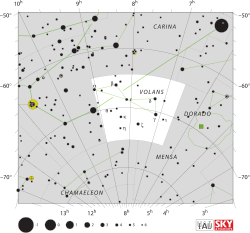
Gamma Volantis, Latinized from γ Volantis, is a wide binary star4 system in the southern constellation of Volans. Based upon parallax measurements, it is approximately 133 light years from Earth. At a combined apparent magnitude of +3.61, it is bright enough to be seen with the naked eye and can be found around 9° to the east-southeast of the Large Magellanic Cloud.12
The brighter component, designated γ2 Volantis, is an orange K-type giant star with a stellar classification of K0III and an apparent magnitude of +3.78, making this the brightest star in the constellation. Its companion, γ1 Volantis, is an F-type main-sequence star of classification F2V and an apparent magnitude of +5.68. As of 2002, the pair were at an angular separation of 14.1″ along a position angle of 296°. Their separation has decreased from 15.7″ in 1826.13 The secondary is a source of X-ray emission with a luminosity of 8.3×1028 erg s−1.14
References
References
- Brown, A. G. A.; et al. (Gaia collaboration) (2021). "Gaia Early Data Release 3: Summary of the contents and survey properties". Astronomy & Astrophysics. 649: A1. arXiv:2012.01533. Bibcode:2021A&A...649A...1G. doi:10.1051/0004-6361/202039657. S2CID 227254300. (Erratum: doi:10.1051/0004-6361/202039657e). Gaia EDR3 record for this source at VizieR.
- Perryman, M. A. C. (1997), The Hipparcos and Tycho Catalogues, European Space Agency, retrieved 2026-06-11
- Brown, A. G. A.; et al. (Gaia collaboration) (2021). "Gaia Early Data Release 3: Summary of the contents and survey properties". Astronomy & Astrophysics. 649: A1. arXiv:2012.01533. Bibcode:2021A&A...649A...1G. doi:10.1051/0004-6361/202039657. S2CID 227254300. (Erratum: doi:10.1051/0004-6361/202039657e). Gaia EDR3 record for this source at VizieR.
- Eggleton, P. P.; Tokovinin, A. A. (September 2008), "A catalogue of multiplicity among bright stellar systems", Monthly Notices of the Royal Astronomical Society, 389 (2): 869–879, arXiv:0806.2878, Bibcode:2008MNRAS.389..869E, doi:10.1111/j.1365-2966.2008.13596.x, S2CID 14878976.
- Wilson, Ralph Elmer (1953), "General Catalogue of Stellar Radial Velocities", Carnegie Institute Washington D.C. Publication, Washington: Carnegie Institution of Washington, Bibcode:1953GCRV..C......0W.
- Ammler-von Eiff, Matthias; Reiners, Ansgar (June 2012), "New measurements of rotation and differential rotation in A-F stars: are there two populations of differentially rotating stars?", Astronomy & Astrophysics, 542: A116, arXiv:1204.2459, Bibcode:2012A&A...542A.116A, doi:10.1051/0004-6361/201118724, S2CID 53666672.
- Casagrande, L.; et al. (June 2011), "New constraints on the chemical evolution of the solar neighbourhood and Galactic disc(s). Improved astrophysical parameters for the Geneva-Copenhagen Survey", Astronomy and Astrophysics, 530: A138, arXiv:1103.4651, Bibcode:2011A&A...530A.138C, doi:10.1051/0004-6361/201016276, S2CID 56118016.
- Holmberg, J.; et al. (July 2009), "The Geneva-Copenhagen survey of the solar neighbourhood. III. Improved distances, ages, and kinematics", Astronomy and Astrophysics, 501 (3): 941–947, arXiv:0811.3982, Bibcode:2009A&A...501..941H, doi:10.1051/0004-6361/200811191, S2CID 118577511.
- Ottoni, G.; Udry, S.; Ségransan, D.; Buldgen, G.; Lovis, C.; Eggenberger, P.; Pezzotti, C.; Adibekyan, V.; Marmier, M.; Mayor, M.; Santos, N. C.; Sousa, S. G.; Lagarde, N.; Charbonnel, C. (2022-01-01), "CORALIE radial-velocity search for companions around evolved stars (CASCADES). I. Sample definition and first results: Three new planets orbiting giant stars", Astronomy and Astrophysics, 657: A87, arXiv:2201.01528, Bibcode:2022A&A...657A..87O, doi:10.1051/0004-6361/202040078, ISSN 0004-6361 Gamma2 Volantis' database entry at VizieR.
- "gam01 Vol -- Star", SIMBAD Astronomical Database, Centre de Données astronomiques de Strasbourg, retrieved 2016-09-03.
- "gam02 Vol". SIMBAD. Centre de données astronomiques de Strasbourg. Retrieved 2016-09-03.
{{cite web}}: CS1 maint: postscript (link) - Bakich, Michael E. (2010), 1,001 Celestial Wonders to See Before You Die: The Best Sky Objects for Star Gazers, The Patrick Moore Practical Astronomy Series, Springer Science & Business Media, p. 13, ISBN 978-1441917775.
- Mason, B. D.; et al. (2014), "The Washington Visual Double Star Catalog", The Astronomical Journal, 122 (6): 3466, Bibcode:2001AJ....122.3466M, doi:10.1086/323920, retrieved 2016-09-04
- Pizzolato, N.; et al. (September 2000), "Evolution of X-ray activity of 1-3 Msun late-type stars in early post-main-sequence phases", Astronomy and Astrophysics, 361: 614–628, Bibcode:2000A&A...361..614P.
External links
External links
- Kaler, James B., "Gamma Volantis", Stars, University of Illinois, retrieved 2016-09-04.