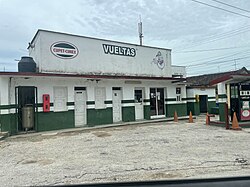
 | |
Native name | Grupo de Administración Empresarial S.A. |
|---|---|
| Type | Conglomerate |
| Founded | 1995 |
| Founder | Raúl Castro |
| Headquarters | Havana, Cuba, |
Area served | Cuba |
| Brands | CIMEX, Aerogaviota, TRD Caribe, ETECSA, Banco Financiero Internacional, Coppelia, Unión de Industrias Militares |
| Owner | Cuban Revolutionary Armed Forces |
| Parent | Ministry of the Revolutionary Armed Forces |
The Grupo de Administración Empresarial S.A. (GAESA) is a Cuban business megaconglomerate,1 owned and operated by the Cuban Revolutionary Armed Forces.2 Among Cuba's "most powerful institutions", it is estimated to control between 40-70% of the Cuban economy,3 with revenues three times the state budget.24 GAESA consists of dozens of businesses, dealing in everything from hotels and tourism to construction, port logistics, fishing and commercial imports, financial services and retail stores.2 Contrasting reports describe it as a financial juggernaut2 protected from sharing its resources with the impoverished Cuban society by its political clout,5 or as much less financially successful,6 being "on the verge of bankruptcy".7
GAESA was founded by Raul Castro to give the Cuban military a financial foundation during the Special Period,82 and was run by the Cuban general Luis Alberto Rodríguez López-Calleja until his death in 2022.9 GAESA functions as "state within the state", as the conglomerate does not allow the Cuban government to audit its accounts and the profits are hoarded by the Cuban ruling elite.3
Operations and holdings
While GAESA does not reveal its financial records, a leak of information from its 2023 and 2024 financial statements was published by El Nuevo Herald in 2025 and provided information. Affiliates include:
- Gaviota (Grupo de Turismo Gaviota S.A.), controls much of Cuba's tourism; Management is mostly done by foreign companies.10
- CIMEX - retail trade
- TRD Caribe - wholesale trade,
- RAFIN S.A. and the Banco Financiero Internacional (BFI), control much of the Cuban financial system.45
GAESA manages remittance businesses, logistics, and storage. This includes the Port of Mariel. It is involved in construction, transportation, and foreign trade. Because it effectively administers the country's main foreign-currency flows, it is "the most influential economic actor" in Cuba.4
Financial performance
Gross profits on GAESA's sales come to approximately 37% of Cuba's GDP, so in excess of one-third of the country's total added value is generated within the military conglomerate. The conglomerate exported goods and services equivalent to about 34% of the island's total exports in the time studied. GAESA has exclusive control over Cuba's hotel industry, from which it has historically acquired billions of US and Canadian dollars in income.11 It also owns Cuba's largest bank.12
Asset valuation
The value of its total assets is disputed by experts. According to The Miami Herald, GAESA, acting as a proxy for the Cuban military, has around $18 billion in assets as of August 2025.5 Another source (The Economist magazine) describes the group as on the verge of bankruptcy as of March 2026.7 Emily Morris, an economist at the University College London Institute of the Americas, disagreed with the report by the Miami Herald. According to Morris, Cuba's accounting system converts U.S. dollars to Cuban pesos in their accounting documents; this means that the $17.9 billion that was reported would translate to $746 million in U.S. dollars.613
References
References
- Torres, Nora Gamez (6 August 2025). "Five takeaways from a Herald investigation of Cuban military's secret dollar cache". Miami, Florida: Miami Herald.
- Anderson, Jon Lee (23 March 2026). "Letter from Havana Is Cuba Next? Trump's campaign to topple foreign adversaries encounters a battered but defiant regime". The New Yorker. Retrieved 3 April 2026.
- Abi-Habib, Maria; Gamio, Lazaro (2026-05-16). "Who Controls Cuba's Economy? What to Know About GAESA". The New York Times. ISSN 0362-4331.
- Vidal, Pavel (19 December 2025). "GAESA, the Invisible Elephant in Cuba's Macroeconomic Stabilization". Columbia Law School. Cuban Capacity Building Project. Retrieved 6 April 2026.
- Gamez Torres, Nora (6 August 2025). "Where is Cuba's money? Secret records show the military has massive cash hoard". The Miami Herald. Retrieved 27 February 2026.
{{cite news}}: CS1 maint: url-status (link) - "Is Cuba's Military Really Holding Billions Overseas? An interview with economist Emily Morris". Belly of the Beast. Retrieved 2026-02-27.
- "The Military Conglomerate Gaesa Is on the Verge of Bankruptcy and the Cuban Economy Will Fall by 7.2% This Year, According to The Economist". Translating Cuba. Retrieved 6 April 2026.
- Torres Pérez, Ricardo (6 August 2025). "The Economic Crisis in Cuba, Its Causes, and Migration". Columbia Law School. Retrieved 3 April 2026.
- "Cuban general Lopez-Calleja dead of heart attack, state media says". Reuters. Archived from the original on 2022-07-02. Retrieved 2026-03-29.
- G. Bolinches, Cristina; Ponce de León, Rodrigo (2 June 2026). "EEUU presiona a empresas hoteleras españolas en Cuba y enciende las alarmas del Gobierno y la UE". elDiario.es (in European Spanish). Retrieved 3 June 2026.
En cuanto al turismo, está detrás de los hoteles del Grupo Gaviota, que suma más de un centenar de establecimientos, en su mayoría gestionados por empresas extranjeras, españolas incluidas.
- Dyer, Evan (2 August 2021). "How Canadian tourism sustains Cuba's army and one-party state". CBC News.
- "Cuba's broken economy leaves it at Donald Trump's mercy". The Economist. ISSN 0013-0613. Retrieved 2026-03-20.
- "The Miami Herald's Fuzzy Math Makes Case for Economic Warfare on Cuba". FAIR. 2025-08-29. Retrieved 2026-05-15.