  | |
| Observation data Epoch J2000 Equinox J2000 | |
|---|---|
| Constellation | Centaurus1 |
| Right ascension | 12h 26m 31.75955s2 |
| Declination | −51° 27′ 02.2899″2 |
| Apparent magnitude (V) | 4.821 |
| Characteristics | |
| Spectral type | B3V(n)3 |
| B−V color index | −0.141±0.0021 |
| Astrometry | |
| Radial velocity (Rv) | +5.0±4.21 km/s |
| Proper motion (μ) | RA: −30.662 mas/yr Dec.: −10.132 mas/yr |
| Parallax (π) | 7.28±0.24 mas2 |
| Distance | 450 ± 10 ly (137 ± 5 pc) |
| Absolute magnitude (MV) | −0.871 |
| Details | |
| Mass | 6.2±0.14 M☉ |
| Radius | 3.425 R☉ |
| Luminosity | 483.061 L☉ |
| Temperature | 13,7326 K |
| Metallicity [Fe/H] | −0.38±0.067 dex |
| Rotational velocity (v sin i) | 298±128 km/s |
| Age | 15.8±0.24 Myr |
| Other designations | |
| G Cen, CD−50°6975, GC 16954, HD 108257, HIP 60710, HR 4732, SAO 239948, CCDM J12265-51279 | |
| Database references | |
| SIMBAD | data |
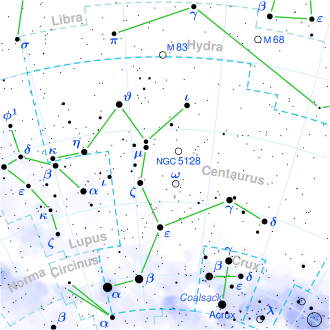
G Centauri is a single10 star in the southern constellation of Centaurus. It is visible to the naked eye as a faint, blue-white hued star with an apparent visual magnitude of +4.82. This object is located approximately 450 light years from the Sun, based on parallax.2 It is a member of the Lower Centaurus–Crux group of the Scorpius–Centaurus association, with the former having an age of about 17 million years.11
This object is a B-type main-sequence star with a stellar classification of B3V(n),3 where the 'n' indicates "nebulous" (broad) lines due to rapid rotation. It is around 164 million years old with a projected rotational velocity of up to 298 km/s.8 The star has six4 times the mass of the Sun and 3.45 times the Sun's radius. It is radiating 4831 times the luminosity of the Sun from its photosphere at an effective temperature of 13,732 K.6 An infrared excess indicates a circumstellar disk of dust with a mean temperature of 50 K is orbiting the star at a separation of 717.8 AU.5
References
References
- Anderson, E.; Francis, Ch. (2012). "XHIP: An extended hipparcos compilation". Astronomy Letters. 38 (5): 331. arXiv:1108.4971. Bibcode:2012AstL...38..331A. doi:10.1134/S1063773712050015. XHIP record for this object at VizieR.
- van Leeuwen, F. (2007), "Validation of the new Hipparcos reduction", Astronomy and Astrophysics, 474 (2): 653–664, arXiv:0708.1752, Bibcode:2007A&A...474..653V, doi:10.1051/0004-6361:20078357, S2CID 18759600.
- Houk, Nancy (1978), Michigan catalogue of two-dimensional spectral types for the HD stars, vol. 2, Ann Arbor: Dept. of Astronomy, University of Michigan, Bibcode:1978mcts.book.....H.
- Tetzlaff, N.; et al. (January 2011), "A catalogue of young runaway Hipparcos stars within 3 kpc from the Sun", Monthly Notices of the Royal Astronomical Society, 410 (1): 190–200, arXiv:1007.4883, Bibcode:2011MNRAS.410..190T, doi:10.1111/j.1365-2966.2010.17434.x, S2CID 118629873.
- Cotten, Tara H.; Song, Inseok (July 2016), "A Comprehensive Census of Nearby Infrared Excess Stars", The Astrophysical Journal Supplement Series, 225 (1): 24, arXiv:1606.01134, Bibcode:2016ApJS..225...15C, doi:10.3847/0067-0049/225/1/15, S2CID 118438871, 15.
- McDonald, I.; et al. (2012), "Fundamental parameters and infrared excesses of Hipparcos stars", Monthly Notices of the Royal Astronomical Society, 427 (1): 343–357, arXiv:1208.2037, Bibcode:2012MNRAS.427..343M, doi:10.1111/j.1365-2966.2012.21873.x, S2CID 118665352.
- Gáspár, András; et al. (2016), "The Correlation between Metallicity and Debris Disk Mass", The Astrophysical Journal, 826 (2): 171, arXiv:1604.07403, Bibcode:2016ApJ...826..171G, doi:10.3847/0004-637X/826/2/171, S2CID 119241004.
- Brown, A. G. A.; Verschueren, W. (1997), "High S/N Echelle spectroscopy in young stellar groups. II. Rotational velocities of early-type stars in SCO OB2", Astronomy and Astrophysics, 319: 811, arXiv:astro-ph/9608089, Bibcode:1997A&A...319..811B. Note: "The He i λ4026 line in this star is broader than the models. The value of vsini may thus be overestimated."
- "G Cen". SIMBAD. Centre de données astronomiques de Strasbourg. Retrieved 2019-08-15.
- Eggleton, P. P.; Tokovinin, A. A. (September 2008), "A catalogue of multiplicity among bright stellar systems", Monthly Notices of the Royal Astronomical Society, 389 (2): 869–879, arXiv:0806.2878, Bibcode:2008MNRAS.389..869E, doi:10.1111/j.1365-2966.2008.13596.x, S2CID 14878976.
- Jang-Condell, Hannah; et al. (August 2015), "Spitzer IRS Spectra of Debris Disks in the Scorpius–Centaurus OB Association", The Astrophysical Journal, 808 (2): 19, arXiv:1506.05428, Bibcode:2015ApJ...808..167J, doi:10.1088/0004-637X/808/2/167, S2CID 118549483, 167.