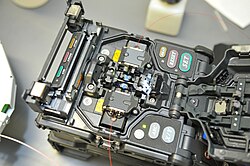
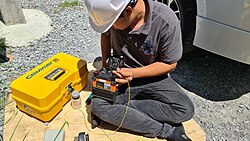

Fusion splicing is the act of joining two optical fibers end-to-end. The goal is to fuse the two fibers together in such a way that light passing through the fibers is not scattered or reflected back by the splice, and so that the splice and the region surrounding it are almost as strong as the intact fiber. The source of heat used to melt and fuse the two glass fibers being spliced is usually an electric arc,1 but can also be a laser, a gas flame, or a tungsten filament through which current is passed.
Governing standards
ANSI/EIA/TIA-455
See also
See also
References
References
- Alwayn, Vivek (2004). Optical Network Design and Implementation. Cisco Press. ISBN 9781587051050.
- US 7125494, "Methods of Removing Matrix from Fiber Optic Cable"
Further reading
Further reading
- "How to Precision Clean All Fiber Optic Connections": Edward J. Forrest, Jr. ISBN 1505549728, 9781505549720
- Fiber Optic Association