Академия Федеральной службы безопасности России имени Ф. Э. Дзержинского | |
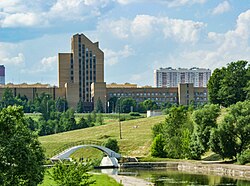 The FSB Academy in 2014. | |
Former name | Higher School of the KGB (until 1995) |
|---|---|
| Established | April 26, 1921 (1921-04-26) August 24, 1992 (1992-08-24) (current form) |
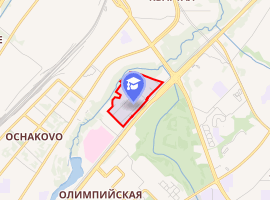
| Location | 70 Michurinsky Prospekt , , 55°41′00″N 37°28′13″E / 55.68333°N 37.47028°E / 55.68333; 37.47028 |
| Website | academy.fsb.ru |
 | |
 | |
The FSB Academy (Russian: Академия ФСБ), in full the Academy of the Federal Security Service of the Russian Federation named after F. E. Dzerzhinskya is a Russian government school which teaches tradecraft to intelligence officers of the Russian Federal Security Service (FSB), the greater Russian Intelligence Community, and Russian allies, including many of the Commonwealth of Independent States (CIS) countries. It has existed in various names and forms since 1921, when it was established by the Cheka to educate Soviet secret police. Following the collapse of the Soviet Union, the FSB Academy was chartered August 24, 1992, to absorb the Higher School of the KGB and the Academy of Border Troops.
The academy is located at the 1980 Olympic Village in Moscow's Ramenki District. The school includes several departments, among them the Institute of Cryptography, Telecommunications and Computer Scienceb and the Institute for Operational Training.c1
Since 2022, the academy's director has been Colonel General Nikolai Plotnikov.
History
Background
The academy has existed through many iterations amid the periodic purges and reformations of the Soviet and Russian intelligence services.
Its origins trace to the Presidium of Soviet Russia's first security service, the Cheka (VChK), who established a special institute for operational training in April 1921.2 When the Cheka was reorganized into the State Political Directorate (GPU) a year later in 1922, the institute was renamed the Higher Courses of the State Political Directorate. The following year in 1923 the GPU was replaced by the Joint State Political Directorate (OGPU). In May 1930 Moscow created higher schools for basic and advanced training of secret agents; on June 4, 1930 the school was known as the Central School of OGPU. July 14, 1934, after the formation of the People's Commissariat of Internal Affairs, the former OGPU Central School was renamed the Central School of General Directorate for State Security (GUGB) of the NKVD. On March 21, 1939 the Central School of GUGB NKVD was reorganized as the Graduate School of the NKVD. By the early 1940s, every third head of the Soviet security organs was a graduate of the course.3 During the Great Patriotic War, the school trained more than seven thousand security officers who organized the fight against Nazi Germany.4
By Resolution of the Council of Ministers on August 2, 1962 the KGB Higher School was named after Felix Dzerzhinsky. During the 1960s to 1980s, graduates took part in countering foreign intelligence services and conducting operational and combat activities.
After the collapse of the Soviet Union, Russian president Boris Yeltsin established the academy by decree on August 24, 1992 to absorb the former Higher School of the KGB.
In 1995, the Higher School of the KGB was renamed the FSB Academy.5 In April 2026, Russian president Vladimir Putin signed a decree to restore Felix Dzerzhinsky's name to the academy.6
| Service | Name | Start Date | End Date |
|---|---|---|---|
| Cheka | Special Institute for Operational Training of the Cheka | April 1921 | 1922 |
| GPU | Higher Courses of the State Political Directorate | 1922 | June 4, 1930 |
| OGPU | Central School of the Joint State Political Directorate | June 4, 1930 | July 14, 1934 |
| GUGB | Central School of Main Directorate of State Security | July 14, 1934 | March 21, 1939 |
| NKVD | Graduate School of the People's Commissariat for Internal Affairs | March 21, 1939 | c. 1954 |
| KGB | Higher School of the Committee for State Security | c. 1954 | August 2, 1962 |
| KGB | Higher School of the Committee for State Security named for F.E. Dzerzhinzky | August 2, 1962 | August 24, 1992 |
| MBRF | Academy of the Ministry of Security of the Russian Federation | August 24, 1992 | December 21, 1993 |
| FSK | Academy of the Ministry of Security of the Russian Federation | December 21, 1993 | June 23, 1995 |
| FSB | Academy of the Federal Security Service | June 23, 1995 | April 21, 2026 |
| FSB | Academy of the Federal Security Service named for F.E. Dzerzhinzky | April 21, 2026 | present |
Directors of the FSB Academy
Colonel General Viktor Ostroukhov was Head of the Academy from 2007 until 2019.7 It was then directed by Colonel General Yevgeny Sysoyev and since 2022 it has been directed by Lieutenant General Nikolay Vladimirovich Plotnikov.
See also
See also
Notes
Notes
References
References
- Бортников напутствовал медалистов Академии ФСБ: вы "будете верны традициям, заложенным нашими ветеранами", Bortnikov, to the medalists of FSB Academy: Shall all of you "will be true to the traditions laid down by our veterans", NEWSru.com
- АКАДЕМИЯ ФСБ - TERRA INCOGNITA Archived 2018-05-29 at the Wayback Machine, FSB.Ru
- АКАДЕМИЯ ФСБ - TERRA INCOGNITA Archived 2018-05-29 at the Wayback Machine, FSB.Ru
- АКАДЕМИЯ ФСБ - TERRA INCOGNITA Archived 2018-05-29 at the Wayback Machine, FSB.Ru
- Татьянин день, бывший когда-то праздником Московского государственного университета, сегодня с удовольствием отмечают все российские студенты. Академия ФСБ - не исключение Archived 2018-05-29 at the Wayback Machine, Nomad.SU
- Times, The Moscow (2026-04-22). "Putin Renames FSB Academy After Red Terror Architect Felix Dzerzhinsky". The Moscow Times. Retrieved 2026-04-22.
- The Head of FSB Academy - Viktor Ostroukhov Archived 2012-05-21 at the Wayback Machine, FSB Academy official website
Further reading
Further reading
- Органы государственной безопасности СССР в Великой Отечественной войне. Сборник документов в 8 т. Том 1. Накануне. В 2-х кн. Кн. 2 (1 января — 21 июня 1941 г.). —М.: А/О «Книга и бизнес», 1995.