| Petalonamae | |||
|---|---|---|---|
| |||
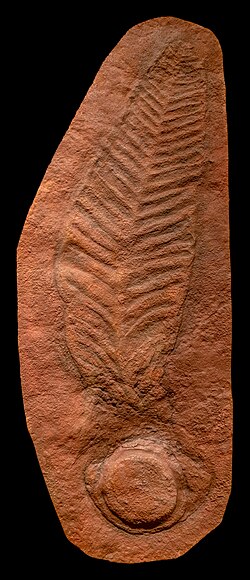
| Arborea arborea | |||
Scientific classification 
| |||
| Kingdom: | Animalia | ||
| Phylum: | †Petalonamae Pflug, 19721 | ||
| Subtaxa23 | |||
| |||
| Synonyms | |||
|
Frondomorpha | |||
The petalonamids (Petalonamae) or frondomorphs are an extinct group of archaic animals typical of the Ediacaran biota, dating from around 635 million years ago to 516 million years ago. They are benthic and immobile animals,4 shaped like leaves, fronds (frondomorphic), feathers, or spindles. While initially considered algae or octocorals akin to sea pens, it is now believed that there are no living descendants of the group, which shares a probable relation to the Ediacaran animals known as vendozoans.
Generally, these animals possess bilateral symmetry, like a feather with one axis and two sides. Some may be trilateral, with one axis and three sides, as seen in the erniettomorphs.56 Phylogenetically they are particularly difficult to classify. Lacking mouths, intestines, reproductive organs, or any other preserved evidence of internal structures, the morphology of these animals is very strange by current standards. The most widely accepted hypothesis is that they could directly absorb nutrients from the water around them by osmosis. It is commonly conjectured that these organisms were fluffy at least in appearance, as if "inflatable".7 The fronds were composed of branched, tubular structures, and the organism was anchored to the substrate by a bulbous structure akin to a holdfast.
Phylogeny
The below phylogeny follows Hoyal Cuthill & Han (2018) who recover a clade which they name Petalonamae, including representatives of Rangeomorpha, Arboreomorpha and Erniettomorpha, Stromatoveris from the Lower Cambrian, as well as Dickinsonia, and identifying them as animals.5 This extended concept of Petalonamae was further extended by Hoyal Cuthill in 2022 to include Thaumaptilon from the Middle Cambrian.8 This concept of Petalonamae is equivalent to the Vendobionta.9
| Animalia |
| ||||||||||||||||||



See also
See also
- †Vendobionta
- †Trilobozoa, another group of Edicaran animals who have trilateral symmetry, similar to basal petalonams.
- †Proarticulata, another group of enigmatic Ediacaran animals
- Eumetazoa
References
References
-
Pflug, Hans D. (1 Jan 1970). "Zur Fauna der Nama-Schichten in Südwest-Afrika (Teil II)" [On the fauna of the Nama Beds in Southwest-Africa (Part II)]. Palaeontographica Abteilung A (in German). A135 (3–6): 198–231. Part II. Rangeidae, Bau und systematische Zugehörigkeit [Rangeidae, morphology and taxonomical position].
- see also
- "†phylum Petalonamae (Pflug, 1972)". Paleobiology database (paleobiodb.org) (basic taxon info). 121415.
- Seilacher, A. (2007). Trace Fossil Analysis. Springer.
- Ivantsov, A.Y.; Grazhdankin, D.V. (1997). "A new representative of Petalonamae from [the] upper Vendian of Arkhangelsk region". Paleontological Journal. 31 (1).
- Hoyal Cuthill, Jennifer F.; Han, Jian (7 August 2018). "Cambrian petalonamid Stromatoveris phylogenetically links Ediacaran biota to later animals" (PDF). Palaeontology. 61 (6): 813–823. doi:10.1111/pala.12393. ISSN 0031-0239 – via U. Essex.
- Buss, Leo W.; Seilacher, Adolf (1994). "The phylum Vendobionta: A sister group of the Eumetazoa?". Paleobiology. 20 (1): 1–4. doi:10.1017/S0094837300011088. ISSN 0094-8373. S2CID 89131248.
- Laflamme, Marc; Xiao, Shuhai; Kowalewski, Michał (2009). "Osmotrophy in modular Ediacara organisms". Proceedings of the National Academy of Sciences of the USA. 106 (34): 14438–14443. doi:10.1073/pnas.0904836106. PMC 2732876. PMID 19706530.
- Hoyal Cuthill, Jennifer F (July 2022). "Ediacaran survivors in the Cambrian: suspicions, denials and a smoking gun". Geological Magazine. 159 (7): 1210–1219. Bibcode:2022GeoM..159.1210H. doi:10.1017/S0016756821001333. ISSN 0016-7568.
- Darroch, S. A. F.; Gibson, B. M.; Syversen, M.; Rahman, I. A.; Racicot, R. A.; Dunn, F. S.; Gutarra, S.; Schindler, E.; Wehrmann, A.; Laflamme, M. (2022). "The life and times of Pteridinium simplex". Paleobiology. 48 (4): 527–556. Bibcode:2022Pbio...48..527D. doi:10.1017/pab.2022.2. S2CID 248879848.
Further reading
Further reading
- Martinsson, Anders (October 1978). "Keys to German palaeontological and stratigraphical terminology". Lethaia. 11 (4): 292. doi:10.1111/j.1502-3931.1978.tb01883.x.
- "The Rise of Animals: Evolution and diversification of kingdom Animalia. Fedonkin M.A., Gehling J.G., Grey C., Narbonne G.M., Vickers-Rich P. (2007)". Integrative Zoology (book review). 3 (4): 333. 14 December 2008. doi:10.1111/j.1749-4877.2008.00114.x.
- Glaessner, M.F.; Walter, M.R. (1975). "New Precambrian fossils from the Arumbera Sandstone, Northern Territory, Australia". Alcheringa: An Australasian Journal of Palaeontology. 1 (1): 59–69. doi:10.1080/03115517508619480.
- Grazhdankin, Dmitriy (2014). "Patterns of evolution of the Ediacaran soft-bodied biota". Journal of Paleontology. 88 (3): 269–283. doi:10.1666/13-072. S2CID 129317326.