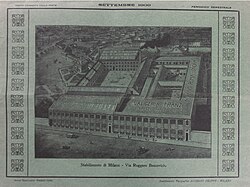
 The premises of the company in 1909 | |
Company type |
|
|---|---|
| Industry | leather goods |
| Founded | 1864, Milan, Italy |
| Founder | Rocco Franzi |
| Defunct | 1998 |
| Fate | closed |
| Headquarters | Milan , Italy |
| Products | leather luggage |
History
Origins
The history of Franzi dates back to 1840, when Rocco Franzi established a small business in Milan, specialising in the production of bags and suitcases.1: 21 2: 234 3
In 1864, Felice Franzi, Rocco's son, formally founded the company under the name Valigeria Franzi in Via Manzoni, Milan.34 Among the products developed during this period was the "Leggerissimo" trunk, constructed with a wooden frame covered in parchment or leather. Conceived to reduce the total weight of travellers’ luggage, the trunk allows a considerable reduction in transportation fees, guaranteeing solidity and durability over time. 35 To develop new production methods, Felice invested in machinery and hired master leather workers from Austria and France to train local craftsmen.4 Among those who worked at the Franzi factory was Guccio Gucci, who later referenced his experience there in the promotional affiche for his first store in Florence.67 Franzi was listed on the Milan stock exchange from 1905 to 1909.2: 233
Relationships with European Royal Houses
In 1877, Felice Franzi was awarded the title of Cavaliere della Corona (Knight of the Crown) of Italy, followed by Ufficiale della Corona (Officer of the Crown) in 1878. The company subsequently became an official supplier to the Royal House of Savoy, the Royal House of Austria, the King of Greece, and the Khedive of Egypt.83
At the 1900 Paris International Exhibition, Franzi received a gold and a silver medal. 4 During those years, the company opened stores in Rome, Genoa, London, and Vienna.4
Oreste Franzi and expansion into Asia
At the turn of the century, Oreste Franzi, son of Felice, assumed leadership of the company. Following travels in China and Japan, he introduced carpentry and leather tanning techniques from Asia to the Franzi production process.4 In 1912, Oreste founded the Conceria Monzese, one of the first industrial facilities in Europe to produce vegetable-tanned leather, using natural additives including walnut, mimosa, and red quebracho extracts.438
"Cuoio Franzi" and commercial development
Franzi developed a textured leather, "Cuoio Franzi" 8(also known as "Franzino"), a registered trademark. Franzi leathers were adopted in sectors beyond accessories, including the interiors of luxury trains and ocean liners such as the Raffaello and the Michelangelo. 4
Post-war period and design collaborations
In 1943, the Franzi factory in Milan was destroyed during World War II. In 1967 Franzi manufactured a suitcase, "Partner", designed by Cini Boeri and made from two half-shells of aluminium and ABS resin with leather interiors.9: 64 10 Several original pieces are held in the permanent collections of the Museum of Modern Art in New York and the Triennale di Milano.11 During the same period, Franzi leathers were used in the interiors of various Ferrari12 and Maserati models by designers including Pininfarina and Bertone.
Decline and relaunch
The company went into liquidation in 1978, and a new company, Oreste Franzi & Co., was set up. It finally closed in 1998.2: 233
In September 2021, Franzi was relaunched by Milan-based entrepreneur Marco Calzoni.3
References
References
- Andrea Guolo, Amato Santi (2007). La borsa... racconta: storia e protagonisti di mezzo secolo di pelletteria (in Italian). Milano: F. Angeli. ISBN 9788846485144
- Giuseppe De Luca (2002). Le società quotate alla Borsa valori di Milano dal 1861 al 2000: profili storici e titoli azionari (in Italian). Milano: Libri Scheiwiller.
- Zargani, Luisa (9 December 2021). "Franzi Relaunched With Margherita Bag". WWD. Retrieved 9 June 2026.
- Giamberardino, Giulia Di (23 May 2023). ""Guccio Gucci (già impiegato della valigeria Franzi)". La storia custodita nelle borse dei Reali". Vogue Italia (in Italian). Retrieved 9 June 2026.
- Andò, Romana; Briatore, Samuele, eds. (2025). Trame: tessuto italiano musei e degli archivi di moda. Cinisello Balsamo (Milano): Silvana. ISBN 978-88-366-5897-8.
- Guccio Gucci (in Italian). Vogue Encyclo. Archived 24 March 2017.
- "Gucci | History, Fashion, Logo, & Facts | Britannica". Encyclopedia Britannica. Retrieved 9 June 2026.
- Tagariello, Maria Luisa (13 June 2024). "Borse di lusso senza tempo: 6 maison storiche che non passano di moda (e con storie bellissime da conoscere)". Vanity Fair Italia (in Italian). Retrieved 9 June 2026.
- Colin Naylor (1990). Contemporary Designers. Chicago: St. James Press. ISBN 9780912289694.
- Cini Boeri: Suitcase, 1966. New York: The Museum of Modern Art. Accessed May 2017.
- "Cini Boeri. Suitcase. 1966 | MoMA".
- "1962 Ferrari 250 GT Cabriolet Series II by Pininfarina".