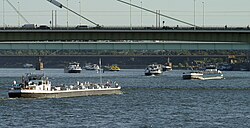
Inland navigation, inland barge transport1 or inland waterway transport (IWT)2 is a transport system allowing ships and barges to use inland waterways (such as canals, rivers and lakes). These waterways have inland ports, marinas, quays, and wharfs.3456
Environment
| Mode | eurocent per tonne-kilometre |
|---|---|
| Road (LCV) | |
| Road (HGV) | |
| Rail (diesel) | |
| Rail (electric) | |
| Inland vessel |
Modern researchers have long recognized that inland navigation is a relatively environmentally friendly option for freight transport compared to other modes of transportation such as air carriage and road transport, and similar to rail freight transport.127 Therefore, policy makers have been aiming to shift the volume of cargo transported by more pollutive means towards inland navigation in order to reduce the overall environmental impact of transport, for example, as part of the European Green Deal (2019).2 To accomplish this, however, various challenges need to be tackled, including making inland navigation itself less pollutive than it has been, building larger barges and tows to increase their efficiency, and constructing or improving inland waterways navigable enough for the projected volume and size of ships (deep and wide enough, with mega-locks for differences in elevation) to avoid bottlenecks.17 The environmental effects of constructing, operating and maintaining inland navigation also need to be mitigated.1
See also
See also
- Water transport in India
- Central Commission for Navigation on the Rhine
- Inland waterways of the United States
- Classification of European Inland Waterways
- Code Européen des Voies de la Navigation Intérieure (European Code for Interior Navigation)
- Grand Canal (China)
- Internal waters
- Navigability
- Roll-on/roll-off car carrying ship
- Container port design process
- Container on barge
References
References
- Hunt, Constance Elizabeth (2013). Thirsty Planet: Strategies for Sustainable Water Management. London: Zed Books. p. 154. ISBN 9781848137905. Retrieved 29 March 2022.
- Hofbauer, Florian; Putz, Lisa-Maria (2020). "External Costs in Inland Waterway Transport: An Analysis of External Cost Categories and Calculation Methods". Sustainability. 12 (5874). MDPI: 9 (Table 11). Bibcode:2020Sust...12.5874H. doi:10.3390/su12145874. Retrieved 29 March 2022.
- "About INE". Inland Navigation Europe. Archived from the original on 2012-11-12. Retrieved 2012-11-20.
- "USACE Planning Center of Expertise for Inland Navigation". US Army Corps of Engineers. Archived from the original on 2012-10-29. Retrieved 2012-11-20.
- "Inland Rules of Navigation & Legal Definition". USlegal Inc.
- "Inland Waterways". US Army Corps of Engineers. Archived from the original on 2004-10-14. Retrieved 2012-11-20.
- Pauli, Gernot (2015). "Chapter 14: Emissions and Inland Navigation". Green Transportation Logistics: The Quest for Win-Win Solutions. Cham, Switzerland: Springer. p. 479. ISBN 9783319171753. Retrieved 29 March 2022.
External links
External links
- Museum of Inland Navigation Archived 2011-07-20 at the Wayback Machine (Battaglia Terme, Padua)