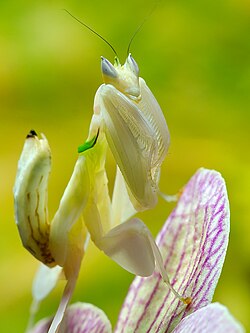
Flower mantises are mantises that use a form of camouflage referred to as aggressive mimicry, which they use both to attract prey and to avoid predators. These insects have specific colorations and behaviors that mimic flowers in their surrounding habitats.2
This strategy has been observed in other mantises including the stick mantis and dead-leaf mantis.2 The observed behavior of these mantises includes positioning themselves on a plant and either inserting themselves within the irradiance or on the foliage of the plants until a prey insect comes within range.2
Many species of flower mantises are popular as pets. The flower mantises are a diurnal group with a single ancestor (a clade), but the majority of the known species belong to the family Hymenopodidae.
Example species: Orchid mantis
The orchid mantis, Hymenopus coronatus, of southeast Asia mimics orchid flowers.32 There is no evidence that suggests that they mimic a specific orchid, but their bodies are often white with pink markings and green eyes.3 These insects display different body morphologies depending on their life stage; juveniles are able to bend their abdomens upwards, allowing them to easily resemble a flower. However, the adult's wings are too large, inhibiting their ability to bend as the juveniles do.2 This dichotomy suggests that there must be other processes involved to attract insect prey species. Since Hymenopus coronatus do not mimic one orchid in particular, their colorations often do not match the coloration of a single orchid species.4
Antipredator behaviour
One mechanism displayed by the orchid mantis to attract prey is the ability to absorb UV light the same way that flowers do.42 This makes the mantis appear flower-like to UV-sensitive insects who are often pollinators.42 To an insect, the mantis and the surrounding flowers appear blue; this contrasts against the foliage in the background that appears red.2
In his 1940 book Adaptive Coloration in Animals, Hugh Cott quotes an account by Nelson Annandale, saying that the mantis hunts on the flowers of the "Straits Rhododendron", Melastoma polyanthum. The nymph has what Cott calls "special alluring coloration" (aggressive mimicry), where the animal itself is the "decoy". The insect is pink and white, with flattened limbs with "that semiopalescent, semicrystalline appearance that is caused in flower petals by a purely structural arrangement of liquid globules or empty cells". The mantis climbs up the twigs of the plant and stands imitating a flower and waits for its prey patiently. It then sways from side to side, and soon small flies land on and around it, attracted by the small black spot on the end of its abdomen, which resembles a fly. When a larger dipteran fly, as big as a house fly, landed nearby, the mantis at once seized and ate it.56 More recently (2015), the orchid mantis's coloration has been shown to mimic tropical flowers effectively, attracting pollinators and catching them.7
Juvenile mantises secrete a mixture of the chemicals 3HOA and 10HDA, attracting their top prey species, the oriental bumblebee. This method of deception is aggressive chemical mimicry, imitating the chemical composition of the bee's pheromones. The chemicals are stored in the mandibles and released when H. coronatus is hunting.2 Adult mantises do not produce these chemicals.234
Taxonomic range
The flower mantises include species from several genera, many of which are popularly kept as pets. Seven of the genera are in the Hymenopodidae:
| Mantodea |
| |||||||||||||||||||||||||||||||||
| Species | Common names | Image | Distribution | Notes |
|---|---|---|---|---|
| Acromantis formosana | Taiwan flower mantis8 | 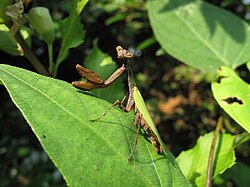
|
Taiwan | Nymphs are dark brown, flanged and spined, highly cryptic on dead leaves. Adults have green wings. |
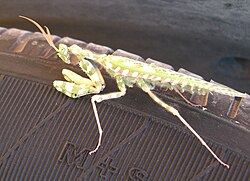
| Blepharopsis mendica | Small devil's flower mantis9 Devil's flower mantis Thistle mantis10 Egyptian flower mantis Arab mantis11 |
|
North Africa, Canary Islands | Deimatic display with head and thorax rotated to one side. |
| Chloroharpax modesta | Nigerian flower mantis12 | 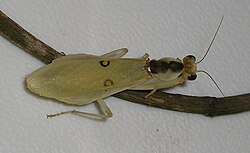
|
West Africa | Adult female has ocellated eyespots on wings. Aggressively hunts prey larger than itself. |
| Creobroter gemmatus and other species in genus Creobroter | Flower mantises13 | 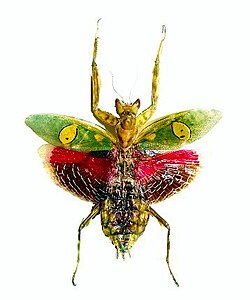
|
South and Southeast Asia | Fly strongly on long wings. Eyespots on forewings, varying colours. Deimatic display of bright hindwings is flashed to startle predators. |
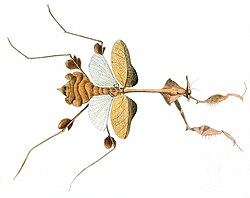
| Gongylus gongylodes | Wandering violin mantis Ornate mantis Indian rose mantis14 |
|
South Asia | Up to 11 cm; males can fly. |
| Harpagomantis tricolor | African false flower mantis15 | 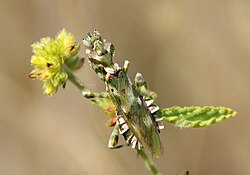
|
Southern Africa | A colourful ambush hunter that waits motionless on flowering plants. Length about 3 cm. |
| Hymenopus coronatus | Orchid mantis16 Walking flower mantis17 |

|
Southeast Asia | Hunts flies on "Straits Rhododendron", Melastoma polyanthum. |
| Idolomantis diabolica | [Giant] devil's flower mantis1819 | 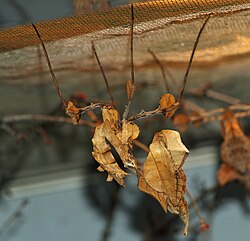
|
Central and East Africa | Large insect, females as much as 13 cm. Brightly coloured deimatic display in red, white, blue, purple and black. |
| Helvia cardinalis (="Parymenopus davisoni") | Yellow flower mantis,20 Davison's mantis |
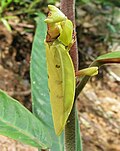
|
Southeast Asia | A slender yellow mantis, the female with three dark spots on the wings |
| Pseudoharpax virescens | Gambian spotted-eye flower mantis21 | 
|
East, Central, and West Africa | Adult female has eye spots on her abdomen. |
| Pseudocreobotra wahlbergii | Spiny flower mantis Bulls-eye mantis #9 mantis22 |

|
South and East Africa | Effective aggressive mimic of flowers, can handle prey much larger than itself, deimatic display with spread wings to show off "number 9" eyespots, variable coloration |
| Pseudocreobotra ocellata | Spiny flower mantis Spiny flower praying mantis African ocellated mantis2324 |

|
West, Central and Southern Africa | Like P. wahlbergii. |
| Theopropus elegans | Banded flower mantis Asian boxer mantis25 |

|
Southeast Asia | White stripe on forewings. Colours can vary. |
References
References
- Levine, Timothy R. (2014). Encyclopedia of Deception. SAGE Publications. p. 675. ISBN 978-1-4833-8898-4.
In aggressive mimicry, the predator is "a wolf in sheep's clothing". Mimicry is used to appear harmless or even attractive to lure its prey.
- Mizuno, Takafumi; Yamaguchi, Susumu; Yamamoto, Ichiro; Yamaoka, Ryohei; Akino, Toshiharu (December 2014). ""Double-trick" visual and chemical mimicry by the juvenile orchid mantis hymenopus coronatus used in predation of the oriental honeybee apis cerana". Zoological Science. 31 (12): 795–801. doi:10.2108/zs140126. ISSN 0289-0003. PMID 25483791. S2CID 42791981.
- O'Hanlon, J. C.; Li, D.; Norma-Rashid, Y. (July 2013). "Coloration and morphology of the orchid mantis Hymenopus coronatus (Mantodea: Hymenopodidae)". Journal of Orthoptera Research. 22 (1): 35–44. doi:10.1665/034.022.0106. ISSN 1082-6467.
- O'Hanlon, James C.; Holwell, Gregory I.; Herberstein, Marie E. (1 January 2014). "Pollinator Deception in the Orchid Mantis". The American Naturalist. 183 (1): 126–132. doi:10.1086/673858. ISSN 0003-0147. PMID 24334741.
- Cott 1940, pp. 392–393
- Annandale, Nelson (1900). "Notes on the Habits and natural Surroundings of Insects made during the 'Skeat Expedition' to the Malay Peninsula, 1899–1900". Proceedings of the Zoological Society of London: 837–868.
- Choi, Charles Q. (30 November 2013). "Found! First Known Predator To Lure Prey By Mimicking Flowers". LiveScience. Retrieved 2 July 2015.
the color of the orchid mantis was indistinguishable from 13 species of wild flowers in the areas the predator lived. The orchid mantis is unique in that the mantis itself is the attractive stimulus.
- "USA Mantis: Acromantis formosana". Archived from the original on 2016-03-05. Retrieved 2012-12-23.
- Keeping Insects: Blepharopsis mendica
- "Insectstore, mantis caresheets: Blepharopsis mendica". Archived from the original on 2012-12-24. Retrieved 2012-12-23.
- Dannesdjur: image gallery: Blepharopsis mendica Archived 2012-06-28 at the Wayback Machine
- "USA Mantis: photos of Chloroharpax modesta". Archived from the original on 2015-06-26. Retrieved 2012-12-23.
- Kuznetsova, Valentina; Grozeva, Snejana; Gokhman, Vladimir (2020). "Telomere structure in insects: A review". Journal of Zoological Systematics and Evolutionary Research. 58 (1): 127–158.
- Cott 1940, p. 336.
- Svenson, G.J.; Hardy, N.B.; Cahill Wightman, H.M.; Wieland, F. (October 2015). "Of flowers and twigs: phylogenetic revision of the plant-mimicking praying mantises (Mantodea: Empusidae and Hymenopodidae) with a new suprageneric classification". Systematic Entomology. 40 (4): 789–834. doi:10.1111/syen.12134. S2CID 86783651. Retrieved 3 May 2017.
- Gullan & Cranston 2010, p. 370
- Dorai, Francis, ed. (2011). Singapore at Random. Editions Didier Millet. p. 18.
- "Insect Store: Idolomantis diabolica". Archived from the original on 2012-12-24. Retrieved 2008-07-20.
- Reptileforums: Idolomantis diabolica
- "Reocities.com: Parhymenopus davisoni". Archived from the original on 2016-03-04. Retrieved 2013-01-01.
- Keeping Insects: Pseudoharpax virescens
- MantisKingdom: Caresheet of Pseudocreobotra wahlbergii
- Exotic Pets: Spiny Flower Mantis
- "PetBugs.com: Caresheet on P. ocellata". Archived from the original on 2016-03-05. Retrieved 2012-12-23.
- "USA Mantis logs: Theopropus elegans". Archived from the original on 2016-05-20. Retrieved 2012-12-23.
Further reading
Further reading
- Cott, Hugh B. (1940). Adaptive Coloration in Animals. London: Methuen.
- Gullan, P. J.; Cranston, P. S. (2010). The Insects: An Outline of Entomology (4th ed.). Wiley.
- Wickler, Wolfgang (1968). Mimicry in plants and animals. McGraw-Hill, New York.