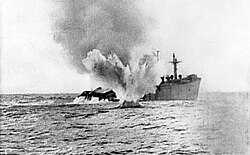
The early phase of the Battle of the Atlantic during which Kriegsmarine U-boats enjoyed significant success against Allied warships and merchantmen was referred to by U-boat crews as the Happy Time (German: Die glückliche Zeit),1 and later the First Happy Time, after a second successful period was encountered.
It started in July 1940, almost immediately after the Fall of France, which brought the German U-boat fleet closer to the British shipping lanes in the Atlantic. From July 1940 to the end of October, 282 Allied ships were sunk off the north-west approaches to Ireland for a loss of 1,489,795 GRT of merchant shipping.2
The reason for this successful Axis period was the British lack of radar and huff-duff-equipped ships which meant that the U-boats were very hard to detect when they made nighttime surface attacks – ASDIC (sonar) could only detect submerged U-boats.
When it ended is a matter of interpretation, with some sources claiming October 19403 and others extending it to April 1941,4 after the Germans lost three prominent U-boat commanders: Günther Prien, Joachim Schepke, and Otto Kretschmer.5
See also
See also
References
References
- Purnell, Tom (April 11, 2003). "The "Happy Time"". "Canonesa", Convoy HX72 & U-100. Archived from the original on October 1, 2007. Retrieved September 1, 2007.
- Blouet, Brian W. Global Geostrategy: Mackinder and the Defence of the West, p. 131
- Hughes, Terry; Costello, John. The Battle of the Atlantic, p. 88
- Macintyre, Donald G. F. W. The Naval War Against Hitler, p. 52
- Milner, Marc (June 2008). "The Battle That Had to Be Won". Naval History Magazine. United States Naval Institute. Retrieved 9 March 2017.