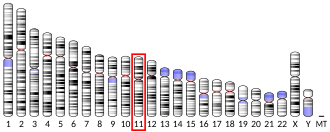
Adrenal ferredoxin (also adrenodoxin (ADX), adrenodoxin, mitochondrial, hepatoredoxin, ferredoxin-1 (FDX1)) is a protein that in humans is encoded by the FDX1 gene.56 In addition to the expressed gene at this chromosomal locus (11q22), there are pseudogenes located on chromosomes 20 and 21.
Function
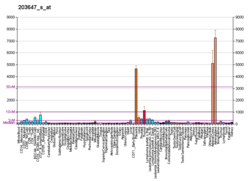
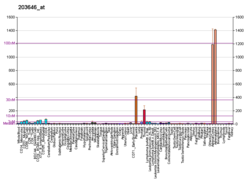
Adrenodoxin is a small iron-sulfur protein that can accept and carry a single electron. Adrenodoxin functions as an electron transfer protein in the mitochondrial cytochrome P450 systems.7 The first enzyme in this system is adrenodoxin reductase that carries an FAD. FAD can be reduced by two electrons donated from coenzyme NADPH.8 These two electrons are transferred one a time to adrenodoxin. Adrenodoxin in return reduces mitochondrial cytochrome P450.7 This particular oxidation/reduction system is involved in the synthesis of steroid hormones in steroidogenic tissues. In addition, similar systems also function in vitamin D and bile acid synthesis in the kidney and liver respectively. Adrenodoxin has been identified in a number of different tissues but all forms have been shown to be identical and are not tissue specific.6
References
References
Further reading
Further reading
- Grinberg AV, Hannemann F, Schiffler B, et al. (2000). "Adrenodoxin: structure, stability, and electron transfer properties". Proteins. 40 (4): 590–612. doi:10.1002/1097-0134(20000901)40:4<590::AID-PROT50>3.0.CO;2-P. PMID 10899784. S2CID 113757.
- Wada A, Waterman MR (1992). "Identification by site-directed mutagenesis of two lysine residues in cholesterol side chain cleavage cytochrome P450 that are essential for adrenodoxin binding". J. Biol. Chem. 267 (32): 22877–82. doi:10.1016/S0021-9258(18)50028-4. PMID 1429635.
- Sparkes RS, Klisak I, Miller WL (1991). "Regional mapping of genes encoding human steroidogenic enzymes: P450scc to 15q23-q24, adrenodoxin to 11q22; adrenodoxin reductase to 17q24-q25; and P450c17 to 10q24-q25". DNA Cell Biol. 10 (5): 359–65. doi:10.1089/dna.1991.10.359. PMID 1863359.
- Skjeldal L, Markley JL, Coghlan VM, Vickery LE (1991). "1H NMR spectra of vertebrate [2Fe-2S] ferredoxins. Hyperfine resonances suggest different electron delocalization patterns from plant ferredoxins". Biochemistry. 30 (37): 9078–83. doi:10.1021/bi00101a024. PMID 1909889.
- Coghlan VM, Vickery LE (1991). "Site-specific mutations in human ferredoxin that affect binding to ferredoxin reductase and cytochrome P450scc". J. Biol. Chem. 266 (28): 18606–12. doi:10.1016/S0021-9258(18)55106-1. PMID 1917982.
- Chang CY, Wu DA, Mohandas TK, Chung BC (1990). "Structure, sequence, chromosomal location, and evolution of the human ferredoxin gene family". DNA Cell Biol. 9 (3): 205–12. doi:10.1089/dna.1990.9.205. PMID 2340092.
- Chang CY, Wu DA, Lai CC, et al. (1989). "Cloning and structure of the human adrenodoxin gene". DNA. 7 (9): 609–15. doi:10.1089/dna.1988.7.609. PMID 3229285.
- Voutilainen R, Picado-Leonard J, DiBlasio AM, Miller WL (1988). "Hormonal and developmental regulation of adrenodoxin messenger ribonucleic acid in steroidogenic tissues". J. Clin. Endocrinol. Metab. 66 (2): 383–8. doi:10.1210/jcem-66-2-383. PMID 3339111.
- Picado-Leonard J, Voutilainen R, Kao LC, et al. (1988). "Human adrenodoxin: cloning of three cDNAs and cycloheximide enhancement in JEG-3 cells". J. Biol. Chem. 263 (7): 3240–4. doi:10.1016/S0021-9258(18)69061-1. PMID 3343244.
- Martsev SP, Chashchin VL, Akhrem AA [in Belarusian] (1985). "[Reconstruction and study of a multi-enzyme system by 11 beta-hydroxylase steroids]". Biokhimiia. 50 (2): 243–57. PMID 3872685.
- Geren LM, Millett F (1981). "Fluorescence energy transfer studies of the interaction between adrenodoxin and cytochrome c". J. Biol. Chem. 256 (20): 10485–9. doi:10.1016/S0021-9258(19)68647-3. PMID 6270113.
- Pikuleva IA, Cao C, Waterman MR (1999). "An additional electrostatic interaction between adrenodoxin and P450c27 (CYP27A1) results in tighter binding than between adrenodoxin and p450scc (CYP11A1)". J. Biol. Chem. 274 (4): 2045–52. doi:10.1074/jbc.274.4.2045. PMID 9890963.
- Kostic M, Pochapsky SS, Obenauer J, et al. (2002). "Comparison of functional domains in vertebrate-type ferredoxins". Biochemistry. 41 (19): 5978–89. doi:10.1021/bi0200256. PMID 11993992.
- Strausberg RL, Feingold EA, Grouse LH, et al. (2003). "Generation and initial analysis of more than 15,000 full-length human and mouse cDNA sequences". Proc. Natl. Acad. Sci. U.S.A. 99 (26): 16899–903. Bibcode:2002PNAS...9916899M. doi:10.1073/pnas.242603899. PMC 139241. PMID 12477932.
- Johnson D, Norman S, Tuckey RC, Martin LL (2004). "Electrochemical behaviour of human adrenodoxin on a pyrolytic graphite electrode". Bioelectrochemistry. 59 (1–2): 41–7. doi:10.1016/s1567-5394(02)00188-3. PMID 12699818.
- Araya Z, Hosseinpour F, Bodin K, Wikvall K (2003). "Metabolism of 25-hydroxyvitamin D3 by microsomal and mitochondrial vitamin D3 25-hydroxylases (CYP2D25 and CYP27A1): a novel reaction by CYP27A1". Biochim. Biophys. Acta. 1632 (1–3): 40–7. doi:10.1016/S1388-1981(03)00062-3. PMID 12782149.
- Gerhard DS, Wagner L, Feingold EA, et al. (2004). "The status, quality, and expansion of the NIH full-length cDNA project: the Mammalian Gene Collection (MGC)". Genome Res. 14 (10B): 2121–7. doi:10.1101/gr.2596504. PMC 528928. PMID 15489334.
- Derouet-Hümbert E, Roemer K, Bureik M (2005). "Adrenodoxin (Adx) and CYP11A1 (P450scc) induce apoptosis by the generation of reactive oxygen species in mitochondria". Biol. Chem. 386 (5): 453–61. doi:10.1515/BC.2005.054. PMID 15927889. S2CID 37533711.
External links
External links