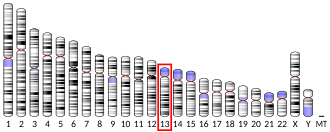
FERM, RhoGEF and pleckstrin domain-containing protein 1 is a protein that in humans is encoded by the FARP1 gene.56
This gene was originally isolated through subtractive hybridization due to its increased expression in differentiated chondrocytes versus dedifferentiated chondrocytes. The resulting protein contains a predicted ezrin-like domain, a Dbl homology domain, and a pleckstrin homology domain. It is believed to be a member of the band 4.1 superfamily whose members link the cytoskeleton to the cell membrane. Two alternatively spliced transcript variants encoding distinct isoforms have been found for this gene.6
See also
See also
References
References
- GRCh38: Ensembl release 89: ENSG00000152767 – Ensembl, May 2017
- GRCm38: Ensembl release 89: ENSMUSG00000025555 – Ensembl, May 2017
- "Human PubMed Reference:". National Center for Biotechnology Information, U.S. National Library of Medicine.
- "Mouse PubMed Reference:". National Center for Biotechnology Information, U.S. National Library of Medicine.
- Koyano Y, Kawamoto T, Shen M, Yan W, Noshiro M, Fujii K, Kato Y (Jan 1998). "Molecular cloning and characterization of CDEP, a novel human protein containing the ezrin-like domain of the band 4.1 superfamily and the Dbl homology domain of Rho guanine nucleotide exchange factors". Biochem Biophys Res Commun. 241 (2): 369–75. doi:10.1006/bbrc.1997.7826. PMID 9425278.
- "Entrez Gene: FARP1 FERM, RhoGEF (ARHGEF) and pleckstrin domain protein 1 (chondrocyte-derived)".
Further reading
Further reading
- Zhuang B, Su YS, Sockanathan S (February 2009). "FARP1 promotes the dendritic growth of spinal motor neuron subtypes through transmembrane Semaphorin6A and PlexinA4 signaling". Neuron. 61 (3): 359–72. doi:10.1016/j.neuron.2008.12.022. PMC 2654783. PMID 19217374.
- Hartley JL, Temple GF, Brasch MA (2001). "DNA cloning using in vitro site-specific recombination". Genome Res. 10 (11): 1788–95. doi:10.1101/gr.143000. PMC 310948. PMID 11076863.
- Strausberg RL, Feingold EA, Grouse LH, et al. (2003). "Generation and initial analysis of more than 15,000 full-length human and mouse cDNA sequences". Proc. Natl. Acad. Sci. U.S.A. 99 (26): 16899–903. Bibcode:2002PNAS...9916899M. doi:10.1073/pnas.242603899. PMC 139241. PMID 12477932.
- Ota T, Suzuki Y, Nishikawa T, et al. (2004). "Complete sequencing and characterization of 21,243 full-length human cDNAs". Nat. Genet. 36 (1): 40–5. doi:10.1038/ng1285. PMID 14702039.
- Dunham A, Matthews LH, Burton J, et al. (2004). "The DNA sequence and analysis of human chromosome 13". Nature. 428 (6982): 522–8. Bibcode:2004Natur.428..522D. doi:10.1038/nature02379. PMC 2665288. PMID 15057823.
- Gerhard DS, Wagner L, Feingold EA, et al. (2004). "The status, quality, and expansion of the NIH full-length cDNA project: the Mammalian Gene Collection (MGC)". Genome Res. 14 (10B): 2121–7. doi:10.1101/gr.2596504. PMC 528928. PMID 15489334.
- Wiemann S, Arlt D, Huber W, et al. (2004). "From ORFeome to biology: a functional genomics pipeline". Genome Res. 14 (10B): 2136–44. doi:10.1101/gr.2576704. PMC 528930. PMID 15489336.
- Mehrle A, Rosenfelder H, Schupp I, et al. (2006). "The LIFEdb database in 2006". Nucleic Acids Res. 34 (Database issue): D415–8. doi:10.1093/nar/gkj139. PMC 1347501. PMID 16381901.
External links
External links