Article · Wikipedia archive · Last revised Jul 1, 2026

Fan graph

In graph theory, a fan graph is a graph formed by the join of a path graph and an empty graph on a single vertex. The fan graph on vertices, denoted , is defined as , where is a single vertex and is a path on vertices.

Last revised
Jul 1, 2026
Read time
≈ 2 min
Length
477 w
Citations
6
Source
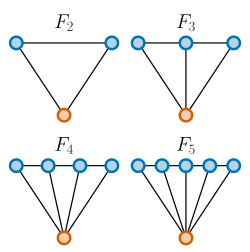
The path P n {\displaystyle P_{n}} and empty graph K 1 {\displaystyle K_{1}} in each fan graph F n {\displaystyle F_{n}} are colored blue and orange respectively source ↗

In graph theory, a fan graph (also called a path-fan graph) is a graph formed by the join of a path graph and an empty graph on a single vertex. The fan graph on n + 1 {\displaystyle n+1} vertices, denoted F n {\displaystyle F_{n}} , is defined as K 1 + P n {\displaystyle K_{1}+P_{n}} , where K 1 {\displaystyle K_{1}} is a single vertex and P n {\displaystyle P_{n}} is a path on n {\displaystyle n} vertices.12

The fan graph F n {\displaystyle F_{n}} has n + 1 {\displaystyle n+1} vertices and 2 n 1 {\displaystyle 2n-1} edges.1

Saturation

A graph G {\displaystyle G} is H {\displaystyle H} -saturated if it does not contain H {\displaystyle H} as a subgraph, but the addition of any edge e E ( G ) {\displaystyle e\notin E(G)} results in at least one copy of H {\displaystyle H} as a subgraph. The saturation number sat ( n , H ) {\displaystyle {\text{sat}}(n,H)} is the minimum number of edges in an H {\displaystyle H} -saturated graph on n {\displaystyle n} vertices, while the extremal number ex ( n , H ) {\displaystyle {\text{ex}}(n,H)} is the maximum number of edges possible in a graph G {\displaystyle G} on n {\displaystyle n} vertices that does not contain a copy of H {\displaystyle H} .

The t {\displaystyle t} -fan (sometimes called the friendship graph), F t ( t 2 ) {\displaystyle F_{t}(t\geq 2)} , is the graph consisting of t {\displaystyle t} edge-disjoint triangles that intersect at a single vertex v {\displaystyle v} .2

The saturation number for F t {\displaystyle F_{t}} is sat ( n , F t ) = n + 3 t 4 {\displaystyle {\text{sat}}(n,F_{t})=n+3t-4} for t 2 {\displaystyle t\geq 2} and n 3 t 2 {\displaystyle n\geq 3t-2} .2

Graph coloring

The packing chromatic number χ ρ ( G ) {\displaystyle \chi _{\rho }(G)} of a graph G {\displaystyle G} is the smallest integer k {\displaystyle k} for which there exists a mapping π : V ( G ) 1 , 2 , , k {\displaystyle \pi :V(G)\to {1,2,\ldots ,k}} such that any two vertices of color i {\displaystyle i} are at distance at least i + 1 {\displaystyle i+1} . The packing chromatic number has been studied for various fan and wheel related graphs.1

See also

See also

References

References

  1. Roy, S. (2017). "Packing chromatic number of certain fan and wheel related graphs". AKCE International Journal of Graphs and Combinatorics. 14 (1): 63–69. doi:10.1016/j.akcej.2016.11.001. ISSN 0972-8600.
  2. Fuller, Jessica; Gould, Ronald J. (2023). "On fan saturated graphs". Involve, a Journal of Mathematics. 16 (4): 637–657. doi:10.2140/involve.2023.16.637.