

In architecture, the false front (also false facade, flying facade, screen wall) is a façade designed to disguise the true characteristics of a building, usually to beautify it.123 The architectural design and purposes of these wall-like4 features vary:
- making a building appear larger, more important, and better-built, like in the Western false front architecture,5 German Blendfassaden (lit. 'blind facades') or Brick Gothic main facades (Schaufassaden, lit. 'show facades'). Some sources also use the term screen facade (German: Schirmfassade) when discussing the Medieval and Renaissance churches,678 not to be confused with the modern "membrane" screen facade;
- creating a fake appearance to improve aesthetics, an architectural equivalent of trompe-l'oeil;9
- in facadism, keeping the old facades with the goal of preserving the visual character of a historical neighborhood while allowing an entirely modern design of the actual buildings. In the view of preservationists, this creates a "Disneyland of false fronts"; 10
- deliberate violation of the truth to materials principle ("false in material")5 for economical, insulation, or aesthetic purposes, like masonry veneer using a non-structural outer layer of stone11 or a membrane screen facade;
- hiding a gable roof, like a tall parapet wall,12 as opposed to cross-sectional facade;
- a purely decorative way to increase height, like the one of a roof comb, a flat structure that tops buildings in Mesoamerican architecture. Sometimes the comb was shifted from the center of the roof to one of the walls, forming a flying facade.13
Tradition of "show facades" goes back to the very beginnings of the architecture, when the simplest buildings might have just one opening serving both as a door and a window. The special role of the wall with this opening was stressed through articulation and decoration.14
Outside of architecture, "false front" is used to describe a deceptive outward appearance in general,15 false hair in front (like bangs).16
Facadism

Facadism, façadism (also pejorative facadectomy, façadomy17)18 is the architectural and construction practice where the facade of a building is designed or constructed separately from the rest of a building, or when only the facade of a building is preserved with new buildings erected behind or around it.
There are aesthetic and historical reasons for preserving building facades. Facadism can be the response to the interiors of a building becoming unusable, such as being damaged by fire. In developing areas, however, the practice is sometimes used by property developers seeking to redevelop a site as a compromise with preservationists who wish to preserve buildings of historical or aesthetic interest. It can be regarded as a compromise between historic preservation and demolition and thus has been lauded as well as decried.
Show facades
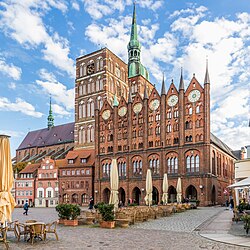
In the Brick Gothic, the Schaufassaden (lit. 'show facades',19 display facades), the facades facing the main street, were richly decorated and frequently concealed the cross-section structure of the building.20
Lombard architecture

In Lombard Gothic architecture, the facciata a vento (lit. 'wind facade') is a type of screen facade where the stone facing rises higher than the roofline, characterized by windows (often the round oculi) that open into the empty sky ("sfondanti sul cielo").21 Angiola Maria Romanini identified these "windows breaking into the sky" as a defining stylistic hallmark of the region's Gothic architecture.21
While the church of San Francesco in Brescia (c. 1254) was traditionally considered the prototype of this style, recent stratigraphical analysis suggests that the upper section of its facade is a later addition.21 Instead, the Basilica of San Francesco in Bologna (completed 1263) is likely the true innovative prototype of the facciata a vento.2223
The facciata a vento reduces the building's front to a two-dimensional screen, replacing the earlier Romanesque tradition of the elaborately 3D-sculpted German: Schirmfassade (screen facade).8 Following its introduction by the Mendicant orders, the style became a distinctively Lombard phenomenon, spreading to Cremona Cathedral, Monza Cathedral, and the (now demolished) Santa Maria della Scala in Milan.8 The style eventually migrated to the Adriatic coast, influencing architecture in the Marche region.8
Western false front architecture

Western false front architecture or false front commercial architecture is a type of commercial architecture used in the Old West of the United States. Often used on two-story buildings, the style includes a false front facade often hiding a gable roof.
The goal for buildings in this style is to project an image of stability and success, while in fact a business owner may not have invested much in a building that might be temporary. By emulating the rectangular profile of buildings in eastern North American cities, the style attempted to lend a more settled, urban feel to small frontier towns.24
- the front façade of the building "rises to form a parapet (upper wall) which hides most or nearly all of the roof"
- the roof "is almost always a front gable, though gambrel and bowed roofs are occasionally found"
- "a better grade of materials is often used on the façade than on the sides or rear of the building" and
- "the façade exhibits greater ornamentation than do the other sides of the building."25
See also
See also
- Fake building, an urban-building-like shell housing unsightly machinery
- Westwork, a structural element that also presents a show facade
- Rood screen and iconostasis, internal decorative walls in church
- Stepped gable, Dutch gable, and clock gable, designs at the top of the triangular gable-end of a building projecting above the roofline
- Bell-gable, a wall extension in the church in lieue of the bell tower
- Potemkin village, the use of structures to make the grim reality appear better
- Cladding (construction), a thin layer of material used primarily for better weather resistance, but also for thermal insulation and appearance
- Stone veneer, cladding using a thin layer of stone
- Formstone, a type of stucco imitating stone
- Harvard brick, a technique for building brick facades in imitation of much older ones
- Rustication (architecture), a range of masonry techniques contrasting with smooth ashlar
References
References
- Ching 2011, p. 16.
- De Gruyter 2008, p. 143.
- Stevens 2008.
- Kreuz 2016, p. 509, Note 277.
- Heath 1989, p. 210.
- Malone 2004, pp. 90–92.
- Davies & Jokiniemi 2012, p. 426, screen facade.
- Rossetti 2018, p. 37.
- Lessard 1987, p. 38.
- Stevens 2008, p. 34.
- Thompson 1983, p. 23.
- Treu 2012, p. 28.
- Stone 1931, p. 40.
- Pech, Pommer & Zeininger 2014, p. 12.
- Phillips 2018, p. 168, façade.
- "false front". Merriam-Webster.com Dictionary. Merriam-Webster. OCLC 1032680871.
- Stevens 2008, p. 246.
- Paul Spencer Byard (1 January 1998). The Architecture of Additions: Design and Regulation. W.W. Norton & Company. pp. 105–. ISBN 978-0-393-73021-0.
- Giese 2021, p. 432.
- Koepf & Binding 2005, p. 411.
- Rossetti 2018, p. 30.
- Rossetti 2018, p. 31.
- Rossetti 2018, p. 36.
- Love, Christy; Sheila Bricher-Wade (1980-05-16). National Register of Historic Places Inventory—Nomination Form: Odd Fellows Hall. National Park Service. Retrieved 2025-03-12.
- "False Front Commercial". ColoradoHistory.
Sources
Sources
- Camus, Marie-Thérèse (1991). "De la façade à tour(s) à la façade-écran dans les pays de l'Ouest : l'exemple de Saint-Jean-de-Montierneuf de Poitiers" [From the tower facade(s) to the screen facade in Western countries: The example of Saint-Jean-de-Montierneuf in Poitiers]. Cahiers de civilisation médiévale (in French). 34 (135): 237–253. doi:10.3406/ccmed.1991.2497. ISSN 0007-9731. Retrieved 2025-10-16.
- Ching, Francis D. K. (2011-12-30). A Visual Dictionary of Architecture. John Wiley & Sons. ISBN 978-1-118-16049-7. Retrieved 2025-09-24.
- Davies, Nikolas; Jokiniemi, Erkki (2012-05-04). Architect's Illustrated Pocket Dictionary. Routledge. ISBN 978-1-136-44406-7. Retrieved 2025-09-26.
- Huber, Rudolf; Rieth, Renatehg, eds. (2008-12-31). Das Baudenkmal: Zu Denkmalschutz und Denkmalpflege. Systematisches Fachwörterbuch [The Architectural Monument: On Historic Preservation and Conservation. A Systematic Glossary] (in German). De Gruyter. doi:10.1515/9783110978872. ISBN 978-3-598-11113-6. Retrieved 2025-09-24.
- Giese, Francine (2021-03-22). "The Hybridization of Sebka Ornament". Mudejarismo and Moorish Revival in Europe: Cultural Negotiations and Artistic Translations in the Middle Ages and 19th-century Historicism. Brill. pp. 431–460. doi:10.1163/9789004448582_022. ISBN 978-90-04-44858-2. Retrieved 2025-10-02.
- Heath, Kingston Wm. (1989). "False-Front Architecture on Montana's Urban Frontier". Perspectives in Vernacular Architecture. 3. Vernacular Architecture Forum: 199–213. doi:10.2307/3514305. ISSN 0887-9885. JSTOR 3514305. Retrieved 2025-09-24.
- Koepf, Hans; Binding, Günther (2005). "Schaufassade". Bildwörterbuch der Architektur [Illustrated Dictionary of Architecture] (PDF). Kröners Taschenausgabe (in German). Vol. 194 (4th ed.). Stuttgart: Alfred Kröner Verlag. ISBN 978-3-520-19404-6. Retrieved 25 September 2025.
- Kreuz, Gottfried Eugen (2016-07-11). Besonderer Ort, poetischer Blick: Untersuchungen zu Räumen und Bildern in Statius' Silvae (in German). Vandenhoeck & Ruprecht. ISBN 978-3-647-20870-1. Retrieved 2025-10-02.
- Lessard, Michel (Summer 1987). "L'art du trompe-l'oeil: le phénomène de la fausse façade" [The art of trompe-l'oeil: the phenomenon of the false front] (PDF). Cap-aux-Diamants (in French). 3 (2): 37–40. ISSN 0829-7983. Retrieved 25 September 2025.
- Malone, Carolyn Marino (2004-01-01). Façade as Spectacle: Ritual and Ideology at Wells Cathedral. Brill. ISBN 978-90-04-13840-7. Retrieved 2025-09-26.
- Pech, Anton; Pommer, Georg; Zeininger, Johannes (2014-09-23). Fassaden (in German). Birkhäuser. ISBN 978-3-99043-087-3. Retrieved 2025-10-02.
- Phillips, Mark (2018-06-26). Vocabulary Dictionary and Workbook: 2,856 Words You Must Know. A J Cornell Publications. ISBN 978-0-9727439-4-5. Retrieved 2025-09-25.
- Rossetti, Jores (2018). "Il fastigio a vento nei prospetti sacri del gotico lombardo. Il caso del San Francesco di Brescia: nascita o recupero di un modello?" (PDF). Studi e ricerche di storia dell'architettura (in Italian) (3): 30–37. doi:10.17401/STUDIERICERCHE-3/2018-ROSSETTI.
{{cite journal}}: CS1 maint: ref duplicates default (link) - Stevens, Deirdre A. (May 2008). Changing the Perspective of Facadism within San Francisco (Doctor of Architecture thesis). University of Hawaiʻi at Mānoa.
- Stone, Daniel James (1931). The culture of the Mayas as shown by their ruins (MA thesis). University of the Pacific. Retrieved 25 September 2025.
- Thompson, Bethany (1983). Historic Bridge Inventory, Island of Oahu. State of Hawaii, Department of Transportation, Highways Division. Retrieved 2025-09-26.
- Treu, M. (2012). Signs, Streets, and Storefronts: A History of Architecture and Graphics Along America's Commercial Corridors. Johns Hopkins University Press. ISBN 978-1-4214-0494-3. Retrieved 2025-09-26.