| Fallingwater | |
|---|---|
 | |
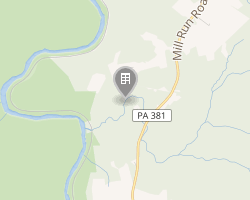 Interactive map showing Fallingwater's location | |
| 39°54′23″N 79°28′04″W / 39.90626°N 79.46783°W / 39.90626; -79.46783 | |
| Location | Stewart Township, Fayette County, Pennsylvania, U.S. |
| Nearest city | Uniontown |
| History | |
| Built | 1936–1937 (main house), 1939 (guest house) |
| Site notes | |
| Architect | Frank Lloyd Wright |
Architectural styles | Modern, organic architecture |
| Governing body | Western Pennsylvania Conservancy |
| Visitors | about 160,000 (in the 2010s) |
| Criteria | Cultural: (ii) |
| Designated | 2019 (43rd session) |
| Part of | The 20th-Century Architecture of Frank Lloyd Wright |
| Reference no. | 1496-005 |
Region | North America |
| Designated | July 23, 19741 |
| Reference no. | 740017811 |
| Designated | May 23, 19762 |
| Designated | May 15, 19943 |
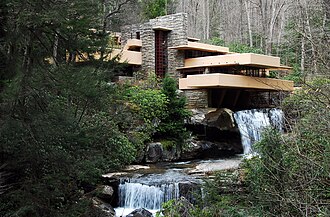
Fallingwater is a house museum in Stewart Township in the Laurel Highlands of southwestern Pennsylvania, United States. Designed by the architect Frank Lloyd Wright, it is built partly over a waterfall on the Bear Run stream. The three-story residence was developed as a weekend retreat for Liliane and Edgar J. Kaufmann Sr., the owner of Kaufmann's Department Store in Pittsburgh. The Western Pennsylvania Conservancy (WPC), which has operated Fallingwater as a tourist attraction since 1963, maintains 5,000 acres (2,000 ha) surrounding the house.
Edgar Kaufmann Sr. had established a summer retreat at Bear Run for his employees by 1916. When employees stopped using the retreat, the Kaufmanns bought the site in July 1933 and hired Wright to design the house in 1934. Several structural issues arose during the house's construction, including cracked concrete and sagging terraces. The Kaufmanns began using the house in 1937 and hired Wright to design a guest wing, which was finished in 1939. Edgar Kaufmann Jr., the Kaufmanns' son, continued to use the house after his parents' deaths. After the WPC took over, it began hosting tours of the house in July 1964 and built a visitor center in 1979. The house was renovated in the late 1990s and early 2000s to remedy severe structural defects, including sagging terraces and poor drainage.
The house includes multiple outdoor terraces, which are cantilevered, extending outward from a chimney without support at the opposite end. Fallingwater is made of locally–quarried stone, reinforced concrete, steel, and plate glass. The first story contains the main entrance, the living room, two outdoor terraces, and the kitchen. There are four bedrooms (including a study) and additional terraces on the upper stories. Wright designed most of the house's built-in furniture. Many pieces of art are placed throughout the house, in addition to objects including textiles and Tiffany glass. Above the main house is a guest wing with a carport and servants' quarters.
Fallingwater has received extensive architectural commentary over the years, and it was one of the world's most discussed modern–style structures by the 1960s. The house has been the subject of books, magazine articles, films, and other media works over the years. Fallingwater is designated as a National Historic Landmark, and it is one of eight buildings in "The 20th-Century Architecture of Frank Lloyd Wright", a World Heritage Site.
Site
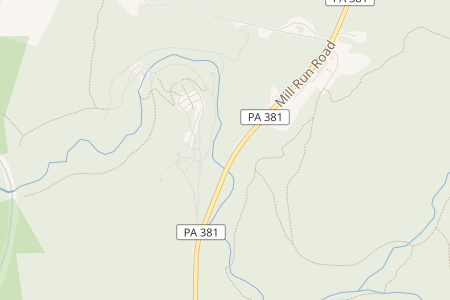
Fallingwater is situated in Stewart Township in the Laurel Highlands of southwestern Pennsylvania, United States,45 about 72 miles (116 km) southeast of Pittsburgh.67 The house is located near Pennsylvania Route 381 (PA 381),89 between the communities of Ohiopyle and Mill Run in Fayette County.49 It is variously cited as being either in Bear Run, the stream that runs below the house, or in Mill Run,410 though the building's deeds give the locale as Stewart Township.11 Nearby are the Bear Run Natural Area to the north, as well as Ohiopyle State Park1213 and Fort Necessity National Battlefield to the south.14 The nearest city is Uniontown, to the west.8 Fallingwater is one of four buildings in southwestern Pennsylvania designed by the architect Frank Lloyd Wright. The others are Kentuck Knob, about a 7-mile (11 km) drive to the southwest,1516a as well as Duncan House1618 and Lindholm House at Polymath Park in Acme, Pennsylvania.19
Geography and structures
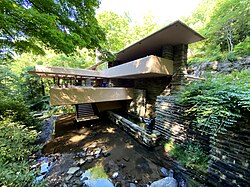
Fallingwater is named for the location of the main house,2021 which is oriented roughly south-southeast.22 It sits above the Bear Run stream, a tributary of the Youghiogheny River, which has an upper falls about 20–30 feet (6.1–9.1 m) high (where the main house is situated) and a lower falls about 7–10 feet (2.1–3.0 m) high.923 At the house, Bear Run is 1,298 feet (396 m) above sea level;2425 contrary to common perceptions, it does not pass through the house.23 The stream sometimes freezes during the winter and dries up during the summer.26 There is a layer of buff and gray sandstone under the site, which is part of the Pottsville Formation.2728 Prior to Fallingwater's construction, several sandstone boulders were scattered across the grounds.28 In contrast to other country estates, Fallingwater is not located on a geographically prominent site and is not easily visible.29 Canopy cover from the surrounding forest hangs above the house.30
Atop a hill to the north of the main house is Fallingwater's guest wing,3132 which is about 90 feet (27 m) away from the main house.33 The guest wing, an "L"-shaped building, is connected to the main house by a curved outdoor walkway (see § Guest wing).32 The house's visitor pavilion, which is not visible from the main house,34 includes five open-air wooden structures with connecting pathways.35 The pavilion includes glass-walled wings with bathrooms, exhibit areas, and a child-care center, in addition to an open-air ticket office.3436 Approximately 0.25 miles (0.40 km) from the main house is the Barn at Fallingwater, which consists of two barns built c. 1870 and in the early 1940s.37
The grounds include a small mausoleum for Edgar and Liliane Kaufmann, which has doors designed by Alberto Giacometti.1238 Edgar Jr. was cremated after his death, and his ashes are spread around the house.38 There are paths throughout the grounds, including a pathway to the waterfall.39 Wright designed a set of gates for the house's driveway, though these were never installed.40 George Longenecker designed a gate that was used at Fallingwater from 1995 to 2005;4041 it weighed 1,700 pounds (770 kg) and measured 5 by 18 feet (1.5 by 5.5 m) across.41 Wright also designed several unbuilt structures for the estate, including a gatehouse, farmhouse, and various expansions.42

Previous site usage
In the 1890s, a freemasonry group from Pittsburgh developed a country club on a plot of land that includes the Fallingwater site. By 1909, this clubhouse had been acquired by another group of masons who turned it into the Syria Country Club.43 The club went bankrupt in 1913.4344 A map from that year shows that the grounds included the clubhouse, the Baltimore and Ohio Railroad's Bear Run station, and 13 other buildings (none of which are extant). One of the structures was a cottage on the site of Fallingwater's guest wing, while the clubhouse was about 1,100 feet (340 m) to the southeast.45
Edgar J. Kaufmann Sr., the president of Kaufmann's Department Store in Pittsburgh,4346 had established a summer retreat at Bear Run for his employees by 1916.4447 Up to one thousand employees used the retreat each summer.48 In 1922, Edgar and his wife Liliane built a simple summer cabin on a nearby cliff, which was nicknamed the "Hangover" and lacked electricity, plumbing, or heating.4749 The Kaufmanns' permanent residence, at the time, was La Tourelle in Fox Chapel.50 Kaufmann's employees eventually bought the Bear Run site in 1926,4748 and the Hangover was expanded in 1931.4749 After Kaufmann's Department Store employees stopped using the summer retreat,5152 the Kaufmann family bought the site in July 1933.53
Development
Edgar and Liliane Kaufmann became familiar with Wright's work through their only child, Edgar Kaufmann Jr..54b The younger Edgar had studied in Europe under the artist Victor Hammer from 1930 to 1933.5657 After returning to the United States, in September 1934, Edgar Jr. traveled to Wright's Wisconsin studio, Taliesin,5859 and began apprenticing under Wright.6061 Edgar Jr.'s parents met with Wright that November while visiting their son.62c The architectural historian Paul Goldberger credits Edgar Jr. as the second-most influential figure in Fallingwater's development, behind Wright himself.63
Planning
Fallingwater was one of three major buildings that Frank Lloyd Wright designed in the 1930s, along with the Johnson Wax Building in Racine, Wisconsin, and Herbert Jacobs's first house in Madison, Wisconsin.65 When Wright was hired as Fallingwater's architect in late 1934, he was 67 years old,1259 and he had designed only two buildings in six years.6667 Wright wanted to select a site "that has features making for character",68 and Edgar Jr. recalled that when Wright visited Bear Run, he had been excited by the landscape he had seen.69 The Kaufmanns wanted Wright to design a building set far back from the road.70 In late December 1934, Wright visited Bear Run and asked for a survey of the area around the waterfall.7071 His team drew up models of the house and site in Arizona,7072 and Wright asked the Kaufmanns to list every tree species on the site.73 A map of the site's boulders, trees, and topography was completed and forwarded to Wright on March 9, 1935.70
The Kaufmanns asked Wright to include a large living–dining space, at least three bedrooms, a dressing room, and a guest and servant wing.70 Edgar Sr. wanted to pay between $20,000 and $30,000 for construction.7475 Wright's apprentices Edgar Tafel and Robert Mosher were the most heavily involved in the building's design, while his employees Mendel Glickman and William Wesley Peters were the structural engineers.76 Wright postponed his sketches for Kaufmann's country home while designing another project for Kaufmann.7477 Concurrently, Wright continued to formulate plans for the house's orientation, materials, and general shape and size.78 Edgar Sr. called Wright on September 22, 1935, to inform the architect that he would visit Taliesin.7980 Wright's apprentices disagree on what exactly happened next, but the sketches were complete when Edgar Sr. arrived two hours later.7981 Contrary to common claims that Wright had ignored the design for nine months before hurriedly sketching it, he had already devised the plans mentally747582 and had written about them to Edgar Sr. multiple times.8384
Wright's plan called for a structure with exposed cantilevers.8586 The house was to be placed on Bear Run's northern bank, oriented 30 degrees counterclockwise from due south, so that every room would receive natural light.8587 It also included terraces that resembled rock ledges.85 Edgar Sr. had expected that the house would be downstream from Bear Run's waterfalls, allowing the Kaufmann family to see the cascades.8889 This meant that the house would have faced north, with suboptimal amounts of natural light,89 so Wright instead designed the home above the waterfall.9091 As he explained to Edgar Sr.: "I want you to live with the waterfall, not to look at it."7992 Wright sent preliminary plans to Edgar Sr. for approval on October 15, 1935, after which Wright visited the site again.9394 The Kaufmanns were impressed with the design, which Wright continued to work on.95
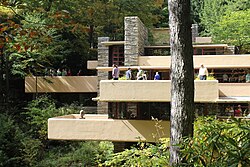
By January 1936, Wright's team had completed detailed drawings,9695 which were largely unchanged from the initial sketches.969798 The next month, Wright's team sent the plans to Edgar Sr. for review, and workers began building a sample wall.96 Edgar Sr. asked engineers in Pittsburgh to review the blueprints for the highly experimental design.999396 The engineers recommended against constructing a building on the site,100101 citing at least eight structural issues.102101 Either Wright or Edgar Sr. reportedly ordered the report to be sealed inside the building,93100103 though Edgar Sr. is known to have kept a copy of the report.104 By early 1937, Wright's team was on its eighth set of drawings.105 In the final plans, Wright added a third floor and rearranged some rooms.106
Construction
Edgar Sr. wrote that he constantly thought about the house, "which has become part of me and a part of my life".39107 Wright visited every four to six weeks,108 appointing Mosher as his on-site representative.93109 Wright hired Walter J. Hall, a contractor from northern Pennsylvania.110111112 Hall's former employee Earl Friar was hired as a reinforced-concrete consultant.112 Edgar Jr. was heavily involved with the project and acted as an intermediary between his father and Wright,113 and several Kaufmann's employees and extended family members also worked on site.114 Work was carried out by local laborers,109115116 many of whom were inexperienced;114117 they were paid between 35 and 85 cents an hour depending on their skill level.102118d The project was characterized by conflicts between Wright, Kaufmann, and the contractors,11193 as Wright prioritized the house's esthetics over any structural concerns.119 Due to Hall's careless attitude and clumsiness, Mosher ended up supervising most of the work.109
Concrete and masonry work
A disused rock quarry nearby was reopened in late 1935 to provide stone for the house,9394107 although actual work on the foundation did not begin until April 1936.114 By then, construction was behind schedule.110 The masonry contractor, Norbert James Zeller, began building the house's access bridge shortly thereafter; he was later fired following disputes with Wright and Kaufmann.120121 During a visit to the site shortly afterward, Mosher inquired where the main level of the house would be located, and Wright directed Mosher to use one of the boulders on site as a datum reference.108122123 By June 1936, workers had completed the access bridge and the footers for three of the house's "bolsters", or piers.124125 However, Mosher ordered that the bolsters be rebuilt after receiving revised plans from Taliesin.125 Despite delays in delivering wood from Algoma, Wisconsin, workers had excavated the basement by that July.109
Workers began pouring concrete formwork for the first-floor terrace in August 1936,109126 and masonry work reached the second story that month.127 As the first-floor terrace was being poured, Kaufmann asked the engineering firm Metzger-Richardson to draw up plans for extra rebar to the concrete.93128129 Wright rejected these plans because he believed the extra steel would overload the terraces,130131 and he also dismissed the idea of constructing additional supports in Bear Run's streambed.131132 Contractors secretly added the rebar anyway,130129 and when Wright heard about the increased rebar, he told Mosher to return to Taliesin.127133134 Wright wrote angrily to Kaufmann: "I have put so much more into this house than you or any other client has a right to expect, that if I don't have your confidence—to hell with the whole thing".130134135 Despite Kaufmann's expressions of confidence in Wright's work, the extra steel remained in place.119130 The second-floor terrace was poured in October 1936,136 and Tafel replaced Mosher as the construction supervisor afterward.67137
The contractors neglected to incline the formwork slightly to account for settling and deflection.133138139 Soon after the concrete was poured, the parapet cracked at two locations.140132 Wright attempted to reassure Edgar Sr. by saying that cracked concrete was normal and safe, but Edgar Sr. remained skeptical.136141 Once the formwork was removed, the first-floor terrace sank about 1.75 inches (4.4 cm).130 Glickman, contacted by Mosher, reportedly confessed that he had forgotten to account for the compressive forces of the concrete beams,141130 though the historian Franklin Toker disputes that this happened.128 Wright attributed the sagging to the parapets' weight,142 and he drew up plans to reinforce the western second-floor terrace and the roof above the eastern second-floor bedroom.143 Meanwhile, structural issues continued to arise: By December 1936, five major cracks had been detected.142144 Mosher was reinstated as the project's supervisor, and Kaufmann's engineer installed a stone wall under the western second-floor terrace in January 1937.145 When Wright discovered the wall, he had Mosher remove the top course of stones;143146 the wall was later disassembled entirely.147
Completion
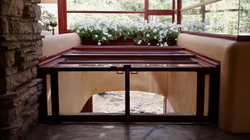
By early 1937, the installation of interior finishes had begun.149 Hope's Windows Inc. of Jamestown, New York, manufactured the window sashes and the hatch for the living-room stairs,148150 while Pittsburgh Plate Glass made the windows themselves.150 Wright also suggested covering the exteriors with gold leaf;118151152 it is unclear whether Wright had made his suggestion jokingly or seriously.153 In either case, Edgar Sr. hired a gold-leaf contractor, who rejected the idea,39153 and Wright subsequently suggested finishing the facade in white mica.154 Wright reportedly decided on the final color, a shade of ocher, after picking up a dried rhododendron leaf;155 he ordered waterproof paint from DuPont.150154 At Kaufmann's request, Wright added a plunge pool at the bottom of the living-room stairs, and he retained the large boulder on the living room's floor.156
Through mid-1937, workers continued to lay floor tiles, and they conducted tests on the terraces.156157 In addition, the contractors refined plans for details such as the paint colors and metalwork.158 The cork tiles in the bathrooms were particularly problematic, since they had to be installed on curved surfaces.159 Wright hired the Wisconsin–based Gillen Woodworking Corporation to produce furniture for the house.160161162 The Kaufmanns moved into the house in November 1937,147 but the main house's furnishings were not completed until 1938.163 Wright came up with the Fallingwater name around the same time;9221 previously, the house had been known as the E. J. Kaufmann Residence or E. J. Kaufmann House.164 Even though some other American country estates (such as Biltmore, Monticello, or Mount Vernon) also used nicknames, the Kaufmanns did not use the Fallingwater name.165
Wright began drawing out plans for a guest wing, replacing an existing cottage on a hill behind the main house.166 Wright had completed blueprints for the guest wing by May 1938, but the Kaufmanns initially objected to the interior layout and the bridge between the main and guest wings. After Wright presented final plans for the guest wing in April 1939, Edgar Jr. modified the main house's decorations and furnishings. By that September, the guest wing was being finished.167 Fallingwater exceeded its budget significantly.168 The final cost for the home and guest house was $155,000 (equivalent to about $2.7 million in 2024).117169170 The total cost was nearly four times Kaufmann's original budget, which in turn was ten times the average cost of a four-bedroom house in Pennsylvania at the time.9 From 1938 through 1941, more than $22,000 was spent on additional details and modifications.118
Use as house
Early years
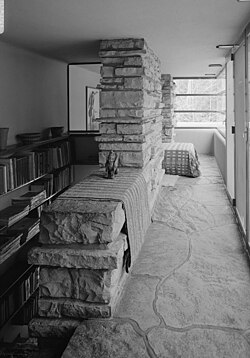
The Kaufmann family used Fallingwater as a weekend home for 26 years.51 The family took the train to the Bear Run station, where a chauffeur drove them to the house.51 Herbert Ohler was the property's caretaker until 1939, when he was replaced by Jesse Hall.171172 Relatively few changes occurred after the guest wing was completed.173 The Kaufmanns sometimes invited small numbers of people to Fallingwater.174 It hosted guests such as the artists Peter Blume,175 Pablo Picasso, and Diego Rivera,116 as well as the scientist Albert Einstein.38 Over the years, the family also added artwork.176 Part of the Kaufmanns' Bear Run estate caught fire in 1941, although the house itself was undamaged.177 The estate's dairy barn burned down in 1945, but the main house again avoided damage.178
Fallingwater showed signs of deterioration after its completion.6 The house originally leaked in 50 places,12 though later investigations found that the leaks had arisen from errors made by the builders.69142e The worsening condition of Fallingwater's terraces prompted Edgar Sr. to hire a surveyor in 1941.179180 Contravening his own surveyor's advice, Edgar Sr. did not expand the wall under the western terrace.181 The terraces were surveyed 16 more times between 1945 and 1955.182 Despite subsequent repairs to the parapet, the cracks there periodically reappeared.138 Fallingwater's problems were so numerous that Edgar Sr. referred to it as "Rising Mildew".5
After World War II
After World War II, the family spent winters at the Kaufmann Desert House in Palm Springs, California.173183 Wright expanded the kitchen in 1946,184185 and he drew up plans for never-built expansions of the dining area and foyer.174 Elsie Henderson was hired as the house's chef in 1947, working there for the next sixteen years.186 In 1950, and again in 1953, workers installed posts under the second floor to prevent it from sagging.187 Edgar Sr. observed that some windows had begun to crack and that some of the doors no longer opened easily.187 Furthermore, Edgar Sr. and Liliane's marriage had become strained, and Liliane wanted to build a house nearby in Ohiopyle.188 In the long run, the family wanted to donate Fallingwater.189188
Liliane died in 1952, and her husband died three years later.190191 Edgar Jr. continued to use the house after his parents died.189170 He discontinued Fallingwater's annual structural surveys181192 and instead had his chief of maintenance monitor the terraces.193 Edgar Jr. abandoned the estate's farm and mill, planting 100,000 pine trees there,171 and he strengthened the living-room hatch.194 The eastern section of the house's roof was rebuilt in 1954.184187 The living room was flooded during a storm two years later; while the furniture was severely damaged, the house experienced no structural damage.69194 By then, the sagging terraces had caused the window frames to warp, and workers had to add supports to the terraces, repair the roof, and rebuild the staircase between the living room and Bear Run.189 Jesse Hall retired as Fallingwater's superintendent in 1959.171172
Use as museum
1960s and 1970s
Edgar Kaufmann Jr. announced in September 1963 that he would donate the house and about 1,500 acres (610 ha) to the Western Pennsylvania Conservancy (WPC).195196 In exchange, the WPC agreed to open the house to the public as a house museum.196 At the time, many of Wright's houses were being demolished or altered significantly.195 The conservancy took over the house on October 29, 1963,197 with a speech by Pennsylvania governor William Scranton.198199 Edgar Jr. gave the WPC $500,000 for the house's maintenance, as well as five annual payments of $30,000 for educational programs.195198 One local newspaper wrote: "We are indeed fortunate, here in Fayette County, to have such beauty."200 The museum was dedicated in memory of Edgar and Liliane Kaufmann.194201 In subsequent years, the WPC's holdings were expanded to 5,000 acres (2,000 ha), becoming the Bear Run Natural Area.190
In accordance with Edgar Jr.'s request, the WPC attempted to recreate the house's original appearance, furnishing the rooms with the family's possessions.12117 Edgar Jr. moved some of the house's artwork to his homes in New York, acquiring other work for the museum.202 Guided tours began in July 1964,203 running from April to November of each year.204205 Visitors were allowed to enter most of the rooms206207 but had to reserve tickets in advance.208209 Edgar Jr. remained involved with the WPC and Fallingwater for the rest of his life,63210 visiting the house twice annually until his death in 1989.211 The house began hosting scholars-in-residence during 1967,212 and Edward A. Robinson was appointed as the museum's supervisor in 1970.213 WPC members received free admission twice annually starting in 1973.214
The facade was repainted in mid-1972,215 and the WPC added a gift shop to the museum next year.205216 The WPC began planning a visitor center in the early 1970s,217 and it hired the landscape architect William G. Swain to design renovations to the property.216 The conservancy constructed new paths, repaved the existing trails with dark gravel, and added a small crafts store.216 Fallingwater was repainted repeatedly over the years,194 and the WPC undertook a major exterior renovation in 1976.218219 Mildew and repeated freeze-and-thaw cycles had caused damage over time.219197 Afterward, the WPC began repairing the facade every three to four years.220 The visitor pavilion was still being developed by 1977;31221 the new structure was to contain a shop, reception center, and child-care center.222 The original pavilion, designed by Grant Curry Jr.,223 opened in April 1979 and burned down two days later.224
1980s and early 1990s
The WPC rebuilt the visitor pavilion,35 obtaining an $800,000 grant from the Edgar J. Kaufmann Foundation.34 The conservancy hired the architect Paul Mayén, along with Curry, Martin & Highberger to redesign the pavilion.36 The pavilion partially reopened in July 198034225 and was rededicated in June 1981.3436 In addition, the trellises at the front entrance were replaced in 1982 following a storm.226 The WPC began hosting limited wintertime tours in January 1984.227228 By then, the museum's annual expenses amounted to $400,000; despite high visitation, the WPC was breaking even.228 Lynda Waggoner was appointed as the house's curator the next year,229 later being promoted to director.210 A restaurant also opened at the visitor center in 1985.220 During the late 1980s, the WPC spent at least $500,000 on repairs.230 The organization restored 182 pieces of furniture for the house's 50th anniversary,231 and it hired a contractor from Wilkinsburg, Pennsylvania, to add waterproofing.232 The woodwork and terraces were also repaired, and the windows were replaced.230
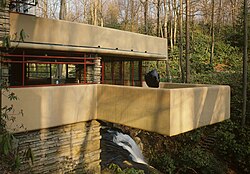
By the late 1980s, acid rain and freeze-and-thaw cycles had caused deterioration.233234 The house was vulnerable to water damage because the site was always humid.235236 Even though most of the leaks had been repaired, rain and snow still pooled on the terraces and roof,237235 and water came in through the walls.230 In addition, the ends of the terraces had sagged by 7 inches (180 mm),7238 tilting almost two degrees.180 In 1992, the WPC hired John Seekircher to fix the living room's glass hatch, which had not been opened in two decades.239 Waggoner also planned to repaint the house, which was complicated by strict environmental regulations regarding Bear Run.237
1990s and 2000s renovations
An engineering student, John Paul Huguley, first identified issues with the terraces in the mid-1990s.92135 The WPC hired the engineer Robert Silman to assess the terraces and design a permanent fix.180240241 Silman's company confirmed that the terraces' cracks were growing.130242 Though Silman's computer models also indicated that the terraces were at risk of collapsing,243244 the WPC's chief executive, Larry Schweiger, said the terraces were not in danger of collapse.241 Waggoner recalled that the terraces were so brittle that visitors could actually feel them bounce.245 Workers installed temporary girders in 1997180240 at a cost of $140,000.246 The girders were intended to help relieve stresses on the cantilevers.247 The WPC cut out a section of the floor,180248 adding a glass opening;249 the living room's sofa was removed as well.192250 Temporary footings were installed in the streambed,246 and the stream was diverted to allow crews to access the terraces,250 In addition, two terraces were closed temporarily.138
The engineering firm Wank Adams Slavin Associates was hired to design a large-scale restoration.251 Silman devised plans to post-tension the slabs by pulling high-strength steel cables through the beams.248252 The idea of jacking up the house was deemed infeasible because it would have exacerbated the cracks.247 A panel of engineers and architects endorsed Silman's proposal in early 1999,251252 and the WPC began raising $6 million for structural repairs that year.138180247 The WPC also discussed the structural issues with engineers, historians, and architects from around the world, including Wright's grandson Eric.135 The work was postponed by two years while the WPC raised money.7249 The Getty Foundation provided the WPC with a $70,000 grant to investigate the structural issues,138 and Fallingwater received approximately $900,000 through the federal Save America's Treasures program.115253 Additionally, Pennsylvania governor Tom Ridge provided $3.5 million,254255 and private donors provided another $7.2 million.256
Work began in late 2001, at which point the restoration was estimated to cost $11.5 million.7249257 The outer end of the first-floor terrace was raised by approximately 0.5 inches (13 mm).258259 The post-tensioning phase cost about $4 million7260 and was completed in six months.92 Though the terraces still had a noticeable sag,261 the post-tensioning prevented further damage to the terraces.129234 The WPC also planned to strengthen one of the terraces using carbon fiber, rebuild the staircase from the living room to Bear Run, and repair water damage.255242 Pamela Jerome of Wank Adams Slavin drew up plans to install roof membranes to improve drainage.262252 Due to acid rain and emissions from a coal-fired power station nearby, the exterior also had to be repainted.263 Workers relocated some outbuildings and replaced the visitor center's sewage system.7249 Signage, paths, and landscape features were rehabilitated as well.249264 The house was connected to a municipal water system for the first time.264 Visitation increased after the renovations,263 which were largely completed in 2003.258263 Fallingwater received $100,000 for landscaping in late 2003;265 the next year, the entrance roadways were reconfigured,40 and the sewage system was finished.266
Mid-2000s to present
After the renovation was completed in 2005,267 the WPC began removing invasive species from the Fallingwater grounds that year.268269 Additionally, the WPC replaced 319 windows at the house after PPG Industries donated glass panes in 2010.270 The WPC hired a firm from Peekskill, New York, to help restore the windows.271 In the mid-2010s, one of Fallingwater's volunteer landscapers created a pottery terrace in one of the house's planters.272 One of the statues on the grounds was toppled and damaged during a rainstorm in 2017, and some trees were damaged as well.273 Waggoner announced in 2017 that she would retire as the museum's director,274 and Justin W. Gunther was appointed to replace her.275276 After becoming Fallingwater's director, Gunther devised plans for a $3 million waterproofing project, which was supposed to have begun in 2019.276277
The museum was temporarily closed in March 2020 due to the COVID-19 pandemic in Pennsylvania; the outdoor spaces reopened for self-guided tours that June.278279 The same September, the Pennsylvania government gave Fallingwater nearly $240,000 to offset financial losses from the pandemic.279 In addition, a photovoltaic power array was installed at Fallingwater in 2022 to help power the main house and guest wing.280281 Meanwhile, the cost of the waterproofing project doubled due to the pandemic.276277 Much of the waterproofing installed in the 1990s had been washed away,276 and water entered the house through small cracks in the walls, door frames, and window frames.282 The WPC started patching the leaks in 2025, and scaffolding was placed around the house, which remained open for tours during the repairs.282283 The project was complete by March 2026, when the scaffolding was removed.284
Architecture
Fallingwater has been described as an example of Wright's organic architecture.285286 Though the house is also sometimes described as a Modern-styled building, The Wall Street Journal wrote that the design was "a kind of streamlined, handmade, organic architecture" not emulated by other architects.285 The site's natural setting may have been inspired by Japanese architecture, a style Wright liked.287288 Fallingwater's design shares elements with Wright's earlier Prairie houses289290f and his later Usonian houses.291 Elements such as trellises are derived from Italian architecture, while the kitchen is inspired by New England colonial architecture.290 Wright's design for the facade also shares similarities with an unbuilt villa designed by Mies van der Rohe,292 and the cantilevers resemble those in three structures designed by Rudolph Schindler.293 Wright tried to preserve natural features; for example, he installed braces and trellises around existing trees.51220294
The main house is three stories high.24295 Wright sought to blur the distinction between the exterior and interior, using the same materials indoors and outdoors.296297 He also wanted breezes to be felt, and the waterfalls to be heard, throughout the house.286 Wright built Fallingwater out of Pottsville sandstone,298153 in addition to reinforced concrete, steel, and plate glass.1264 The concrete is a mixture of sand, cement, and gravel from the streambed.299 All the woodwork in the house is made of black walnut from North Carolina,153300 which was selected because it did not warp as other types of wood did.31 Decorative motifs, such as courses of stone and wood grains, are oriented horizontally.294301 Several of the design features—including the corner windows, foam-rubber seats, and indirect lighting—were uncommon when Fallingwater was completed.116302
Exterior
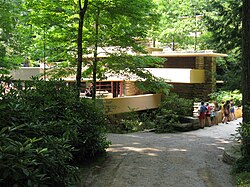
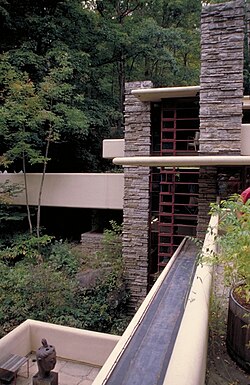
The facade uses three colors: gray for the sandstone, a light-ocher "dead rhododendron" color for the concrete, and Cherokee red for the steel.39303g Red was used because Wright believed that the hue was an "invincible" color of life83304h and because it was the color of burning metal.158305 The house's windows have metal casings,306 which are painted Cherokee red.1264 The windows are embedded directly into the facade, with no visible vertical mullions; they only contain horizontal transom bars.218294 Some of the house's corners have windows that open inward.306307
The roof has rolled edges308 and is covered with beige gravel, blending in with the color of the facade.152148 The northern elevation of the house's facade contains masonry walls with setbacks, which were intended to replicate the textures of the cliff opposite it.309 The house's chimney is covered in striated sandstone291 and rises 30 feet (9.1 m) above the first story.122294
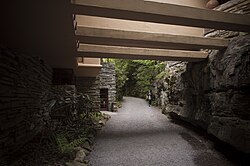
The house is accessed by a 28-foot-long (8.5 m) bridge across Bear Run.122 At either end of the bridge are planters made of rough stone.151 There is a rectangular concrete panel at the middle of the bridge deck, with square, inlaid lights.310 Heading north from the bridge, the pathway curves to the west.311 The entrance is reached via a driveway with horizontal trellises overhead, which doubles as a porte-cochère.309311 The main doorway is recessed from the facade.12206 There is a small fountain next to the entrance,12312 where the Kaufmanns could wash their feet after going into Bear Run.313
Terraces
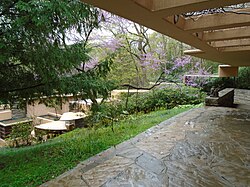
Fallingwater has many cantilevered terraces,295238 which are made of concrete.24189 The terraces are supported only at one end, extending outward from the house's chimney.12189 All the terraces have parapets with rounded tips, which are covered with stucco152 and were intended to strengthen the terraces.31314 The parapets are 26 inches (660 mm) high, much shorter than what is allowed under modern building codes.276 At the time of the house's construction, neither cantilevers nor reinforced concrete were commonplace.308 Wright likened the terraces to tree branches189 and, as one Associated Press writer described it, "a tray balancing on the fingers of a waiter".108 The terraces have also been compared to horizontal trays315 and to a treehouse.316 The horizontal axes of the terraces also contrasts with the vertical axis of the darker-gray chimney.29
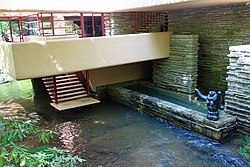
The primary section of the main house, which includes the living room, runs perpendicular to the stream22 and is carried on an enclosed terrace.92 The underside of the terrace is made of a reinforced-concrete slab76242 and is supported at one end by four "bolsters" or piers.7678131 There is a grid of cantilevered beams and joists above the slab, which is similar in shape to an inverted coffered ceiling.242317 Above the grid are wooden planks, which are covered by the living room's stone floor tiles.76 Additional outdoor terraces run to the east and west of the living room;24130 the western terrace protrudes past the kitchen's western wall.318
Each of the bedrooms has its own outdoor terrace.69302 On the second floor's southern side is another terrace,92 which extends further outward than the living room below it.130131319 The terrace was missing rebar at key points,319 so it instead rested partially on four vertical mullions along the southern wall of the living room.7130242 On the eastern end of the second floor are eight trellis beams and a glass canopy above the living room.320 On the western side of the house, there is another terrace above the second floor,320 with stairs to Edgar Sr.'s second-floor bedroom and Edgar Jr.'s third-floor study.321322 The second floor's eastern terrace, serving the guest bedroom, is the only one in the house with a canopy.323
Interior
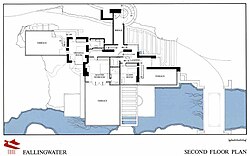
Fallingwater's asymmetrical floor plan was loosely derived from the cruciform plan of the Prairie houses.99 It has a floor area of 5,330 square feet (495 m2),1692 of which 2,445 square feet (227.1 m2) is composed of outdoor terraces.7892303 The remaining 2,885 square feet (268.0 m2) is indoors.78303 Including the guest wing and terraces, there is about 8,000 square feet (740 m2) of space.298 The walls, chimney, and piers are made of sandstone from the surrounding area.24 The house's superstructure does not use any steel I-beams,86 but it does use folded slabs of reinforced concrete for structural support.64 Steel was used for the windows and doors. The floors have black-walnut millwork as well as sandstone finishes.24 The terraces' subfloors are made of redwood timbers.148317
The house has four bedrooms.116119323i Fallingwater has smaller spaces leading to larger rooms, an example of Wright's compression-and-release principle;291325 one source described the interiors as "spaces of varying sizes and shapes that seem to flow from one to the other".98 The hallways have low ceilings to prevent loitering88 and to create a cave-like atmosphere.5164 There are windows at the ends of the hallways.326 Wright also shrank the bedrooms to encourage occupants to use the terrace.88327 Wright, who was 5 ft 8 in (1.73 m) tall, designed the house based on the assumption that the average person was his height, so some ceilings are as low as 6 feet 4 inches (1.93 m).68168328 The highest ceilings are 9 feet (2.7 m).168 The three rooms in the chimney—the first-floor kitchen and two bedrooms above—are the only rooms in the house with identical dimensions.329 Although the first story is wheelchair-accessible, the other stories are not,115206 and there is no space for an elevator in the house.330
Interior decorations, including lights with dentils and shields, were intended to contrast with the exterior design.161 Some interior design elements (such as furniture, shelves, and the beam on which the kitchen kettle is hung) are cantilevered,206298 while others (including niches and stairs) incorporate circular arcs.302327 The spaces are illuminated by indirect lighting, a novelty for residential buildings at the time of Fallingwater's completion.6869119 The illumination is primarily composed of fluorescent lights covered by shields, though there are also desktop and tabletop lamps,69315 which are made of bronze with wooden shields.331 Wright placed the house's toilets about 10.5 inches (270 mm) above the floor,7 as he believed that a squatting position was healthier than sitting atop a standard American toilet.912 In addition, he clad the bathrooms with cork tiles,51315332 and he ordered industrial-sized shower heads to make visitors feel like they were under a waterfall.988
First story
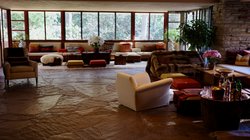
The ground or first story contains the main entrance, the living area (which is cantilevered above the waterfall), and the kitchen.24295 The first story has a waxed stone floor, an allusion to the stream flowing below it.6420630 The bolsters divide the house into four bays from west to east,333 each of which measures 12 feet (3.7 m) wide.318 The main entrance, within the easternmost bay,333 leads to a small foyer with stone walls.334 There is a niche for storing coats and scarves.313 Three steps ascend from the foyer to the living room.311334
The living area occupies the center two bays.333j The room also functions as a study and dining area64 and, as such, has been described as a great room.99336 A niche on one wall was intended as a music area.305 On the western wall,335 another 6-foot-tall (1.8 m) niche includes a fireplace,337 whose hearth is made of boulders from the site.88295 In the niche is a cast iron kettle suspended from a swinging arm.158337338 In front of the fireplace, a 7-foot-long (2.1 m) boulder protrudes from the floor.189 Wright had wanted to shave the top of the boulder, but Edgar Sr. insisted that it be kept.89108307 A dining area, on the living room's northern wall,326300338 adjoins a stone staircase to the upper stories.338339 The eastern wall has a small library. Two stone piers, in the middle of the room, support a coved ceiling.335
There are windows on three sides of the living room,5164 as well as doors to the western and eastern terraces.24 From the eastern terrace, a stairway ascends to the second floor.340 The living area also has a glass-enclosed hatch,648889 which covers a concrete stairway descending into Bear Run.29532 Despite Edgar Sr.'s doubts about the hatch, Wright and Edgar Jr. had insisted that the stair was "absolutely necessary from every standpoint".113139 The stairs are mostly underneath a canopy,320341 except the lowest steps, which are beneath a semicircular lightwell.341 The stairs end at a landing just above the stream.32 There is a shallow plunge pool at the bottom of the stairway,k which is fed by a reservoir.124342 The Kaufmanns kept the hatch open during the summer.69
A doorway connects the living area with the kitchen,337338 which occupies the house's westernmost bay.333 Unlike the other rooms in the house, the kitchen is a utilitarian space;302343 one writer described it as having a cave-like atmosphere.338 An annex adjoins the kitchen to the west.174 When the Kaufmanns lived there, Liliane seldom used the kitchen.337335
Other stories
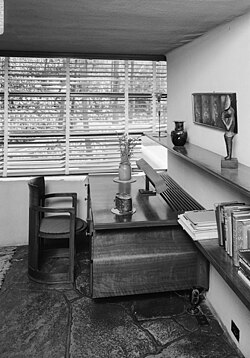
From the main staircase's second-story landing, steps lead up and down to the various rooms and terraces.327 The second floor contains two bedrooms.24 There is a master bedroom above the middle of the living room.24333 The master bedroom has custom movable shelves and bedside lighting,64 glass doors to the master-bedroom terrace,321 and an ornate fireplace mantel with three large rocks.332344 There is a dressing room above the kitchen,24333321 as well as a second bedroom (originally used by guests) above the eastern portion of the living room.2439 These rooms have simpler fireplaces.332 The bedroom ceilings decrease in height from wall to wall.140294 A gallery connects with a footbridge over the house's driveway, which leads to the guest wing24345 and is covered by a terrace.176 There is a moss garden and part of a cliff face next to the footbridge.346
The third story's concrete floor slab is folded for additional strength.140 There is a bedroom directly above the second-story dressing room,24333321 which Edgar Jr. used as a study.324 The study's fireplace mantel is made of red stone from the site.332347 Liliane used the third-story terrace as a roof garden with herbs.64 On the third floor is a dead-end gallery, which was originally intended to connect with the footbridge over the driveway,173348 but instead functioned as a bedroom for Edgar Jr.348 A set of stairs descends to the western second-story terrace.24345
The house also has a cellar with space for a partial bathroom, storage, and a boiler room,69109 in addition to a wine cellar.78 There are exposed pipes and boilers in the cellar,69220 and heat pipes are embedded in the walls.220
Guest wing

The footbridge from the main house connects to a curved breezeway or open-air walkway,68327184 which in turn connects with a guest and servant wing.32349 The walkway runs underneath a stepped concrete canopy,345350351 supported by steel posts along one side.176351 The path curves around the site of a large oak tree that was removed in 2001.268 The walkway includes a small rock pool with a sculpture and a boulder that has water cascading down it.8864 The cascade was not part of the original plans but was added after workers discovered a hidden spring near the boulder.64
The guest wing's ceilings are typically 7 feet 4 inches (2.24 m) tall,328 and it has a lounge, bedroom, and bathroom.39184352 The lounge has a stone fireplace mantel,33 a hidden wardrobe, clerestory windows and shelves on one wall,353 and a bench that doubles as a bed.33354 The adjoining guest room is adjacent to an outdoor swimming pool.355 The guest pool, measuring 31 feet (9.4 m) long33 and 6 feet (1.8 m) deep, is fed by water from a spring.64356 The guest wing's bathroom has a mirror designed by Edgar Jr.355
Adjacent to the guest house is a carport with four parking spots, which is accessed from the house's driveway32167 and has a tall concrete wall.357 The carport and guest wing are connected by a chimney and recessed stair.167358 There are three bedrooms and a bathroom above the carport, which are used by staff.167184349 These rooms contain the same finishes as the main house.184357 Extending southeast of the guest wing is a terrace with a cantilevered canopy.33 A garage on the upper story was designed in 1947 but not built.174349
Collection
Fallingwater's collection includes over 1,000 objects.359 Until the 2000s renovation, the house had no air conditioning or curtains. This, along with high humidity and high levels of ultraviolet light, has made the collection particularly vulnerable to damage.229
Furnishings and furniture
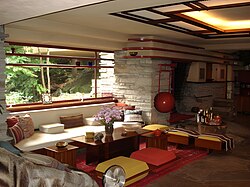
Half of the house's furniture is built-in, while the other half is movable.162 Wright, who believed that his clients should not arbitrarily swap out decoration,316162 designed most of Fallingwater's built-in furniture.24306 There are nearly 200 pieces of furniture,73l including wooden wardrobes, chairs, cabinets, tables, and backboards.360 Many objects have walnut finishes to prevent moisture buildups, and many of the walls have wooden shelves and trim.12360 Among the original furnishings are sheepskin rugs, a sheepskin couch,295 foam-rubber seats,361315 and cantilevered tables.12 Edgar Jr. helped Wright design sliding shelves for some of the cabinets.362 The WPC owns the trademarks to the pieces of furniture that Wright designed.363
The living room's expandable dining table, which could seat about 18 people,300 conceals a pier underneath.99 Each bedroom's headboard is located on the room's eastern wall so the Kaufmanns would not wake up with sun in their eyes.218 Some of the furniture, including a desk in Edgar Sr.'s study,206364 has rounded cutouts to accommodate the corner windows, which swing inward.360365 The house also has wooden radiator cases,64 and the kitchen has metal cabinets and a stove.160343 The Kaufmanns bought other objects for the house, including Tiffany lamps.64306 The family also acquired objects through trips to Mexico and through Edgar Jr.'s connections with New York's Museum of Modern Art (MoMA).366 Most of the Kaufmanns' furnishings remain in place,12117288 though some objects, such as rugs and pillowcases, have been replaced over the years.367
The Kaufmanns occasionally rejected some of Wright's suggested decorations and furnishings.368 For instance, Edgar Sr. refused Wright's designs for custom rugs, floor lamps, and chairs.368369 The Kaufmanns, unhappy with Wright's original barrel-shaped seats, bought three-legged stools, which provided more stability on the irregular stone floors.306369 For the most part, the windows did not have drapes or shades,68 since Wright wanted the windows to be unobstructed.88 Liliane ordered privacy blinds for the guest bedroom's windows,88370 and shelves were installed across the living room's windows.98371 In another case, a local newspaper described a rumor that the Kaufmans hid a set of tables whenever Wright came over, because he disliked them.218
Art
When Fallingwater was finished, Wright gifted the Kaufmanns six Japanese woodblock prints by Hiroshige and Hokusai.359372 The rest of Fallingwater's art was selected by the Kaufmanns, who liked collecting art from a variety of cultures.55 The multicolored artwork in the house contrasts with the ocher, gray, and red tones of the exterior.161 The main house contains artwork from countries such as Japan, Morocco, and Mexico,359 as well as religious artworks.55 During visits to the house, Wright sometimes recommended artwork for the Kaufmanns to acquire.372
The art collection includes pieces such as Diego Rivera's El Sueño and Pablo Picasso's The Smoker and The Artist and his Model.359 The mural Madonna and Child, painted in the 18th century by an unknown artist, is placed at the second-floor staircase landing.55 Liliane's bedroom features a niche with a wooden sculpture of Madonna and Child, which was carved c. 1420,55373 while Edgar Sr.'s room includes two busts by Richmond Barthé.359373 Edgar Jr.'s study includes a marble sculpture by Jean Arp and an abstract landscape by Lyonel Feininger.373 A portrait of Edgar Sr. by Victor Hammer hangs next to the dining area.339359373 The bottom of the house's plunge pool contains Jacques Lipchitz's sculpture Mother and Child.273374 One of the house's original artworks, The Horseman by Marino Marini, was destroyed in a 1956 flood.202
The outbuildings and grounds have other pieces of art. The guesthouse includes woodblock prints and an 1877 landscape painting by José María Velasco Gómez, while the guest wing's pool has an abstract sculpture by Peter Voulkos.373 The grounds also contain three sculptures by Mardonio Magaña,359 and there are also items such as a Hindu god's head and a Buddha statue.2655 Other artworks included a silk screen by Marcel Duchamp.218 After the WPC took over Fallingwater, the collection was expanded with murals and sculptures by Picasso, Lyonel Feininger, Luisa Rota, and Bryan Hunt.202 Edgar Jr. also donated some of his own books to the museum.375
Management
Tours and programs
The Western Pennsylvania Conservancy maintains Fallingwater, as well as the 5,000-acre (2,000 ha) Bear Run Natural Area surrounding it.115298 The WPC's logo for the house, as of 2026, is inspired by a typeface devised by Edgar Kaufmann Jr.376 The WPC hosts tours of the house,5188 which typically run between March and November of each year.377378 In addition, during December, there are tours on weekends and during the last week of the year.377
There are several types of tours, which cover different parts of the house.291 Standard tours cover only part of the house and do not allow photography;51350 extended tours, which do allow photographs, cover the entire house.51 There are also pre-recorded tours for non-English speakers.287 Prior to the COVID-19 pandemic, guided tour groups were sent through the house every six minutes, and different tour groups often ran into each other. After the pandemic, tour groups were sent every ten minutes, allowing them to see the rooms without being interrupted by another group.379 Every year in late August, the WPC hosts a "twilight tour" in which visitors can go on self-guided tours before attending a picnic and concert at sunset.380
The conservancy operates the visitor pavilion.88381 Young children, who cannot tour the house, stay at the visitor pavilion's child-care center.13206381 Starting in the 1990s, the WPC sold furnishings based on the designs of Fallingwater's furniture;382 these include chairs, coffee tables, and desks.365383 Additionally, in the 2000s, the WPC sold jewelry with pieces of concrete that were removed from Fallingwater during its restoration.384 During the Christmas and holiday season, the Fallingwater Museum Store operates a temporary outpost in Downtown Pittsburgh.385 The WPC operates several educational programs for students and teachers as well.378 Starting in 2010, the WPC hosted sleepover events for adults at nearby Mill Run, which included private tours of Fallingwater.386
Attendance
In its first two years as a museum, Fallingwater had 117,000 visitors from 66 countries and nearly every U.S. state.387 Initially, the busiest months for the house were September and October,388 in part because people came to see the foliage during the autumn.221 Many of the visitors are fans of Wright's architecture.336 The museum's visitors over the years have included U.S. second lady Joan Mondale,221 as well as the actors Anne Baxter,221 Brad Pitt, and Angelina Jolie.389
The house accommodated 250,000 total visitors during the 1960s,390 and Fallingwater recorded a lifetime attendance of more than half a million by 1975, when it accommodated 62,000 visitors per year.205 One million people had visited the house by 1982;370 at the time, the house accommodated 120,000 visitors a year.297 One reporter estimated in 1989 that 15% of the house's visitors were from foreign countries.287 Fallingwater continued to record nearly 130,000 annual visitors through the 1990s,306 and an Associated Press article from 1999 estimated that over 2.7 million people had visited the building ever since it opened to the public.115 Contract magazine said in 2001 that the house saw 140,000 visitors annually,249 though other sources from the 2000s put the annual visitor numbers at around 120,000.18381 By the 2010s, annual visitation had reached 160,000.391392 A 2022 article from The Architect's Newspaper wrote that Fallingwater had seen 5 million visitors ever since its opening.280
Impact
Fallingwater was one of the world's most-heavily-discussed modern–style structures by the 1960s,195 and it has been described as the world's most famous private residence not belonging to a member of royalty.67393 Alice T. Friedman said in 1998 that Fallingwater was one of a few 20th-century residences, along with the Farnsworth House and Villa Savoye, which consistently captivated visitors despite being widely covered in the media.394 Another writer for Curbed grouped Fallingwater and the Farnsworth House with Philip Johnson's Glass House and Eero Saarinen's Miller House as American modernist icons, "glorified in equal part by architecture geeks and tourists".395 Though it is unknown whether Wright had an active role in publicizing Fallingwater,396 its fame helped revitalize Wright's career.245 He went on to design 200 additional structures,18 though the Kaufmann family never rehired him.397
Reception
Mid-20th century
Upon Fallingwater's completion, it received near-universal praise from American media publications as diverse as New Masses and Town & Country.398 A writer for The Christian Science Monitor in 1938 wrote that the use of contrasting materials, shapes, and tones "add so much enchantment to the interior",295 while Time called Fallingwater Wright's "most beautiful job".399 Town & Country likened the horizontal terraces to an airplane and described the house as "solid and sensible [...] aerated with imagination, with the spirit of the woods".400 Fallingwater was even praised by critics who disliked modern architecture, such as Talbot Hamlin,398 as well as in foreign publications.401 Only two architecture magazines—Charette and The Federal Architect—are known to have reviewed the house negatively upon its completion.402 For Fallingwater's design, Wright received a silver medal from the Pan-American Congress of Architects in 1940.403
The Pittsburgh Sun-Telegraph wrote in 1941 that Fallingwater "was for several years the prime example of modernism".404 Olgivanna Wright regarded Fallingwater as "the most dramatic home my husband designed",405 saying that the house was the only Wright–designed building that many people could name.406 Nearly two decades after the house's completion, The Baltimore Sun described Fallingwater as "a handsome and daring house" in its own way but a "monumental profanity" with relation to the natural setting.407 When the house was turned over to the WPC, a writer for the Pittsburgh Press described the home as having a "deeper beauty".315 Newsday praised the "sheer poetry of" the house's existence, saying that the house blended with its natural surroundings,207 while a Baltimore Sun writer said "it could only have been built by an American, for an American".68 The Evening News wrote in 1974 that the house "seems like it was built yesterday".116
Late 20th century to present
A Baltimore Sun writer, in 1981, praised both the house's architecture and furnishings, regarding the Kaufmanns' possessions as giving Fallingwater a homey feel.408 The Patriot-News said that Fallingwater retained the character of a mountain lodge,102 and Thomas Hine of The Philadelphia Inquirer regarded the house as being simultaneously comfortable and rustic.409 The New York Times described Fallingwater in 1991 as "probably the most widely acclaimed modern residence in America".410 A writer for The Philadelphia Inquirer observed that the house was unusually cozy for a modern–styled house and that the rooms were not "pretentious, grand or even luxurious".51 The Wall Street Journal's architecture critic Ada Louise Huxtable wrote that the house "surprises and inspires" and that images of the house's cantilevered terraces were iconic.411 A New York Times writer and Edwin Heathcote of the Financial Times both described Fallingwater as a rejoinder to the Bauhaus movement,412413 while a writer for the National Post characterized the house as a summary of Wright's design philosophy.26 Critics have also likened Fallingwater to an art piece,9414 and the art historian Vincent Scully called it "one of the complete masterpieces of twentieth-century art".316415
Several critics have written about the house's relationship with nature. For example, writers for the Indiana Gazette and The Washington Post described the house as interpreting and adapting to its surroundings and to nature.206294 The Hartford Courant said that, despite mixed reviews of Wright's design philosophy, the house itself "feels organic and inevitable",155 and The Guardian said that Fallingwater combined the natural environment and modern-style architecture.168 Blair Kamin wrote for the Chicago Tribune that the house "appears to be in complete harmony with nature yet it also appears distinctly man-made".92 David Taylor of The Washington Post said the design "gives fresh meaning to the phrase 'living on the land'",82 while Americas magazine called the house "a universal icon of the persistent effort to achieve harmony with nature".416 Another writer for The Globe and Mail said that the house was "abstract, bold, intellectually rigorous, formally unnatural", counterbalancing its surroundings.417 Smithsonian magazine said that the house "evokes the American desire to exalt nature and dominate it, to claim modernity and reject it",245 while McCarter said the house "appears to us to have grown out of the ground and into the light".418
Not all commentary was positive. In 1997, The Baltimore Sun wrote that the house "reeks of the architect's arrogance, from the low ceilings (Wright himself was short) to the uneven floors" and questioned whether the house's high maintenance costs were worth it.419 William Thorsell wrote for The Globe and Mail that the house "turns its back to the landscape" and that the terrace parapets, the built-in furniture, and the use of rock and dark wood gave the house "a basement feeling".420 Thorsell felt that the house was in the wrong place because the waterfall, the site's primary attraction, could not readily be seen from the house itself.420 A writer for the Detroit Free Press, viewed the house largely positively but regarded the house as being impractical for families, with little closet space.350
Media
Even before its completion, Fallingwater attracted sightseers287 and was the subject of news articles and photographs.421422 The first newspaper articles to mention Fallingwater were published in Wisconsin in January 1937.145 The house gained more prominence in early 1938 following a MoMA exhibition and extensive media coverage,518423 particularly in publications controlled by Henry Luce and William Randolph Hearst.5424 The Pittsburgh Post-Gazette wrote that the house attracted notice because of its unusual site.425
Over the years, there have been many books, articles, and studies on Fallingwater.102 NBC produced a television episode about Fallingwater in 1963,426 and the house appeared in an episode of the TV show American Life Style427 and the PBS television special Walt Harper at Fallingwater in 1972.428 Fallingwater was also the subject of a 1994 documentary film. produced by Kenneth Love and the WPC,429 and another documentary in 2011, also produced by Love.430 Several books have been written about Fallingwater, including Frank Lloyd Wright's Fallingwater (1978) by Donald Hoffmann,431 Fallingwater: A Frank Lloyd Wright Country House (1986) by Edgar Kaufmann Jr.,432 Fallingwater: Frank Lloyd Wright's Romance with Nature (1996) by the WPC,433 and Fallingwater Rising (2001) by Franklin Toker.10434 To celebrate the house's 75th anniversary, another book about its history was published in 2011.391435
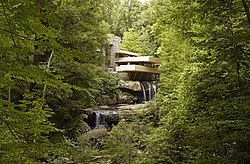
Photographs from downstream have been widely circulated.417 In addition, blueprints and letters from the house's development have been sold over the years.436 Virtual tours of Fallingwater have been created as well.330 One such tour was released in CD format in 1997,437 and Love created a 3-D virtual tour of the house in the mid-2010s.330438 The house has been commemorated in other media, such as a postage-stamp issue from 1982.439 Fallingwater has been depicted in several creative works. For example, it inspired the fictional Vandamm residence in the 1959 film North by Northwest,440 in addition to buildings in Ayn Rand's 1943 novel The Fountainhead and its 1949 film adaptation.441 The conclusion of Greg Sestero's 2021 film Miracle Valley was shot inside of Fallingwater; according to Sestero, it was the first feature film to be shot in the house.442
Awards and landmark designations
American architects deemed Fallingwater one of "seven wonders of American architecture" in a 1958 survey.443 A 1976 poll of American architects ranked it the country's third-best design, tied with the Dulles Main Terminal,444 while a 1982 poll of Architecture: the AIA journal readers ranked Fallingwater as the country's best building.189445 In a survey of 170 American Institute of Architects (AIA) fellows the next year, the building was ranked second on a list of the "most successful examples of architectural design".446 AIA members voted Fallingwater the "best all-time work of American architecture" in 1991,447 and the AIA dubbed it the "building of the century" in 2000.82411 AIA members also ranked Fallingwater 29th on the society's "America's Favorite Architecture" list in 2007.448449
Architectural Record named Fallingwater "the world's most significant building of the 20th century",267 and Smithsonian listed the house among its "Life List of 28 Places to See Before You Die" in 2008.450451 In 2025, Time Out magazine ranked Fallingwater among the world's most beautiful buildings, calling it "a masterclass in blending architecture with nature".452 The New York Times said that architects considered Fallingwater "one of Wright's supreme creations".8
Fallingwater became a National Historic Landmark in 1966,391453 and the house was separately added to the National Register of Historic Places in 1974.454 The Pennsylvania Historical and Museum Commission installed a historical marker in 19943 and named Fallingwater as a "Commonwealth Treasure" in October 2000.256455 Fallingwater was deemed eligible for inclusion on UNESCO's World Heritage List in 2008,451 and the United States Department of the Interior nominated Fallingwater to the World Heritage List in 2015, alongside nine other buildings.392456 UNESCO ultimately added eight properties, including Fallingwater, to the World Heritage List in July 2019 under the title "The 20th-Century Architecture of Frank Lloyd Wright".457
Exhibits and architectural influence
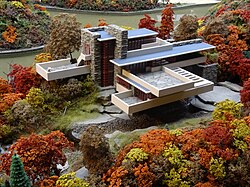
There have also been museum exhibits about Fallingwater.102 Among them was a MoMA exhibit in 1938,458 which was organized when MoMA curator John McAndrew visited the house shortly after its completion.459 MoMA hosted other exhibits featuring Fallingwater, including a scale model in 1940,460 an image showcase in 1959,461 and another model in 2009.462 New York's Columbia University hosted a symposium on the structure in 1986,26375 and Pittsburgh's Carnegie Museum of Art463 and the State Museum of Pennsylvania have hosted exhibits about Fallingwater.464 In addition, the Miniature Railroad & Village at Pittsburgh's Carnegie Science Center displays a model of Fallingwater.465
Despite Fallingwater's renown, its design was seldom copied.285 At the time of the house's completion, modernist architects were turning away from organic designs, such as Fallingwater, in favor of more industrial designs, such as New York's Seagram Building.285 Among the structures inspired by Fallingwater are an office in Philadelphia;466 a gas station in the Washington metropolitan area;467 a home in Ross Township, Allegheny County;468 Paul Mayén's home in Garrison, New York;469 and a house in North Burnaby, British Columbia, Canada.470
See also
See also
References
References
Notes
- Geographically, Kentuck Knob is 4 miles (6.4 km) away.17
- The younger Edgar spelled the "jr." in his name with lowercase letters.556 For consistency, this article refers to him as Edgar Kaufmann Jr.
- Sources disagree on whether this was when Edgar Jr.'s parents first met Wright. Toker 2003, p. 122, says that Edgar Sr. was already considering hiring Wright for various projects when Edgar Jr. started his apprenticeship. Waggoner 2011, p. 178, says that Toker's claim is contradicted by the Kaufmann family letters and that Edgar Jr. went to Taliesin of his own accord.
- Toker 2003, p. 204, gives a different figure of between 35 and 75 cents.
- According to Hoffmann 1977, p. 48, these issues included moist waterproofing, which caused the subflooring to rot, and improperly poured concrete, which contained loose pockets of sand.
- McCarter specifically cites the Thomas H. Gale House in Oak Park, Illinois, as an inspiration.289
- Some sources, such as the Centre Daily Times, cite ocher and Cherokee red as the only two colors used in the house.16
- Milao et al. 2024, pp. 9–10, writes that, although the color was originally described as Venetian red, it was changed to Cherokee red in the 1970s. Hoffmann 1977, p. 58, cites Mosher as saying that Cherokee red had been used from the outset.
- Some sources give a conflicting figure of three bedrooms.31612 Edgar Jr.'s study occupies what was supposed to be the fourth bedroom.324
- Sources variously cite the living area as measuring 45 by 35 feet (14 by 11 m),69 48 by 38.5 feet (14.6 by 11.7 m),127 or 50 by 40 feet (15 by 12 m) across.335
- The depth of the plunge pool is variously cited as 48 inches (4 ft; 122 cm)342 or 53 inches (130 cm).124
- An Architectural Digest article gives a figure of nearly 170 pieces.291 Another source cites a figure of more than 160 pieces.161
Citations
- "National Register Information System". National Register of Historic Places. National Park Service. July 9, 2010.
- "Fallingwater". National Historic Landmark summary listing. National Park Service. Archived from the original on June 24, 2008. Retrieved July 2, 2008.
- "PHMC Historical Markers". Historical Marker Database. Pennsylvania Historical & Museum Commission. Retrieved December 20, 2013.
{{cite web}}: CS1 maint: deprecated archival service (link) - Toker 2003, p. 78.
- Heyman, Stephen (July 27, 2016). "In Frank Lloyd Wright Country, Architecture and Apple Pie". The New York Times. ISSN 0362-4331. Retrieved December 9, 2024.
- Silman 2000, p. 88.
- Wald, Matthew L. (September 2, 2001). "Rescuing a World-Famous but Fragile House". The New York Times. ISSN 0362-4331. Retrieved December 6, 2024.
- Sommers, Carl (June 23, 1991). "Q and A". The New York Times. ISSN 0362-4331. Retrieved December 6, 2024.
- Kraft, Randy (October 7, 1990). "Fallingwater lives up to its billing". The Morning Call. pp. F1, F4. Retrieved December 6, 2024 – via newspapers.com.
- Maslin, Janet (September 29, 2003). "Books of the Times; Behind a Masterpiece, a Merchant and a Modernist". The New York Times. ISSN 0362-4331. Retrieved December 8, 2024.
- Toker 2003, pp. 258–259.
- Ecenbarger, William (August 30, 1992). "Waterfall Wonder: Architect Frank Lloyd Wright Refused to Build Fallingwater Where the Owners Wanted It. So – It Has Become an Architectural Marvel Around the World". The Philadelphia Inquirer. pp. R1, R8. ISSN 0885-6613. ProQuest 1839103842. Retrieved December 6, 2024 – via newspapers.com.
- "The Shades of Summer". The Daily American. May 29, 1993. p. 20. Retrieved December 6, 2024 – via newspapers.com.
- Toker 2003, p. 84.
- Stabert, Lee (February 27, 2017). "On the Way to...Frank Lloyd Wright's Fallingwater". Keystone Edge. Retrieved December 7, 2024.
- "An architectural masterpiece". Centre Daily Times. May 26, 2014. pp. QF13, QF15. Retrieved December 9, 2024 – via newspapers.com.
- Hoffmann, Donald (2000). Frank Lloyd Wright's House on Kentuck Knob. Cambridge University Press. p. 3. ISBN 978-0-8229-4119-4.
- "Western Pa. offering Wright 'trinity' tour". Lancaster New Era. Associated Press. September 3, 2007. p. 10. Retrieved December 8, 2024 – via newspapers.com.
- Dvorak, Amy (May 20, 2019). "Frank Lloyd Wright's Mäntylä House Opens to Overnight Guests at Polymath Park". Dwell. Retrieved December 8, 2024.
- "Frank Lloyd Wright personalized houses". Standard-Speaker. November 6, 1986. p. 39. Retrieved December 12, 2024 – via newspapers.com.
- Toker 2003, p. 260.
- McCarter 1997, p. 212.
- Toker 2003, p. 155.
- National Park Service 1974, p. 2.
- Hoffmann 1977, p. 3.
- Fulford, Robert (May 26, 2015). "Take me to the river; Soaking up Frank Lloyd Wright's masterpiece". National Post. p. B.1. ProQuest 1683276736.
- Toker 2003, p. 81.
- Hoffmann 1977, p. 5.
- McCarter 1997, p. 211.
- Waggoner 2011, p. 190.
- Fales, Gregg (July 24, 1977). "Function and beauty combine in Frank Lloyd Wright house". The Morning Call. p. 119. Retrieved December 12, 2024 – via newspapers.com.
- Waggoner 2011, p. 209.
- Hoffmann 1977, p. 82.
- Haurwitz, Ralph (May 31, 1981). "Fallingwater Visitor Center Built in Wright Mold". The Pittsburgh Press. p. 23. Retrieved December 12, 2024 – via newspapers.com.
- Haurwitz, Ralph (February 20, 1980). "Bear Run Beckons to Wildlife, Man". The Pittsburgh Press. p. 19. Retrieved December 12, 2024 – via newspapers.com.
- Miller, Donald (June 3, 1981). "New Fallingwater pavilion blends well". Pittsburgh Post-Gazette. p. 28. ISSN 2692-6903. Retrieved December 12, 2024 – via newspapers.com.
- Murdock, James (January 2006). "The Barn at Fallingwater Mill Run, Pennsylvania" (PDF). Architectural Record. Vol. 194. pp. 132–135. ProQuest 222126263.
- Pitz, Marylynne (December 15, 2015). "E. J. Kaufmann: Major player in city's first renaissance". Pittsburgh Post-Gazette. pp. A1, A6. ISSN 2692-6903. Retrieved December 9, 2024 – via newspapers.com.
- Bell, Judith (October 29, 1995). "The Wright Way: at Fallingwater, Man-made Beauty Complements Nature in the Hills of Western Pennsylvania". Boston Globe. p. B1. ProQuest 3050102768.
- "Urban designer from Britain advocates long-term approach". Pittsburgh Post-Gazette. October 12, 2005. p. 24. ISSN 2692-6903. Retrieved December 8, 2024 – via newspapers.com.
- "Fallingwater gate sells for $10,000". The Evening Sun. Associated Press. October 3, 2005. p. 5. Retrieved December 8, 2024 – via newspapers.com.
- Toker 2003, p. 105.
- Hoffmann 1977, p. 7.
- Toker 2003, p. 92.
- Hoffmann 1977, pp. 7–8.
- Toker 2003, pp. 36–37.
- Hoffmann 1977, pp. 8–9.
- Toker 2003, pp. 92–93.
- Toker 2003, p. 94.
- Van Trump, J.D. (1983). Life and Architecture in Pittsburgh. Pittsburgh & Landmarks Foundation. pp. 115–116. ISBN 978-0-916670-08-5. Retrieved December 6, 2024.
- Cass, Julia (September 10, 1995). "Falling for Fallingwater: the Much-photographed House That Frank Lloyd Wright Built is Even More Striking in Real Life. The Surrounding Countryside of Western Pennsylvania Has Good Looks, Too". The Philadelphia Inquirer. pp. T1, T10. ISSN 0885-6613. ProQuest 1841056679. Retrieved December 6, 2024 – via newspapers.com.
- Hoffmann 1977, p. 10; Toker 2003, p. 95.
- Hoffmann 1977, p. 10; Toker 2003, p. 98.
- "The Kaufmann Family – Fallingwater". Fallingwater. Retrieved December 13, 2017.
- Wecker, Menachem (November 18, 2016). "Wright's iconic home houses eclectic artwork". National Catholic Reporter. Vol. 53, no. 53. ProQuest 1841302384. Retrieved December 9, 2024.
- Goldberger, Paul (August 1, 1989). "Edgar Kaufmann Jr., 79, Architecture Historian". The New York Times. ISSN 0362-4331. Retrieved December 6, 2024.
- Waggoner 2011, pp. 174–177.
- Waggoner 2011, p. 178.
- Hoffmann 1977, p. 11.
- Hoffmann 1977, p. 12.
- McCarter 1997, p. 204.
- Hoffmann 1977, p. 12; Toker 2003, p. 123; Waggoner 2011, p. 181.
- Goldberger, Paul (August 6, 1989). "Architecture View; A Discerning Eye and a Democratic Outlook". The New York Times. ISSN 0362-4331. Retrieved December 12, 2024.
- Hartzok, Alanna (August 12, 1992). "Thousands tour landmark home". Public Opinion. pp. 25, 26. Retrieved December 6, 2024 – via newspapers.com.
- McCarter, Robert (2001). "Wright, Frank Lloyd". In Boyer, Paul S. (ed.). The Oxford Companion to United States History. Oxford: Oxford University Press. ISBN 978-0-19-508209-8.
- Hoffmann 1977, p. 11; Toker 2003, p. 161.
- Storrer 1993, p. 236.
- Dorsey, John (June 18, 1967). "A House Suited to the People It Was Built for: That Was Frank Lloyd Wright's Aim in Designing Falling-water, Which Remains World Famous". The Baltimore Sun. p. SM13. ISSN 1930-8965. ProQuest 541463102.
- Reif, Rita (March 15, 1971). "Returning to House Wright Called Fallingwater". The New York Times. ISSN 0362-4331. Retrieved December 12, 2024.
- Hoffmann 1977, p. 13.
- Toker 2003, pp. 138–139.
- Waggoner 2011, pp. 181–182.
- Hornby, Lance (December 5, 2023). "Fall for Frank Lloyd Wright's Fallingwater". Toronto Sun. Retrieved December 9, 2024.
- Hoffmann 1977, p. 15.
- Lowry, Patricia (September 20, 2005). "70 Years Later, Wright Apprentice Recalls Witnessing the Genesis of Fallingwater". Pittsburgh Post-Gazette. pp. D-1, D-2. ISSN 2692-6903. ProQuest 390745794. Retrieved December 8, 2024 – via newspapers.com.
- Silman 2000, p. 90.
- Toker 2003, p. 141.
- Toker 2003, p. 150.
- Hoffmann 1977, pp. 16–17.
- Tafel 1985, p. 3.
- Toker 2003, pp. 181–182.
- Taylor, David (April 20, 2005). "Man of the House". The Washington Post. ISSN 0190-8286. Retrieved December 8, 2024.
- Hoffmann 1977, p. 14.
- Toker 2003, p. 140.
- Hoffmann 1977, p. 18.
- Toker 2003, p. 152.
- Toker 2003, pp. 183–184.
- Mooney, Joan (July 15, 1990). "Fallingwater: Frank Lloyd Wright's idea of a home". The Baltimore Sun. p. 2G. ISSN 1930-8965. ProQuest 1753854824.
- McCarter 1997, p. 214.
- Kaufmann 1987, p. 31.
- McCarter 2002, p. 7.
- Kamin, Blair (August 18, 2002). "Terrace firma; Engineering feats shore up Fallingwater, restoring Frank Lloyd Wright's masterpiece". Chicago Tribune. p. 7.1. ISSN 1085-6706. ProQuest 419704752.
- McCarter 2002, p. 12.
- Hoffmann 1977, p. 21.
- Toker 2003, p. 199.
- Hoffmann 1977, p. 23.
- McCarter 1997, p. 205.
- Keeran, James (May 18, 1997). "Fallingwater // Wright's architectural wonder inspires and teaches 60 years later". Pantagraph. p. B.1. ProQuest 406983133.
- McCarter 1997, p. 206.
- Hoffmann 1977, p. 24.
- Toker 2003, pp. 200–201.
- Bramson, Constance Y. (July 29, 1984). "Fallingwater has the Wright stuff". The Patriot-News. pp. G1, G2. Retrieved December 12, 2024 – via newspapers.com.
- Guilfoil, Michael (March 9, 1997). "Cliffhangers Good Design Helps Create Dream Homes on Nightmare-inspiring Building Sites". Spokesman Review. p. E.1. ProQuest 394820109.
- Toker 2003, p. 202.
- Toker 2003, p. 195.
- Toker 2003, p. 186.
- Toker 2003, p. 203.
- Sancetta, Amy (June 20, 1999). "Frank Lloyd Wright's Historical Masterpiece Needs a Face Lift". Sun Sentinel. Associated Press. p. 12J. ProQuest 388262191.
- Hoffmann 1977, p. 33.
- Hoffmann 1977, p. 26.
- Nark, Jason (April 30, 2024). "Fallingwater attracts tourists, but you can spend night at Lynn Hall". The Morning Call. p. A005. Retrieved December 9, 2024 – via newspapers.com.
- Toker 2003, pp. 208–209.
- Waggoner 2011, p. 183.
- Toker 2003, p. 204.
- Story, Paula (July 11, 1999). "Modest plan spawned masterpiece". Indiana Gazette. Associated Press. p. 12. Retrieved December 7, 2024 – via newspapers.com.
- Beers, Paul B. (August 12, 1974). "Reporter at Large". The Evening News. p. 17. Retrieved December 12, 2024 – via newspapers.com.
- Wardle, Lisa (June 8, 2017). "Behind Fallingwater: How Pa. became home to one of Frank Lloyd Wright's greatest works". The Patriot-News. Retrieved December 12, 2024.
- Hoffmann 1977, p. 52.
- Puente, Maria (April 13, 1999). "Immersion in artistic vision sinking Fallingwater". USA Today. p. 03D. ProQuest 408824695.
- Toker 2003, p. 205.
- Hoffmann 1977, pp. 24–25.
- Hoffmann 1977, p. 27.
- Toker 2003, p. 206.
- Hoffmann 1977, p. 29.
- Toker 2003, p. 207.
- Toker 2003, p. 210.
- Hoffmann 1977, p. 39.
- Toker 2003, p. 215.
- Feldman, Gerard C. (September 2005). "Fallingwater Is No Longer Falling" (PDF). Structure. pp. 46–50. Archived from the original (PDF) on February 15, 2010.
- Silman 2000, p. 91.
- Hirsch, Rebecca (May–June 2014). "Saving Fallingwater". Odyssey. Vol. 23, no. 5. pp. 24–27. ProQuest 1537638803.
- Silman 2000, pp. 91–92.
- McCarter 2002, pp. 12–13.
- Toker 2003, p. 218.
- Saffron, Inga (April 18, 1999). "Fallingwater's falling down; experts think they can save the Wright gem". The Philadelphia Inquirer. pp. F1, F7. ISSN 0885-6613. Retrieved December 7, 2024 – via newspapers.com.
- Toker 2003, p. 220.
- Tafel 1985, p. 9.
- "Restoration to strengthen cantilevers at Fallingwater". Civil Engineering. Vol. 69, no. 5. May 1999. p. 28. ProQuest 228516599.
The cantilevers, Fallingwater's distinguishing features, have become the source of the building's most troubling problems. Steel-reinforced concrete beams and the concrete cantilevered decks they support have deflected. Two terraces have been closed to visitors, and a temporary steel beam was placed under the first-floor cantilever in 1997 as a precautionary support, says Linda Waggoner, the director of Fallingwater, which in 1976 was listed in the National Register of Historic Places and is now a house museum overseen by the Pittsburgh-based Western Pennsylvania Conservancy. A $70,000 grant from the Getty Foundation helped the conservancy study the problems and devise a restoration plan.
- Hoffmann 1977, p. 34.
- Hoffmann 1977, p. 41.
- Hoffmann 1977, p. 42.
- Hoffmann 1977, p. 48.
- Hoffmann 1977, p. 49.
- Toker 2003, p. 221.
- Toker 2003, p. 222.
- McCarter 2002, p. 13.
- Toker 2003, p. 226.
- Hoffmann 1977, pp. 50–51.
- Toker 2003, p. 223.
- Toker 2003, p. 224.
- Waggoner 2011, p. 28.
- Milao et al. 2024, p. 9.
- Storrer 1993, p. 237.
- Hoffmann 1977, p. 53.
- Hazell, Naedine Joy (July 22, 2001). "Lofty Visions Fallingwater, the Frank Lloyd Wright Masterpiece in Pennsylvania, Still Stuns, and Still Leaks". The Hartford Courant. p. F1. ISSN 1047-4153. ProQuest 256425702.
- Hoffmann 1977, pp. 55–56.
- Toker 2003, pp. 225–226.
- Hoffmann 1977, p. 58.
- Hoffmann 1977, pp. 62–63.
- Hoffmann 1977, p. 65.
- Waggoner 2011, p. 218.
- Toker 2003, p. 237.
- Toker 2003, p. 239.
- Toker 2003, p. 258.
- Toker 2003, pp. 259–261.
- Hoffmann 1977, p. 75.
- Hoffmann 1977, p. 78.
- Glancey, Jonathan (September 10, 2001). "Architecture: The folly of Fallingwater: Frank Lloyd Wright's most famous house is falling down. Well, it was built on top of a waterfall". The Guardian. p. 2.12. ProQuest 245713879. Retrieved December 8, 2024.
- McCarter 2002, p. 59.
- Plushnick-Masti, Ramit (September 27, 2007). "New Wright house in western Pa. completes trinity of work". Associated Press. Retrieved October 9, 2007.
- "Superintendent of Famed Bear Run Estate Retires". The Morning Herald. April 17, 1959. p. 11. Retrieved December 10, 2024 – via newspapers.com.
- "Jesse Hall Retires After 20 Years at Kaufmann's". The Daily Courier. May 5, 1959. p. 8. Retrieved December 10, 2024 – via newspapers.com.
- Hoffmann 1977, p. 88.
- Hoffmann 1977, p. 90.
- Kantner, Dorothy (December 19, 1950). "Blume's Painting Wins Popular Prize at Show". Pittsburgh Sun-Telegraph. p. 28. Retrieved December 9, 2024 – via newspapers.com.
- Hoffmann 1977, p. 85.
- "Fires Threaten Large Estates". The Pittsburgh Press. April 21, 1941. pp. 1, 4. Retrieved December 9, 2024 – via newspapers.com.
- "Costly Fire Razes Bear Run Dairy Barn". The Daily Courier. January 4, 1945. p. 1. Retrieved December 9, 2024 – via newspapers.com; "Dairy Barn Fire Loss of $50,000". Pottsville Republican. January 4, 1945. p. 7. Retrieved December 9, 2024 – via newspapers.com.
- Silman 2000, p. 92.
- Bernstein, Fred (March 11, 1999). "An Icon in Peril; Saving Fallingwater From a Fall". The New York Times. ISSN 0362-4331. Retrieved December 6, 2024.
- Hoffmann 1977, pp. 56–58.
- Waggoner 2011, pp. 262–263.
- Waggoner 2011, p. 186.
- National Park Service 1974, p. 5.
- Hoffmann 1977, pp. 88–90.
- Guggenheimer, Paul (March 23, 2021). "Legendary Fallingwater cook Elsie Henderson dies at 107". Pittsburgh Tribune-Review. Retrieved December 9, 2024.
- Hoffmann 1977, p. 91.
- Waggoner 2011, p. 187.
- Frost, Edward (February 6, 1986). "Wright's 'Fallingwater' still an architectural marvel". Rapid City Journal. Associated Press. p. D1. Retrieved December 6, 2024 – via newspapers.com.
- Miller, Donald (November 10, 1996). "Kaufmann's Rich Legacy on the Store's 125th Anniversary, Reflections". Pittsburgh Post-Gazette. pp. G1, G14. ISSN 2692-6903. ProQuest 391767510. Retrieved December 6, 2024 – via newspapers.com.
- Hoffmann 1977, pp. 91–92.
- "The Wright Stuff Gets Old Fallingwater Given Firmer Support". Pittsburgh Post-Gazette. January 4, 1997. p. B.1. ISSN 2692-6903. ProQuest 391754575.
- Waggoner 2011, p. 263.
- Hoffmann 1977, p. 92.
- Huxtable, Ada Louise (September 7, 1963). "Wright House at Bear Run, Pa., Will Be Given Away to Save It; Landmark's Preservation Assured". The New York Times. ISSN 0362-4331. Retrieved December 9, 2024.
- "E. J. Kaufmann Home Donated to Conservancy". Pittsburgh Post-Gazette. September 7, 1963. pp. 1, 4. ISSN 2692-6903. Retrieved December 10, 2024 – via newspapers.com; "Famed Mountain Structure Given to the Conservancy". The Morning Herald. September 9, 1963. p. 3. Retrieved December 10, 2024 – via newspapers.com.
- Storrer 1993, p. 238.
- Barcousky, Len (October 27, 2013). "Eyewitness: 1963 Kaufmann Makes Gift Out of Fallingwater". Pittsburgh Post-Gazette. p. A.2. ISSN 2692-6903. ProQuest 1445259104.
- "Conservancy Receives Ex-Kaufmann Home". Standard-Speaker. Associated Press. October 30, 1963. p. 15. Retrieved December 10, 2024 – via newspapers.com.
- Tormay, B.J. (November 2, 1963). "Fallingwater Has Inspiring Beauty". Evening Standard. p. 6. Retrieved December 10, 2024 – via newspapers.com.
- "'Fallingwater' Is Famous Home". Evening Standard. March 17, 1964. p. 63. Retrieved December 10, 2024 – via newspapers.com.
- Waggoner 2011, p. 241.
- "Famed Fayette County House Is Open for Tours". The Progress. July 27, 1964. p. 8. Retrieved December 10, 2024 – via newspapers.com; "Fallingwater Opened to Public". The Daily Herald. United Press International. July 28, 1964. p. 7. Retrieved December 10, 2024 – via newspapers.com.
- "Fallingwater Is Popular". Evening Standard. March 9, 1973. p. 47. Retrieved December 12, 2024 – via newspapers.com.
- "Tourists Flocking to Fallingwater". The Morning Herald. March 25, 1975. p. 74. Retrieved December 12, 2024 – via newspapers.com.
- Forgey, Benjamin (September 7, 1994). "A River Runs Through It in Western Pennsylvania, Wright's Fallingwater Never Failed to Please Its Owners. Now It's Our Turn for a Taste". The Washington Post. ISSN 0190-8286. ProQuest 307821688. Retrieved December 6, 2024.
- "On Vacation: an Architect's Living Museum". Newsday. April 20, 1968. p. 23W. ISSN 2574-5298. ProQuest 916052789.
- "Record Crowds 'Back to Nature'". Pittsburgh Post-Gazette. August 14, 1964. p. 17. ISSN 2692-6903. Retrieved December 10, 2024 – via newspapers.com.
- "Fallingwater, Built By Wright, On View". The Baltimore Sun. March 27, 1966. p. H6. ISSN 1930-8965. ProQuest 539612962.
- Sharpe, Jerry (August 30, 1990). "Art career guided her to top at Fallingwater". The Pittsburgh Press. p. 2. Retrieved December 6, 2024 – via newspapers.com.
- Perlmutter, Ellen M. (August 1, 1989). "Kauffmann heir, 79, dies of leukemia". The Pittsburgh Press. p. 33. Retrieved December 12, 2024 – via newspapers.com.
- "Bird Expert Named Scholar At Falling Water". The Hartford Courant. December 23, 1967. p. 8A. ISSN 1047-4153. ProQuest 549645184.
- "Supervisor Named for Fallingwater". Evening Standard. March 25, 1970. p. 33. Retrieved December 12, 2024 – via newspapers.com.
- "Fallingwater to Open". The Pittsburgh Press. March 31, 1974. p. 82. Retrieved December 12, 2024 – via newspapers.com; "Free Admission to Fallingwater". The Morning Herald. May 19, 1973. p. 11. Retrieved December 12, 2024 – via newspapers.com.
- "Near record season at Fallingwater". The Ligonier Echo. November 1, 1972. p. 18. Retrieved December 12, 2024 – via newspapers.com.
- Gigler, Rich (June 11, 1974). "Fallingwater 'Improved' for Tourists". The Pittsburgh Press. p. 22. Retrieved December 12, 2024 – via newspapers.com.
- "Talk on Fallingwater". The Morning Herald. June 7, 1974. p. 22. Retrieved December 12, 2024 – via newspapers.com; "Fallingwater Famous Site". Evening Standard. March 2, 1971. p. 70. Retrieved December 12, 2024 – via newspapers.com.
- Southwick, Karen (October 25, 1976). "Facelift Under Way to Restore Wright's Fallingwater". Latrobe Bulletin. United Press International. p. 18. Retrieved December 12, 2024 – via newspapers.com.
- "Fallingwater Gets a Lift". The Pittsburgh Press. September 21, 1976. p. 11. Retrieved December 12, 2024 – via newspapers.com.
- "Fallingwater: a building ahead of its time". Citizens' Voice. March 29, 1985. p. 33. Retrieved December 12, 2024 – via newspapers.com.
- Rohlf, Betty (November 22, 1977). "Fallingwater Visits Are Up". Evening Standard. p. 1. Retrieved December 12, 2024 – via newspapers.com.
- "Fallingwater Attracts Worldwide Attention". Evening Standard. March 18, 1977. p. 74. Retrieved December 12, 2024 – via newspapers.com.
- "Grant Curry Jr., Architect, Dies". The Pittsburgh Press. January 16, 1979. p. 8. Retrieved December 12, 2024 – via newspapers.com.
- "State". The Times Leader. April 5, 1979. p. 12. Retrieved December 12, 2024 – via newspapers.com; "Fire Destroys New Pavilion". Latrobe Bulletin. April 4, 1979. p. 24. Retrieved December 12, 2024 – via newspapers.com.
- Merkel, Ralph (July 27, 1980). "Everything All 'Wright' at Fallingwater". The Pittsburgh Press. p. 123. Retrieved December 12, 2024 – via newspapers.com.
- Miller, Donald (February 8, 1985). "Wright in winter". Pittsburgh Post-Gazette. p. 42. ISSN 2692-6903. Retrieved December 12, 2024 – via newspapers.com.
- "Winter Tours of Wright's Fallingwater Available". Centre Daily Times. January 8, 1984. p. 31. Retrieved December 12, 2024 – via newspapers.com; "Fallingwater opens for January, February tours". Pittsburgh Post-Gazette. December 30, 1983. p. 14. ISSN 2692-6903. Retrieved December 12, 2024 – via newspapers.com.
- "House by Wright Has Winter Tours". The New York Times. United Press International. February 9, 1984. ISSN 0362-4331. Retrieved December 12, 2024.
- "Fallingwater's Longtime Director Lynda Waggoner Prepares To Retire". 90.5 WESA. March 8, 2018. Retrieved December 9, 2024.
- Lowry, Patricia (April 4, 1990). "Restoration work continues, but Fallingwater opens doors". The Pittsburgh Press. p. 52. Retrieved December 12, 2024 – via newspapers.com.
- "'Fallingwater' to get facelift". Centre Daily Times. Associated Press. July 2, 1986. p. 5. Retrieved December 12, 2024 – via newspapers.com; "Fallingwater gets facelift". York Daily Record. July 5, 1986. p. 46. Retrieved December 12, 2024 – via newspapers.com.
- Scarton, Dana (January 2, 1986). "Fallingwater job boosts Wilkinsburg firm". The Pittsburgh Press. p. 95. Retrieved December 12, 2024 – via newspapers.com.
- Brackey, Harriet (May 18, 1990). "Fallingwater repairs; Turkel House sale". USA Today. p. 04B. ProQuest 306321208.
- "Preservation History". Fallingwater. Retrieved December 6, 2024.
- "Fallingwater Falling Down?". Latrobe Bulletin. Associated Press. March 8, 1990. p. 11. Retrieved December 12, 2024 – via newspapers.com.
- Milao et al. 2024, p. 18.
- Aeppel, Timothy (July 5, 1994). "They Go for the Mops When This House Lives Up to Its Name: Frank Lloyd Wright Wanted To Bring Nature Inside—And Fallingwater Leaks". The Wall Street Journal. p. A1. ISSN 0099-9660. ProQuest 903508639.
- Silman 2000, pp. 90–91.
- Singer, Penny (November 15, 1992). "A Restorer's Motto: If It's Broken, Fix It". The New York Times. ISSN 0362-4331. Retrieved December 6, 2024.
- Silman, Robert & Matteo, John (July 1, 2001). "Repair and Retrofit: Is Falling Water Falling Down?" (PDF). Structure. Archived from the original (PDF) on September 27, 2007. Retrieved September 20, 2007.
- Miller, Donald (March 13, 1999). "Fallingwater, Under Repair, Set to Reopen on Tuesday". Pittsburgh Post-Gazette. p. B-4. ISSN 2692-6903. ProQuest 391373955.
- Sullivan 2002, p. 96.
- Toker 2003, p. 213.
- Silman 2000, p. 93.
- Snyder, Michael (November 19, 2024). "How Fallingwater Gave Frank Lloyd Wright a Second Wind". Smithsonian Magazine. Retrieved December 9, 2024.
- Aeppel, Timothy (October 24, 1997). "Famed Fallingwater House Is Slowly Falling Down". The Wall Street Journal. p. B18. ISSN 0099-9660. ProQuest 398624227.
- Hale, Jonathan (September 1998). "Tough Times for Wright Houses". Architectural Record. p. 53. ProQuest 222139592.
- Broughton, Philip Delves (March 12, 1999). "Lloyd Wright's Fallingwater falling". The Daily Telegraph. p. 19. Retrieved December 7, 2024 – via newspapers.com.
- "Forever an icon". Contract. Vol. 43, no. 11. November 2001. p. 18. ProQuest 223767154.
- "New supports will shore up terraces at Fallingwater". The Daily American. January 11, 1997. p. 35. Retrieved December 7, 2024 – via newspapers.com.
- "Post-Tensioning to Settle Tensions Over Fallingwater". Engineering News-Record. Vol. 242, no. 15. April 19, 1999. p. 20. ProQuest 235744744.
- Soren, Larson (May 1999). "New Plans for Fallingwater Could Save an Icon from Disaster" (PDF). Architectural Record. p. 97. ProQuest 222101904.
- Jesdanun, Anick (May 20, 1999). "62 'treasures' get grants for preservation". The Atlanta Constitution. Associated Press. p. 37. Retrieved December 7, 2024 – via newspapers.com; "Representatives at Work". Latrobe Bulletin. May 25, 1999. p. 4. Retrieved December 7, 2024 – via newspapers.com.
- "Comment: Preservation Wrighting Wrongs". The Wall Street Journal. March 30, 2000. p. A28. ISSN 0099-9660. ProQuest 398715467.
- Mamula, Kris B. (March 24, 2000). "Fallingwater gets $3.5 million improvement grant". The Daily American. p. 1. Retrieved December 7, 2024 – via newspapers.com.
- Pitz, Marylynne (October 23, 2000). "Fallingwater Dubbed State Treasure". Pittsburgh Post-Gazette. p. A-11. ISSN 2692-6903. ProQuest 391198704. Retrieved December 7, 2024 – via newspapers.com.
- Lowry, Patricia (December 8, 2001). "Restoration of drooping Fallingwater uncovers flaws amid genius". Pittsburgh Post-Gazette. ISSN 2692-6903. Archived from the original on December 8, 2017. Retrieved June 17, 2015.
- Spangler, Todd (April 16, 2002). "Fallingwater no longer in danger of becoming Fell-in-water". The Morning Call. Associated Press. p. A17. Retrieved December 8, 2024 – via newspapers.com.
- Gonchar, Joann (March 25, 2002). "'Wrighting' a Fragile Landmark Sagging for Nearly 65 Years". Engineering News-Record. Vol. 248, no. 11. pp. 17–18. ProQuest 235779200.
- Spangler, Todd (November 22, 2001). "If reconstruction fails, Fallingwater could fall". The Patriot-News. Associated Press. p. B21. Retrieved December 7, 2024 – via newspapers.com.
- Toker 2003, p. 214.
- Sullivan 2002, p. 97.
- Rosenbaum, Lee (August 20, 2003). "... While His Tumbledown Fallingwater Is Shored Up in Pennsylvania". The Wall Street Journal. p. D.12. ISSN 0099-9660. ProQuest 398873401.
- "In Brief". Wisconsin State Journal. Associated Press. July 2, 2000. pp. 3H. Retrieved December 7, 2024 – via newspapers.com.
- "Shuster secures Fallingwater funding". The Daily American. November 26, 2003. p. 16. Retrieved December 8, 2024 – via newspapers.com.
- Hopey, Don (January 19, 2004). "Cleaner Waters at Wright's Masterpiece Along Bear Run, Sewage Getting 21st Century Treatment". Pittsburgh Post-Gazette. p. A-8. ISSN 2692-6903. ProQuest 390983820.
- Ecenbarger, William (July 19, 2009). "Wright's wondrous house: Fallingwater, in southwestern Pennsylvania, is shelter and more – a work of art at one with the woods and the roaring falls". The Philadelphia Inquirer. pp. N1, N4. ISSN 0885-6613. ProQuest 287755236. Retrieved December 8, 2024 – via newspapers.com.
- Lowry, Patricia (April 28, 2005). "Volunteer Gardeners Taming Wild Landscape at Fallingwater". Pittsburgh Post-Gazette. p. B-5. ISSN 2692-6903. ProQuest 390755421. Retrieved December 8, 2024 – via newspapers.com.
- Schlesinger, Allison (April 24, 2005). "Wright home teeming with unwanted greenery; Non-native plants beset Fallingwater". Chicago Tribune. p. 66. ISSN 1085-6706. ProQuest 420272300.
- "Frank Lloyd Wright's Fallingwater gets new windows-at a great price". Building Design & Construction. Vol. 51, no. 3. March 2010. p. 60. ProQuest 210945560.
- Wood, Dayle; Lopez-Cordero, Mario; Brown, Hillary; Petersen, Kaitlin (May–June 2016). "The Power of Preservation". Veranda. Vol. 30, no. 3. p. 65. ProQuest 1802258669.
- Oster, Doug (September 13, 2015). "'Secret garden' restored at Frank Lloyd Wright house". The Providence Journal. Retrieved December 9, 2024.
- Santoni, Matthew (July 16, 2017). "Tree topples Fallingwater house statue; Heavy rain caused the creek flowing beneath Frank Lloyd Wright's famous Fallingwater house to overflow and topple a statue, according to the Western Pennsylvania Conservancy". Pittsburgh Tribune-Review. ProQuest 1919401042. Retrieved December 9, 2024; "Flood topples statue at iconic Fallingwater house". Observer-Reporter. July 5, 2017. Retrieved December 9, 2024.
- Thomas, M. (September 9, 2017). "Fallingwater director to retire in 2018". Pittsburgh Post-Gazette. p. B2. ISSN 2692-6903. Retrieved December 9, 2024 – via newspapers.com.
- McMarlin, Shirley (March 14, 2018). "New Fallingwater director announced". Pittsburgh Tribune-Review. Retrieved December 7, 2024.
- Bernstein, Fred A. (February 23, 2025). "Frank Lloyd Wright's Fallingwater Is Leaking. Inside the $7 Million Job to Fix It". The Wall Street Journal. ISSN 0099-9660. Retrieved February 23, 2025.
- Hughes, Kaitlyn (March 21, 2025). "What's Going On With Fallingwater?". Pittsburgh Magazine. Retrieved March 23, 2025.
- "Fallingwater announces reopening date". The Business Journals. June 15, 2020. Retrieved December 8, 2024.
- "Fallingwater, State Theatre receive funding to offset pandemic closures". Herald-Standard. September 22, 2020. Retrieved December 8, 2024.
- Hickman, Matt (May 2, 2022). "Frank Lloyd Wright's Fallingwater gets clean energy assist from on-site solar array". The Architect's Newspaper. Retrieved December 9, 2024.
- "Fallingwater unveils solar panel array to help power Frank Lloyd Wright's iconic Fayette County house". Pittsburgh Post-Gazette. April 24, 2022. ISSN 2692-6903. Retrieved December 9, 2024.
- Stimpson, Ashley (August 25, 2025). "Inside the $7M project to save Frank Lloyd Wright's iconic masterpiece". The Washington Post. ISSN 0190-8286. Retrieved August 29, 2025.
- Thomas, Mary Ann (March 9, 2025). "When architecture and nature clash: Fallingwater undergoes $7M in repairs to protect its legacy". Pittsburgh Post-Gazette. ISSN 2692-6903. Archived from the original on January 10, 2026. Retrieved March 10, 2025.
- Thomas, Mary Ann (March 13, 2026). "After 3-year preservation project, scaffolding gone at Fallingwater; tours begin Saturday for 90th anniversary". Pittsburgh Post-Gazette. ISSN 2692-6903. Archived from the original on March 13, 2026. Retrieved March 14, 2026.
- Netto, David (May 7, 2011). "What's So Great About Frank Lloyd Wright's Fallingwater?". The Wall Street Journal. p. D7. ISSN 0099-9660. ProQuest 2729856894.
- Decker, Cindy (May 4, 2017). "Falling for Frank Lloyd Wright in Pennsylvania's Laurel Highlands". Chicago Tribune. ISSN 1085-6706. Retrieved December 9, 2024.
- Zengerle, Patricia (November 12, 1989). "The Wright magic: Fallingwater, one of the architect's best works, open for tours". Chicago Tribune. p. K17. ISSN 1085-6706. ProQuest 1019127424.
- Forgey, Benjamin (February 1, 1987). "Fallingwater in Winter: Fallingwater". The Washington Post. ISSN 0190-8286. ProQuest 139263657. Retrieved December 12, 2024.
- McCarter 1997, pp. 205–206.
- Toker 2003, p. 165.
- Fazzare, Elizabeth (October 20, 2023). "Fallingwater: Everything to Know About Frank Lloyd Wright's Masterpiece". Architectural Digest. Retrieved December 12, 2024.
- Toker 2003, p. 172.
- Toker 2003, pp. 174–175.
- Ruddock, Vicki (November 7, 1981). "Fallingwater: Frank Lloyd Wright's Architectural Masterpiece a Testament". Indiana Gazette. pp. 2, 3. Retrieved December 12, 2024 – via newspapers.com.
- Keyes, Helen Johnson (February 26, 1938). "A House in a River Gorge: Adopts Nature's Suggestion Three Floors Within The Architect's Credo". The Christian Science Monitor. p. 6. ISSN 0882-7729. ProQuest 514604526.
- Toker 2003, p. 231.
- O'Brien, Jeff (October 10, 1980). "Fallingwater: a monument to the mind". Indiana Gazette. pp. 4, 6. Retrieved December 12, 2024 – via newspapers.com.
- "Form, Function Meet at Fallingwater". Centre Daily Times. October 6, 1995. p. 40. Retrieved December 6, 2024 – via newspapers.com.
- Milao et al. 2024, p. 10.
- Waggoner 2011, p. 80.
- Waggoner 2011, p. 221.
- Mooney, Elizabeth C. (July 12, 1981). "Fallingwater: Touring the House That Made Peace With Nature". The Washington Post. ISSN 0190-8286. ProQuest 147231147. Retrieved December 12, 2024.
- Salant, Katherine (September 8, 2007). "Fallingwater, Built on Brave Choices and Still Unconventional". The Washington Post. ISSN 0190-8286. Retrieved December 8, 2024.
- "Frank Lloyd Wright" (PDF). Architectural Forum. Vol. 68, no. 1. January 1938. p. 102+2 (PDF p. 140).
- Waggoner 2011, p. 54.
- Podger, Pamela J. (February 8, 1991). "An original Wright by a waterfall". The Philadelphia Inquirer. p. 69. ISSN 0885-6613. Retrieved December 6, 2024 – via newspapers.com.
- Hoffmann 1977, p. 56.
- Sullivan 2002, p. 95.
- Waggoner 2011, p. 40.
- Waggoner 2011, p. 30.
- McCarter 1997, p. 213.
- Waggoner 2011, p. 42.
- Deitz, Paula (September 3, 1981). "Design Notebook; Vestibule: the Transition Into a House". The New York Times. ISSN 0362-4331. Retrieved December 12, 2024.
- Toker 2003, pp. 216–217.
- O'Hara, Mary (May 24, 1964). "Bear Run Marvel". The Pittsburgh Press. p. 81. Retrieved December 10, 2024 – via newspapers.com.
- National Park Service 1974, p. 3.
- Toker 2003, p. 212.
- Hoffmann 1977, p. 32.
- Toker 2003, p. 216.
- Hoffmann 1977, p. 40.
- McCarter 1997, p. 219.
- Waggoner 2011, p. 110.
- Waggoner 2011, p. 84.
- Waggoner 2011, p. 121.
- Devore, Lenore (August 25, 2016). "Fallingwater: Frank Lloyd Wright's architectural masterpiece at center of natural treasure". Lakeland Ledger. Retrieved December 18, 2024.
- Toker 2003, p. 233.
- Hoffmann 1977, p. 59.
- Toker 2003, p. 228.
- Toker 2003, p. 192.
- Beras, Erika (August 4, 2015). "Forget The 117 Steps: 3-D Video Makes Fallingwater Accessible To All". NPR. Retrieved December 9, 2024.
- Toker 2003, pp. 240–241.
- Hoffmann 1977, p. 62.
- Hoffmann 1977, p. 30.
- Waggoner 2011, p. 47.
- Toker 2003, p. 234.
- Cohn, Meredith (October 23, 2005). "Frank Lloyd Wright houses draw fans to Pennsylvania". The Baltimore Sun. p. 1R. ISSN 1930-8965. ProQuest 406683642.
- Waggoner 2011, p. 76.
- McCarter 1997, p. 218.
- Waggoner 2011, p. 82.
- Waggoner 2011, p. 45.
- Waggoner 2011, p. 56.
- Waggoner 2011, p. 32.
- Waggoner 2011, p. 79.
- Waggoner 2011, p. 91.
- Hoffmann 1977, p. 83.
- Waggoner 2011, pp. 131–132.
- Waggoner 2011, p. 117.
- Waggoner 2011, p. 122.
- Storrer 1993, p. 239.
- Creager, Ellen (November 18, 2012). "Falling for Wright". Wisconsin State Journal. pp. T1, T4. ProQuest 1171307177. Retrieved December 8, 2024 – via newspapers.com.
- Waggoner 2011, p. 136.
- Hoffmann 1977, pp. 81–82.
- Waggoner 2011, p. 148.
- Waggoner 2011, p. 147.
- Waggoner 2011, p. 152.
- Waggoner 2011, p. 156.
- Waggoner 2011, p. 161.
- Waggoner 2011, p. 158.
- Wari, Fitale (June 4, 2017). "Frank Lloyd Wright not the only artist at work here". Pittsburgh Post-Gazette. pp. E1, E3. ISSN 2692-6903. Retrieved December 9, 2024 – via newspapers.com.
- Hoffmann 1977, p. 66.
- Hoffmann 1977, p. 68.
- Waggoner 2011, p. 92.
- Ackerman, Jan (May 11, 1994). "Conservancy sues over the Wright stuff". Pittsburgh Post-Gazette. p. a-1. ISSN 2692-6903. ProQuest 391988430; "Fallingwater owner sues Wright Foundation". The Evening News. Associated Press. May 12, 1994. p. 15. Retrieved December 6, 2024 – via newspapers.com.
- Waggoner 2011, p. 104.
- Toker 2003, p. 240.
- Waggoner 2011, p. 236.
- Waggoner 2011, pp. 241–242.
- Waggoner 2011, pp. 221, 230.
- Hoffmann 1977, p. 69.
- Shoup, Michael (August 26, 1982). "A presence in nature". The Times Leader. pp. 1D, 2D. Retrieved December 12, 2024 – via newspapers.com.
- Waggoner 2011, p. 75.
- Waggoner 2011, p. 238.
- Shaw, Kurt (August 22, 2004). "The art of Fallingwater". Pittsburgh Tribune-Review. Retrieved December 9, 2024.
- Waggoner 2011, p. 61.
- Goldberger, Paul (November 30, 1986). "Architecture View; Fallingwater, at 50, Still Sums Up the 20th Century". The New York Times. ISSN 0362-4331. Retrieved December 9, 2024.
- Martinez-Pazzi, Mariana (March 17, 2026). "Fallingwater replaces its logo with a wordmark from a 1986 book cover". The Architect's Newspaper. Retrieved March 19, 2026.
- "Frank Lloyd Wright's Fallingwater". VisitPA. Retrieved December 7, 2024.
- "Fallingwater: A home, a school, an architectural wonder". Citizens' Voice. December 15, 2004. p. 26. Retrieved December 8, 2024 – via newspapers.com.
- Thomas, Mary Ann (October 4, 2025). "Fallingwater's plan to draw fewer but more engaged post-pandemic visitors". Pittsburgh Post-Gazette. ISSN 2692-6903. Retrieved October 4, 2025.
- Sheridan, Patricia (August 27, 2013). "Twilight Tour at Fallingwater benefits Western Pennsylvania Conservancy". Pittsburgh Post-Gazette. ISSN 2692-6903. Retrieved December 9, 2024; "'Twilight' time at famed Fallingwater". ABC News. August 1, 2008. Retrieved December 9, 2024.
- Flint, Anthony (April 19, 2009). "Wright's Fallingwater appeals to many senses: If you go . . ". Boston Globe. p. M.3. ProQuest 405165380.
- Bair, Jeffrey (February 25, 1998). "Furniture has noted architect's flair". Pottsville Republican. Associated Press. p. 8. Retrieved December 6, 2024 – via newspapers.com.
- Sheridan, Patricia (February 16, 2008). "Furniture adds touch of Frank Lloyd Wright". Pittsburgh Post-Gazette. p. 31. ISSN 2692-6903. Retrieved December 8, 2024 – via newspapers.com.
- Schlesinger, Allison (January 5, 2003). "Wright fans can wear Fallingwater". Standard-Speaker. Associated Press. p. 3. Retrieved December 8, 2024 – via newspapers.com.
- Linn, Virginia (November 22, 2013). "Fallingwater store opens Downtown". Pittsburgh Post-Gazette. ISSN 2692-6903. Retrieved December 9, 2024.
- Foreman, Chris (September 27, 2009). "Fallingwater sleep-overs in Mill Run offer unique perspective". Pittsburgh Tribune-Review. ProQuest 382323704. Retrieved December 8, 2024.
- "Fallingwater, Fayette County, Open to Public". The Daily Notes. September 9, 1966. p. 3. Retrieved December 10, 2024 – via newspapers.com.
- "Fallingwater Continues to Attract Thousands". The Daily American. September 27, 1967. p. 12. Retrieved December 11, 2024 – via newspapers.com.
- "Brad Pitt, A. Jolie visit Fallingwater". The Daily American. Associated Press. December 9, 2006. p. 13. Retrieved December 8, 2024 – via newspapers.com.
- "Fallingwater Will Reopen". The Daily Herald. March 13, 1970. p. 3. Retrieved December 12, 2024 – via newspapers.com.
- Polier, Alexandra (July 28, 2011). "A 75th Anniversary for an American Icon". Architectural Record. Retrieved December 6, 2024.
- Hopey, Don (January 30, 2015). "Fallingwater one of 10 Wright structures nominated for World Heritage List". Pittsburgh Post-Gazette. ISSN 2692-6903. Retrieved December 9, 2024.
- Toker 2003, p. 299.
- Friedman, Alice T. (1998). Women and the Making of the Modern House: A Social and Architectural History. Harry N. Abrams, Incorporated. p. 127. ISBN 978-0-8109-3989-9.
- Keith, Kelsey (October 13, 2011). "The Miller House: blue-chip midcentury modernism in America's heartland". Curbed. Archived from the original on October 15, 2020. Retrieved September 26, 2025.
- Toker 2003, pp. 248–249.
- Toker 2003, p. 132.
- Toker 2003, p. 269.
- "Usonian Architect". Time. January 17, 1938. Archived from the original on March 12, 2008. Retrieved January 27, 2008.
- Patterson, Augusta Owen (February 1938). "3 Modern Houses". Town & Country. Vol. 93, no. 4185. pp. 64, 104. ProQuest 2120628400.
- Toker 2003, p. 272.
- Toker 2003, p. 278.
- "70 U.S. Architects Get Design Prizes; Take 4 Awards of Honor at 5th Pan-American Congress Held at Montevideo". The New York Times. April 28, 1940. ISSN 0362-4331. Retrieved December 9, 2024; "City Architecture Wins Recognition". The Pittsburgh Press. April 30, 1940. p. 4. Retrieved December 9, 2024 – via newspapers.com.
- "Buhl Planetarium Impressive in Stone". Pittsburgh Sun-Telegraph. September 15, 1941. p. 72. Retrieved December 9, 2024 – via newspapers.com.
- Frangos, Betty (September 2, 1971). "Mrs. Frank Lloyd Wright Calls Fallingwater Most Dramatic". The Morning Herald. p. 16. Retrieved December 12, 2024 – via newspapers.com.
- Fowler, Glenn (January 13, 1972). "Architects Trained by Wright Will Design Factory-Built Homes". The New York Times. ISSN 0362-4331. Retrieved December 12, 2024.
- McCardell, Lee (July 5, 1955). "From Bear Run To Colorado Springs". The Baltimore Sun. p. 12. ISSN 1930-8965. ProQuest 541503505.
- Atwater, Maxine H. (May 10, 1981). "Surprises await visitors to Frank Lloyd Wright's masterpiece". The Baltimore Sun. p. R1. ISSN 1930-8965. ProQuest 535965951.
- Hine, Thomas (August 31, 1986). "Fallingwater Shows the Art of Weaving Building Into Terrain". The Philadelphia Inquirer. p. R.4. ISSN 0885-6613. ProQuest 1830677019. Retrieved December 12, 2024 – via newspapers.com.
- Fowler, Glenn (July 18, 1991). "William Wesley Peters Dies at 79; A Devotee of Frank Lloyd Wright". The New York Times. ISSN 0362-4331. Retrieved December 6, 2024.
- Huxtable, Ada Louise (March 18, 2006). "A Marriage Of Nature and Art: In creating Fallingwater, Frank Lloyd Wright pushed beyond convention". The Wall Street Journal. p. 14. ISSN 0099-9660. ProQuest 2637887079. Retrieved December 7, 2024.
- Raynor, Vivien (January 25, 1985). "Art: Wright Drawings Again Offered to Public". The New York Times. ISSN 0362-4331. Retrieved December 12, 2024.
- Heathcote, Edwin (June 20, 2009). "Just add to water". Financial Times. ProQuest 229198093.
- Storring, Kathryn (August 7, 2004). "Fallingwater; Frank Lloyd Wright's Creation Blends Seamlessly With Nature". The Guelph Mercury. p. H14. ProQuest 355669879.
- "Fallingwater a tribute to Wright's love of nature". The Daily American. April 30, 1988. p. 22. Retrieved December 12, 2024 – via newspapers.com.
- Jiménez, Inmaculada (September–October 2011). "Frank Lloyd Wright: a Precursor of Sustainable Architecture". Americas. Vol. 63, no. 5. p. 10. ProQuest 887542558.
- Mays, John Bentley (October 31, 2013). "A visit to Fallingwater". The Globe and Mail. Retrieved December 8, 2024.
- McCarter 1997, p. 220.
- Jay, Peter A. (June 5, 1997). "The human fascination with falling water". The Baltimore Sun. p. 17.A. ISSN 1930-8965. ProQuest 406983133.
- Thorsell, William (August 16, 1997). "The house that Frank Lloyd Wright built, warts and all". The Globe and Mail. p. D.6. ProQuest 384668338.
- Hoffmann 1977, pp. 51–52.
- Toker 2003, pp. 250–253.
- Hoffmann 1977, pp. 73–74; Toker 2003, p. 263.
- Toker 2003, p. 267.
- "Country Lodge, Waterfall Merged by Noted Builder". Pittsburgh Post-Gazette. January 18, 1938. p. 5. ISSN 2692-6903. Retrieved December 7, 2024 – via newspapers.com.
- "TV: 'Sunday' Afternoon; Somewhere Between Brunch and Dusk N.B.C. Offers a Weekly Pastiche". The New York Times. October 28, 1963. ISSN 0362-4331. Retrieved December 10, 2024; "Famous House in Ohiopyle Area is TV Feature". The Daily American. October 26, 1963. p. 1. Retrieved December 10, 2024 – via newspapers.com.
- Williams, Jonathan (February 21, 1972). "Fallingwater Setting for Series Segment". Pittsburgh Post-Gazette. p. 31. ISSN 2692-6903. Retrieved December 12, 2024 – via newspapers.com; "Fallingwater Is Scene for Television Series". Evening Standard. February 22, 1972. p. 5. Retrieved December 12, 2024 – via newspapers.com.
- Garland, Hazel (March 18, 1972). "'Walt Harper At Fallingwater' TV Show Nominated For Emmy". New Pittsburgh Courier. p. 17. ProQuest 202558336.
- Miller, Donald (April 16, 1994). "1982 interview leads to new film on Fallingwater". Pittsburgh Post-Gazette. p. b-6. ISSN 2692-6903. ProQuest 392054488.
- Brake, Alan G. (October 17, 2011). "FLW Double Header! Experience Fallingwater at the Guggenheim". The Architect's Newspaper. Retrieved December 8, 2024; "Wright's Fallingwater still breathtaking at 75". Pittsburgh Post-Gazette. November 27, 2011. ISSN 2692-6903. Retrieved December 8, 2024.
- Condit, Carl W. (July 1, 1979). "Donald Hoffmann, Frank Lloyd Wright's Fallingwater: The House and Its History (Book Review)". Technology and Culture. Vol. 20, no. 3. p. 645. ProQuest 1301544100.
- Lehmann-Haupt, Christopher (December 1, 1986). "Books of the Times". The New York Times. ISSN 0362-4331. Retrieved December 12, 2024; Miller, Donald (December 4, 1986). "Memoir recounts life in modern work of art". Pittsburgh Post-Gazette. p. 18. ISSN 2692-6903. Retrieved December 12, 2024 – via newspapers.com.
- Abercrombie, Stanley (February 1997). "Fallingwater: Frank Lloyd Wright's Romance with Nature". Interior Design. Vol. 68, no. 2. pp. 102–103. ProQuest 234951269.
- Lowry, Patricia (September 25, 2003). "The Secrets of Fallingwater". Pittsburgh Post-Gazette. pp. C-1, C-3. ISSN 2692-6903. ProQuest 391014362. Retrieved December 8, 2024 – via newspapers.com; Day, Anthony (October 17, 2003). "Fallingwater's place in American culture; Fallingwater Rising: Frank Lloyd Wright, E.J. Kaufmann and America's Most Extraordinary House. Franklin Toker Alfred A. Knopf: 482 pp., $35". Los Angeles Times. p. E.30. ISSN 0458-3035. ProQuest 421851460.
- Carter, Alice T. (June 9, 2011). "'Fallingwater at 75' generates a new look at a classic". Pittsburgh Tribune-Review. ProQuest 859591209. Retrieved December 6, 2024; "Fallingwater still modern after 75 years". Times Leader. June 11, 2015. Retrieved December 7, 2024.
- Pitz, Marylynne (September 26, 2012). "Blueprints of Frank Lloyd Wright windows in auction". Pittsburgh Post-Gazette. ISSN 2692-6903. Retrieved December 9, 2024.
- "Omniview releases Frank Lloyd Wright's Fallingwater CD-ROM". Information Today. Vol. 14, no. 2. February 1997. p. 23. ProQuest 214822763.
- Thomas, Mary (April 2, 2014). "Filmmaker returns to Fallingwater to add dimension". Pittsburgh Post-Gazette. ISSN 2692-6903. Retrieved December 9, 2024.
- "Postings; Architects' Designs Commemorated". The New York Times. September 19, 1982. ISSN 0362-4331. Retrieved December 12, 2024; "New Stamp to Feature Fallingwater". Lancaster New Era. September 7, 1982. p. 14. Retrieved December 12, 2024 – via newspapers.com.
- "The top houses from the movies". The Daily Telegraph. Archived from the original on May 2, 2012.
- Toker 2003, pp. 294–295.
- "Filmed in Tucson: Miracle Valley Comes to Theaters Soon". Tucson Lifestyle. July 1, 2021. Retrieved December 6, 2024; Ritman, Alex (October 1, 2021). "How 'The Room' Star Greg Sestero Channelled Tommy Wiseau for His Debut Feature 'Miracle Valley'". The Hollywood Reporter. Retrieved December 6, 2024.
- "Johnson Tower Is Hailed as Architectural Wonder". The Journal Times. September 27, 1958. p. 3. Retrieved December 29, 2024 – via newspapers.com.
- Conroy, Sara Booth (July 25, 1976). "'The Proudest Achievements of American Architecture': Form and Function A Poll of the 'Proudest Achievements of American Architecture'". The Washington Post. p. 121. ISSN 0190-8286. ProQuest 146559854; McFeatters, Ann (July 23, 1976). "Architects, critics favor buildings at U of Virginia". The Albuquerque Tribune. p. 11. Retrieved December 12, 2024 – via newspapers.com.
- Gapp, Paul (May 23, 1982). "Architecture: Falling Water Rises to the Top of the AIA's 'Best' List". Chicago Tribune. p. G16. ISSN 1085-6706. ProQuest 172714490.
- Hampson, Rick (May 30, 1986). "The Architects' Choice; Wright's 'fallingwater' Leads List of Top 10 Us Buildings". Boston Globe. p. 2. ProQuest 294325413.
- "Travel Notes: Wright's Waterfall House Open for Tours". The Salt Lake Tribune. April 5, 1992. p. F5. ProQuest 288490308.
- "AIA Reveals Public's Choice America's Best Architecture". The American Institute of Architects. February 9, 2007. Retrieved August 1, 2024.
- Napsha, Joe (February 8, 2007). "Fallingwater, courthouse make Architects' cut". Pittsburgh Tribune-Review. ProQuest 382519762.
- "The Smithsonian Life List". Smithsonian. January 2008. Retrieved August 19, 2010.
- "World Attention Fallingwater is Commanding a Greater View". Pittsburgh Post-Gazette. January 26, 2008. p. B.6. ISSN 2692-6903. ProQuest 390486630.
- Lopez, Gerrish (June 25, 2025). "Two U.S. stunners are ranked among the world's most beautiful buildings". Time Out United States. Retrieved June 27, 2025.
- "NHLs Associated with Frank Lloyd Wright". National Park Service. March 29, 2007. Retrieved December 12, 2024.
- "Fallingwater Historic Site". Evening Standard. August 3, 1974. p. 3. Retrieved December 12, 2024 – via newspapers.com.
- "Around the State". Press Enterprise. October 24, 2000. p. 2. Retrieved December 7, 2024 – via newspapers.com.
- "Ten Frank Lloyd Wright Buildings Nominated for UNESCO Distinction". Metropolis. May 17, 2022. Archived from the original on November 28, 2024. Retrieved November 28, 2024; Winston, Anna (February 3, 2015). "Frank Lloyd Wright buildings nominated for UNESCO World Heritage List". Dezeen. Archived from the original on July 2, 2024. Retrieved November 28, 2024.
- Axelrod, Josh (July 7, 2019). "UNESCO Adds 8 Frank Lloyd Wright Buildings To Its List Of World Heritage Sites". NPR. Retrieved January 18, 2025; Tareen, Sophia (July 7, 2019). "Guggenheim Museum Added to UNESCO World Heritage List". WNBC. Archived from the original on July 8, 2019. Retrieved January 18, 2025.
- Jewell, Edward Alden (January 25, 1938). "Pictures Analyze 'Cantilever' House; Photos of Home Built Over a Waterfall Is Displayed at Modern Art Museum". The New York Times. ISSN 0362-4331. Retrieved December 6, 2024.
- Waggoner 2011, p. 184; Hoffmann 1977, p. 70; Toker 2003, pp. 261–262.
- "Wright Goes to Washington With a $15,000,000 Surprise". Newsweek. Vol. 16, no. 22. November 25, 1940. p. 48. ProQuest 1924001021.
- "Museum Opens Tribute To the Architect Today". The New York Times. April 10, 1959. ISSN 0362-4331. Retrieved December 6, 2024.
- ""In Situ: Architecture and Landscape" Opens Today at MoMA". Bustler. April 8, 2009. Retrieved December 13, 2024.
- Kahn, Eve M. (April 1999). "The Wright client". Interiors. Vol. 158, no. 4. p. 17. ProQuest 221538817.
- "Must see exhibits at the State Museum of Pennsylvania". WITF. October 19, 2024. Retrieved December 13, 2024; "State Museum of Pennsylvania opens 'Fallingwater' exhibit". ABC27. June 21, 2024. Retrieved December 13, 2024.
- Axelrod, Joshua (October 4, 2023). "Ready for Takeoff". Pittsburgh Post-Gazette. pp. B1, B2. ISSN 2692-6903. Retrieved December 8, 2024 – via newspapers.com.
- Austin, Gene (October 10, 1982). "The essence of Wright is found on the Main Line". The Philadelphia Inquirer. pp. 1-G, 4-G. ISSN 0885-6613. Retrieved December 12, 2024 – via newspapers.com.
- Aeppel, Timothy (July 13, 1995). "Food and Fallingwater, next exit: Go Wright to designer gas station". The Wall Street Journal. p. B1. ISSN 0099-9660. ProQuest 398469679.
- Merriman, Woodene (November 24, 1979). "Indian Rugs and Organic Architecture". Pittsburgh Post-Gazette. pp. 11, 13. ISSN 2692-6903. Retrieved December 12, 2024 – via newspapers.com.
- Paletta, Anthony (March 18, 2022). "Living History: a Home That Pays Homage to Fallingwater". The Wall Street Journal. p. M.3. ISSN 0099-9660. ProQuest 2640211691. Retrieved December 9, 2024; Croke, Karen (October 27, 2021). "'Fallingwater' heir built this Garrison home in 1975; now for sale". lohud.com. Retrieved December 9, 2024.
- Freimond, Kathleen (October 12, 2019). "Home reno inspired by Frank Lloyd Wright's Fallingwater". Vancouver Sun. Retrieved December 9, 2024.
Sources
- Fallingwater (Report). National Register of Historic Places, National Park Service. July 23, 1974.
- Hoffmann, Donald (1977). Frank Lloyd Wright's Fallingwater: The House and Its History (1st ed.). Dover Publications. ISBN 0-486-27430-6.
- Kaufmann, Edgar (1987). Fallingwater: A Frank Lloyd Wright Country House. WW Norton. ISBN 978-0-89659-662-7.
- McCarter, Robert (1997). Frank Lloyd Wright. London: Phaidon Press. pp. 204–220. ISBN 978-0-7148-3148-0.
- McCarter, Robert (2002). Fallingwater Aid (Architecture in Detail). Phaidon Press. ISBN 0-7148-4213-3.
- Milão, Susana; Ribeiro, Telma; Neves, Isabel Clara; Lima, Ana; Pacheco, Luís Paulo (September 21, 2024). "20th-Century World Built Heritage Facing Water: Conservation of Fallingwater and Boa Nova Tea House". Buildings. 14 (9): 3004. doi:10.3390/buildings14093004. hdl:11328/6139. ISSN 2075-5309. ProQuest 3110410666.
- Silman, Robert (September 2000). "The Plan to Save Falling water". Scientific American. Vol. 283, no. 3. Scientific American, a division of Nature America, Inc. pp. 88–95. ISSN 0036-8733. JSTOR 26058864. Retrieved December 6, 2024.
- Storrer, William Allin (1993). The Frank Lloyd Wright Companion. Chicago: University of Chicago Press. ISBN 978-0-226-77624-8.
- Sullivan, C C (September 2002). "Falling water, standing still". Architecture: The AIA Journal. Vol. 91, no. 9. pp. 95–97. ProQuest 227857210.
- Tafel, Edgar (1985). Years with Frank Lloyd Wright: Apprentice to Genius. Dover Publications. ISBN 978-0-486-14433-7.
- Toker, Franklin (2003). Fallingwater Rising: Frank Lloyd Wright, E. J. Kaufmann, and America's Most Extraordinary House. Knopf Doubleday Publishing Group. ISBN 978-0-307-42584-3.
- Waggoner, Lynda, ed. (2011). Fallingwater. Rizzoli Publications. ISBN 978-0-8478-4847-8.
Further reading
Further reading
- Brand, Stewart (1995). How Buildings Learn: What Happens After They're Built. Penguin Books. ISBN 0-14-013996-6.
- Stoller, Ezra (January 1, 2000). Frank Lloyd Wright's Fallingwater. New York: Springer Science & Business. ISBN 1-56898-203-8.
- Waggoner, Lynda S.; Western Pennsylvania Conservancy (1996). Fallingwater. Universe. ISBN 978-0-7893-0072-0.